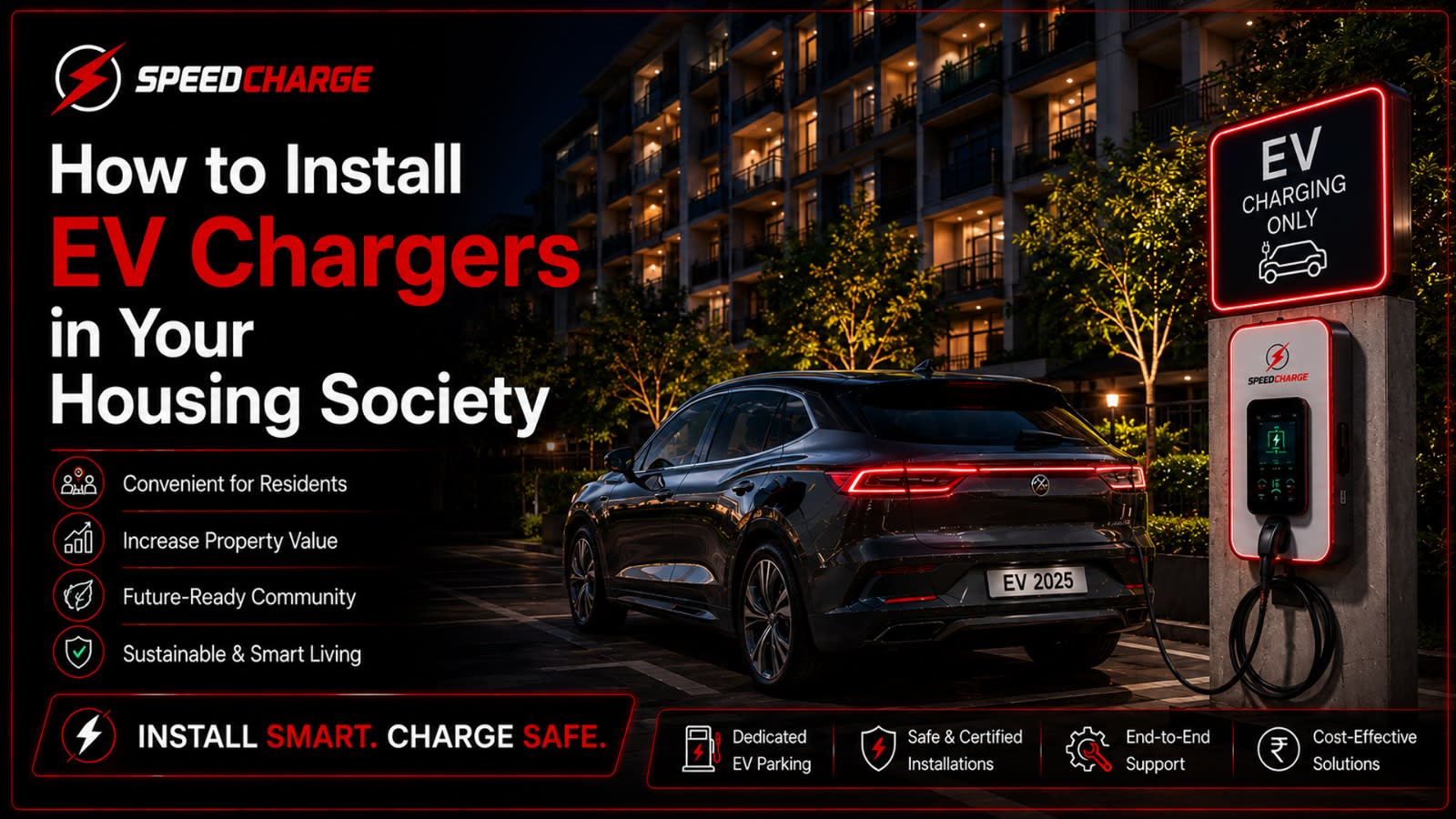
Electric vehicles are becoming easier to own in Indian cities, but apartment charging still requires more planning than charging at an independent house. The parking bay may be far from the resident's meter, the cable route may pass through common areas, and the building's electrical infrastructure may eventually need to support many EVs rather than only one early adopter.
A successful EV charger installation in housing society should therefore begin with site feasibility, not charger procurement. The society needs to understand parking rights, available electrical capacity, metering, cable routing, safety, billing and future expansion before deciding whether residents should receive individual chargers, shared charging points or a managed combination of both.
India's current national charging framework remains the Ministry of Power's Guidelines for Installation and Operation of Electric Vehicle Charging Infrastructure, 2024. Housing societies have also been expressly permitted under the Ministry's charging framework to install charging infrastructure for residents and permitted visitors. The policy direction is supportive, but it does not eliminate legitimate electrical, property, safety or local compliance requirements.
What Housing Societies Need to Decide Before Installation
The first decision is not whether the society should “allow EVs.” It is what charging architecture fits the property.
A resident with an allotted bay close to an electrical route may be able to use an individual charging circuit. A large high-rise with hundreds of parking bays may be better served by common EV distribution infrastructure and managed charging. Some societies will need both.
The committee should establish five things early: who can use the chargers, where electricity comes from, how users are billed, how much EV load the property can support, and who is responsible for installation and maintenance.
EV Charger Installation in Housing Society: Individual or Shared?
Individual and shared charging solve different problems. A society does not need to force every resident into one model if the building can support a mixed design.
Charging Model | Best Fit | Main Advantage | Main Planning Issue |
|---|---|---|---|
Individual resident charger | Fixed allotted bay with practical cable route | Direct access for resident | Long cable routes and future scaling |
Separate EV connection | Resident wants dedicated metering | Clear electricity accounting | DISCOM process and meter location |
Common supply with user metering | Shared electrical infrastructure | Avoids many long private cable runs | Billing policy and applicable electricity rules |
Managed shared charging | Multiple users or common bays | Central access, billing and load control | Software, governance and operating responsibility |
Mixed model | Large societies with varied parking | Flexible and scalable | Requires coordinated design |
The right solution depends on the building's layout and expected EV adoption, not an arbitrary threshold such as “20 EV owners means shared charging.”
Can a Housing Society Install Public or Visitor Charging?
Yes. Ministry of Power guidance has explicitly allowed housing societies, malls, offices, hotels and similar premises to install public charging stations for vehicles permitted to enter their premises.
That is different from a private resident charger. A public or shared station can introduce user authentication, tariff display, payment collection, operating support and charger-discovery requirements that a private home charger does not need.
A society should decide whether it is creating a private residential amenity, a resident-only shared service or a public charging operation before selecting the commercial and software model.
Does the RWA or Society Committee Need to Approve the Work?
Where the proposed charger uses common electrical infrastructure, crosses shared property, affects a common parking area or requires civil work in a society-controlled space, written coordination with the RWA or management committee is the practical approach.
Avoid the two extremes often found online: “the RWA can refuse anything” and “the RWA has no right to review anything.” National policy supports EV charging, but a committee can still examine genuine issues such as electrical capacity, cable routing, fire access, parking entitlement, restoration of common property and maintenance responsibility.
For a policy-focused explanation, residents can use RWA Government Guidelines for EV Charging Installation.
What Should Be Included in the Resident's Proposal?
A written proposal should make the technical and billing arrangement easy for the committee to understand.
Proposal Item | What It Clarifies |
|---|---|
Resident and flat details | Who is requesting installation |
Parking-bay details | Exact charger location and parking entitlement |
Charger make/model | Proposed equipment |
Rated electrical input | Added electrical demand |
Electricity source | Resident supply, separate connection or society supply |
Cable-route sketch | Impact on common areas |
Load assessment | Whether available capacity is sufficient |
Installer details | Who is responsible for technical work |
Metering/billing plan | How consumption will be allocated |
Restoration and maintenance plan | Responsibility after installation |
A committee expecting multiple requests should convert this into a standard application process rather than reinventing the approval procedure for every resident.
Separate EV Connection vs Existing Electricity Connection
The Electricity (Rights of Consumers) Rules were amended in 2024 to allow consumers to obtain separate electricity connections for charging EVs. The amendments also strengthened consumer choice and metering arrangements in residential colonies and multi-storey buildings.
A separate connection is an option, not a universal requirement. Where an existing residential connection has adequate capacity and an acceptable cable route, using that supply may be practical. In other cases, a dedicated EV connection or society-level supply may provide cleaner metering and easier expansion.
Do not assume a separate EV tariff is always cheaper. Electricity tariffs differ by state, DISCOM, connection category and time period. BEE's current electric-mobility resources report 29 notified State EV Policies and provide state tariff and nodal-agency references.
DISCOM Connection Timelines: What They Actually Mean
The 2024 Electricity (Rights of Consumers) amendments reduced timelines for obtaining new electricity connections to three days in metropolitan areas, seven days in other municipal areas, fifteen days in rural areas and thirty days in rural hilly terrain.
These are electricity-connection timelines under the consumer rules.
They are not:
A universal RWA NOC deadline
A guaranteed society approval period
A complete EV charger installation timeline
A guarantee that upstream electrical work will finish in that period
A complete project can also involve site surveys, committee review, equipment procurement, civil work, load enhancement and commissioning.
Assess Sanctioned Load Before Choosing Charger Power
Sanctioned load is important because a charger operates alongside the rest of the resident's or building's electrical demand. But it is incorrect to assume that every 2BHK has the same load or that every 7.4 kW charger automatically requires an upgrade.
A proper assessment considers existing sanctioned load, peak household or building demand, spare capacity, supply configuration, the number of chargers and expected simultaneous charging.
Smart charging can help manage available capacity, but it does not create unlimited grid power.
For multi-charger design, see Smart EV Charging & Load Management.
Which Charger Type Works Best in a Residential Society?
Long parking duration usually makes AC charging the first technology to evaluate for residential use, but there is no universal “7.4 kW for everyone” rule.
The charging requirement should come from the energy that needs to be restored before the vehicle leaves again:
Required average charging power ≈ energy to replace ÷ available charging hours
A resident who drives relatively little and parks for ten hours may need modest charging power. A high-mileage user with a shorter overnight window may need more.
The vehicle's own charging capability also matters. A higher-rated wallbox cannot force the vehicle to accept more AC power than its onboard charger supports.
For individual overnight bays, AC charging will often be the starting point. Several private bays can benefit from managed AC charging, while shared visitor bays can require networked access and billing. Fleet or genuinely high-turnover charging can justify a different AC/DC mix.
DC fast charging is not automatically required simply because a society has many EV owners. The deciding factor is charging demand and dwell time.
Portable Chargers Are Not a Shortcut Around Electrical Planning
A portable EVSE can be appropriate where the vehicle manufacturer and electrical setup support it. It should not be treated as permission to use any convenient socket in a parking basement.
The outlet, wiring and protection need to suit sustained charging load. Avoid loose adapters, ordinary extension boards and cables crossing vehicle or pedestrian paths.
If a society wants to provide socket-based charging temporarily, those electrical points should still be designed, protected and billed for the intended use.
Cable Routing Often Determines the Real Difficulty
The charger itself can be relatively simple to mount. The difficult part can be bringing electricity from the approved source to the parking bay.
Routes may pass through:
Meter rooms
Electrical risers
Basement ceilings
Common corridors
Cable trays
Fire-rated walls
Multiple parking levels
Long routes can materially change conductor sizing, containment and installation cost.
Do not publish a universal instruction such as “every 7.4 kW charger needs 6 sq mm cable.” Conductor selection depends on current, route length, installation method, environment, voltage-drop criteria and the overall electrical design.
The broader installation workflow is covered in the EV Charger Installation Guide and How to Install an EV Charger in Your Parking.
Electrical Safety: Use the Current CEA Framework
The Central Electricity Authority's current safety archive lists the CEA Measures relating to Safety and Electric Supply Regulations, 2023 together with the 2026 Amendment Regulations. The archive was updated on August 24, 2026.
That matters because society charging should be treated as electrical infrastructure rather than a consumer gadget mounted on a wall.
The appropriate protection, earthing, isolation, cabling and equipment requirements should be determined for the exact charger and site.
Avoid one-size-fits-all breaker, RCD/RCCB or earthing instructions. Some protection functions may be integrated into the EVSE while other elements may be external. The entire installation needs to be assessed as one system.
Basement, Podium and Open Parking Need Different Designs
Basement charging is not governed by one universal nationwide yes/no rule. The project should account for electrical rooms, fire compartments, escape paths, water ingress, physical protection and cable routing.
Open or podium parking adds rain, heat, dust and vehicle-impact considerations. The charger and mounting arrangement should match the actual environmental exposure instead of relying only on a generic “weatherproof” claim.
For hot-weather considerations, see Is EV Charging Safe in Summer?.
Step-by-Step EV Charger Installation in Housing Society
The safest sequence is feasibility first, equipment second.
Stage | Main Action | Key Output |
|---|---|---|
1. Demand assessment | Identify current and likely future EV users | Individual/shared strategy |
2. Parking survey | Map allotted and common charging bays | Physical charging locations |
3. Electrical feasibility | Review sanctioned load, panels and supply | Available charging capacity |
4. Cable-route survey | Map approved electrical pathways | Installation design |
5. Society approval | Document common-area/property work | Defined approval |
6. DISCOM process | Connection/load modification where required | Suitable electricity supply |
7. Charger/CMS selection | Match hardware/software to users | Final architecture |
8. Installation | Electrical and civil work | Installed infrastructure |
9. Testing and commissioning | Verify charger operation and protections | Operational chargers |
10. Billing/operating setup | Configure users, tariff and support | Ready-to-use service |
11. Documentation | Store drawings, warranty and approvals | Maintenance/expansion record |
Ordering hardware before the first four stages are complete can lock the society into the wrong power rating, charger configuration or cable architecture.
What Should the Electrical Site Survey Cover?
For an individual charger, the survey should identify the electricity source, available capacity, distribution board, cable route, mounting location and environmental exposure.
For society-level infrastructure, it should also evaluate common transformer or supply capacity, diversity of existing building load, likely future EV demand, possible charging zones and whether central load management would improve utilisation of available power.
Future conduit, panel space or cable pathways can be planned even when chargers are not immediately installed in every bay.
Shared Charging: When Does It Make Sense?
There is no evidence-based rule saying a housing society needs a shared station once exactly 10, 15 or 20 residents own EVs.
Shared infrastructure becomes attractive when private cable routes are becoming repetitive, residents do not all have fixed bays, visitor charging is required, available EV electrical capacity is constrained, the committee wants central billing, or several chargers need coordinated maintenance.
A society can start with a smaller managed charging system and expand as measured demand grows.
For a wider society/RWA framework, see EV Charging for Apartments & RWAs and EV Chargers for Apartments.
How Smart Load Management Helps
Without coordination, multiple chargers can request power at the same time that lifts, water pumps, air conditioning and other building systems are operating.
Smart load management can enforce a defined EV charging limit and allocate available power among active charging sessions. Depending on the system, it can also prioritise users or shift charging into selected time windows.
This can improve utilisation of existing infrastructure and potentially defer some upgrades.
It does not guarantee that the society will never need additional sanctioned load or transformer capacity as total EV energy demand increases.
How Should Residents Be Billed?
The billing structure should be agreed before commissioning.
Billing Approach | How It Works | Best Fit | Main Control Needed |
|---|---|---|---|
Resident's existing meter | Charging appears on resident electricity bill | Practical private cable route | Capacity and routing |
Separate EV connection | Dedicated utility meter | Separate energy accounting | DISCOM process |
Society supply + approved metering | Consumption allocated to charging users | Shared infrastructure | Transparent recovery policy |
App/CMS session billing | Platform records authenticated sessions | Multi-user system | Data accuracy and payment rules |
Public charging | Users pay applicable charging/service tariff | Visitor/public facility | Public-operation requirements |
Do not assume a society can resell electricity at any arbitrary rate. The pricing and recovery arrangement should be checked against the applicable electricity and charging framework.
Cost Planning for EV Charger Installation in Housing Society
There is no defensible nationwide standard price for either one resident's charger or a society-wide charging hub.
Two projects using the same wallbox can have completely different installed costs because cable routing, electrical infrastructure, metering and civil work differ.
Cost Component | What Changes the Cost |
|---|---|
EVSE / charger hardware | Power, connector, network features and brand |
Electrical panels | Existing capacity and expansion requirement |
Cabling | Route length and electrical design |
Cable containment | Tray, conduit, shafts and fire stopping |
Metering | Existing, separate or shared architecture |
Load enhancement | DISCOM and site requirements |
Transformer/upstream work | Existing building capacity |
Civil work | Drilling, mounting, bollards and restoration |
CMS/software | Billing, users and remote monitoring |
Connectivity | SIM/LAN/network design |
Maintenance | Warranty, AMC, spares and service |
Ask vendors for an itemised, survey-based quotation separating charger hardware, electrical infrastructure, software and recurring charges.
Avoid publishing fixed ₹26,500–₹62,000 or similar “standard installation” figures unless they refer to a current, clearly defined commercial package.
Do Not Assume a Transformer Upgrade Is Always Required
A multi-charger installation can create substantial electrical demand, but transformer or upstream work depends on the property's existing capacity and the proposed charging profile.
Some societies may have sufficient spare capacity for an initial rollout. Others may need load enhancement, new panels or transformer augmentation.
The decision should come from the electrical study and DISCOM requirements rather than charger count alone.
Can Society EV Charging Work With Rooftop Solar?
Yes. Rooftop solar can support common electrical demand, including EV charging, but the charging and solar-generation profiles may not occur at the same time.
Government information on PM Surya Ghar has recognised Group Housing Societies and RWAs for common facilities including EV charging within the rooftop-solar CFA framework. That support relates to eligible rooftop-solar capacity—it should not be described as a direct universal EV charger subsidy.
A society should evaluate the solar project and the charging infrastructure separately, then model how they interact.
Model Building Bye-Laws: Don't Apply One Percentage Nationwide
MoHUA amended the Model Building Bye-Laws and planning guidelines in 2019 to facilitate EV charging infrastructure.
Crucially, the official announcement describes those provisions as a guiding document for States and Union Territories to incorporate into their own building bye-laws and master-plan regulations.
Therefore, avoid claims such as:
“Every new housing society in India must reserve exactly 20% of parking for EV charging.”
The applicable local requirement should be checked for the specific state, city and building.
State EV Policies Matter
BEE's current electric-mobility portal reports 29 States with notified EV Policies and provides links to State EV tariffs and State Nodal Agencies.
That is why a national article should not hard-code a Delhi, Maharashtra, Karnataka or Haryana charging tariff, subsidy or approval timeline unless it has been freshly verified from the relevant current state source.
The national guide should explain the process. City and state landing pages can carry current local figures.
Can a Resident Install Without Society Approval?
The answer depends on the property arrangement.
If the charger, meter and cabling remain entirely within privately controlled infrastructure, the process can differ from a typical high-rise installation. In many apartment societies, however, the cable crosses common areas or reaches a society-managed parking bay.
Residents should not bypass the process by using unapproved common-area electricity or permanently routing cables through common property without permission.
At the same time, do not assume every resident needs load enhancement simply because they are adding a charger. First assess the existing connection and proposed charging load.
Common Mistakes Housing Societies Should Avoid
Buying chargers before completing the electrical study. The selected equipment may not fit the actual site.
Treating every resident as an isolated project forever. Repeated private cable routes become difficult to manage at scale.
Assuming smart charging eliminates grid constraints. It manages demand; it does not create electricity.
Copying another building's cable and breaker specifications. Electrical design is site-specific.
Leaving billing decisions until after commissioning. This creates unnecessary resident disputes.
Ignoring software and exit terms. CMS ownership, data and portability matter over time.
Choosing equipment only by maximum kW. Residential dwell time often makes lower charging power sufficient.
Using a fixed ROI or payback assumption. Society charging can be an amenity, cost-recovery service or commercial activity.
Treating private and public charging as identical. Their access and operating requirements differ.
Failing to plan future pathways. Spare panel capacity and conduit can reduce future civil disruption.
What to Ask a Charging Infrastructure Provider
Before signing a proposal, the committee should obtain written answers to questions such as:
What exact equipment is included?
Which installation costs are excluded?
Who owns the chargers?
Who controls the CMS and charging data?
Who pays electricity costs?
How is billing handled?
Who controls any service charge?
What is the warranty?
Is AMC included or optional?
What is the service-escalation process?
Can third-party chargers be added later?
What happens when the agreement terminates?
For commercially managed property charging, societies can also partner with SpeedCharge for commercial charging after completing site feasibility.
Checklist Before EV Charger Installation in Housing Society
Before physical work starts, confirm that the society has:
Defined the individual/shared charging model
Completed the electrical feasibility study
Mapped approved cable routes
Identified charging bays
Agreed the electricity and metering arrangement
Defined resident billing
Completed society documentation
Completed the DISCOM process where required
Selected site-appropriate equipment
Defined maintenance responsibility
Planned load management where useful
Considered future panel and cable-path capacity
Defined commissioning and handover requirements
A strong design should remain understandable to the committee, installer and future EV owners who join the charging system later.
How SpeedCharge Can Fit Into a Society Charging Plan
Residents considering their own charging bay can start with How to Charge an EV at Home in India and How to Install an EV Charger in Your Parking.
Committees planning multiple charging users should review EV Charging for Apartments & RWAs, EV Chargers for Apartments and Smart EV Charging & Load Management.
For technical implementation, use the EV Charger Installation Guide. For public charging away from the society, residents can use the SpeedCharge Station Finder.
The commercial proposal should still be assessed on site feasibility, electrical design, hardware, software, maintenance, billing and contractual responsibility rather than unsupported network-size or uptime claims.
Final Thoughts
The right EV charger installation in housing society is not simply a one-time wallbox purchase. It is a scalable part of the building's electrical and parking infrastructure.
Start by understanding demand and the property's available electrical capacity. Decide how individual and shared charging will coexist, document the RWA process, establish transparent billing and design the infrastructure so that future EV adoption does not force the society to rebuild everything from scratch.
India's policy direction supports charging in housing societies, but successful implementation still depends on engineering, governance and clear commercial responsibility.
Frequently Asked Questions
1. Can housing societies install EV charging stations in India?
Yes. Ministry of Power guidance permits housing societies and similar premises to install charging infrastructure, subject to applicable technical, electricity, property and operating requirements.
2. Does every resident need a separate EV electricity connection?
No. Separate EV connections are available, but an existing residential connection or an approved society-level arrangement may also be possible depending on capacity, metering and local rules.
3. Can an RWA refuse an EV charger request?
An RWA should consider the applicable charging framework while evaluating genuine technical and common-property issues. A particular dispute can depend on state law, society structure and the proposed installation.
4. Which charger power is best for a housing society?
There is no universal rating. Select charging power according to vehicle capability, energy requirement, parking duration, available electrical capacity and whether chargers are private or shared.
5. How much does society EV charging installation cost?
There is no reliable national fixed price. Cost depends on charger hardware, cabling, panels, metering, civil work, software, load enhancement, maintenance and any required upstream electrical work.
6. Is smart load management necessary?
It becomes increasingly useful when several chargers share limited electrical capacity. It manages available power but does not eliminate all future capacity upgrades.
7. Can a society charge visitors for EV charging?
Housing societies can establish charging infrastructure for permitted visitors, but a customer-facing charging model should follow applicable electricity, billing and operating requirements.
8. Can rooftop solar power society EV chargers?
Yes. Rooftop solar can support charging and other common loads. The actual benefit depends on solar generation, charging time, electricity usage and the applicable solar/net-metering arrangement.
9. Does every new housing society need the same EV-ready parking percentage?
No. MoHUA's model provisions are implemented through State/UT and local building rules, so the applicable requirement should be checked for the specific property.
10. What should a society do first when residents request EV chargers?
Start with a demand and electrical-feasibility assessment. Do not purchase charging equipment until parking locations, available capacity, cable routes, metering and the likely future scale of EV adoption are understood.