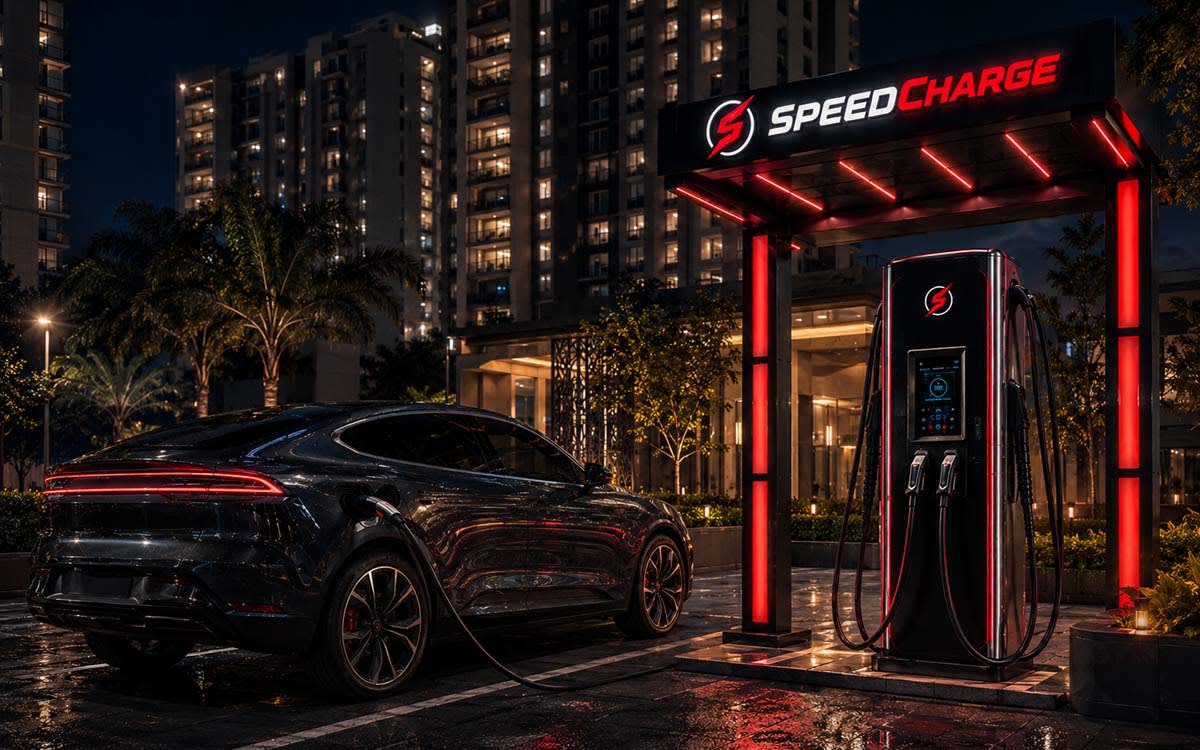
Owning an electric car while living in a flat creates a different charging problem from owning an independent house. The vehicle may be parked several floors away from the flat meter, the cable route may cross common property, and several residents may eventually want to charge at the same time. Choosing an EV charger for apartment in India therefore requires more planning than simply selecting a wallbox.
The good news is that India's current charging framework expressly covers private parking spaces, Group Housing Societies and residential charging. Residents can use existing electricity connections where suitable, request separate metered EV connections, and install private charging points in designated parking spaces under the framework, subject to the applicable electrical, property and local requirements.
Can You Install an EV Charger for Apartment in India?
Yes, apartment charging is contemplated by the Ministry of Power's 2024 charging-infrastructure framework. Group Housing Societies and RWAs are specifically covered, and the framework provides routes for both private charging points and community charging.
That does not mean every proposed installation must be accepted without technical review. A housing society can legitimately examine cable routing through common areas, parking entitlement, electrical capacity, fire access, civil work and maintenance responsibility. The better legal and practical position is to enable a compliant installation through a documented process rather than treat either “automatic approval” or “automatic prohibition” as the national rule.
The central framework is also not a substitute for state electricity regulations, local building rules or the society's valid property-management requirements. Apartment owners should check the applicable state EV policy and DISCOM process before relying on any exact NOC timeline or tariff claim.
What the 2024 Charging Framework Means for Apartment Residents
The current national framework distinguishes between charging at a residence and community charging for residents. It allows a resident to use an existing connection for home charging where suitable, request a separate metered connection, and seek additional sanctioned load if the charging requirement exceeds the available capacity.
For Group Housing Societies, the framework also recognises community charging stations and private charging points in designated parking spaces. Electricity for a private point can be arranged through the resident's existing meter or a separate metering arrangement depending on the applicable setup.
This is important because apartment charging does not have to follow one universal architecture. A resident close to the meter room may use a very different arrangement from a resident whose parking bay is several basement levels away.
Individual Charger vs Community Charging
Model | How It Works | Best Suited For | Main Planning Issue |
|---|---|---|---|
Individual charger from resident supply | Dedicated circuit reaches allotted parking bay | Fixed parking with workable cable route | Cable distance and sanctioned load |
Separate EV connection | Dedicated metered EV connection | Clean electricity accounting | DISCOM process and infrastructure |
Common supply with approved user metering | Society supply feeds charger and user consumption is measured | Long private cable runs are impractical | Billing policy and electricity rules |
Managed community chargers | Shared charging points authenticate and bill users | Multiple EV owners / shared parking | Access, load management and software |
Mixed model | Private bays plus shared chargers | Large societies with different parking layouts | Governance and expansion planning |
A large housing society may eventually need more than one of these models.
How to Choose an EV Charger for Apartment in India
Start with the vehicle, not the charger brochure. Check the EV's AC charging capability, your normal daily energy requirement, how long the car remains parked and the electrical capacity available at the property.
A higher-rated AC charger will not make a vehicle charge faster than its onboard charger allows. Likewise, total battery size alone does not determine the right charging power. A large-battery EV driven only a short distance each day may need less overnight energy than a smaller-battery EV used heavily.
A practical planning calculation is:
Required average charging power ≈ energy to replace ÷ available charging hours
Charging losses and site constraints still need to be considered, but this is a better starting point than choosing equipment only from maximum kW.
AC vs DC for Apartment Charging
For individual residential parking, AC charging is usually the logical starting point because cars often remain parked for many hours. DC fast charging is designed for use cases where turnaround has greater value, such as public charging hubs and some fleet operations.
That does not mean DC is technically impossible in every residential property. It means the additional electrical infrastructure and capital normally provide little value for an individual overnight parking bay.
Charging Approach | Residential Fit | Key Advantage | Key Limitation |
|---|---|---|---|
Lower-power AC | Strong for long dwell | Lower electrical demand | Slower energy delivery |
Higher-power AC | Useful where vehicle and supply support it | More energy in shorter window | May require more capacity |
Managed AC | Strong for multi-EV societies | Shares available site capacity | Requires compatible controls |
Portable EVSE | Useful where OEM/site setup supports it | Flexible | Socket/circuit must suit continuous load |
DC fast charging | Usually not needed for individual bay | Fast turnaround | Higher infrastructure requirement |
The correct charger is the one that delivers the required energy before departure without creating unnecessary infrastructure cost.
Portable Charging in an Apartment
Portable charging can be useful, but it should not be treated as permission to plug into any socket available in a basement. The outlet, wiring and protective arrangement must be suitable for the intended continuous load, and common-area electricity should not be used casually without an approved billing arrangement.
Avoid extension boards, loose adapters and long improvised leads across parking aisles. If portable charging will be used regularly, have the proposed electrical point assessed for that duty.
A fixed wallbox becomes attractive when the owner wants a dedicated parking-side circuit, cleaner cable management, higher supported power or smart-control features.
Electrical Planning for an EV Charger for Apartment in India
Sanctioned load is one of the first numbers to check, but it is not the only one. The installer should also assess the flat or building's current demand, distribution-board capacity, cable route, earthing/protection arrangement and whether multiple EV chargers are likely to be added later.
Do not assume that every apartment has a 5 kW connection or that every 7.4 kW charger automatically requires a load enhancement. The answer depends on the actual connection and simultaneous household demand.
Smart load management can help allocate available power more intelligently. It may reduce or delay the need for an upgrade, but it cannot create unlimited capacity if total charging energy eventually exceeds what the building can supply.
For a detailed technical explanation, see Smart EV Charging & Load Management.
Existing Meter vs Separate EV Connection
The Electricity (Rights of Consumers) framework allows consumers to obtain separate electricity connections for EV charging, while the Ministry of Power's charging framework also allows residential charging through an existing connection where suitable.
Option | Advantage | What to Verify |
|---|---|---|
Existing flat meter | Simple billing to resident | Capacity, route and DISCOM requirements |
Separate EV connection | Clean dedicated metering | Connection cost, tariff and meter location |
Society connection with user metering | Practical for shared infrastructure | Applicable billing/recovery rules |
Managed community platform | Automated user-level session records | Software fees, payment flow and data ownership |
A separate EV tariff should not automatically be assumed to be cheaper. State tariffs differ, can change, and may include fixed or time-of-day components.
DISCOM Timelines Are Not RWA Approval Timelines
The 2024 Electricity (Rights of Consumers) amendments shortened national timelines for new electricity connections to three days in metropolitan areas, seven days in other municipal areas, fifteen days in rural areas and thirty days in rural hilly terrain.
These are distribution-licensee connection timelines. They are not a universal national rule requiring every RWA to issue an EV charger NOC within the same period.
Some states may issue separate directions for housing societies, but those should be verified from the current state-specific source before publication or escalation.
What to Submit to the RWA or Housing Society
A technically complete proposal is more effective than an informal request. Include the resident and flat details, parking location, proposed charger, rated input, electricity source, cable route, load assessment and installer details.
Where the cable crosses common property, the proposal should also explain how the route will be protected and how any drilling or civil work will be restored. Provide maintenance/contact responsibility so the committee knows who will handle the installation after commissioning.
A society can reduce disputes by adopting one standard application checklist for all residents instead of deciding every request from scratch.
RWA Approval Checklist
Information | Why It Matters |
|---|---|
Flat and resident details | Identifies applicant |
Parking bay | Confirms installation location |
Charger make/model | Defines proposed equipment |
Rated electrical input | Shows added demand |
Electricity source | Clarifies billing |
Cable-route sketch | Shows common-area impact |
Load assessment | Addresses capacity concern |
Installer details | Establishes technical responsibility |
Restoration method | Protects common property |
Maintenance contact | Defines post-install responsibility |
If the committee has a genuine technical objection, ask for the issue in writing so it can be solved rather than allowing the request to remain indefinitely vague.
What if the Society Says No?
First ask the committee to identify the precise reason. “Fire risk,” “transformer load” and “common-area routing” are engineering questions that can be evaluated. “We have no EV policy” is different from demonstrating that the proposed installation is technically unsafe.
Use the current Ministry of Power framework and the applicable state/DISCOM rules in the discussion. If a dispute continues, the appropriate escalation path depends on the legal structure of the society and the state, so avoid assuming that one registrar, regulator or court route applies throughout India.
For a detailed policy-focused explanation, use RWA Government Guidelines for EV Charging Installation.
Cable Routing Can Be the Hardest Part
In many apartments, the charger hardware is straightforward while the route from the electricity source to the parking bay is the difficult part.
The cable may need to pass through meter rooms, electrical shafts, basement ceilings, fire-rated walls or long parking sections. The complete route should be surveyed before a final quotation is accepted.
Do not publish a universal cable size such as “every 7.4 kW charger needs 6 sq mm copper.” Conductor sizing depends on current, length, installation method, ambient conditions, voltage-drop criteria, conductor characteristics and the overall protection design.
Use the EV Charger Installation Guide for the broader installation workflow.
Electrical Safety and Charger Standards
EV charging should be treated as a dedicated electrical installation. The Central Electricity Authority's current safety archive lists the 2023 Measures relating to Safety and Electric Supply Regulations together with the 2026 Amendment Regulations.
The exact protection arrangement should be designed around the charger, circuit and applicable standards. Avoid copy-pasting one breaker, residual-current device or earthing configuration from another property.
BIS also maintains the IS 17017 family for EV conductive charging systems. Buyers should ask which exact standard applies to the charger they are purchasing rather than accepting the generic marketing phrase “BIS approved.”
Basement and Open Parking
Basement charging should not be described with one pan-India yes/no rule. Building design, local fire requirements, cable routes, ventilation systems, water exposure and emergency access all matter.
Outdoor or podium parking introduces heat, rain, dust and physical-impact considerations. Select equipment and mounting suitable for the actual environment, and verify the manufacturer's installation requirements rather than relying only on “weatherproof” marketing.
For hot-weather charging guidance, see Is EV Charging Safe in Summer?.
Stack and Mechanical Parking
Mechanical or puzzle parking deserves separate planning because the vehicle platform itself moves. A charger cable must not be positioned where it can be stretched, crushed or entangled by the mechanism.
Where individual charging cannot be engineered safely, a shared ground-level charging bay may be more practical. Involve the parking-system provider or a competent engineer before modifying a mechanical parking installation.
Step-by-Step Apartment Charger Installation
A good EV charger for apartment in India should be planned in this order:
Stage | Action | Result |
|---|---|---|
1 | Confirm parking arrangement | Defines private/shared charging location |
2 | Check vehicle charging capability | Prevents overspecifying charger |
3 | Assess sanctioned load and site demand | Establishes electrical feasibility |
4 | Survey cable route | Defines installation scope |
5 | Submit RWA/property documents | Resolves common-area issues |
6 | Complete DISCOM process if required | Provides suitable connection/load |
7 | Finalise charger and electrical design | Matches equipment to site |
8 | Install and commission | Creates operational charging point |
9 | Configure software/access where applicable | Enables monitoring/billing |
10 | Retain documentation | Supports warranty and future changes |
Do not order the charger before the first four steps are clear unless the supplier allows the hardware choice to be changed after the survey.
What a Professional Site Assessment Should Cover
The survey should establish the electricity source, available load, existing panel, cable distance, parking environment, mounting location, connectivity needs and the expected future charging demand.
For a society project, it should also identify common infrastructure that may need upgrading if many residents adopt EVs. The first charger should not be installed in a way that makes the tenth charger unnecessarily difficult.
A survey is valuable because two flats in the same building can have very different installation costs simply because their parking bays have different cable routes.
Apartment EV Charger Installation Cost
There is no reliable nationwide fixed price for apartment charger installation. Hardware is only one part of the bill.
The total project can include charger hardware, cable and containment, electrical panel work, protection, metering, load enhancement, civil work, mounting, labour and commissioning.
Cost Component | Why It Varies |
|---|---|
Charger hardware | Power, features, connectivity and brand |
Cabling | Route length and electrical design |
Conduit/trays | Property construction and routing |
Panel/protection work | Existing electrical infrastructure |
Metering | Existing, separate or shared setup |
Load enhancement | DISCOM/site requirements |
Civil work | Drilling, fire-stopping and restoration |
Mounting/protection | Wall, pedestal or bollard |
Software | Smart charging, billing or CMS functions |
Labour/commissioning | Site complexity |
Ask for an itemised quotation after the site survey. Do not compare suppliers on charger price alone.
How Much Does Apartment EV Charging Cost Per Month?
Monthly energy cost is better calculated from actual metered charging consumption than from battery capacity.
Use:
Monthly charging energy cost = metered EV charging kWh × applicable electricity tariff
The result depends on kilometres driven, vehicle efficiency, charging losses and the tariff applicable to that connection.
Do not publish one “India home charging rate” or a fixed per-kilometre saving. Electricity tariffs differ by state and consumer category, and petrol-versus-EV savings also depend on the vehicles being compared.
BEE currently maintains state EV policy and tariff resources that can be checked before using a current tariff in a local article.
Individual Bay Chargers vs Shared Society Charging
Individual charging works well when residents have fixed parking bays, convenient cable routes and sufficient electrical capacity. Shared infrastructure can become more efficient as EV adoption grows.
A society should consider moving to a coordinated model when repeated independent installations begin to create duplicated cable routes or load-management problems.
Typical shared infrastructure can include a dedicated EV distribution panel, planned cable pathways, user-level metering, smart load management and common charging bays.
Read EV Charging for Apartments & RWAs and How to Install EV Chargers in a Housing Society for the society-wide design.
Smart Load Management for Multiple Residents
Smart charging can enforce a site-level power limit and distribute that available power among connected vehicles. This is useful when many EVs have long overnight parking windows.
It can also prioritise users or adjust charging according to schedules, depending on the system. But the society still needs enough total energy capacity to meet charging demand by departure time.
Use Smart EV Charging & Load Management when planning multiple chargers.
How Should Shared Charging Be Billed?
Transparent billing matters because residents who do not charge EVs should be able to understand how common electricity costs are allocated.
The charging model can use approved sub-metering, platform-recorded sessions or another arrangement compatible with the electricity connection and applicable rules. Do not assume that a housing society can simply resell common-area electricity at any arbitrary rate.
Define the tariff basis, service fee where applicable, taxes, meter responsibility, payment cycle and treatment of visitors before the shared system goes live.
The policy should be consistent across residents.
New Buildings and the “20% EV Parking” Claim
The source article states that the Ministry of Housing and Urban Affairs universally mandates 20% EV charging parking in new residential buildings. That is too broad.
MoHUA amended the Model Building Bye-Laws and planning guidelines to facilitate EV charging, but the official announcement describes these as guidance for States and Union Territories to incorporate into their own building bye-laws and planning regulations.
The Ministry of Power's current framework also links common parking capacity requirements to applicable state building bye-laws rather than imposing one identical percentage on every building nationwide.
Check the local rule before publishing an exact parking percentage for a city or state.
State EV Policies and Subsidies
State policy matters, but incentive figures can become outdated quickly. BEE's current e-mobility resources show that 29 States have notified EV policies and provide links to state EV tariffs and nodal agencies.
A national evergreen article should therefore avoid hard-coding Delhi charger subsidies, Maharashtra fee waivers or specific tariff advantages unless they are freshly verified for the date of publication.
If a local version of this article is created later, state-specific incentives can be added with current official citations.
Apartment Charging vs Public Fast Charging
A private apartment charger and a public fast charger are complementary. Residential charging covers routine energy while the car is already parked, while public charging supports road trips, urgent top-ups and journeys away from home.
Apartment owners can use How to Charge an EV at Home in India for residential charging strategy and the SpeedCharge Station Finder when public charging is needed.
For longer journeys, the EV Road Trip & Monsoon Guide provides a separate planning framework.
What to Verify Before Buying the Charger
Before placing an order, confirm your vehicle's supported AC charging power, daily energy requirement, parking rights, sanctioned load, cable route, metering arrangement, applicable charger standard, warranty, environmental exposure and future expansion requirement.
This is more useful than shopping first and solving the infrastructure later.
How SpeedCharge Can Support the Apartment Charging Journey
Apartment owners can begin with EV Chargers for Apartments and How to Install an EV Charger in Your Parking to understand charger and parking requirements.
For RWA policy, use RWA Government Guidelines for EV Charging Installation. For a society-wide project, continue to EV Charging for Apartments & RWAs and How to Install EV Chargers in a Housing Society.
Commercial or managed-property requirements can be explored through Partner With SpeedCharge, while public charging remains available through the SpeedCharge Station Finder.
Final Thoughts
The right EV charger for apartment in India is the one that fits the vehicle, parking layout, electrical capacity and approval structure—not simply the charger with the largest kW number.
Start with a site survey and cable route, confirm the metering and load arrangement, document the proposal for the RWA where common infrastructure is involved, and select the charger only after feasibility is understood.
For individual residents, that creates a convenient overnight charging setup. For housing societies, the same process provides a foundation that can scale as more residents switch to EVs without repeatedly rebuilding the electrical infrastructure.
Frequently Asked Questions
1. Can a flat owner install an EV charger in an allotted parking space?
India's current charging framework provides for private EV charging points in designated parking spaces within Group Housing Societies. The actual installation should still address electricity supply, cable routing, property requirements and applicable local rules.
2. Can I use my existing flat electricity meter for EV charging?
The Ministry of Power framework allows residential charging from an existing electricity connection where suitable. A separate metered EV connection is also available as an option.
3. Is a separate EV meter compulsory in an apartment?
No. The suitable arrangement depends on the existing connection, sanctioned load, cable route, society setup and DISCOM process.
4. Can an RWA refuse an EV charger?
A housing society should not treat EV charging as automatically prohibited, but it can review legitimate safety, load, common-property and cable-routing issues. State-specific legal disputes may require local advice.
5. Which charger power is best for an apartment?
There is no universal kW rating. Choose based on vehicle AC capability, energy required before the next trip, parking duration and available electrical capacity.
6. How much does apartment charger installation cost?
There is no reliable national fixed price. Cost depends on hardware, cable distance, electrical work, metering, load enhancement, civil work and the parking layout.
7. Is smart load management necessary in a housing society?
It becomes increasingly useful as several chargers share limited electrical capacity. Whether it is required depends on site design and charging demand.
8. Can EV charging be installed in basement parking?
Potentially, but the building's electrical, fire, access, water-exposure and local requirements need to be considered. Avoid a universal yes/no assumption.
9. Does every new apartment building need 20% EV charging parking?
Do not apply one national percentage automatically. MoHUA's model guidelines are implemented through state and local building regulations, and the applicable requirement should be checked locally.
10. Should I buy a wallbox before asking the RWA?
Usually, complete the site survey, cable-route assessment and required property approvals first. This reduces the risk of buying equipment that does not suit the final approved installation.