Buying an electric vehicle is increasingly straightforward. Charging it inside a large apartment complex can be more complicated because electricity, parking and building infrastructure are shared between many residents.
Planning EV charging in apartments and RWAs therefore requires more than selecting a charger and asking an electrician to install it. A workable system needs clear parking access, electrical feasibility, metering, billing, cable routes, safety responsibilities and a plan for what happens when the number of EV-owning residents grows.
India's policy direction supports residential EV charging. The Ministry of Power's 2024 EV charging infrastructure guidelines remain part of the current national framework as of August 2026, while the Electricity (Rights of Consumers) Rules provide additional options for consumers in multi-storey residential premises.
The practical objective for an RWA should be simple: make charging available without creating electrical overload, billing disputes or repeated civil work every time another resident buys an EV.
What EV Charging in Apartments and RWAs Actually Involves
Residential charging can be organised in several ways. One resident may connect a charger to an existing flat electricity connection. Another may request a separate EV connection. A larger society may use common electrical infrastructure with individual user metering or a centrally managed charging system.
None of these models is automatically correct for every building.
The best architecture depends on:
Parking ownership and allocation
Location of electricity meters
Existing sanctioned load
Building peak demand
Distance to parking bays
Number of current EVs
Expected future EV adoption
Billing requirements
Common-area access
Maintenance responsibility
An older high-rise with two basement levels may require a different design from a newly constructed gated society with EV-ready electrical pathways.
Individual Chargers vs Shared Society Charging
Charging Model | Best Suited For | Main Advantage | Main Challenge |
|---|---|---|---|
Individual charger from resident supply | Fixed parking with practical cable route | Direct resident billing | Repeated long cable runs as EV adoption grows |
Separate EV connection | Resident wants dedicated utility metering | Clear electricity accounting | Meter location and DISCOM process |
Common supply with user metering | Multiple chargers share society infrastructure | Central electrical design | Transparent billing rules required |
Managed shared charging | Common parking or many EV users | Central billing and load control | Requires software and operating model |
Mixed architecture | Large societies with different parking conditions | Flexible and scalable | More planning at design stage |
There is no reliable threshold such as “10 EV owners means shared charging” or “20 owners require a fast-charging hub.”
The decision should follow actual property conditions.
Can an RWA Refuse an EV Charger Installation?
This question needs more nuance than the common internet answer that an RWA either has complete authority or has no authority at all.
National policy supports the development of EV charging, and Ministry of Power guidance has permitted housing societies and similar premises to install charging infrastructure, including charging for vehicles permitted to enter the premises.
However, an RWA can still have legitimate reasons to review a proposed installation where it affects:
Common electrical infrastructure
Common parking areas
Cable shafts
Basement ceilings
Fire access
Building structure
Shared meters
Sanctioned load
Civil work
A committee should therefore evaluate the technical design, not arbitrarily prohibit the technology.
Similarly, a resident should not treat an allotted parking bay as permission to drill through common walls, draw electricity from a common circuit or run cables through common property without coordination.
For the policy angle, residents can review RWA Government Guidelines for EV Charging Installation.
What an RWA EV Charging Policy Should Cover
A written policy can prevent repeated arguments as additional residents request chargers.
It should define:
Who can apply
What documents are required
Approved parking locations
Electrical-assessment requirements
Permitted cable routes
Responsibility for installation cost
Metering arrangement
Electricity billing
Maintenance responsibility
Restoration of common property
Removal or transfer when a resident moves
Process for future shared infrastructure
The policy should create a predictable route to technically acceptable charging rather than an unnecessarily restrictive approval process.
What Should a Resident Submit?
Document / Information | Why the RWA Needs It |
|---|---|
Applicant and flat details | Identifies responsible resident |
Parking-bay details | Confirms proposed location |
Charger specification | Identifies planned equipment |
Rated electrical demand | Supports load assessment |
Electricity source | Clarifies supply and billing |
Cable-route drawing | Shows effect on common property |
Electrical feasibility | Addresses capacity concerns |
Installer details | Establishes technical responsibility |
Metering proposal | Prevents billing disputes |
Maintenance/restoration plan | Defines long-term responsibility |
A detailed application usually gives the committee something concrete to approve instead of forcing it to make a decision based on assumptions.
Existing Flat Connection vs Separate EV Connection
The Electricity (Rights of Consumers) Rules were amended in 2024 to explicitly allow consumers to obtain separate electricity connections for charging electric vehicles. The amendments also introduced additional consumer-choice and metering provisions for cooperative group housing societies and multi-storey buildings.
That does not make a separate connection mandatory.
Where adequate capacity exists, charging may be possible through the resident's existing connection under the applicable framework. In other projects, a dedicated EV connection or common society connection can be more practical.
Important: Don't Assume the EV Tariff Is Always Cheaper
Electricity tariffs vary between states, distribution companies and connection categories.
BEE's current e-mobility resources report 29 States with notified EV Policies and provide State EV tariff and nodal-agency resources.
Check the actual tariff applicable to the property instead of building the financial model around a generic “EV tariff.”
Electricity and Billing Options
Model | Billing Method | Best Use | Main Question |
|---|---|---|---|
Resident's existing meter | Appears on resident electricity bill | Individual fixed bay | Is load and cable route suitable? |
Separate EV connection | Dedicated utility meter | Independent accounting | What does the local DISCOM require? |
Society supply + user metering | Consumption allocated to each EV user | Shared infrastructure | How will costs legally be recovered? |
CMS-based authenticated charging | Session data assigned to each account | Multi-user charging | Who manages platform and payments? |
Public/visitor charging | User pays applicable charging/service tariff | Guest or commercial use | What public-charging obligations apply? |
The society should decide this structure before chargers are commissioned.
Do not install common chargers first and decide later how residents will split the bill.
How Should EV Charging in Apartments and RWAs Be Billed?
The objective is transparent cost allocation.
Residents who do not use the charging infrastructure should be able to understand how EV consumption is separated from other common-area electricity. At the same time, the society should not simply invent an arbitrary per-unit electricity resale rate without checking the applicable tariff and regulatory structure.
For private charging from a resident's own connection, billing can be relatively simple.
For a common charging system, the society may need to account separately for:
Energy consumed
Applicable electricity tariff
Charging losses where relevant
Platform/service costs
Taxes where applicable
Maintenance
Any legitimate charging-service component
The final model should be documented and applied consistently to all users.
Check Electrical Capacity Before Buying Chargers
One of the biggest mistakes in society charging is deciding charger power before understanding the building.
A proper study should review:
Sanctioned load
Existing peak demand
Transformer/supply capacity where relevant
Distribution panels
Spare electrical capacity
Existing common loads
Cable pathways
Number of expected chargers
Likely simultaneous charging
Future expansion
Do not assume every apartment has a 3 kW, 5 kW or any other standard sanctioned load. Connections vary.
Likewise, installing one charger does not automatically require a load enhancement. The answer depends on the property's existing demand and the proposed charging profile.
Smart Load Management Can Reduce Peak Demand
For EV charging in apartments and RWAs, smart load management becomes particularly useful when several charging points share constrained electrical capacity.
Instead of allowing every charger to request its maximum available power at the same time, a management system can enforce a site-level limit and distribute power among active sessions.
For example, the system may allocate more power when building demand is low and reduce charging power during a higher-demand period.
That can improve utilisation of existing electrical infrastructure.
It does not mean:
“Smart charging means the society will never need a load enhancement.”
If total EV energy demand continues growing, additional upstream capacity may eventually be required.
Read Smart EV Charging & Load Management for the detailed grid-management approach.
AC vs DC Charging for Apartment Societies
Residential dwell time is often the most important factor.
Cars parked overnight may have many hours available to recover the energy used during the day. That makes appropriately sized AC charging highly relevant.
DC fast charging becomes more valuable when vehicles need rapid turnaround.
Charging Approach | Typical Residential Role | Main Advantage | Main Limitation |
|---|---|---|---|
Lower-power AC | Individual long-dwell parking | Lower infrastructure demand | Slower charging |
Higher-power AC | Residents with shorter charging window where vehicle/site support it | Faster energy delivery | Higher site demand |
Managed AC | Multiple society users | Coordinates shared capacity | Requires compatible management system |
Shared destination charging | Resident/visitor use | Flexible access | Needs billing/access controls |
DC fast charging | Specific high-turnover or mixed-use sites | Rapid turnaround | Higher electrical and capital requirements |
Do not automatically prescribe 7.4 kW, 11 kW or 22 kW solely from the size of the flat or battery.
The correct charger depends on:
energy required ÷ time available + vehicle capability + site capacity
A higher-rated charger cannot force an EV to accept more power than the vehicle supports.
For charger selection, see EV Chargers for Apartments.
Is DC Fast Charging Necessary for a Large Housing Society?
Not necessarily.
A society with many EV owners can still have long overnight dwell periods. Several managed AC chargers can sometimes serve that demand more efficiently than one high-power DC unit.
DC becomes worth evaluating when the property has a genuine short-dwell requirement—for example:
High-turnover visitor charging
Taxi or fleet activity
Mixed commercial/residential property
Residents requiring rapid charging rather than overnight replenishment
Charger count alone should not determine AC versus DC.
Cable Routing Can Determine Project Cost
In high-rise buildings, the charger may be inexpensive compared with the infrastructure required to reach the parking bay.
Cable routes can involve:
Basement ceilings
Electrical shafts
Cable trays
Fire-rated walls
Long parking aisles
Meter rooms
Distribution panels
Outdoor sections
This is why a supplier cannot responsibly provide a complete fixed installation cost without seeing the site.
Longer or more complex routes can change both electrical design and labour requirements.
For individual parking installations, see How to Install an EV Charger in Your Parking.
Do Not Copy Cable Sizes From Another Installation
The source article used fixed cable and protection assumptions in several places. These should not be treated as universal engineering instructions.
Conductor selection depends on factors including:
Circuit current
Cable length
Conductor material
Installation method
Ambient conditions
Grouping
Voltage-drop limits
Protective-device coordination
Charger manufacturer's requirements
Similarly, one MCB, RCCB/RCD or earthing arrangement should not be copy-pasted across every housing society.
Use a competent electrical professional and the applicable technical framework.
Current Electrical Safety Framework
The Central Electricity Authority currently lists the CEA (Measures relating to Safety and Electric Supply) Regulations, 2023 together with the 2026 Amendment Regulations. The CEA archive was updated on August 24, 2026.
This reinforces an important point: an EV charging point is electrical infrastructure, not simply another household gadget.
A professional installation should address the charger, circuit, protection, earthing, environment and upstream electrical system as one design.
Use the EV Charger Installation Guide for the broader installation workflow.
Basement Parking Needs Proper Planning
Basement EV charging should not be treated as universally prohibited or universally acceptable without review.
The project needs to account for:
Cable routing
Fire compartments
Emergency access
Water ingress
Vehicle movement
Mounting
Physical charger protection
Electrical-room location
Building-specific fire/safety requirements
An approved fixed installation is very different from running an extension cable through a basement parking aisle.
Open Parking Requires Environmental Protection
Open or podium parking exposes equipment to heat, rain, dust and sometimes direct sunlight.
Equipment should be selected and installed for the actual environmental conditions. Do not accept the marketing term “weatherproof” without checking the manufacturer's documented rating and installation requirements.
For heat-related considerations, see Is EV Charging Safe in Summer?.
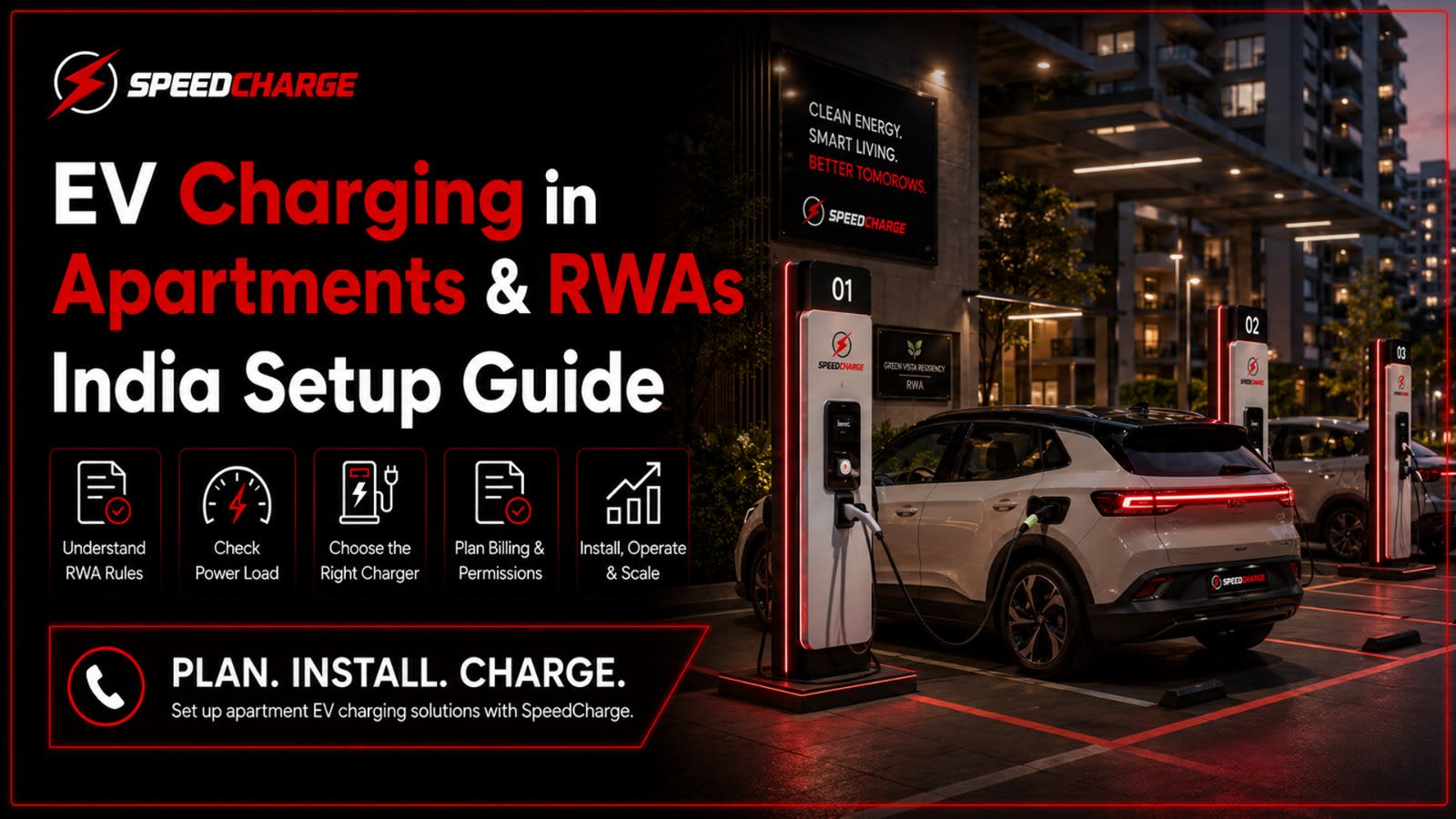
Step-by-Step RWA EV Charging Process
A practical sequence is:
Step 1 — Estimate Demand
Count current EV owners, likely near-term adopters, visitor demand and parking types.
Step 2 — Map the Parking
Identify allotted bays, common charging spaces and practical cable routes.
Step 3 — Conduct Electrical Feasibility
Assess supply, sanctioned load, peak demand and expansion capacity.
Step 4 — Select the Charging Architecture
Choose individual, separate-connection, common, managed or mixed infrastructure.
Step 5 — Adopt a Written RWA Policy
Define applications, billing, installation, maintenance and future expansion.
Step 6 — Complete the DISCOM Process Where Required
Obtain a new connection, modification or load enhancement only where the project needs it.
Step 7 — Select Hardware and Software
Match charger capability to actual vehicles, dwell time and electrical capacity.
Step 8 — Install and Commission
Complete electrical/civil work and verify charging functionality.
Step 9 — Configure Billing and Access
Set up resident authentication and transparent consumption records.
Step 10 — Keep Documentation
Retain designs, approvals, warranty, commissioning and service records.
The detailed installation workflow is also covered in How to Install EV Chargers in a Housing Society.
Don't Confuse DISCOM Timelines With Complete Project Timelines
The 2024 Electricity (Rights of Consumers) amendments reduced timelines for new electricity connections to:
3 days in metropolitan areas
7 days in other municipal areas
15 days in rural areas
30 days in rural hilly terrain
These are electricity-connection timelines under the Rules.
They are not a guaranteed timeframe for:
RWA approval
Equipment procurement
Transformer work
Civil construction
Complete charger commissioning
Therefore, do not publish a universal claim such as “your housing society charger will be ready in 2–4 weeks.”
Give a site-specific schedule after feasibility.
Cost of Society EV Charging
There is no responsible nationwide fixed price.
The total cost depends on:
Charger hardware
Electrical panels
Cable distance
Cable containment
Metering
Load enhancement
Transformer/upstream work where needed
Civil work
Mounting
Connectivity
Software
Commissioning
Maintenance
Cost Planning by Component
Cost Area | Individual Charger | Shared Society Setup | Main Variable |
|---|---|---|---|
Charger hardware | Required | Multiple/shared units | Power and features |
Cabling | Required | Central + distribution cabling | Distance and route |
Metering | May be needed | Usually central to billing design | Connection model |
Panel work | Site dependent | Often more substantial | Available capacity |
Load enhancement | Only if required | Site dependent | Existing infrastructure |
CMS/software | Optional depending on use | Often valuable | Number of users/features |
Civil work | Site dependent | Site dependent | Parking/building design |
Maintenance | Resident/provider | Society/provider | Service structure |
Request an itemised quotation after the physical and electrical survey.
Do not compare vendors only on wallbox price.
Does the RWA Need a Charge Management System?
Not always.
A single private charger connected to one resident's electricity account may not need a sophisticated multi-user CMS.
A society-level system becomes more useful when it needs:
User authentication
Session records
Billing
Multiple chargers
Load management
Fault monitoring
Remote controls
Tariff configuration
Usage reporting
Software should solve a real operational problem rather than be included only because it appears advanced.
Maintenance Responsibility Must Be Written Down
A charger will eventually require inspection, software support or repair.
The policy or commercial agreement should state:
Who reports faults
Who contacts the service provider
Who pays maintenance
Warranty duration
AMC terms if any
Response/escalation process
Who owns replacement parts
What happens when a resident moves
What happens when equipment reaches end of life
Without this clarity, a technical failure can become a committee dispute.
New Buildings and EV-Ready Parking
The source article implies that central model rules automatically create identical charging-parking requirements across India. That is too broad.
MoHUA amended the Model Building Bye-Laws and planning guidelines in 2019 to facilitate EV charging infrastructure. But the official announcement clearly describes the framework as a guiding document for States and Union Territories to incorporate into their own building bye-laws and master-plan regulations.
Therefore, check the applicable state and municipal building rules before publishing a fixed EV-ready parking percentage for a specific property.
State EV Policies Also Matter
BEE's current portal reports that 29 States have issued EV Policies and separately provides state tariff information and State Nodal Agency resources.
This means national articles should avoid hard-coding:
One EV electricity tariff
One RWA approval period
One state subsidy
One installation rebate
One connection charge
Local pages can include these figures after verifying the latest official state source.
How to Scale EV Charging in Apartments and RWAs
The first resident's charger should not make the fiftieth resident's charger harder to install.
Even when only one or two vehicles need charging today, the society can consider future:
Cable trays
EV panel capacity
Meter space
Approved charger zones
Shared charging bays
Network connectivity
Load-management architecture
Transformer/supply expansion
Planning does not mean installing dozens of chargers immediately.
It means avoiding unnecessary demolition and rewiring later.
Individual Charging vs Society-Wide Infrastructure
Individual installations often work well in the early stages when parking bays have convenient routes and only a few residents charge.
As adoption grows, the committee should periodically reassess whether central infrastructure would reduce duplicated work.
Triggers can include:
Multiple overlapping cable routes
Insufficient meter space
Shared parking
Billing complexity
High simultaneous charging demand
Need for visitor charging
Repeated electrical upgrades
The transition should happen because the property's needs changed—not because an arbitrary EV-owner count was reached.
Home Charging and Public Charging Work Together
Apartment charging does not eliminate the need for public charging.
Residential infrastructure can handle routine daily energy while the vehicle remains parked. Public charging remains useful during road trips, unusual high-mileage days or when residential charging is temporarily unavailable.
Residents can review How to Charge an EV at Home in India for home-charging strategy and use the SpeedCharge Station Finder when public charging is required.
What to Ask a Society Charging Provider
Before approving a proposal, ask:
Who owns the hardware?
Who owns/control the CMS?
Can another charger brand be added later?
Who pays electricity?
How are residents billed?
Who determines charging/service fees?
What installation work is excluded?
Who manages DISCOM coordination?
What maintenance is included?
What happens after warranty?
Is there an AMC?
What is the exit process?
Who owns historical charging data?
What happens when the commercial agreement ends?
Commercial-property or managed-charging options can be explored through Partner With SpeedCharge after electrical and site feasibility is established.
Final RWA Checklist
Before approving physical installation, confirm:
EV demand has been assessed.
Parking locations are identified.
Electrical feasibility is complete.
Cable routes are approved.
Metering architecture is defined.
Resident billing rules are written.
Installation responsibility is clear.
Necessary DISCOM work is identified.
Charger selection matches actual use.
Smart load management is considered where useful.
Maintenance responsibility is documented.
Future expansion pathways are considered.
A written system is easier to administer than repeated one-off committee decisions.
Final Thoughts
The best approach to EV charging in apartments and RWAs is not to start with the fastest charger or the cheapest quotation. Start with the building.
Understand where the vehicles park, how much electricity is available, how cables can reach the bays, how consumption will be billed and how the infrastructure can grow as more residents adopt EVs.
Then select the charger and operating model.
When engineering, governance and billing are addressed in that order, residential EV charging becomes a manageable building service rather than a recurring RWA dispute.
Frequently Asked Questions
1. Can an apartment society install EV chargers in India?
Yes. India's charging framework supports charging infrastructure at housing societies and residential premises, subject to applicable electrical, property, local and operating requirements.
2. Can an RWA stop a resident from installing an EV charger?
An RWA can review legitimate issues involving common property, electrical capacity, parking, cable routes and safety. Blanket legal conclusions should be avoided because the exact situation can depend on state law and property structure.
3. Do I need a separate EV electricity meter?
Not necessarily. A separate EV connection is available as an option, while existing residential connections or society-level arrangements may also be suitable depending on capacity and local rules.
4. What charger is best for apartment parking?
There is no universal power rating. Choose according to the EV's charging capability, daily energy requirement, parking duration and available building capacity.
5. Is DC fast charging required for a large society?
No. Large residential demand can often be served through managed AC charging because vehicles remain parked for long periods. DC should be evaluated when rapid turnaround is genuinely required.
6. What is smart load management?
It is a system that controls the total EV charging demand and distributes available power among active chargers. It helps manage peak load but cannot create unlimited electrical capacity.
7. How much does a society EV charging setup cost?
There is no national fixed price. Charger hardware, cabling, electrical infrastructure, metering, software, civil work, load enhancement and maintenance all affect project cost.
8. Can a society bill individual residents for charging?
A society can use appropriate individual metering or charging-session records, but the charging and cost-recovery structure should comply with the applicable electricity and billing framework.
9. Does every apartment building need the same percentage of EV-ready parking?
No. MoHUA's Model Building Bye-Law provisions are implemented through state, UT and local planning regulations. Check the rules applicable to the specific property.
10. What should an RWA do before installing its first charger?
Start with demand assessment and electrical feasibility. Establish the parking, metering, billing and cable-routing model before buying hardware.