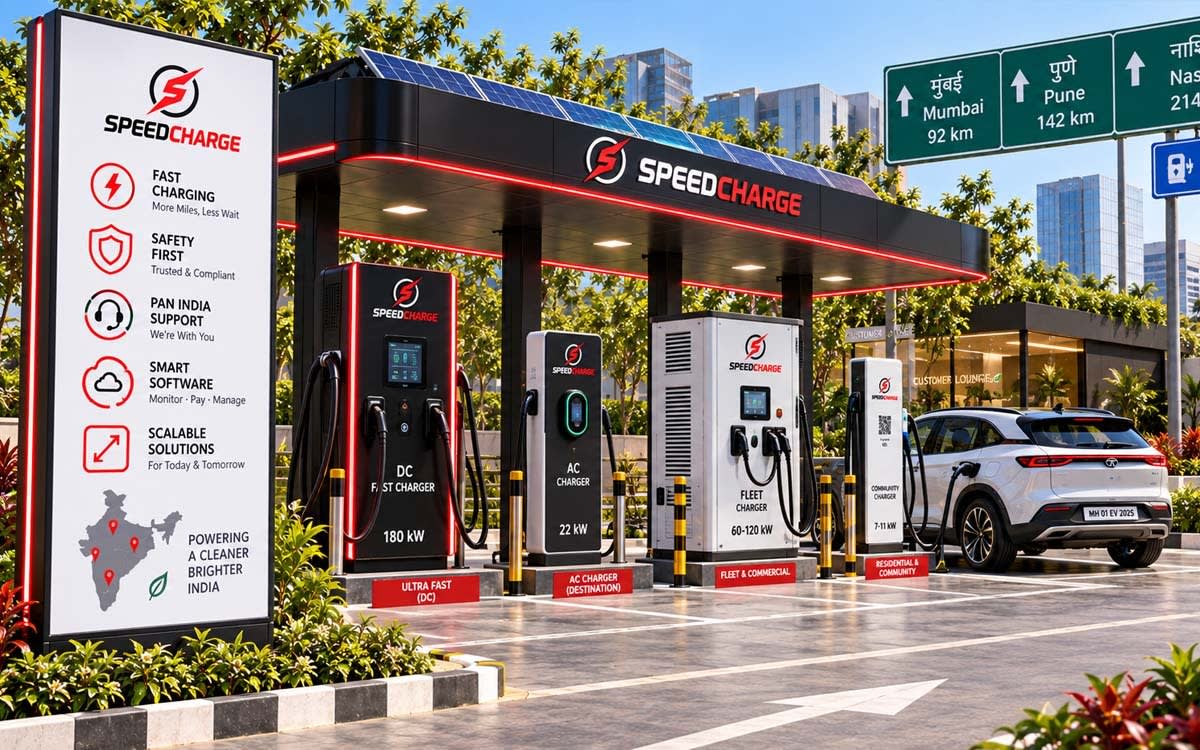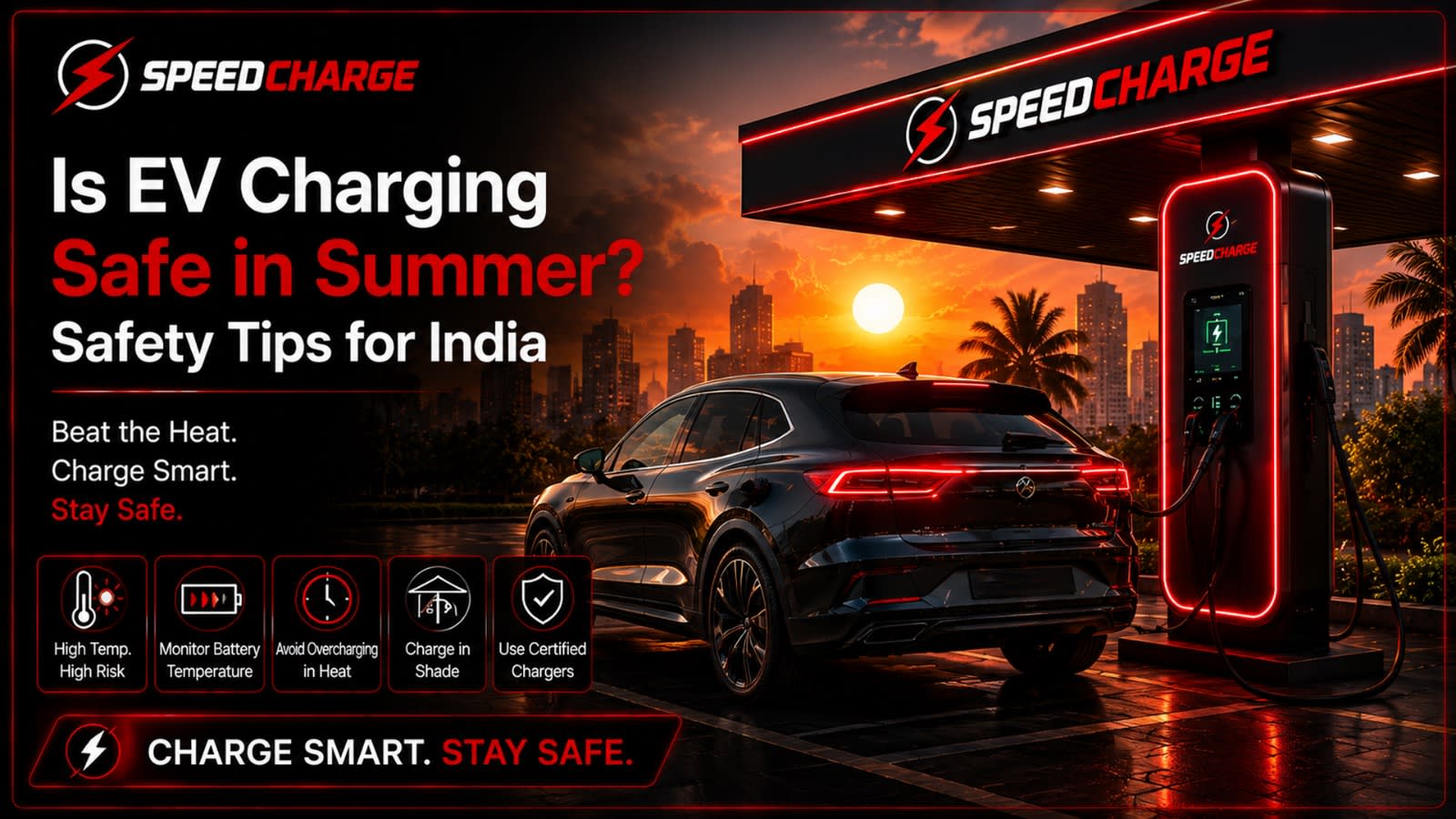
EV charging in summer is safe when the vehicle, charger and electrical installation are used within their designed operating conditions. Indian drivers regularly deal with high ambient temperatures, sun-heated parking areas, long highway runs and heavy household electricity demand, so hot-weather charging needs sensible planning rather than fear.
The important questions are whether the charger is suitable for the installation environment, whether the wiring and protective devices are correctly designed, whether the cable and connector are undamaged, and whether the vehicle is allowed to manage battery temperature and charging power normally. Modern EVs can reduce charging power when battery conditions require it; slower charging on a very hot day is not automatically a charger fault.
This guide explains EV charging in summer for home users, apartment residents, public-charging customers, fleet operators and property managers in India.
For related battery-health guidance, read the SpeedCharge EV Battery Degradation Guide.
Is EV Charging Safe in Summer?
Yes. Properly installed EV charging equipment and compatible vehicles are designed to manage charging within defined electrical and thermal limits. Heat can influence battery temperature and charging speed, but high ambient temperature by itself does not mean a normal charging session is unsafe.
The vehicle's Battery Management System can monitor battery condition, voltage, current, state of charge and temperature. Depending on the vehicle, thermal-management systems may cool or condition the battery, while charging power can be reduced when conditions are outside the range intended for peak charging performance.
The charging station also contains control and protection functions. Safe operation still depends on the complete electrical installation, including earthing, overcurrent protection, residual-current protection, correct cable sizing and the supply feeding the EVSE.
India's IS 17017 family covers conductive EV charging equipment and electrical-safety requirements, while CEA maintains India's wider Safety and Electric Supply Regulations, including a 2026 amendment.
Why Hot Weather Can Change EV Charging Performance
A lithium-ion battery generates heat while charging and discharging. On a hot day, the battery can begin a charging session at a higher temperature than it would in mild weather, especially after sustained highway driving or repeated high-power operation.
Battery thermal management is designed to keep the pack within limits established by the manufacturer. When additional cooling or lower charging power is required, the vehicle can prioritise battery protection over maximum speed.
That means two sessions at the same charger can behave differently even when the charging station itself is operating normally.
Summer Condition | Possible Effect | Practical Response |
|---|---|---|
Vehicle parked in direct sun | Higher cabin/component temperature | Use shade where practical |
Long highway drive | Battery may arrive warmer | Expect charging power to vary |
High battery State of Charge | Charging can taper | Charge only as high as required |
High battery temperature | Vehicle may reduce power | Let thermal management operate |
High household demand | Less electrical headroom | Use correctly sized circuit/load management |
Outdoor charger exposure | Higher equipment temperature | Install within rated conditions |
Loose/damaged connection | Localised heating risk | Stop use and arrange inspection |
Battery Management Matters More Than a Fixed Temperature Rule
There is no single outdoor-temperature number at which every EV suddenly becomes unsafe to charge. Battery chemistry, pack construction, cooling system, charger type and vehicle-control strategy differ between models.
The correct source for operating-temperature limits is the vehicle manufacturer's documentation. If the vehicle reduces power, displays a charging warning or pauses a session, do not attempt to bypass that behaviour with unofficial equipment or software settings.
Modern battery and charging systems are designed around active temperature management rather than expecting drivers to manually calculate a universal safe temperature.
Does Summer Heat Damage an EV Battery?
Heat is one factor that can accelerate lithium-ion battery ageing, particularly when elevated temperature is combined with prolonged periods at high State of Charge.
However, battery degradation is multifactorial. Chemistry, thermal history, State of Charge, charging rate, calendar age, driving behaviour and the manufacturer's usable battery window all influence long-term capacity.
Very-high-power charging can also generate substantial heat, which is why EV battery cooling and thermal-control systems are important engineering elements. U.S. Department of Energy research on extreme fast charging highlights heat generation as a major technical consideration.
For daily use, follow the charging limit recommended for your specific EV rather than applying the same percentage rule to every vehicle.
Should You Charge Only to 80% in Summer?
Not necessarily.
Around 80% can be a practical stopping point for some DC fast-charging sessions because many EVs reduce charging power at higher states of charge. That can make the final portion of a public charging session relatively time-consuming.
However, charging above 80% can be completely reasonable when:
You need additional highway range
Charging infrastructure ahead is limited
You are entering a difficult route section
Your destination has no charger
The manufacturer recommends a particular charging routine
The more useful rule is:
Charge according to your vehicle manufacturer's guidance and the journey ahead.
Do not treat 20–80% as a universal battery-safety law.
Is Fast Charging Safe in Hot Weather?
Yes, when the vehicle supports DC charging and the station is correctly installed and maintained. EV charging in summer does not require drivers to avoid DC charging simply because ambient temperature is high.
A fast charger makes power available, but the vehicle controls what it can accept. Battery temperature, State of Charge, charging curve, charger capability and available site power can all influence the actual kW displayed during a session.
Very-high-power charging can create additional thermal load, which is precisely why battery cooling and charging controls matter. If a warm battery accepts less power after a highway run, that can represent normal thermal-management behaviour rather than a failure.
For a deeper explanation, read EV Fast Charging in India: Myths & Facts.
AC vs DC Charging During Hot Weather
Factor | AC Charging | DC Fast Charging |
Typical use | Home, workplace, destination | Highway, public, fleet |
Power conversion | Mainly vehicle onboard charger | Mainly charging station |
Session duration | Usually longer | Usually shorter |
Charging power | Generally lower | Potentially much higher |
Best use | Routine charging during long parking | Travel and quick turnaround |
Key consideration | Correct electrical installation | Vehicle capability + station condition |
AC charging should not be described as inherently “safe” and DC charging as inherently “unsafe.” Both can be safe when the vehicle, charging equipment and electrical system are designed and maintained correctly.
Why Fast Charging May Slow Down on Hot Days
Drivers sometimes assume a charger is defective when the output falls below the number advertised on the cabinet.
The charger's kW rating is its maximum equipment capability, not a promise that every vehicle will continuously receive that power.
Actual charging output can be affected by:
Vehicle maximum DC acceptance
Battery temperature
State of Charge
Charging curve
Battery chemistry
Thermal-management strategy
Available charger power
Shared site capacity
Vehicle-charger communication
A busy site may also distribute available power between multiple charging points.
Should You Wait Before Charging After a Long Drive?
You generally do not need to invent a fixed 10-, 20- or 30-minute cooling period unless your vehicle manufacturer specifies one.
Modern vehicles with active thermal management are designed to control battery temperature during driving and charging. If the battery is too warm for peak charging power, the vehicle can reduce its demand or manage cooling.
Parking in shade where practical may reduce solar heat load, but do not disable normal thermal-management functions merely to “let the battery cool.”
Follow the vehicle's dashboard warnings and owner's manual.
Home EV Charging During Indian Summer
Home charging is convenient because the car can recharge while it is already parked. The important summer concern is not that the charger automatically becomes unsafe as outdoor temperature increases.
The main issue is ensuring that electrical connections carrying sustained current are correctly sized, protected and maintained.
A dedicated EV charging circuit should be designed around the charger load and installation environment. The charger should be installed according to manufacturer requirements and applicable electrical standards instead of being connected through an improvised arrangement.
For complete residential planning, read How to Charge an EV at Home in India.
Electrical Checks That Matter at Home
A qualified electrical installer should assess the supply before installing a higher-power charger.
Important checks include:
Available sanctioned load
Dedicated circuit requirement
Cable conductor size
Earthing
Overcurrent protection
Residual-current protection
Isolation
Surge protection where required
Distribution-board capacity
Cable route
Environmental exposure
Manufacturer-specified clearances
The charger and electrical installation should be evaluated together rather than treating the wallbox as an independent appliance.
Why Extension Boards Can Create Problems
Portable EVSE can be useful when used exactly as intended by the vehicle and charger manufacturer and connected to an electrical outlet suitable for the charging load.
The risk often comes from the improvised connection:
Low-quality extension boards
Loose sockets
Undersized conductors
Damaged plugs
Unapproved adapters
Improper cable joints
Electrical resistance at a weak connection can generate localised heat.
If a plug, socket or cable becomes unusually hot, smells burnt, discolours, sparks or trips protection repeatedly, stop charging and arrange inspection.
Outdoor Home Chargers: Heat, Sun and Weather
An outdoor charger should be selected for the environment in which it will operate.
Check:
Ingress-protection rating
Operating-temperature range
Mounting instructions
Direct-sun exposure guidance
Cable-entry protection
Connector storage
Required clearances
Drainage around the installation
A strong IP rating does not override the rest of the manufacturer's installation instructions.
Where practical, suitable placement or a correctly designed canopy can reduce direct solar loading without blocking cooling paths or violating charger clearances.
Apartment and Housing Society Charging
EV charging in summer becomes a site-management issue when many residents charge at the same property while air-conditioning, lifts, water pumps and other building loads are also high.
The solution is not to prohibit charging during hot months. Building managers should understand the site's sanctioned load, transformer capacity, panel headroom, existing peak demand and expected EV charging load.
Dynamic load management can distribute available charging capacity across connected vehicles and prevent infrastructure from being designed around the assumption that every charger must operate at its maximum output simultaneously.
The Ministry of Power's 2024 charging guidelines apply to private, semi-restricted and public charging sites, including Group Housing Societies, and explicitly include grid preparedness among their objectives.
Read How to Install EV Chargers in a Housing Society and EV Chargers for Apartments for residential-complex planning.
What Property Managers Should Verify
Area | What to Check |
Electrical capacity | Sanctioned load, transformer and panel headroom |
Charger quantity | Current users plus expansion |
Load management | Total site limit and allocation logic |
Metering | User/session energy measurement |
Access control | Who can use the chargers |
Cable routing | Avoid walking/vehicle obstruction |
Environment | Temperature/IP suitability |
Maintenance | Fault reporting and response |
Billing | Transparent allocation |
Emergency access | Keep routes and isolators accessible |
A scattered collection of uncontrolled sockets is not a scalable solution for a housing society with growing EV adoption.
Public EV Charging During Indian Summer
Public charging stations can operate through hot weather when the equipment is specified for the environmental conditions and maintained appropriately.
Before plugging in, inspect the cable and connector. Avoid visibly damaged charging equipment, cracked housings, exposed conductors or units displaying active fault conditions.
Use the SpeedCharge Station Finder when planning longer journeys and identify an alternative charging location for critical highway legs.
Summer Highway Charging Strategy
Highway driving can warm the battery before a fast-charging stop, and high ambient temperature can add to the thermal load.
The best strategy is to understand the vehicle's charging behaviour rather than apply one fixed percentage or cooling rule.
Before a long trip:
Check the route and primary chargers.
Identify backup chargers where practical.
Verify connector compatibility.
Check weather and traffic conditions.
Start with a battery level appropriate for the route.
Use battery preconditioning if supported.
Expect charging power to change through the session.
Charge higher when the next route section requires more reserve.
For wet-weather travel, see EV Charging in Rain: Monsoon Safety Guide.
Battery Preconditioning and Thermal Management
Some EVs can precondition the traction battery before reaching a DC fast charger.
The objective is to bring the battery toward temperature conditions suitable for charging performance.
Implementation differs between vehicles. Some automatically begin battery conditioning when a charging station is selected through built-in navigation, while others provide different controls or do not offer the feature.
Do not assume every EV supports battery preconditioning, and do not confuse cabin pre-cooling with traction-battery preconditioning.
Does Parking in Shade Help?
Shade can reduce solar heating of the cabin and exterior surfaces. It can also reduce direct solar exposure on charging equipment where the installation is designed appropriately.
However, shade is not a substitute for correct charger specifications, electrical protection or battery thermal management.
An unshaded public charger is not automatically unsafe. If the equipment is correctly installed, undamaged and being operated within its specified environmental range, use it according to the charging-network and vehicle instructions.
Can EV Charging Cause a Fire in Summer?
Any high-energy electrical system can fail, but it is inaccurate to imply that normal summer EV charging should result in fire.
Risk can increase when there is:
Damaged charging equipment
A compromised battery
Poor electrical workmanship
Loose electrical connections
Incorrect circuit protection
Unsuitable or counterfeit adapters
Severe physical damage
Operation outside manufacturer requirements
Summer heat can add thermal stress, but it is only one part of the overall risk picture.
Warning Signs You Should Never Ignore
Stop charging and seek technical support if you observe:
Smoke
Visible arcing
Burning smell
Melted or discoloured socket
Abnormally hot connector
Repeated protective tripping
Exposed electrical conductors
Damaged charger enclosure
Persistent fault messages
Vehicle warning instructing you to stop charging
Do not repeatedly reset a protection device without determining why it is operating.
What to Do During a Charging Emergency
Use the normal stop control, vehicle controls or emergency-stop procedure provided by the charger manufacturer.
If there is smoke, fire or immediate danger, move people away and contact local emergency services. Do not improvise firefighting on electrical/high-voltage equipment.
Property and fleet operators should maintain emergency procedures appropriate to their electrical and fire-safety plans.
After a significant battery impact, flooding, unusual overheating event or fire exposure, follow manufacturer and professional recovery guidance before charging the vehicle again.
Does Charging at Night Protect the Battery?
Charging at night can provide cooler ambient conditions in many Indian locations and can fit naturally with long parking periods.
That makes it convenient for many home users.
However, night charging is not a universal battery-safety requirement. Some electricity and energy-management strategies can also favour daytime charging, particularly where onsite solar generation is available.
The Ministry of Power's 2024 guidelines specifically identify encouraging charging during solar hours as one of the objectives of India's charging framework.
Choose the charging window based on:
Vehicle guidance
Electricity tariff
Household/site load
Solar production
Vehicle parking schedule
Solar EV Charging During Summer
Strong daytime solar generation can make EV charging attractive for homes, offices, campuses and fleet sites with rooftop solar.
A solar-aware charger or energy-management system may coordinate charging with onsite generation depending on the property's electrical and metering arrangement.
This can increase direct use of locally generated solar power where vehicle parking time overlaps with generation.
For detailed planning, read the SpeedCharge Solar EV Charging Guide.
Fleet and Commercial Summer Charging
Fleet depots cannot rely on consumer rules such as “always charge slowly” or “never fast charge during summer.”
The charging strategy must meet vehicle duty cycles while staying within the thermal and electrical limits of the fleet, chargers and site.
Commercial planning should consider:
Required energy per vehicle
Vehicle arrival time
Departure requirements
Charger-to-vehicle ratio
AC vs DC mix
Site electrical capacity
Dynamic load management
Charger uptime
Maintenance response
Environmental exposure
Battery preconditioning where supported
Backup charging capacity
Businesses can review SpeedCharge Commercial EV Charging Solutions for fleet and property charging planning.
Best Summer Charging Strategy by Use Case
User | Practical Charging Strategy |
Private home owner | Correctly sized AC charging during regular parking |
Apartment resident | Managed charging within society load limits |
Highway traveller | DC fast charging when speed is useful |
Taxi/fleet driver | Duty-cycle based AC/DC strategy |
Office user | Managed destination charging |
Solar-equipped property | Coordinate charging with generation where useful |
Property manager | Monitored scalable system with load control |
There is no one “safest charger type” for every situation. Correct system design and use are more important than a blanket AC-versus-DC rule.
Summer EV Charging Safety Checklist
Before EV charging in summer, complete a quick visual and operational check.
Before Charging
Inspect the cable and connector.
Check the charger for fault messages.
Make sure the equipment is not physically damaged.
Use only the electrical connection approved for the charger.
Pay attention to vehicle warnings after unusual overheating or impact.
Use portable charging equipment only as instructed.
During Charging
Let the vehicle control charging power.
Never block charger cooling or ventilation openings.
Avoid improvised extension boards and adapters.
Stop if you notice smoke, burning smell, melting or repeated trips.
Use the charger display/app to verify session status.
After Charging
End the session through the normal procedure.
Return public charging cables correctly.
Check unusual heat or visible damage.
Report faulty charging equipment.
Common Summer EV Charging Mistakes
Treating 20–80% as a Universal Rule
It is not. Battery guidance can differ by vehicle and chemistry.
Assuming Reduced Charging Power Means Failure
Battery temperature and the vehicle's charging curve can reduce output even when the station is functioning properly.
Installing High-Power Charging on Inadequate Wiring
Charger power must match the electrical installation and available supply.
Using Cheap Extension Boards
Sustained EV charging requires an electrical system suitable for the load.
Covering the Charger to Protect It From Sun
Never block ventilation or cooling paths. Follow the equipment manufacturer's installation guidance.
Assuming DC Fast Charging Is Unsafe in Summer
Supported DC fast charging can operate in hot weather. The vehicle manages power acceptance according to its conditions.
Ignoring Repeated Trips or Hot Connections
Protective trips and abnormal heat require investigation.
Depending on Unverified Network Claims
Use current station information rather than relying on old charger-count, uptime or coverage claims.
How SpeedCharge Can Help
Drivers can use the SpeedCharge Station Finder to identify charging options before travelling and review EV Charger Types in India to understand connector compatibility.
Home users can start with the Home EV Charging Guide, while apartment users can review the Housing Society EV Charging Guide.
Businesses, fleets and property owners can explore SpeedCharge Partner Solutions for commercial charging infrastructure.
Final Thoughts
EV charging in summer is primarily an equipment, installation and operating-discipline question—not a reason to stop using an electric vehicle during India's hottest months.
Let the vehicle manage battery temperature and charging power, use EVSE suited to the operating environment, maintain the electrical installation properly and avoid improvised charging arrangements.
Frequently Asked Questions
1. Is it safe to charge an EV in hot weather?
Yes, when the vehicle and charger are used within their specified operating conditions and the electrical installation is correctly designed. The vehicle may reduce charging power if battery conditions require it.
2. Can I fast charge my EV in summer?
Yes, if the vehicle supports DC fast charging and the station is compatible and properly maintained. High battery temperature can affect available charging power.
3. Should I charge my EV only to 80% in summer?
Not as a universal rule. Follow the recommendations for your specific vehicle and battery chemistry, and charge higher when your journey requires additional range.
4. Does hot weather damage an EV battery?
High temperature can contribute to battery ageing, but degradation depends on several factors including battery chemistry, thermal history, State of Charge and vehicle thermal management.
5. Is home EV charging safe during Indian summer?
Yes, when the charger and electrical circuit are correctly sized, installed and protected. Avoid loose sockets, unsuitable extension boards and damaged electrical connections.
6. Should I let my EV cool before fast charging?
Do not apply a fixed cool-down period unless the manufacturer recommends one. Modern vehicles can manage charging power and battery cooling according to their design.
7. Is AC charging safer than DC charging in summer?
Not inherently. Both AC and DC charging can be safe when the vehicle, charger and electrical infrastructure are designed, installed and maintained correctly.
8. Can I charge an EV outdoors in direct sunlight?
Use the charger within its stated environmental and installation limits. Shade can reduce solar loading where practical but does not replace properly rated equipment.
9. What should I do if a charging plug becomes very hot?
Stop the session safely and have the plug, socket, cable and electrical installation inspected. Unusual heat can indicate a poor connection or another electrical fault.
10. What is the best time to charge an EV in summer?
There is no universal best hour. Consider the vehicle manufacturer's guidance, electricity tariff, site demand, solar generation and when the vehicle will remain parked.