
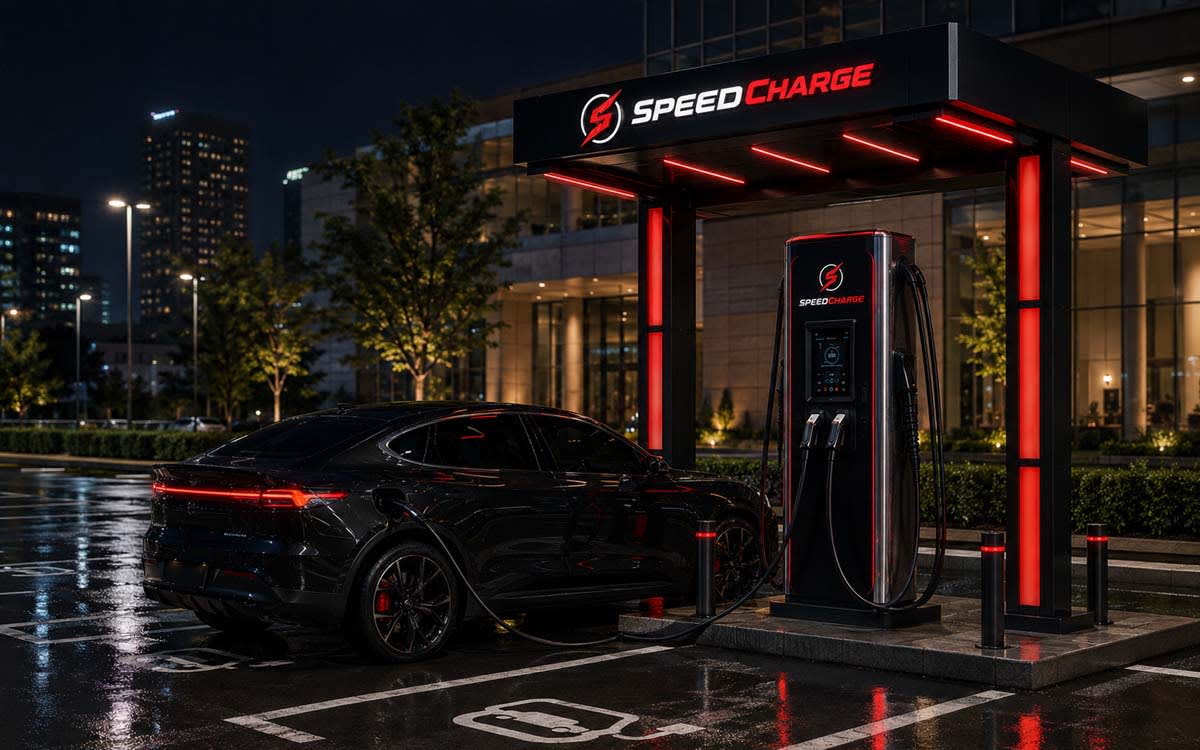
Installing a charger where your vehicle already remains parked for several hours can make EV ownership substantially more convenient. Instead of depending on a public charging stop for normal daily energy, the vehicle can recover the energy used during commuting while it is at home, at work or parked at another long-dwell property.
A reliable EV charger installation in parking is not simply a charger fixed to a wall. It is a small electrical-infrastructure project involving vehicle compatibility, available electricity capacity, parking rights, cable routing, metering, protection, environmental conditions and future expansion.
For an independent house, many of these decisions remain within the property. In an apartment, office or shared commercial building, the cable may cross common infrastructure and multiple users may eventually require charging, making planning and documentation more important.
Planning EV Charger Installation in Parking
The first decision should not be charger brand or maximum kW. Start by identifying how the parking space is actually used.
Ask:
Who will charge here?
Which vehicles need charging?
How long are they normally parked?
How much energy needs to be replaced?
Is the bay private or shared?
Where is the electrical source?
Is the existing sanctioned load sufficient?
Will several chargers eventually share the same electrical infrastructure?
This approach prevents the common mistake of installing a technically impressive charger that does not fit the parking or electrical environment.
What Is a Parking EV Charger?
A parking EV charger is EV Supply Equipment installed at or near a vehicle parking space so that charging can happen while the vehicle remains parked.
For long-dwell residential, office and hotel use, AC charging is commonly appropriate because the vehicle has several hours available. The EV's onboard charging system determines how much AC power the vehicle can accept.
Commercial parking can have a wider mix. A property serving employees for eight hours has different needs from a public charging hub where customers arrive specifically to charge and leave quickly.
AC vs DC Charging for Parking Spaces
AC charging should usually be the first technology evaluated for long-dwell parking, but it is incorrect to state that every parking site must use AC or that DC never makes sense.
Parking Use Case | Likely Starting Point | Why |
|---|---|---|
Independent home | AC | Long overnight dwell |
Apartment resident bay | AC | Routine private charging |
Housing society shared bays | Managed AC | Multiple users and long parking periods |
Workplace employee parking | Managed AC | Vehicles remain for several hours |
Hotel guest parking | AC or mixed | Overnight guests plus possible transient traffic |
Mall / destination parking | AC or mixed | Customer dwell varies |
Fleet parking | AC, DC or mixed | Duty cycle determines requirement |
Public rapid-charging parking | DC-focused | Turnaround and throughput matter |
DC can make sense when the parking facility is effectively functioning as a rapid-charging location rather than passive long-dwell parking.
For a deeper technology comparison, refer users to relevant charger-technology guides through the SpeedCharge Blog.
Charger Power Should Follow Energy Requirement
Do not choose a charger using fixed statements such as:
“Under 80 km/day means 7.4 kW.”
or:
“Above 100 km/day means 11 kW.”
A better calculation starts with the energy that needs to be restored before the next trip.
Required average charging power ≈ Energy to replace ÷ Available charging hours
If a vehicle needs only a modest amount of energy each night and remains parked for eight or ten hours, relatively modest charging power may be sufficient.
If a commercial vehicle needs significant energy during a short parking window, higher charging power can become important.
The final selection must also respect the EV's own AC or DC charging capability.
A Higher-Rated Charger Does Not Force the Vehicle to Charge Faster
A charger provides available power; the vehicle determines how much it accepts within its supported limits.
If an EV accepts a lower maximum AC power than the wallbox can supply, buying a larger wallbox does not force the battery to charge at the wallbox's full rating.
The same principle applies to DC charging. Charger nameplate power and actual battery charging power are not the same thing.
This is why equipment should be selected around the target vehicles instead of marketing numbers alone.
Electricity Capacity Comes Before Charger Procurement
For EV charger installation in parking, electricity feasibility should be checked before hardware is ordered.
Review sanctioned or connected load, existing building demand, spare capacity, supply configuration, distribution-board capacity, cable route and expected future EV demand.
A charger is another significant electrical load. In a single home, the question may be whether the charger can operate alongside air conditioners and other appliances. In a housing society, the question becomes how dozens of future chargers will interact with common infrastructure.
Use Smart EV Charging & Load Management when several chargers may eventually operate at the same property.
Do You Need a Load Enhancement?
Not automatically.
Whether additional sanctioned load is necessary depends on:
Existing approved load
Other simultaneous loads
Charger configuration
Charging schedule
Number of chargers
Site electrical architecture
Some properties can accommodate appropriate charging within existing capacity. Others will require enhancement.
Smart charging can control aggregate EV demand and potentially defer an upgrade, but it cannot create unlimited electrical capacity.
Existing Electricity Connection vs Separate EV Connection
India's Electricity (Rights of Consumers) framework allows consumers to seek separate electricity connections for EV charging. This should be described as an available option, not a mandatory requirement for every installation.
Using an existing connection can be practical where capacity and cable routing are suitable. A separate EV connection can provide cleaner metering or fit a specific DISCOM's tariff structure.
Electricity / Metering Option | Main Advantage | Main Consideration |
|---|---|---|
Existing resident connection | Direct household billing | Sufficient capacity and cable route required |
Separate EV connection | Clear dedicated metering | Additional DISCOM process and infrastructure |
Common supply + approved sub-metering | Useful where private cable route is difficult | Billing mechanism must be clearly defined |
Managed society charging | User-level charging records | Requires central platform/infrastructure |
Commercial/fleet connection | Suitable for business use | Tariff and capacity depend on applicable arrangement |
Do not assume that a dedicated EV tariff is automatically cheaper than domestic electricity in every state.
Check the current DISCOM tariff and connection rules for the property.
DISCOM Timelines Are Not Complete Installation Timelines
The Electricity (Rights of Consumers) amendments reduced connection timelines to 3 days in metropolitan areas, 7 days in other municipal areas, 15 days in rural areas and 30 days in rural hilly terrain.
These are electricity-connection timelines under the relevant framework.
They should not be presented as:
RWA NOC deadlines
Complete charger-installation timelines
Guaranteed project go-live timelines
Site surveys, property approval, load enhancement, equipment supply, civil work and commissioning can follow separate schedules.
Apartment Parking Requires More Coordination
Apartment owners can install residential charging infrastructure subject to the applicable electrical, property and local framework, but avoid the overstatement that every RWA must approve every proposed charger design without review.
The national policy direction supports expansion of residential EV charging. At the same time, apartment installations can affect:
Common cable routes
Electrical rooms
Parking rights
Shared panels
Fire access
Building services
Common property
These are legitimate areas for technical review.
Apartment owners should read EV Chargers for Apartments and RWA Government Guidelines for EV Charging Installation before purchasing hardware.
What to Give the RWA or Property Manager
A strong proposal reduces unnecessary back-and-forth.
Item | What It Clarifies |
|---|---|
Parking details | Exact charging location |
Charger make/model | Equipment being proposed |
Rated electrical input | Added electrical demand |
Vehicle compatibility | Intended use |
Electricity source | Existing/separate/shared connection |
Cable-route plan | Impact on common areas |
Load assessment | Electrical feasibility |
Installation contractor | Responsibility for work |
Property restoration plan | Treatment of drilling/cable work |
Maintenance contact | Responsibility after commissioning |
Avoid starting civil work before the common-area route has been agreed.
A written record protects both the resident and the housing society.
Is RWA Permission Always Required?
The practical answer depends on the property.
If the charger and wiring remain entirely within private electrical and parking infrastructure, the approval situation can differ from an apartment installation where cables cross common property.
In most multi-storey residential situations, some part of the electrical or physical route can involve common infrastructure, so coordinating with the society or building manager early is sensible.
Do not turn this practical recommendation into one universal legal rule for every residential property in India.
Model Building Bye-Laws: Use Them Correctly
MoHUA amended the Model Building Bye-Laws and related planning guidelines in 2019 to facilitate EV charging infrastructure in residential and commercial development. Importantly, these model provisions act as a framework for adoption through states, UTs and local planning systems rather than automatically becoming identical local rules everywhere.
Therefore, avoid copying a national model parking percentage into a property article and claiming that it automatically applies to every existing apartment or office building.
Check the applicable local building/development regulation.
Cable Routing Can Become the Largest Installation Challenge
The charger may be only a few metres from the vehicle, while the electrical source may be tens of metres away.
A parking installation can require routing through:
Meter rooms
Electrical shafts
Basement ceilings
Cable trays
Fire-rated walls
Parking levels
Outdoor sections
Shared common areas
This is why a quotation provided without inspecting the proposed cable path is inherently incomplete.
For broader installation planning, refer to the EV Charger Installation Guide.
Do Not Publish One Universal Cable Size
The source article repeatedly prescribed fixed conductor sizes for specific charger ratings. That is not safe as evergreen engineering advice.
The required conductor depends on:
Charging current
Cable length
Installation method
Conductor material
Ambient environment
Bundling
Voltage-drop criteria
Protection design
Charger instructions
Applicable electrical standards
A longer cable run does not simply mean “use X mm² cable.” The final circuit must be designed for the actual installation.
Protective Devices Should Also Be Site-Specific
Similarly, avoid one-size-fits-all statements about breaker or residual-current-device ratings.
A charging circuit requires an appropriate protection strategy, but the exact devices depend on the EVSE and electrical design. Some functions can be integrated into the charging equipment while others are external.
The installer should verify the charger's documentation and applicable electrical requirements rather than blindly repeating another site's component list.
Current Electrical Safety Framework
The Central Electricity Authority currently lists the CEA (Measures relating to Safety and Electric Supply) Regulations, 2023 together with the 2026 Amendment Regulations on its safety-regulation archive.
A parking charger should therefore be treated as an electrical installation requiring competent design, installation and commissioning—not as a large household appliance that can simply be connected wherever a socket is available.
The correct technical requirements depend on the specific installation and equipment.
Earthing: Avoid Generic “Dedicated Earth Is Mandatory” Claims
Earthing is a critical safety consideration, but saying every EV charger must have a completely separate independent earth electrode is too broad.
The earthing arrangement depends on the electrical system, applicable standards, EVSE design and the property.
The important requirement is that the charging circuit has an appropriate and verified protective-earthing arrangement.
Ask the electrical professional to document the relevant test results rather than relying on visual inspection.
Basement Parking
Basement EV charging should not be described as universally prohibited or universally approved across India.
The design should account for:
Electrical safety
Cable routing
Fire compartments
Ventilation systems
Escape paths
Firefighting access
Water ingress
Vehicle movement
Physical charger protection
A professionally engineered installation inside a basement is fundamentally different from an extension lead crossing a common parking aisle.
Outdoor and Open Parking
Outdoor charging equipment must be suitable for the actual environmental conditions.
Important considerations include:
Rain exposure
Dust
Heat
Drainage
Direct sunlight
Cable management
Vehicle impact
Equipment mounting
Do not use marketing language such as “weatherproof” as a substitute for the product's documented environmental rating and installation requirements.
For extreme-temperature considerations, refer users to Is EV Charging Safe in Summer?.
Stack and Mechanical Parking
Mechanical, puzzle and stack parking need additional analysis because the parking platform itself moves.
A fixed cable cannot be positioned where moving machinery can crush, stretch or entangle it.
Where individual charging is impractical, options may include an engineered solution approved by the parking-system provider or dedicated shared charging bays outside the moving structure.
Do not improvise mounting on mechanical parking equipment without technical review.
Step-by-Step Parking Charger Installation Process
The correct process is feasibility-first rather than hardware-first.
Stage | Main Action | Output |
|---|---|---|
1. Parking assessment | Confirm private/shared bay and vehicle access | Feasible charger location |
2. Vehicle assessment | Confirm charging interface and AC capability | Appropriate charger range |
3. Electrical survey | Check load, panel and supply | Power feasibility |
4. Cable-route survey | Inspect complete path | Installation design |
5. Property approval | Complete RWA/building process where relevant | Approved route |
6. DISCOM process | Connection/load change if required | Adequate electricity supply |
7. Charger selection | Match hardware to site | Final equipment |
8. Installation | Electrical/civil work | Installed EVSE |
9. Commissioning | Test charger and vehicle | Operational charging |
10. Documentation | Retain records/warranty | Maintenance file |
This sequence avoids buying equipment before learning that the site cannot support the proposed configuration.
Site Survey: What Should Be Checked?
The installer or electrical professional should inspect:
Electricity source
Sanctioned load
Distribution panel
Cable route
Parking layout
Mounting location
Earthing arrangement
Environmental exposure
Mobile/network connectivity if required
Future expansion potential
For apartments, the survey should clearly identify which sections of the proposed route cross common property.
How Long Does Installation Take?
There is no reliable national standard such as “every home charger takes four hours” or “every apartment installation takes two weeks.”
A straightforward installation can involve relatively little work. A project requiring society approval, load enhancement and long common-area cable routing can take considerably longer.
Project duration depends on:
approvals + power availability + equipment + civil work + cable routing + commissioning
Give customers a site-specific schedule only after feasibility has been completed.
EV Charger Installation Cost in Parking
The cost of EV charger installation in parking can vary significantly even for the same charger model.
The major reason is that the wallbox is only one component of the project.
Cost Component | What Changes the Cost |
|---|---|
EVSE / charger | Power, connectivity and features |
Cabling | Distance and electrical design |
Cable trays / conduit | Route and property construction |
Electrical panel work | Existing capacity |
Protective equipment | Charger and circuit design |
Metering | Existing vs separate/shared arrangement |
Load enhancement | Site/DISCOM requirements |
Civil work | Drilling, foundations and restoration |
Mounting/protection | Wall/pedestal/bollard requirements |
Connectivity | Network architecture |
Commissioning | Scope and equipment |
Maintenance | Warranty and support structure |
For this reason, do not publish fixed national prices such as “₹28,000–₹65,000 all-inclusive” unless those figures represent a current verified quotation with a clearly defined scope.
Get an Itemised Quotation
The final quote should identify what is included and excluded.
At minimum, separate:
Charger hardware
Cable
Cable containment
Panel/protection work
Metering
Civil work
Mounting
Labour
Commissioning
Taxes
Warranty
Additional cable cost
Load-enhancement work
Restoration work
Two vendors quoting the same charger can otherwise appear similar while offering completely different installation scopes.
Society-Wide EV Charging
Individual private chargers can work well while only a few residents own EVs. As adoption increases, however, repeated independent cable routes become difficult to manage.
A scalable EV charger installation in parking strategy for a large society may use:
Planned EV distribution panels
Common cable pathways
User-level metering
Smart load management
Defined charger specifications
Shared charging bays
Central software where useful
Housing societies should review EV Charging for Apartments & RWAs and How to Install EV Chargers in a Housing Society before EV demand becomes large.
Smart Load Management for Multiple EVs
Smart charging can prevent every charger from requesting its full available power simultaneously.
Suppose several residents plug in after returning home. The system can distribute a defined building-level EV load across active sessions instead of treating every connector independently.
This can improve use of existing infrastructure and potentially defer upgrades.
It cannot eliminate the need for additional electrical capacity forever if total energy demand continues growing.
Individual Metering Is Useful—but Not Universally Mandatory
User-level metering is particularly valuable where several people use shared electricity because it makes billing transparent.
But saying every charging point in every society legally requires a particular sub-meter configuration is too broad.
The correct billing architecture depends on:
Electricity connection
Society structure
DISCOM framework
Charging platform
Applicable local requirements
The important objective is transparent allocation of actual charging consumption.
Workplace and Office Parking
Workplace charging is another long-dwell use case.
Employees often park for several hours, making managed AC infrastructure efficient for many sites. Higher-power charging can still serve fleet or short-turnaround users.
The same installation principles apply:
demand → parking behaviour → electricity capacity → access model → equipment
Commercial-property owners considering managed charging can review Partner With SpeedCharge after completing demand and electrical feasibility.
Commercial Parking Facilities
Malls, hotels and public parking structures may need paid access, authentication and charging-session management.
Unlike a private charger, a commercial deployment can require:
User identification
Tariff management
Session records
Payment processing
Remote monitoring
Fault management
Revenue reporting
This makes the Charger Management System part of the infrastructure decision rather than an optional mobile-app feature.
OCPP and Software Portability
Open protocols can reduce software lock-in, but avoid stating that any OCPP charger will automatically work with any backend.
Compatibility can depend on:
OCPP version
Implemented features
Charger firmware
Certificates
CSMS configuration
Smart-charging profiles
Vendor implementation
If platform portability matters, test the exact charger/CSMS combination before deploying a large portfolio.
Public Charging in Commercial Parking
A property may decide to allow visitors or the general public to use parking chargers.
This changes the operating model from private/captive charging to customer-facing infrastructure.
India's current framework continues to support development of public and private charging infrastructure, and public EV charging stations remain an unlicensed activity subject to the applicable framework.
Public sites should also consider digital discovery, customer support and pricing transparency.
Drivers can use the SpeedCharge Station Finder when looking for SpeedCharge public locations.
Common Installation Mistakes
Mistake | Why It Causes Problems | Better Approach |
|---|---|---|
Buying charger before survey | Equipment may not fit site capability | Complete feasibility first |
Copying cable size from another home | Electrical conditions differ | Engineer actual circuit |
Starting work before RWA approval | Can create common-area dispute | Obtain written route approval |
Assuming separate EV meter is mandatory | Can add unnecessary complexity | Compare available connection options |
Ignoring future EV demand | Society repeatedly rebuilds infrastructure | Plan scalable pathways |
Treating smart charging as unlimited power | Energy capacity remains finite | Combine with long-term load planning |
Using fixed installation price online | Site scope varies | Issue itemised quotation |
Assuming all parking needs DC | Wastes capex at long-dwell sites | Match charger to dwell time |
Ignoring maintenance responsibility | Faults remain unresolved | Define post-install support |
Selecting hardware only on kW | User and site requirements are missed | Evaluate full charging system |
These corrections improve both technical accuracy and long-term SEO value because the article remains useful as vehicle and charger specifications change.
What to Verify After Installation
Before final handover, confirm that:
The charger is securely mounted.
The approved cable route has been followed.
Electrical testing has been completed.
Vehicle charging starts and stops correctly.
Network/app functions operate where included.
User authentication works where configured.
Session records are accurate where applicable.
Required labels and operating instructions are present.
Warranty/service contacts have been provided.
Installation documentation has been handed over.
Do not ask a consumer to interpret technical test values themselves. The electrical professional should record and certify the relevant results according to the applicable installation requirements.
Keep the Installation Records
Retain:
Charger invoice
Product documentation
Warranty
Electrical design/site-survey documents provided
DISCOM approval where applicable
RWA/property approval
Commissioning records
Service/AMC information
These records help if the charger is serviced, upgraded, replaced or moved later.
When Should You Upgrade the Charger?
A faster charger is not automatically an upgrade.
Upgrade when your current charging system no longer provides the energy required within the available parking window.
Possible triggers include:
Higher daily driving
Second EV
New vehicle with different capability
Commercial fleet use
Shorter parking time
Expansion to shared charging
If the existing charger already replenishes the required daily energy before departure, replacing it purely for a larger kW number can have little practical benefit.
Home Charging vs Public Charging
A private parking charger and a public fast charger serve different jobs.
Routine home charging can happen while the vehicle is already parked. Public charging becomes valuable during intercity travel, when private charging is unavailable, or when additional range is needed quickly.
Home EV owners can continue to How to Charge an EV at Home in India, while public charging requirements can be supported through the SpeedCharge Station Finder.
The best EV ownership experience can use both rather than treating them as competing alternatives.
How SpeedCharge Content Supports the Complete Installation Journey
Start with How to Charge an EV at Home in India to understand residential charging behaviour, then use the EV Charger Installation Guide for technical planning.
Apartment owners should continue to EV Chargers for Apartments and RWA Government Guidelines for EV Charging Installation.
Housing societies planning several chargers can use EV Charging for Apartments & RWAs, How to Install EV Chargers in a Housing Society and Smart EV Charging & Load Management.
Commercial landlords exploring managed infrastructure can use Partner With SpeedCharge, while drivers can use the SpeedCharge Station Finder for public charging away from their parking location.
Final Thoughts
A successful EV charger installation in parking starts with understanding the property and electrical system before selecting hardware.
For private residential use, long parking durations often make appropriately sized AC charging a strong solution. Apartments require additional coordination around common property, metering and future shared demand. Commercial parking may also need access control, billing and charging-management software.
Do not rely on fixed cable sizes, guaranteed installation timelines, universal RWA rules or generic cost ranges copied from another property.
Survey the parking location, confirm the electricity supply, document the cable route, complete required approvals and select equipment only after feasibility is established.
That process creates a charging installation that is safer, easier to expand and more useful over the full life of the vehicle.
Frequently Asked Questions
1. Can I install an EV charger in my parking space?
Yes, where the property, electricity supply and parking arrangement can support the installation. Apartment projects may also require coordination for common cable routes and shared infrastructure.
2. Which EV charger is best for home parking?
There is no single best power rating. Choose a charger according to your vehicle's charging capability, daily energy requirement, parking duration and available electrical capacity.
3. Do I need RWA permission for an apartment parking charger?
Where the installation affects common property, cable routes, shared electrical infrastructure or society-controlled parking, the building's approval process should be addressed before work begins.
4. Do I need a separate EV electricity meter?
No. A separate EV connection is an available option, not a universal requirement. Existing supply may be suitable where capacity and utility rules allow.
5. How much does parking charger installation cost?
There is no reliable nationwide fixed amount. Cost depends on charger hardware, cable distance, electrical work, civil work, metering, load enhancement and property layout.
6. Does every 7.4 kW charger use the same cable size?
No. Cable selection depends on current, length, installation method, environment, voltage-drop limits and other electrical-design factors.
7. Can I install an EV charger in basement parking?
Potentially, but the installation must be assessed against the building's electrical, fire, access, cable-routing and local requirements rather than relying on a universal yes/no rule.
8. Is AC or DC charging better for parking?
AC is often appropriate for long-dwell residential and workplace parking. DC becomes more useful when vehicles require faster turnaround. The site use case should decide.
9. What happens when many residents want EV chargers?
The society should consider coordinated electrical distribution, common cable routes, user-level metering and smart load management instead of indefinitely adding isolated installations.
10. What should I do before buying an EV charger?
Confirm the vehicle's charging capability, parking rights, electrical capacity, cable route, metering arrangement and any required building or DISCOM process before purchasing equipment.
