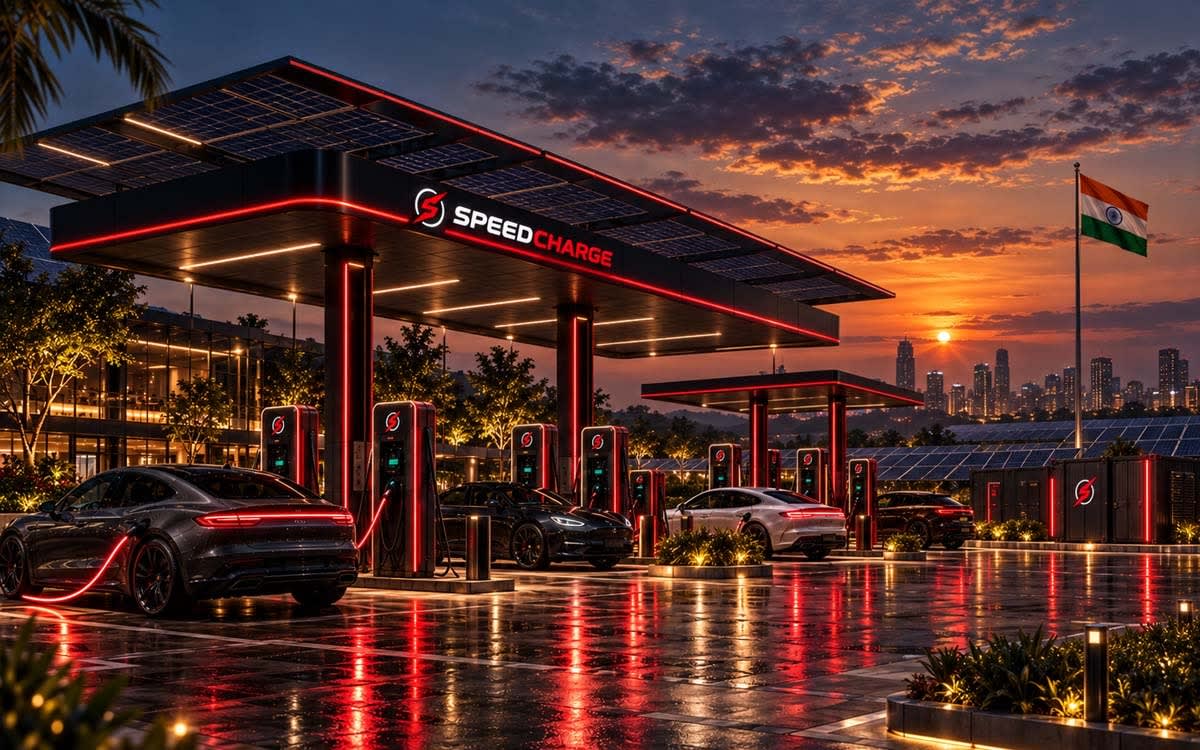
Electric vehicles already replace direct petrol or diesel use with electricity, but the environmental and economic outcome of charging depends partly on where that electricity comes from. Solar powered EV charging creates an opportunity to supply part of an EV’s energy from onsite renewable generation rather than purchasing every kilowatt-hour from the electricity grid.
India is particularly well positioned for solar integration. The Ministry of New and Renewable Energy states that most parts of the country receive roughly 4–7 kWh per square metre per day of solar radiation, making solar photovoltaic generation suitable for distributed applications.
But one misconception needs to be removed immediately:
A solar panel does not charge an EV battery directly simply because both operate with DC electricity.
A practical charging system still needs power electronics, an EVSE or charger, electrical protection, communication with the vehicle and—in most commercial installations—a connection to the grid.
For a dedicated explanation of solar array sizing, onsite generation, battery storage and charging economics, read SpeedCharge’s Solar EV Charging in India: Cost, Setup & Savings Guide 2026.
Quick Answer: How Does Solar Charging Affect an EV?
Solar powered EV charging mainly changes the source and timing of electricity used by the vehicle.
It can potentially:
Reduce grid electricity consumption
Lower charging-energy cost where onsite solar is economically favourable
Increase consumption of locally generated renewable energy
Reduce pressure on the grid during suitable periods
Allow daytime charging from rooftop or carport solar
Work with smart charging to match EV demand with solar generation
Support battery storage where charging happens after sunset
What it does not automatically do is:
Increase the EV’s maximum charging rate
Increase battery capacity
Extend vehicle range per kWh
Eliminate charging losses
Guarantee better battery health
Remove the need for a grid connection
Make a charging station profitable
Those outcomes depend on the vehicle, charger, battery, site and commercial model.
How a Solar EV Charging System Actually Works
A common grid-connected system looks like this:
Solar PV → Inverter / Electrical Bus → EV Charger → Vehicle Battery
with:
Electricity Grid ↔ Site Electrical System
During strong solar generation, part or all of the charging demand may be served by onsite PV.
When solar output is lower than charging demand, electricity can come from both sources:
Solar + Grid → EV Charger
When no solar generation is available:
Grid → EV Charger
A battery-storage system can add another path:
Solar → Stationary Battery → EV Charger
This architecture lets solar electricity generated earlier be used later, but storage increases cost, losses and system complexity.
Impact 1: Solar Can Reduce Dependence on Grid Electricity
The most obvious impact of Solar powered EV charging is a reduction in the amount of electricity that must be purchased from the grid when the EV charges during periods of onsite solar production.
Consider a workplace where:
Employees arrive around 9 AM
Vehicles remain parked until 6 PM
Rooftop solar generation is strongest around midday
That is a naturally compatible load profile.
The EV does not need all of its required energy immediately at 9 AM.
Charging can be distributed across the day so that more electricity is supplied during periods of stronger solar production.
This is where SpeedCharge’s Smart EV Charging in India: Grid & Load Management Guide 2026 becomes relevant. Smart charging can control charging power and schedules according to site demand, available capacity and renewable generation.
NITI Aayog also notes that smart charging can synchronise vehicle charging with periods of higher renewable generation and can control charging power to avoid exceeding a site’s sanctioned load.
Impact 2: Solar Does Not Automatically Make an EV Charge Faster
This is one of the biggest misconceptions.
Charging speed is determined primarily by:
Charger output
Vehicle AC or DC charging limit
Battery State of Charge
Battery temperature
Charging curve
Power available at the site
Suppose a home has a 7.2 kW wallbox.
Even if the rooftop solar plant is capable of generating more than 7.2 kW at that moment, a vehicle whose onboard AC charger accepts only 7.2 kW will not suddenly charge at 15 kW.
Similarly, connecting a solar array to a 120 kW public DC charger does not guarantee the EV will continuously receive 120 kW.
Solar determines where some of the energy comes from.
The vehicle and charging system determine how quickly the battery can accept it.
For everyday residential charging, SpeedCharge’s Home EV Charging in India: Installation, Cost & Apartment Guide 2026 explains AC charging limits, sanctioned load, wallbox sizing, metering and charging schedules.
Impact 3: Daytime Charging Can Improve Direct Solar Consumption
Direct consumption is usually the simplest way to use solar energy for EV charging.
Instead of:
Solar → Grid → later EV consumption
the system can use:
Solar → EV
during the same generation period.
This can be particularly attractive at:
Offices
Colleges
Hospitals
Fleet depots
Retail parking
Government campuses
Industrial facilities
Commercial properties
The more charging demand overlaps with solar generation, the less dependent the project may be on storage for renewable-energy shifting.
Impact 4: Solar Can Affect EV Charging Cost
Electricity is one component of total EV ownership cost.
A vehicle owner with an existing rooftop solar installation may be able to supply part of the EV’s energy through onsite generation.
But the calculation should compare the value of that solar electricity against its alternative use.
For example, solar energy could potentially be:
Consumed by the building
Used by an EV
Exported under an applicable arrangement
Stored for later use
Therefore, solar electricity should not automatically be treated as “free electricity.”
A proper calculation may consider:
Solar system cost + financing + maintenance + generation + electricity tariff + alternative value of generated energy
For broader EV running-cost calculations, SpeedCharge’s EV Charging Cost in India: Home, Public & Cost per Km Guide 2026 explains electricity tariffs, charging losses, home charging, public charging and cost-per-kilometre calculations. The charging-cost URL is present in the current sitemap.
The official e-AMRIT resource on electricity cost for charging also explains that EV tariffs differ between states and can include both energy and demand-charge components.
Impact 5: Solar Electricity Does Not Directly Improve Battery Chemistry
Another common claim is:
“Solar charging is healthier for an EV battery.”
That statement is too simplistic.
An EV battery does not normally know whether incoming electricity originated from:
Solar
Wind
Coal
Hydro
Nuclear
The general electricity grid
By the time energy reaches the traction battery, the charging system has converted and controlled it according to the vehicle’s charging architecture.
Battery stress is influenced more directly by factors such as:
Charge rate
Battery temperature
State of Charge
Battery chemistry
Depth of cycling
Time spent at high State of Charge
Thermal-management strategy
Manufacturer controls
Therefore, Solar powered EV charging can improve the energy source without inherently changing the electrochemical rules inside the traction battery.
For a deeper explanation of State of Health, heat, charging behaviour and ageing, see SpeedCharge’s EV Battery Health and Degradation in India. The URL is verified in the SpeedCharge sitemap.
Does Solar Charging Reduce EV Battery Degradation?
Not by itself.
Consider two identical cars.
Vehicle A
Charges at 7 kW AC using electricity generated partly by rooftop solar.
Vehicle B
Charges at 7 kW AC using grid electricity.
Assuming charging conditions, temperatures and battery State of Charge are otherwise the same, the battery does not automatically experience a fundamentally different charging process simply because one site has solar panels.
Where solar can indirectly help is through scheduling.
For example, smart charging may allow a vehicle to charge gradually during a long daytime parking window instead of depending on an urgent high-power session later.
But that is a result of the charging strategy, not a special battery-healing property of solar electricity.
What About DC Fast Charging From Solar?
A solar-integrated DC station can still be a DC fast charger.
If a compatible EV receives high DC power, the battery-management implications are determined by charging rate, State of Charge, temperature and vehicle design.
The solar source does not change those principles.
SpeedCharge’s Does Fast Charging Damage EV Battery? Battery Health Guide 2026 examines fast charging, heat, charging curves and battery-management systems separately. The page is part of the SpeedCharge sitemap.
Impact 6: Solar Can Reduce Grid Demand When Timing Is Right
EV charging adds a new electrical load.
That does not mean every EV creates the same grid impact.
A vehicle charging at:
2 PM during strong onsite solar production
can create a different net grid demand from the same vehicle charging at:
9 PM after solar production has ended.
This is why timing matters.
Solar-integrated charging can potentially reduce:
Daytime grid imports
Some local peak demand
Energy drawn through the distribution connection
Dependence on additional generation during favourable periods
However, the impact depends on the site.
If every EV arrives at 8 PM, rooftop solar alone does little to reduce the immediate charging peak unless:
Charging is shifted to another period
Energy was previously stored
Another renewable supply arrangement exists
Impact 7: Smart Charging Makes Solar More Useful
Solar powered EV charging becomes substantially more flexible when combined with energy-management software.
Consider 20 EVs connected at a workplace.
Without smart controls:
20 chargers → charge immediately
With managed charging:
EV demand + solar output + building demand + electrical limit → optimised charging schedule
The system can potentially:
Prioritise vehicles leaving soon
Reduce charger power when building load rises
Increase charging during stronger solar generation
Avoid exceeding sanctioned load
Distribute available power between vehicles
Reduce unnecessary demand spikes
Smart charging often delivers value before a project considers expensive stationary storage.
Impact 8: Solar Charging Can Reduce Operational Emissions
An EV does not produce tailpipe emissions while driving.
But electricity generation still has upstream environmental impacts.
Increasing the proportion of charging supplied from renewable electricity can improve the energy-side emissions profile of electric mobility.
The magnitude depends on:
Actual renewable generation
Direct consumption
Grid electricity displaced
Charging timing
Storage losses
Lifecycle impacts of equipment
It is therefore more accurate to say:
Solar can reduce the grid-energy and electricity-generation emissions associated with charging.
It is less accurate to say:
“Every kilometre becomes zero-emission because the charger has solar panels.”
Lifecycle analysis includes more than the charging session itself.
Impact 9: Solar Can Improve Energy Independence at Homes
Home charging and rooftop solar are a natural combination because both are distributed energy technologies.
A household may have:
Rooftop PV
Normal household load
AC EV charger
Grid connection
Smart meter
Optional battery storage
The challenge is that residential solar production is generally strongest when many private cars are away from home.
Owners working from home, charging on weekends or parking during daylight can achieve greater direct solar consumption.
Others may rely more heavily on grid charging at night.
This is why household charging economics should be based on the actual parking schedule rather than assuming every solar-equipped house can charge the EV directly from sunlight every day.
Impact 10: Battery Storage Can Shift Solar Energy Into the Evening
Stationary battery storage can solve part of the timing mismatch.
The energy path can become:
Daytime: Solar → Stationary Battery
followed by:
Evening: Stationary Battery → EV Charger → EV
This can potentially:
Increase onsite solar utilisation
Shift renewable electricity to later charging
Support peak shaving
Provide limited resilience
Reduce some grid imports
But storage also introduces:
Additional CAPEX
Conversion losses
Battery degradation
Cooling requirements
Battery Management System
Fire-safety design
Maintenance
Replacement cost
A battery should therefore solve a measurable technical or commercial problem.
It should not be added automatically to every solar charging project.
Impact 11: Solar Panels Do Not Eliminate Charging Losses
No practical EV charging system is 100% efficient.
Energy losses can occur through:
Solar inverter
Stationary storage
Electrical cables
Charger electronics
Vehicle onboard charger
Battery thermal management
Auxiliary systems
If solar electricity passes through:
PV → inverter → battery storage → charger → EV
there are more conversion stages than direct:
PV → charger → EV
This is one reason direct daytime charging can be technically attractive.
Impact 12: Solar Charging Does Not Change Vehicle Range Efficiency
Solar charging can change the source and cost of electricity.
It does not make the vehicle consume fewer watt-hours per kilometre once it is driving.
Driving efficiency still depends on:
Vehicle design
Speed
Traffic
Elevation
Temperature
HVAC use
Tyre pressure
Vehicle weight
Driving behaviour
If a car normally consumes 150 Wh/km, charging it from solar does not automatically reduce that figure.
The benefit occurs before the journey—in how the electricity used to charge the battery was generated.
Solar Generation and EV Charging Must Be Sized Separately
A major design mistake is matching solar-system kW directly to charger kW.
Suppose a property has:
100 kW solar array
120 kW DC charger
That does not mean solar continuously provides 100 kW while the charger simply draws another 20 kW from the grid.
Solar output varies throughout the day.
The real calculation requires:
Hourly PV generation
Existing property demand
Number of charging sessions
Vehicle arrival times
Energy required per session
Charger output
Simultaneous charging
Seasonal conditions
The Ministry of New and Renewable Energy notes India’s substantial distributed solar potential, but solar resource availability still varies by location and operating conditions.
Public Solar Charging Needs a Strong Site First
Installing solar cannot rescue a charging station with poor EV demand.
Before building a commercial project, evaluate:
Vehicle traffic
Local EV population
Fleet activity
Parking duration
Site visibility
Road access
Electricity capacity
Competition
Amenities
Expansion space
Solar roof or canopy area
SpeedCharge’s EV Charging Station Location: Complete Site Selection Guide India 2026 explains why traffic, dwell time, electricity feasibility, competition and anchor demand must be evaluated before infrastructure is installed. The URL is in the SpeedCharge sitemap.
Solar Carports Can Combine Energy and Parking Infrastructure
Solar carports can be attractive because one structure performs two functions:
Parking shade + electricity generation
Potential locations include:
Offices
Retail centres
Hospitals
Universities
Fleet yards
Hotels
Public parking
The EV charger itself still requires correct electrical design and applicable equipment standards.
BIS maintains an official overview of EV charging infrastructure and standards for India.
Solar Does Not Remove EV Charger Installation Requirements
A solar-integrated charging project still requires professional charger installation.
Depending on the site, that can include:
Load assessment
Distribution panels
Dedicated circuits
Protection devices
Cable sizing
Earthing
Metering
Charger mounting
Communication
Testing
Commissioning
The official e-AMRIT page on EV charging station installation identifies equipment, installation, electricity infrastructure, land, manpower and maintenance among relevant project-cost categories.
For the complete project sequence, SpeedCharge’s How to Set Up an EV Charging Station in India: Complete 2026 Guide covers electricity feasibility, charger selection, installation, software, commissioning and operating requirements. The current live page was also verified.
Can Solar Make a Public Charging Station More Profitable?
Potentially, but Solar powered EV charging should not be presented as guaranteeing profit.
Solar can potentially reduce the amount of electricity bought from the grid when:
Generation occurs at the right time
Chargers are actually being used
Solar electricity is economically valuable onsite
The system is correctly sized
But charging-station economics also depend on:
Number of charging sessions
Energy sold
Customer tariff
Charger utilisation
Site rent
Electricity tariff
Demand charges
Maintenance
Software
Payment fees
Financing
Downtime
Solar CAPEX
Battery-storage CAPEX
A station with low utilisation will not automatically become profitable because its electricity source includes solar.
SpeedCharge’s EV Charging Station Cost and Profit in India: CaaS Economics explains why full commissioned CAPEX, energy throughput, electricity cost, demand charges, maintenance and utilisation should be modelled together. The sitemap confirms this URL, and the live article is currently available.
Home Solar vs Commercial Solar Charging
Factor | Home Solar Charging | Commercial Solar Charging |
|---|---|---|
Main objective | Lower household charging/grid use | Serve multiple EV users |
Charging pattern | Usually predictable | More variable |
Charger type | Mainly AC | AC and/or DC |
Solar space | Residential roof | Roof/carport/land |
Storage | Optional | Site-specific |
Grid connection | Usually essential | Essential for most public sites |
Smart charging value | High | Very high |
Revenue requirement | Usually none | Critical |
Maintenance complexity | Lower | Higher |
When Solar Charging Works Particularly Well
Solar integration can be strongest where vehicles naturally remain parked during the day.
Examples include:
Offices
Employees remain parked through solar-generation hours.
Colleges and Universities
Campuses often combine rooftops, parking and long daytime dwell.
Fleet Depots
Charging schedules can potentially be coordinated around route requirements and solar availability.
Hospitals
Large parking facilities can provide prolonged vehicle dwell.
Commercial Buildings
Solar generation may serve both building and charging loads.
Hotels and Resorts
Solar can serve broader property demand even when many guest EVs charge later.
Public Parking
Solar canopies can produce energy while improving parking comfort.
When Solar Charging Is More Difficult
The model becomes harder when:
Vehicles mainly charge at night
Rooftop space is limited
Site shading is severe
DC demand is very high
Charging demand is unpredictable
The property already consumes all available solar generation
Grid-export economics are unfavourable
Storage cost is too high
Local charging utilisation is weak
The correct solution may still include solar—but solar contribution could be smaller than initially expected.
Common Solar EV Charging Myths
Myth 1: Solar Panels Directly Charge the EV Battery
Not normally. Power conversion, EVSE and vehicle-control systems remain between the generation source and the traction battery.
Myth 2: Solar Charging Is Automatically Slower
False.
Charging speed depends primarily on the available charger power and vehicle limit. Solar contribution only affects the energy source unless power availability is deliberately constrained.
Myth 3: Solar Charging Automatically Extends Battery Life
False.
Battery ageing depends much more directly on chemistry, temperature, charging rate, State of Charge and battery-management strategy.
Myth 4: Solar Means No Electricity Bill
Not necessarily.
A site can still require substantial grid electricity, particularly at night or during high charging demand.
Myth 5: Solar Makes Every Charging Station Profitable
False.
Utilisation remains one of the most important determinants of charging-station economics.
Myth 6: Every Solar Charging Station Needs a Battery
False.
Direct daytime solar consumption can work without stationary storage when vehicle charging aligns with generation.
Practical Solar Charging Decision Checklist
For EV Owners
Check:
When the vehicle is normally parked
Existing rooftop solar generation
Vehicle AC charging limit
Home sanctioned load
Current electricity tariff
Charging energy required each day
Whether smart scheduling is available
For Businesses
Check:
Employee or customer EV demand
Rooftop/carport area
Daytime parking duration
Existing building demand
Electrical capacity
Number of chargers required
Energy monitoring
For Public Charging Operators
Check:
Measurable EV traffic
Charger utilisation
Grid connection
Solar-generation profile
Simultaneous charging demand
Smart load management
Storage economics
Electricity and demand tariffs
Maintenance responsibility
Businesses, fleets and commercial properties evaluating an integrated solar and charging project can Partner With SpeedCharge for site-specific charging infrastructure assessment. The partner URL is present in your sitemap and the current page is live.
Final Thoughts
Solar powered EV charging can make electric mobility less dependent on grid electricity and increase the use of distributed renewable generation, especially when EVs remain parked during periods of strong solar output.
Its biggest impact is on the energy system around the vehicle, not on the basic electrochemistry of the EV battery.
Solar can influence:
where the electricity comes from + when charging occurs + how much grid energy is purchased + charging economics + grid demand
It does not automatically change:
vehicle charging limit + battery capacity + driving efficiency + battery chemistry
The strongest approach is therefore:
measure EV energy demand → assess solar production → use direct solar consumption where possible → introduce smart charging → retain dependable grid supply → add storage only where its value is justified.
That creates a practical charging system instead of treating solar panels as a shortcut to faster charging, longer battery life or guaranteed savings.
Frequently Asked Questions
1. Can an electric vehicle be charged completely with solar power?
Yes, technically, if sufficient solar energy and suitable charging infrastructure are available. However, reliable all-solar operation may require storage when the vehicle charges outside solar-generation hours.
2. Does charging an EV with solar panels improve battery life?
Not automatically. Battery life is influenced more directly by temperature, charging power, State of Charge, battery chemistry and the vehicle’s battery-management strategy.
3. Is solar charging slower than grid charging?
Not inherently. Charging speed depends on the charger’s available output and the vehicle’s charging limit. It becomes slower only if available solar or site power is deliberately limiting charger output.
4. Can rooftop solar power a home EV charger?
Yes. A grid-connected rooftop solar installation can offset some or all of the electricity used for home charging when generation and charging demand align.
5. Can solar power a DC fast charger?
Solar can contribute electricity to a DC fast-charging station, but high-power chargers often require grid support because instantaneous charging demand can greatly exceed onsite solar output.
6. Does a solar charging station need battery storage?
Not always. Storage is useful when charging demand and solar production occur at different times, but direct daytime consumption may be simpler and less expensive.
7. Can solar reduce EV charging cost?
Potentially. The actual saving depends on solar-system cost, generation, charging timing, electricity tariff, financing and how that solar electricity would otherwise be used.
8. Does solar charging reduce EV range?
No. The source of charging electricity does not reduce the vehicle’s usable battery capacity or driving efficiency.
9. Is a solar charging station completely off-grid?
Not necessarily. Most commercial designs can remain grid-connected so charging continues when solar output is insufficient.
10. What is the best location for solar EV charging?
Sites with strong solar exposure, adequate electrical capacity and long daytime vehicle parking—such as offices, campuses, fleet depots and commercial properties—can be good candidates after site-specific feasibility analysis.