
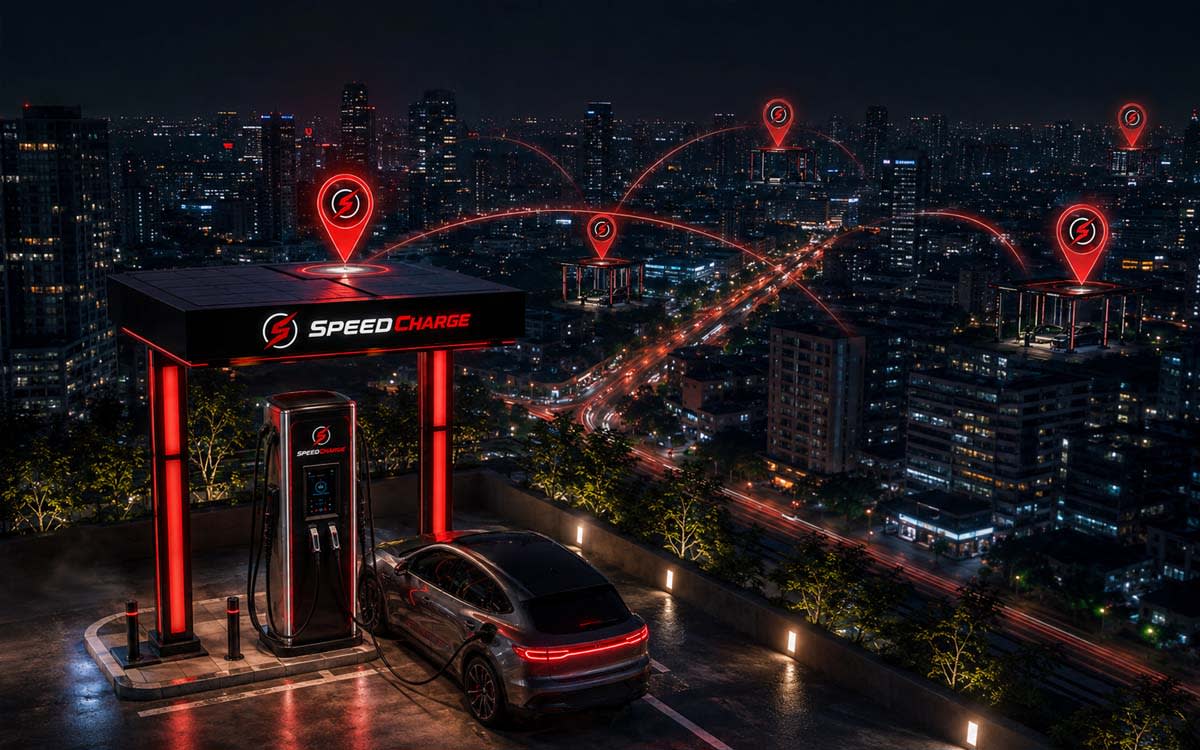
India's public EV charging network is much larger than it was only a few years ago. The Ministry of Heavy Industries reported 52,718 public charging stations as of July 21, 2026, including 16,561 public stations equipped with fast EV chargers for cars. That expansion makes charging easier, but a national station count does not tell you whether the particular connector you need is working, accessible or available when you arrive.
If you are trying to find EV charging stations near me, the most reliable approach is to combine a charging-network locator, an official or government-backed charging database where useful, and a general mapping platform such as Google Maps. Before driving to a station, verify connector compatibility, charging power, access conditions and—where supported—current availability.
The objective is not simply to find a charger pin on a map. It is to find a charger that suits your vehicle and your journey.
Why Finding a Charger Is Different From Finding a Working Charger
A map listing proves that a charging location has been indexed. It does not always prove that the exact connector you need is free and functioning at the moment you arrive.
Charging stations can be occupied, temporarily faulted, located behind restricted gates or listed with outdated access information. A driver's search process should therefore have two stages:
Discover the charging location → verify the station before travelling.
India's current charging framework is also moving toward a more connected and interoperable public network. The Ministry of Power's 2024 guidelines include provisions relating to charger-data mapping and public charging-network interoperability.
Best Ways to Find EV Charging Stations Near Me
No single discovery platform is perfect for every situation. Different tools solve different parts of the problem.
Search Method | Best Use | Useful Information | Main Limitation |
|---|---|---|---|
Charging-network locator/app | Daily use on a known network | Network stations, connectors and supported status data | Usually focused on one network |
SpeedCharge Station Finder | Finding SpeedCharge locations | SpeedCharge location discovery | Limited to SpeedCharge network information |
Google Maps | Broad discovery and navigation | Location, plugs, charging speed, reviews and some live availability | Live coverage varies by operator/location |
e-AMRIT locator | Government-backed discovery | Nearby listed public charging locations | Data coverage/freshness can vary |
Vehicle navigation | Route-integrated charging | Compatible charging stops on supported vehicles | Vehicle/software dependent |
EV owner communities | Recent practical context | Access issues, outages and local experiences | Community information is anecdotal |
A reliable EV owner should know at least two ways to locate charging before the battery becomes low.
Step 1 — Start With the SpeedCharge Station Finder or Your Charging Network
For SpeedCharge locations, start with the SpeedCharge Station Finder.
A network-specific locator is useful because it focuses on infrastructure belonging to that particular charging ecosystem. Depending on the platform, station information can include location, connector type, charging power, operating status, pricing or access details.
Do not automatically assume that every charging app provides:
Advance booking
Remote charging stop
Live connector status
Wallet payments
Route planning
Reservation guarantees
These features vary between operators and can change over time. Check what the platform currently provides rather than relying on an old article or screenshot.
Step 2 — Use Google Maps for Broad EV Charger Discovery
Older advice often says Google Maps can only tell you where a charger exists and cannot provide live charging information. That is no longer fully accurate.
Google has added EV-specific functionality including compatible-plug filtering, charging-speed information and real-time availability for supported stations and charging-network integrations. Google has also specifically added authoritative charging-station information from Indian charging providers. Coverage still depends on the station and network, so live information should not be assumed for every charger.
You can search for terms such as:
EV charging station near me
or:
EV charging stations
and then inspect the charging results.
Where supported, configure your EV or plug preferences so that Maps can prioritise compatible charging locations.
Step 3 — Use the Government-Backed e-AMRIT Charging Locator
NITI Aayog's e-AMRIT platform includes a charging-station locator that lets users search for nearby charging infrastructure using location information such as a pincode.
It provides an additional discovery source when you want to cross-check charging locations shown by commercial apps or mapping platforms.
Do not assume that one national database necessarily contains every active public charger. Charging networks expand, stations change status and different databases can update at different times.
Using more than one source gives you useful redundancy.
Step 4 — Check These Details Before You Start Driving
A station may be nearby and still be the wrong charging stop.
Check | Why It Matters | What to Confirm |
|---|---|---|
Connector | Charger may not fit your EV | Compatible plug/interface |
Charging power | Determines whether stop fits your available time | Charger power + vehicle capability |
Current status | Helps avoid unnecessary detours | Available/in use/faulted where supported |
Access hours | Chargers may sit inside private properties | Opening and closing times |
Parking access | Location may be inside a basement or paid parking | Entry gate, level and charges |
Tariff | Charging rates can differ | Current operator pricing |
Connector count | More compatible ports provide redundancy | Number of usable connectors |
Recent information | Old data may no longer be correct | Recent operator status/reviews |
This short check is more useful than automatically choosing the closest map pin.
Connector Compatibility: Check Your Exact EV
India's EV market includes passenger cars, two-wheelers, three-wheelers and commercial EVs. Their charging interfaces are not universally identical.
CCS2 is important in India's passenger-car DC fast-charging ecosystem and Type 2 is widely used for passenger-car AC charging, but these should not be presented as universal standards for every vehicle currently operating in India.
Older vehicles and other EV segments may use different interfaces.
Vehicle / Use Case | Check Before Searching | Why |
|---|---|---|
Passenger EV using DC | DC connector + vehicle DC capability | Avoid incompatible charging stop |
Passenger EV using AC | AC connector + onboard charger limit | Higher EVSE power may not increase car speed |
Electric scooter | OEM-supported charging method | Interfaces vary widely |
Electric three-wheeler | Manufacturer/fleet specification | Charging architecture varies |
Fleet EV | Connector + power + operating window | Turnaround can be commercially important |
Save your vehicle's charging-interface information somewhere easy to access.
Charger kW Does Not Equal Your Car's Charging Speed
A 120 kW charger does not guarantee that your vehicle will charge at 120 kW.
The EV determines how much power it can accept based on factors including:
Vehicle DC or AC charging capability
Battery State of Charge
Battery temperature
Charging curve
Battery-management strategy
Shared charger output
The practical question is therefore not:
“Which nearby charger has the largest number?”
It is:
“Which compatible charger can add the energy I need in the time available?”
For deeper technical charging guidance, use the SpeedCharge EV Charging Blog and EV Charging Safety in Summer.
What Does “Live Availability” Actually Mean?
Live availability is highly useful, but it should not be treated as a reservation guarantee.
Where supported, a charging platform can indicate whether a connector is:
Available
Occupied
Offline
Faulted
The information can change between the moment you check and the moment you arrive.
Google Maps now supports real-time charging availability from supported networks and charging locations, including data integrations in India. First-party network systems can also receive live data from their own infrastructure.
The accurate rule is:
Check live data where it exists, but maintain a backup for important journeys.
How to Find EV Charging Stations Near Me on a Highway Trip
Highway charging deserves more planning because alternative stations can be much farther apart than they are in cities.
Before leaving, identify your likely charging stop based on:
Realistic vehicle range
Compatible connector
Charging power
Route location
Access hours
Available backup
Do not wait until the dashboard shows very low remaining range before starting your charger search.
Road-Trip Stage | What to Do | Why |
|---|---|---|
Before departure | Review route and realistic range | Establish charging requirement |
Primary stop | Choose compatible suitable-power charger | Main energy stop |
Backup | Identify another usable station | Covers faults/queues/access problems |
Before arrival | Recheck status where available | Reduces surprise |
During charging | Take enough energy for next leg + reserve | Avoid unnecessary waiting |
Before departure | Confirm next charging option | Maintains route resilience |
For longer Indian journeys, combine the SpeedCharge Station Finder with the EV Road Trip & Monsoon Guide.
Do Not Plan From Advertised Vehicle Range Alone
A vehicle's certified or advertised range is not the exact distance it will achieve on every journey.
Actual energy use can change with:
Highway speed
Elevation
Air conditioning
Temperature
Rain
Traffic
Tyre pressure
Vehicle load
Build a practical reserve into your charging plan instead of trying to reach the next charger at effectively zero battery.
There is no need to publish one mandatory reserve percentage for every EV.
What if the Nearest Charger Is Occupied?
If all compatible connectors are occupied, first check whether the charging platform shows another nearby station or estimated availability.
Then compare:
Waiting at the current site
versus:
Driving to another charger
A station 3 km farther away may still be a worse option if it has slower charging, only one connector or difficult parking access.
At busy sites, number of working compatible connectors can matter almost as much as charger power.
What if the EV Charger Is Not Working?
Have a simple fallback routine rather than trying random fixes.
Problem | First Action | Backup Action |
|---|---|---|
Connector shows fault | Do not depend on it | Try another compatible connector/station |
Session will not start | Recheck instructions/authentication | Contact operator support |
Station is offline | Check operator information | Navigate to backup |
Payment fails | Use another officially supported method | Contact support/change station |
Bay is blocked | Follow site/operator process | Choose another station |
Charging is slower than expected | Check SOC, vehicle limits and shared power | Decide whether another stop saves time |
Property is inaccessible | Verify entry hours/instructions | Use backup location |
Report genuine station faults through the operator's official support route so that the issue can be investigated.
Should You Trust Google Reviews and EV Community Groups?
Yes—but for the right purpose.
Recent reviews can reveal things that charger telemetry may not explain, such as:
Charger hidden inside basement parking
Difficult property entrance
Parking charges
Broken signage
Poor lighting
Restricted access
EV communities can also provide recent experiences with a location.
But a community message from yesterday does not confirm that a connector is free today.
Use reviews for context and live operator data for current status, where available.
Finding Chargers at Malls, Hotels and Offices
A destination charger can be convenient because the vehicle charges while you shop, eat, work or stay overnight.
But public accessibility should never be assumed.
A charger located at a hotel may be guest-only. An office charger can require security access. A mall charger may sit inside paid parking and operate only during mall hours.
Always check:
Property access
Parking charges
Public-use restrictions
Opening hours
Commercial properties interested in adding charging can review Partner With SpeedCharge.
Finding Public Chargers if You Live in an Apartment
Drivers without private parking charging access often depend more heavily on public stations.
If that applies to you, identify reliable chargers near:
home + workplace + regular travel routes
rather than depending on only one station.
Also investigate whether home or society charging can eventually be installed. See EV Charging for Apartments & RWAs and How to Install an EV Charger in Your Parking.
When Home Charging Makes More Sense
For EV owners with fixed parking, routine charging can often happen while the vehicle is already parked overnight.
Public fast charging then becomes particularly useful for:
Highway travel
Unexpected extra driving
Journeys away from home
Drivers without residential charging
Urgent top-ups
This is usually more convenient than treating every weekday commute as a public charging problem.
For residential planning, use How to Charge an EV at Home in India and the EV Charger Installation Guide.
India's Public Charging Network in 2026
The July 2026 Government figure of 52,718 public charging stations demonstrates substantial national expansion, but the number that matters to one driver is how many usable stations exist on the routes they actually travel.
BEE remains the Central Nodal Agency for EV public charging infrastructure and works with State Nodal Agencies as part of India's charging-infrastructure ecosystem.
The Ministry of Power's 2024 framework also supports a connected and interoperable charging network and charger-data mapping.
These systems make charging discovery better, but station-level verification remains useful before a critical stop.
Build a Charging Search Routine Before You Need It
To find EV charging stations near me without turning every charging stop into a research exercise, create your routine while the battery is full.
Save:
Your regular charger near home
A second backup near home
A station near work
A reliable highway stop on frequent routes
Your vehicle's connector information
Bookmark the SpeedCharge Station Finder if you use SpeedCharge locations.
Regular public-charging users can also review ChargeClub for the current SpeedCharge membership offering.
Final Checklist Before Driving to a Charger
Before navigation starts, confirm:
The location still appears active.
The station is publicly accessible at your arrival time.
Your connector is supported.
The available charging power suits the stop.
Current availability is checked where supported.
You understand the current tariff.
Any required app/account/payment setup is ready.
You have a backup for a critical highway leg.
Your remaining battery can reach the station with reasonable reserve.
You know how to contact the operator if something fails.
Choosing the nearest charger is not always the same as choosing the best charger.
Final Thoughts
The easiest way to find EV charging stations near me is to combine broad discovery with quick station verification.
Use a charging-network locator for network-specific information, Google Maps for broad local discovery and navigation, and government-backed tools such as e-AMRIT as an additional reference. Google Maps can now provide plug, speed and some live availability information in India, but availability coverage should still be checked rather than assumed.
For SpeedCharge locations, start with the SpeedCharge Station Finder, save the charging locations you use regularly and identify backups before long journeys.
Frequently Asked Questions
1. How do I find EV charging stations near me in India?
Use a charging-network locator, Google Maps and government-backed tools such as e-AMRIT. Before travelling, check connector compatibility, charging power, accessibility and current station status where available.
2. Can Google Maps find EV charging stations in India?
Yes. Google Maps supports EV charging-station discovery in India and can display information including plug type, charging speed and live availability for supported networks and locations. Coverage varies.
3. How can I check if an EV charger is available right now?
Use a platform that receives current connector or station status from the operator. Availability information is not available for every charger on every platform.
4. How do I know which charger is compatible with my EV?
Check the connector types supported by your exact vehicle and filter charging results accordingly. Do not assume every Indian EV uses the same charging connector.
5. Is the nearest EV charger always the best option?
No. A slightly farther station may offer more compatible connectors, better access, higher useful charging power or stronger backup capacity.
6. How should I plan charging on an EV road trip?
Choose your primary charging stops before departure and identify a backup where practical. Recheck station information before arrival and plan using realistic range rather than only the vehicle's maximum advertised range.
7. What should I do if an EV charger is offline?
Check another compatible connector if available, contact the charging operator through its official support channel and use your backup station if the problem cannot be resolved.
8. Can I rely on EV charging station reviews?
Reviews are useful for access, parking and recent user experiences, but they should not replace current operational-status data where live information is available.
9. Are all public EV chargers available 24/7?
No. Chargers inside malls, hotels, workplaces or gated properties can have restricted access hours. Always check the property's access conditions.
10. Do I still need public charging if I have a home charger?
Yes, particularly for long-distance journeys and travel away from home. Home charging can handle much of normal daily use, while public charging provides travel and backup infrastructure.
