Electric mobility is no longer only a hardware story. A modern EV depends on software before, during and after a journey: the driver uses digital tools to locate charging, the vehicle manages energy and thermal limits, the charger communicates with back-end systems, the operator monitors faults and payments, and fleets or property managers rely on dashboards to control utilisation and cost.
The role of EV software in India is becoming more important as charging infrastructure expands. The Government reported 52,718 public charging stations as of July 21, 2026, including 16,561 public stations equipped with fast EV chargers for cars. A larger physical network creates more choice, but it also creates a greater need for accurate station data, interoperability, dependable payments and remote operations.
Software does not replace reliable chargers, sound electrical infrastructure or good vehicle engineering. It is the coordination layer that helps those systems work together and makes the charging experience easier to understand.
What Does EV Software Actually Include?
“EV software” is a broad term. It can refer to software inside the vehicle, software embedded in the charger, cloud platforms used by charging operators, mobile applications used by drivers, energy-management systems used by properties, or fleet platforms that coordinate vehicles and chargers.
Software Layer | Main Job | Typical User |
|---|---|---|
Driver charging app | Station discovery, account, session and payment experience | EV driver |
Charger firmware / edge software | Executes charger controls and communicates with vehicle/back end | Charger/operator |
CSMS / charge management system | Monitors and manages a charging network | CPO/operator |
Energy/load management | Controls site-level EV demand | RWA, office, fleet, site operator |
Fleet charging platform | Coordinates vehicles, chargers and schedules | Fleet manager |
Partner/business dashboard | Usage, settlement and station performance reporting | Property/franchise partner |
Data/security layer | Identity, permissions, logs and protection | Operator/technology team |
A good charging ecosystem therefore needs more than a polished mobile app. The front end can be excellent while the back end has poor station telemetry, slow fault detection or fragmented billing. The user experiences the combined result.
Why EV Software in India Matters for EV Owners
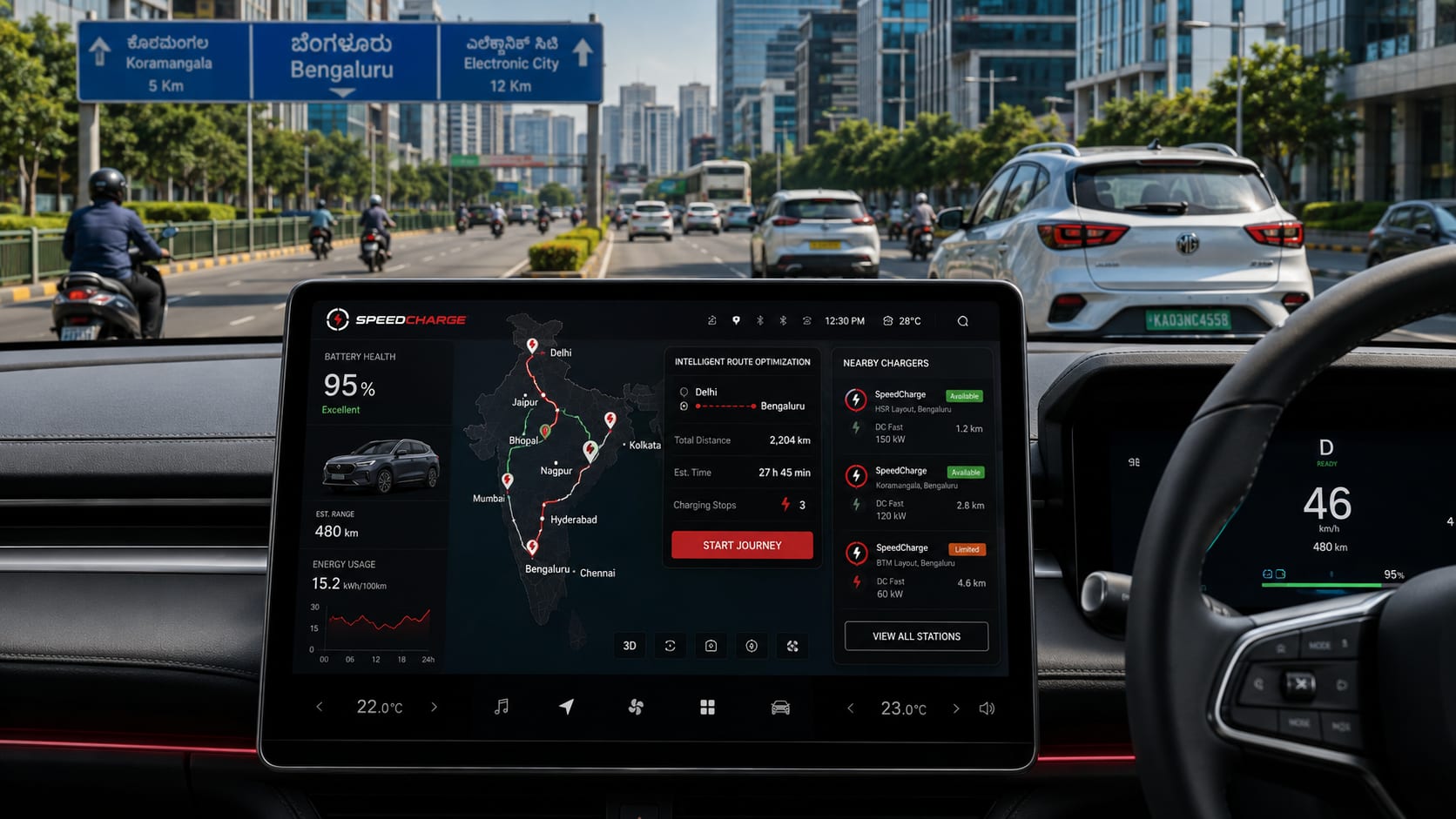
The most visible problem software solves is uncertainty. A driver needs to know where a charger is, whether it is compatible with the vehicle, whether the site can be accessed, what the charging power is, and—where the operator provides live data—whether a connector is available or faulted.
That information directly affects route planning and confidence. A charger pin on a map is useful, but it is more useful when the surrounding digital system provides current connector, access, pricing and session information.
India's Ministry of Power has explicitly framed its 2024 charging guidelines around a connected and interoperable EV charging network and the use of open communication protocols. This policy direction matters because a larger charging network becomes easier to use when chargers, back ends and public data systems can exchange information consistently.
Charging Apps: What Drivers Actually Need
A charging app should solve practical problems rather than add unnecessary steps. Not every operator offers every feature, so users should verify current functionality instead of assuming booking, roaming, wallet payments or live status are universally available.
App Feature | User Benefit | What to Verify |
|---|---|---|
Station discovery | Finds charging locations | Data freshness and access information |
Connector filtering | Avoids incompatible stations | Vehicle/connector metadata accuracy |
Live status | Reduces wasted trips | Whether data is truly real time |
Pricing display | Improves cost transparency | Current tariff and additional fees |
Session start/stop | Simplifies charging workflow | Authentication method |
Session monitoring | Shows energy/time/status | Update frequency and accuracy |
Payment/receipt | Creates clear transaction record | Supported payment methods |
Route planning | Helps long-distance journeys | Coverage and backup-stop logic |
History | Tracks previous sessions | Export/receipt availability |
For SpeedCharge locations, drivers can use the SpeedCharge Station Finder as the network-specific discovery layer. Regular users can separately review ChargeClub for the current membership proposition.
Live Availability Is Useful, but It Is Not a Guarantee
When a charging platform receives real-time data from the station, it can indicate whether a connector is available, occupied or faulted. That can significantly reduce wasted journeys.
However, live availability can change while the driver is travelling. A free connector may become occupied, a site can become inaccessible, or communication between the charger and back end can temporarily fail.
For important highway stops, software should support better planning—not encourage the driver to operate with no backup margin. The EV Road Trip & Monsoon Guide provides a separate route-planning framework for longer journeys.
What a Charge Management System Does Behind the App
The CSMS, sometimes called a CMS in commercial material, is the operational software behind a charging network. It communicates with charging equipment, records sessions, manages users or credentials, and provides the operator with a remote view of infrastructure.
CSMS Function | Operational Value | User Impact |
|---|---|---|
Charger status monitoring | Identifies online/offline/fault states | Better status visibility |
Session management | Records start, stop and energy data | More reliable history and billing |
Remote commands | Allows supported remote actions | Faster recovery in some situations |
Fault/event logs | Helps diagnose recurring problems | Potentially less downtime |
Tariff configuration | Applies approved pricing logic | Clearer billing |
User/access management | Controls authorised charging | Better access control |
Firmware/configuration support | Helps maintain deployed chargers | More consistent operation |
Reporting/analytics | Shows utilisation and failures | Better network planning |
Remote diagnostics can help resolve some software, communication or configuration problems without a site visit. It cannot repair a damaged cable, failed power module or physical connector remotely, so software-backed operations still need field service and spare-parts capability.
Interoperability: Why Open Protocols Matter
For EV software in India, interoperability is one of the most important long-term design goals. The Ministry of Power's 2024 charging framework specifically promotes connected and interoperable infrastructure and open communication protocols.
Open protocols can reduce vendor lock-in and allow chargers and back-end systems to exchange standardised messages. But “supports an open protocol” is not the same as “works perfectly with every charger and every platform.”
Real interoperability depends on the protocol version, which functions are implemented, charger firmware, certificates, smart-charging profiles, payment architecture and back-end configuration. Large deployments should test the exact charger–CSMS combination before rollout.
This matters to property owners too. A mall, office or charging operator should know whether changing the software provider later would require replacing chargers, reconfiguring them, or losing historical data.
Hardware Standards and Software Communication Work Together
Software cannot make non-compliant hardware safe. Charger design, vehicle communication and protective functions still depend on applicable technical standards.
BIS updated its EV charging standards in 2026. IS 17017 (Part 23):2026 covers DC EV supply equipment and includes requirements involving digital communication with the vehicle, protective functions, emergency conditions and other technical aspects of DC charging equipment.
For a buyer or charging operator, the useful lesson is to evaluate the complete system: hardware standard, charger firmware, back-end compatibility, electrical installation and operating software.
For site implementation, use the EV Charger Installation Guide rather than treating a software platform as a substitute for electrical engineering.
Smart Charging and Load Management
Charging software can also manage how much power a site allocates to EVs. This is increasingly relevant for apartments, workplaces, fleets and multi-charger hubs.
A load-management system can impose a site-level charging limit and distribute that capacity among active vehicles. Depending on the architecture, it may react to building demand, schedules, charger priority or fleet departure requirements.
This can reduce peak demand and improve the use of existing capacity, but it does not create unlimited electrical power. If the site's total EV energy requirement keeps increasing, electrical upgrades can still become necessary.
The detailed technical use case is covered in Smart EV Charging & Load Management.
How EV Software in India Supports Fleets, RWAs and Businesses
Different users need different software outcomes. A private driver cares about charger discovery and a successful session. A fleet manager cares about vehicle readiness. An RWA needs fair billing and load control. A property owner may care about usage, maintenance and customer experience.
User Type | Most Valuable Software Capability | Business/Operational Reason |
|---|---|---|
Private EV driver | Accurate discovery and session visibility | Reduces charging uncertainty |
Highway traveller | Route and backup-stop planning | Protects journey continuity |
Fleet operator | Scheduling, charger status and energy data | Improves vehicle readiness |
Housing society | User billing and load management | Reduces common-load disputes |
Workplace | Access control and reporting | Manages employee/tenant charging |
Commercial property | Usage and operational analytics | Measures amenity performance |
Charging operator | CSMS, fault management and reporting | Enables multi-site operations |
Franchise/asset partner | Transparent usage and settlement records | Supports commercial oversight |
Apartment charging is a good example. A society with multiple EV owners may need user-level session records and dynamic load allocation rather than a simple consumer wallbox. The broader infrastructure choices are covered in EV Charging in Apartments & RWAs.
Commercial sites considering managed charging can review Partner With SpeedCharge after completing demand and electrical feasibility.
Fleet Charging Software Is About Readiness, Not Just Reporting
A fleet can have enough chargers and still miss departure schedules if charging is poorly coordinated. Software can help decide which vehicle needs energy first, which charger is free, how much energy has already been delivered and whether a fault threatens the next shift.
Good fleet systems can also support energy-cost analysis and utilisation reporting. The exact capabilities depend on the platform and the vehicle/charger integrations available.
Avoid assuming that software can accurately predict every departure state without good input data. Fleet scheduling remains only as reliable as the telemetry, charger status and operational assumptions feeding the system.
Software Can Improve Charging-Site Planning
Charging operators accumulate data on energy throughput, sessions, time of use, charger utilisation and fault patterns. That information can improve expansion decisions.
For example, persistent queues can indicate capacity pressure, while low utilisation can indicate weak site demand, poor discovery, access restrictions or overspecified hardware.
Analytics should support site decisions rather than replace field research. Traffic, local EV mix, property access and electrical feasibility remain essential inputs.
Payments and Billing Need More Than a Checkout Screen
A reliable charging payment flow needs to connect authentication, tariff logic, session records, taxes where applicable, payment confirmation and receipts.
Failed or unclear payment experiences can create distrust even when the charging hardware works correctly. For fleets and business users, the challenge expands to account-level billing, cost centres, GST documentation or consolidated reporting depending on the use case.
Payment systems should also avoid storing more user data than necessary and should clearly define which entity handles the transaction and user information.
Cybersecurity and Personal Data Are Core EV Software Requirements
As EV software in India handles user accounts, charging history, location-related information, payments, access credentials and operational telemetry, privacy and cybersecurity are not optional product features.
India's Digital Personal Data Protection Rules, 2025 were notified by MeitY in November 2025 together with an enforcement timeline. Charging operators and software providers processing digital personal data should map their data flows, notices, consent or other lawful processing basis, retention practices, security safeguards and user-rights processes against the provisions applicable to them and their effective dates.
CERT-In also maintains directions under Section 70B of the Information Technology Act relating to information-security practices, prevention, response and reporting of cyber incidents. The exact obligations depend on the organisation and incident, but connected charging businesses should have a defined security and incident-response process rather than treating cybersecurity as only an app-development issue.
What a Secure Charging Platform Should Consider
Security / Data Area | Practical Question | Why It Matters |
|---|---|---|
Account security | How are users authenticated? | Reduces unauthorised access |
Role permissions | Can staff access only what they need? | Limits internal exposure |
Payment handling | Which regulated payment provider handles money/data? | Reduces payment risk |
Encryption | How is sensitive data protected in transit/storage? | Protects confidentiality |
Logs | Are important system actions recorded? | Supports investigation |
Charger credentials | How are charger/backend credentials managed? | Protects infrastructure access |
Updates | How are security patches and firmware updates handled? | Reduces known vulnerabilities |
Data retention | How long is user/session data kept? | Limits unnecessary storage |
Incident response | Who acts when a security event occurs? | Reduces response delay |
Vendor governance | What third parties process data? | Clarifies accountability |
Do not market a platform as “100% secure.” Security is an ongoing risk-management process, not a permanent product state.
EV Software and Battery Health: Keep the Claim Narrow
Vehicle battery-management software plays an important role in controlling charging limits, temperature responses and other battery protections. Charger-side software can communicate charging requests and follow supported protocols.
But a charging-network app should not claim that using its network automatically protects battery chemistry or guarantees longer battery life.
Battery ageing depends on vehicle design, cell chemistry, temperature, state of charge, charging power, usage and many other factors. Software is one control layer within that larger system.
For routine residential charging strategy, see How to Charge an EV at Home in India.
Route Planning Should Use Realistic, Not Perfect, Data
EV route planning can combine distance, estimated vehicle energy use and charging locations. More advanced systems may also consider elevation, weather, traffic or vehicle state where data is available.
However, a route planner should not be presented as a guarantee that the predicted battery percentage will exactly match arrival conditions.
Drivers should maintain a practical reserve and have a backup charging option on critical highway legs.
Software for Franchise and Charging-Asset Partners
Charging infrastructure investors need visibility into the asset, but dashboards should not be mistaken for guaranteed financial performance.
A useful partner dashboard can show energy throughput, session count, uptime or availability metrics, settlement records and site-level trends. The commercial agreement should define how those metrics relate to Revenue Share or payments.
SpeedCharge's franchise structure should be evaluated through the current SpeedCharge Franchise Program and its agreement rather than through old blog claims about fixed investment, ROI or network size.
Software improves transparency. It does not turn a weak charging location into a profitable one.
What to Check Before Choosing EV Charging Software
For an individual driver, the decision may be as simple as choosing a reliable charging network and app. For a fleet, RWA or CPO, software selection is a longer-term architecture decision.
Check:
Charger compatibility
Protocol/version support
Live status quality
User/access controls
Tariff configuration
Payment integrations
Session and billing records
Load-management capability
Fault and event logging
Remote operations
Reporting/export capability
API/integration support
Security architecture
Data ownership and portability
Service/support process
Exit and migration options
A polished interface is useful. Reliable operations and clean data are more important.
How SpeedCharge Fits Into a Software-Backed Charging Journey
Users can learn more about SpeedCharge and use the network-specific SpeedCharge Station Finder for charging-location discovery.
For regular charging, ChargeClub can be reviewed separately. Housing societies can use EV Charging in Apartments & RWAs and Smart EV Charging & Load Management for property-level planning.
Businesses and property owners can explore Partner With SpeedCharge, while investors should use the SpeedCharge Franchise Program for current commercial terms.
The important principle is to assess the software features that are actually live and contractually supported instead of relying on unverified network counts, uptime percentages or future feature claims.
Final Thoughts
The next phase of EV software in India will be less about adding more screens to an app and more about making the entire charging ecosystem dependable.
Drivers need accurate discovery, clear pricing and reliable session data. Operators need CSMS tools, fault visibility and maintainable integrations. Fleets need charging schedules and readiness. RWAs need load management and fair billing. Businesses need reporting and accountable operations.
India already has a rapidly expanding physical charging network. The software layer will determine how efficiently that infrastructure can be discovered, monitored, paid for, integrated and trusted.
Frequently Asked Questions
1. What is EV software?
EV software includes vehicle software, charging apps, charger firmware, charge management systems, load-management platforms, fleet software, billing systems and business dashboards that help vehicles and charging infrastructure operate digitally.
2. What does an EV charging app do?
Depending on the operator, an app can provide charger discovery, compatibility information, live station status, session controls, payments, receipts, route planning and charging history. Features vary by network.
3. Is live charger availability always accurate?
No. Live data is useful where supported, but connector status can change and communication can fail. Critical journeys should still include a backup charging option.
4. What is a CSMS in EV charging?
A Charging Station Management System is the back-end platform used to monitor and manage chargers, sessions, users, tariffs, events, remote commands and reporting.
5. Does OCPP guarantee that every charger works with every software platform?
No. Open-protocol support improves interoperability potential, but real compatibility depends on protocol version, implemented functions, firmware, certificates, configuration and the specific CSMS.
6. Can one EV charging app work across every charging network in India?
Not necessarily. Roaming and interoperability are improving, but access, payment and live data can still vary between operators and platforms.
7. Can charging software improve EV battery health?
Vehicle battery-management software can control important charging and thermal protections, but a charging-network app does not guarantee better battery health. Battery ageing depends on the vehicle, battery and usage conditions.
8. How does software help electric fleets?
Fleet software can coordinate charging schedules, vehicle readiness, charger availability, energy consumption and operational reporting, helping managers reduce charging bottlenecks.
9. Do EV charging apps need to follow India's data-protection rules?
Charging businesses processing digital personal data should assess their obligations under India's applicable data-protection framework, including the DPDP Act and notified Rules, based on the data and processing involved.
10. What should businesses check before selecting EV charging software?
Evaluate charger/protocol compatibility, uptime data quality, payments, billing, load management, security, APIs, reporting, data ownership, support, migration options and the exact features included in the contract.