
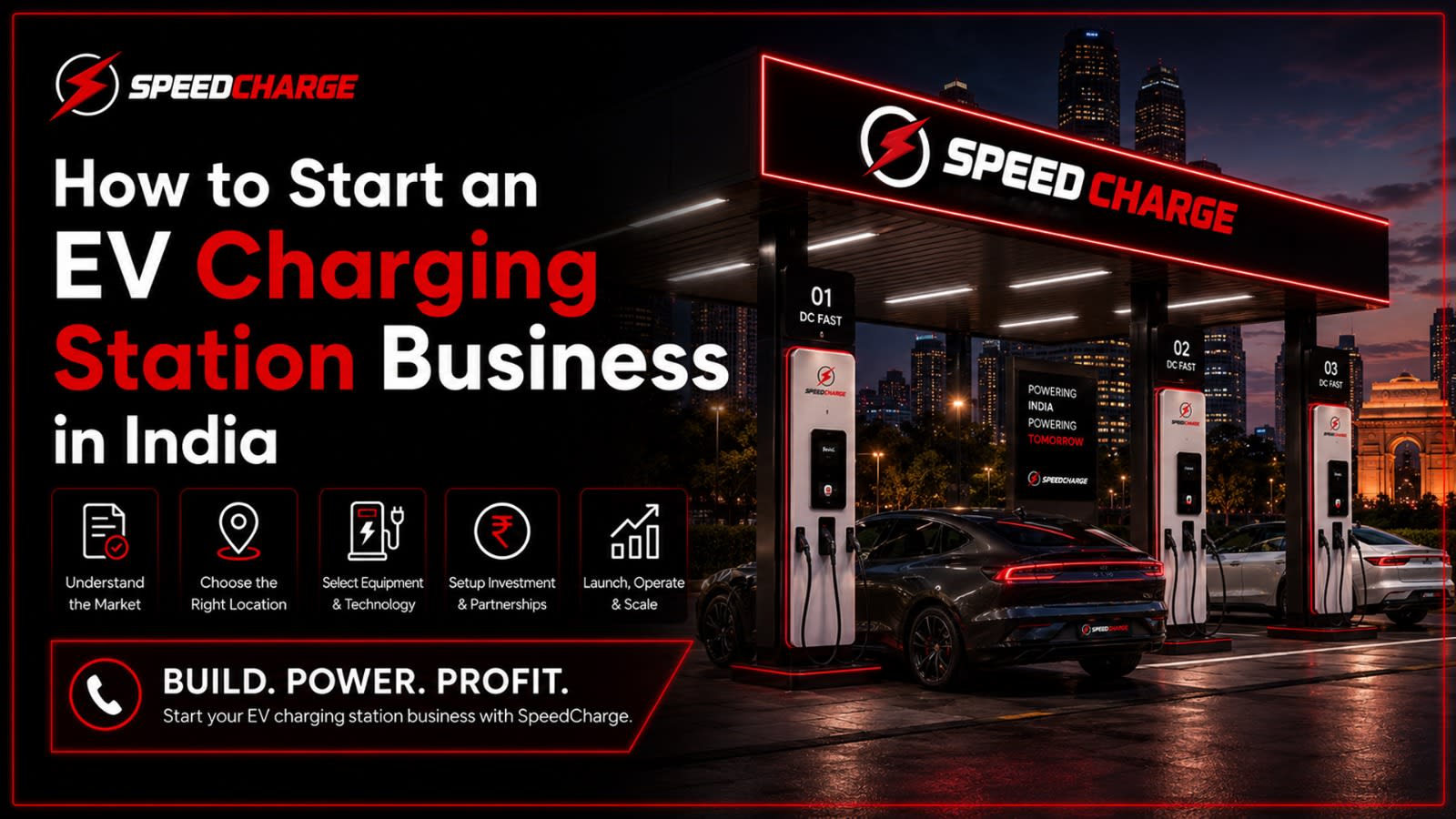
India's public charging infrastructure is expanding rapidly. The Government reported 52,718 public charging stations as of July 21, 2026, including 16,561 public stations equipped with fast EV chargers for cars. That growth creates a larger charging ecosystem, but it does not mean that every new charger automatically becomes a profitable business.
A successful EV charging station business in India depends primarily on local charging demand, electrical feasibility, site economics, charger utilisation and uptime. Hardware is important, but even an excellent fast charger can remain commercially weak when installed where drivers have little reason to stop.
Entrepreneurs should therefore start with demand and power availability rather than charger price or a promised ROI. The sequence should be customer demand → location → electricity feasibility → business model → financial model → charger selection → deployment.
What Does an EV Charging Station Business in India Actually Involve?
A public charging business is an infrastructure and service operation. The owner or operator creates charging capacity at a property, connects the installation to electricity, uses software to manage sessions and payments, and earns revenue or another commercial benefit from the charging activity.
India's current framework makes market entry comparatively accessible because setting up an EV charging station is an unlicensed activity, and private entities are permitted to establish, operate and maintain charging infrastructure subject to the applicable Ministry of Power guidelines and other requirements.
De-licensed does not mean regulation-free. Electricity connection, technical standards, electrical safety, property permissions, civil work, local approvals and applicable business/tax obligations still need to be addressed.
EV Charging Is Not the Same Business as a Petrol Pump
The comparison is useful only at a very high level. Both serve vehicle energy demand, but their infrastructure and operating economics differ substantially.
An EV charging station does not need liquid-fuel storage, tanker logistics or fuel inventory. Instead, the major operational dependencies are electrical capacity, charging equipment, software, payment systems, uptime and utilisation.
A petrol station can refuel a vehicle quickly and release the bay. EV charging sessions can occupy a parking space for much longer, which makes parking turnover and charger utilisation important commercial metrics.
Business Models Available to EV Charging Investors
There are more than two ways to enter the charging market. Independent ownership and franchise participation are important options, but host partnerships, fleet charging and managed charging can also create viable models.
Business Model | Who Typically Invests? | Main Revenue / Value | Main Risk |
|---|---|---|---|
Independent public charging | Entrepreneur/property owner | Charging revenue | Operator carries full demand and operating risk |
Franchise/network model | Investor/site owner | Contractual Revenue Share or station economics | Agreement terms and network dependency |
Host-site partnership | CPO + property owner | Rent or Revenue Share | Weak location or poorly structured contract |
Fleet/captive charging | Fleet/operator | Contracted energy/service | Fleet concentration and SLA obligations |
Destination charging | Hotel, mall, restaurant | Charging + customer/tenant value | Charging may not generate standalone returns |
Charging-as-a-Service | CPO/service provider | Recurring infrastructure/service fee | Provider carries asset/capital risk |
Society/workplace charging | Property/operator | User billing or managed service | Shared load and administration |
The best model is the one aligned with the property's natural customer base and the investor's appetite for operational involvement.
Independent EV Charging Station
In an independent model, the business owner selects hardware, arranges electrical infrastructure, chooses the Charger Management System, manages payments, maintenance, customer support and charging-station discovery.
This provides greater control over the station, pricing and technology stack. It also means the operator needs to manage multiple specialised vendors.
Independent operation can work well for experienced infrastructure businesses, fleets, property groups or entrepreneurs who want direct control over the asset.
The main mistake is assuming that independence means buying hardware and switching it on. Charger discovery, remote monitoring, payment reliability and maintenance are continuing operating functions.
EV Charging Franchise or Network Model
A network partnership can simplify several operating responsibilities. Depending on the provider and agreement, a network may handle some combination of hardware selection, installation, software, mobile-app visibility, payment processing, maintenance and technical support.
However, EV charging franchise is not one standard legal or commercial structure. Different providers may use FOFO, FOCO, equipment-sale, lease, Revenue Share, managed-service or other arrangements.
Before comparing franchise offers, identify who carries:
Hardware investment
Electrical infrastructure cost
Site rent
Electricity cost
Software charges
Maintenance
Customer acquisition
Payment processing
Pricing control
Utilisation risk
Investors evaluating a SpeedCharge arrangement can review the SpeedCharge Franchise and Partner With SpeedCharge pages for the current commercial structures rather than relying on old blog figures.
FOCO vs FOFO: Understand the Contract, Not Just the Acronym
FOCO generally refers to Franchise Owned, Company Operated, while FOFO usually refers to Franchise Owned, Franchise Operated. But businesses can use these labels differently, so the agreement remains more important than the marketing term.
A genuine FOCO arrangement should clearly explain who operates the station, who pays operating expenses and how Revenue Share or settlements are calculated.
Before investing, confirm:
Asset ownership
Operational responsibility
Settlement frequency
Revenue definition
Electricity responsibility
Maintenance SLA
Pricing rights
Exclusivity
Contract tenure
Exit mechanism
End-of-term asset treatment
Never evaluate a charging partnership only from the headline percentage.
How to Start an EV Charging Station Business in India
Starting an EV charging station business in India becomes much easier when the project is executed in the correct order.
Step 1 — Choose the Customer Before the Charger
Determine who you are planning to serve.
Possible target segments include:
Highway passenger EVs
Urban public charging users
Taxi fleets
Corporate fleets
Delivery vehicles
Hotels and destination properties
Offices
Housing societies
Electric two- and three-wheelers
Each segment has different dwell time, charger-power requirements and price sensitivity.
Step 2 — Validate the Location
Do not select a location simply because the land is available.
A strong charging site combines relevant EV traffic with good physical access, enough parking dwell or turnover, electrical feasibility and useful nearby amenities.
Use the EV Charging Site Selection Guide before committing to a lease or land agreement.
EV Charging Site Evaluation Scorecard
Site Factor | Suggested Weight | What to Measure |
|---|---|---|
Relevant EV demand | 25% | EVs travelling, parking or operating nearby |
Electrical feasibility | 20% | Available load and upgrade requirement |
Access | 15% | Easy entry, exit and visibility |
Dwell suitability | 10% | Does parking duration match charger type? |
Competition | 10% | Nearby compatible charging alternatives |
Amenities | 5% | Food, washrooms, retail, waiting options |
Safety | 5% | Lighting and nighttime usability |
Expansion | 5% | Space and electrical scalability |
Property economics | 5% | Rent or Revenue Share burden |
This is a screening framework, not a universal investment formula. Different business models can justify different weightings.
Highway Sites Are Not Automatically Better
Highway charging can provide high-value fast-charging demand because drivers need energy to continue travelling. But saying highway utilisation is structurally guaranteed to exceed urban utilisation is incorrect.
A highway site can still fail because of poor access, inadequate amenities, competing chargers, low relevant EV traffic or unreliable equipment.
Similarly, an urban hub can perform strongly when it serves taxis, apartment residents without private charging or high-frequency commercial users.
The right measure is verified site demand, not location category alone.
Step 3 — Confirm Electricity Before Ordering the Charger
Electrical feasibility should happen early.
Check:
Existing sanctioned load
Current property peak demand
Spare capacity
LT/HT supply arrangement
Transformer capacity where relevant
Cable route
Metering
Required load enhancement
Future charger expansion
The Ministry of Power's current framework includes expedited connection provisions for charging infrastructure and specific electricity-tariff principles, but the actual site connection still depends on the DISCOM and property.
Use the Smart EV Charging & Load Management Guide if multiple chargers will share limited site power.
DC Chargers Do Not Automatically Require a New Transformer
High-power DC infrastructure can create substantial electrical demand, but it is incorrect to state that every DC charger needs a dedicated transformer.
The requirement depends on:
Existing transformer/supply capacity
Property load
Charger count
Charger output
Simultaneous demand
DISCOM requirements
A prepared commercial site may support a charger without major upstream construction, while another site can require significant electrical work.
Get site-specific electrical feasibility rather than applying a generic infrastructure package.
Step 4 — Choose AC, DC or Mixed Charging
The charger type should follow customer dwell time and energy requirement.
Site | Likely Starting Mix | Main Reason |
|---|---|---|
Highway corridor | DC-focused | Turnaround matters |
Urban fast-charging hub | DC or mixed | Public throughput |
Hotel | AC or mixed | Overnight guests + transient users |
Mall | AC/mixed | Longer customer dwell |
Workplace | Managed AC | Vehicles remain parked |
Apartment | AC/shared | Long residential dwell |
Fleet depot | AC/DC depending on duty cycle | Fixed departure requirement |
Two/three-wheeler hub | Vehicle-specific low-power/swapping | Different battery ecosystem |
A 120 kW charger is not automatically more profitable than a 60 kW charger, and a 60 kW unit is not automatically better than AC.
Charger capacity must match the vehicle population expected at the site.
For a deeper comparison, the SpeedCharge Blog can support related charger-selection and infrastructure research.
Connector Compatibility Is Vehicle-Specific
CCS2 is highly relevant to India's passenger-car fast-charging ecosystem, but it should not be described as the universal connector for every EV category.
Two-wheelers, three-wheelers, fleets and legacy vehicles can use different charging architectures. Infrastructure investors should identify the target vehicle mix before specifying connectors.
Similarly, AC equipment should not automatically be described as Type 2-only for every possible application.
Purchase infrastructure around actual target vehicles + current applicable standards, not broad market assumptions.
Step 5 — Select Hardware and Software Together
Public charging equipment should not be purchased as isolated hardware.
The station typically needs a software layer for:
Charger monitoring
Session management
Tariff configuration
Payments
User authentication
Fault alerts
Reporting
Remote commands
Revenue data
Load management where applicable
OCPP support can reduce backend lock-in, but “OCPP-ready” does not guarantee compatibility with every CMS. Verify the implemented protocol version and the functions required by your project.
Step 6 — Complete Installation and Commissioning
Once the site, electrical design and equipment are finalised, installation can include civil work, charger foundations or mounting, cabling, panels, electrical protection, signage, networking and charger commissioning.
Do not promise a universal 2–4 week installation timeline. A prepared site with adequate electricity can move quickly, while a site requiring upstream electrical work and additional permissions can take much longer.
Use How to Set Up an EV Charging Station in India for the implementation sequence and the EV Charger Installation Guide for installation planning.
Licences and Approvals for EV Charging Stations
A separate EV charging-business licence is not required simply to operate charging infrastructure under the current Ministry of Power framework. Private entities can establish charging stations because charging is treated as an unlicensed activity.
However, the business can still need other registrations and approvals based on its structure and property.
Possible requirements include:
Business registration
Electricity connection/load enhancement
Applicable local property/civil approvals
Electrical-safety compliance
Applicable tax registration
Landlord/land agreement
Fire/building requirements where applicable
Charger/data registration requirements under the charging framework
The exact checklist should be prepared for the particular state and project.
Public Charger Data and EV Yatra
India's 2024 charging framework provides for a national public-charging database maintained through BEE and supports public charger mapping and data sharing. The framework also encourages open communication standards and requires public CPO information to support the national ecosystem.
This matters commercially because charger discovery is part of utilisation.
A station that physically exists but is difficult for drivers to discover can underperform even when the hardware is excellent.
Drivers searching the SpeedCharge network can use the SpeedCharge Station Finder.
How Much Does an EV Charging Station Cost?
There is no responsible national fixed amount such as:
“An EV charging station costs ₹20 lakh.”
The project cost depends on station type, electrical infrastructure, charger configuration, property, software and civil work.
Main EV Charging Station Investment Components
Cost Category | What It Includes | What Makes It Variable |
|---|---|---|
Charger hardware | AC/DC EVSE, cables, modules | Power, connector count, features |
Electrical infrastructure | Panels, cabling, transformer/load work | Existing site capacity |
Civil work | Foundations, bays, bollards, drainage | Site condition |
Grid connection | Metering/load enhancement | DISCOM/site |
Software/CMS | Monitoring, payments, billing | Provider and features |
Networking | SIM/LAN/connectivity | Site design |
Payment systems | Gateway/integration | Commercial model |
Signage/branding | Wayfinding and station identity | Site size |
Maintenance | AMC, field service, spares | SLA/hardware |
Property | Rent or Revenue Share | Location demand |
Security/operations | CCTV, staff, cleaning | Operating model |
Obtain a detailed site-specific quotation before publishing an investment figure to a prospective investor.
Do Not Build the Model From Charger Price Alone
A cheaper charger can result in a more expensive project when installation, maintenance or software costs are higher.
Likewise, an expensive high-power charger may be economically efficient at a site where its throughput can be utilised.
Compare total installed and operating cost, not hardware invoice value.
The investment model should include at least:
hardware + grid + civil + software + property + maintenance + financing + operations
PM E-DRIVE Subsidy: Important but Not Automatic
PM E-DRIVE includes ₹2,000 crore for public EV charging infrastructure, including prescribed charging, battery-swapping and battery-charging infrastructure categories.
However, this does not mean every private entrepreneur purchasing an EV charger receives a direct capital subsidy. The current implementation identifies specific eligible government entities, nodal agencies and proposal routes for subsidy funding.
Therefore, your financial model should work without unconfirmed subsidy.
If a particular project receives formally approved support, add that benefit afterward.
Do Not Use FAME-II as a Current Private Subsidy Assumption
FAME-II funded earlier public-charging infrastructure deployments and remains relevant historically, but investors planning a 2026 project should not copy an old FAME-II subsidy percentage into a new business plan.
The current project should be assessed under:
Ministry of Power 2024 charging framework
PM E-DRIVE implementation
Current state EV policy
Current DISCOM tariff
Applicable technical/safety standards
Old subsidy tables can produce incorrect investment expectations.
EV Charging Electricity Tariffs Vary by State
There is no single all-India electricity purchase rate for commercial EV charging.
BEE's current E-Mobility resources include state EV policy and tariff information, and BEE reported that 29 states had notified EV policies as of its July 2026 update.
Before building the financial model, verify the latest tariff applicable to the proposed location.
Do not copy the electricity rate from Delhi into Maharashtra, Bengaluru, Hyderabad or another market.
Revenue: What Actually Determines Charging-Station Income?
Charging revenue is driven primarily by energy sold, but the complete business can have multiple revenue streams.
A simple charging-revenue formula is:
Charging Revenue = Billable kWh × Realised Charging Revenue per kWh
Depending on the business model, additional value can come from:
Parking
Property footfall
Fleet contracts
Membership
Advertising
Retail
Service contracts
Host Revenue Share
Charging-as-a-Service fees
Do not combine these into one figure without identifying which revenue belongs to charging and which belongs to the host property.
KPIs That Determine EV Charging Station Profitability
KPI | Why It Matters |
|---|---|
kWh/day | Core energy throughput |
Sessions/day | Transaction volume |
kWh/session | Average energy purchased |
Connector utilisation | Productivity of installed capacity |
Charger uptime | Availability for revenue |
Successful-session rate | Real customer reliability |
Revenue/kWh | Realised monetisation |
Electricity cost/kWh | Major operating input |
Contribution/kWh | Unit economics |
Queue time | Capacity pressure |
Repeat users | Local customer retention |
Payment failure rate | Lost conversions |
Maintenance cost | Ongoing asset burden |
Track these from the day the station goes live.
Sessions per Day Are Not Enough
Two chargers can complete the same number of sessions while selling very different amounts of energy.
A charger serving 5 kWh top-ups and another serving 30 kWh road-trip sessions should not be valued equally from session count alone.
For this reason, kWh/day is usually one of the strongest commercial metrics when analysing charging utilisation.
Connector utilisation and successful-session rate should also be monitored.
How to Calculate EV Charging Station Break-Even
The business needs to separate gross customer billing from actual contribution.
Use:
Contribution per kWh = Retained charging revenue per kWh − variable operating cost per kWh
Then estimate:
Monthly contribution = Contribution per kWh × kWh sold per month
Operating break-even occurs when monthly contribution covers fixed operating expenses.
A full project-return calculation should also account for:
Capital recovery
Financing cost
Depreciation
Tax treatment
Equipment replacement
Maintenance
Demand ramp-up
Property escalation
Seasonal utilisation
This is why one fixed “2.5-year payback” cannot responsibly be promised for every station.
Is an EV Charging Station Guaranteed to Generate 28–36% ROI?
No.
Those percentages can appear in individual commercial proposals, but they are not an industry-wide guaranteed return.
ROI depends on:
capital invested + kWh sold + realised revenue + electricity cost + rent + software + maintenance + financing + uptime
A weak site can produce poor returns even with excellent equipment. A strong fleet or high-demand site can perform much better.
Investors should request a site-specific financial model and stress-test it using conservative, base and strong utilisation scenarios.
Financial Scenario Model
Scenario | Demand Assumption | How to Use It |
|---|---|---|
Conservative | Slow utilisation ramp | Tests downside and cash requirement |
Base | Realistic observed demand | Main planning case |
Strong | Higher repeat usage | Tests expansion requirement |
Contracted fleet | Known energy demand | More predictable model |
Stress case | Higher costs + weaker demand | Tests project resilience |
A proposal that shows only the strongest scenario is not adequate due diligence.
Location Is Usually More Important Than Charger Brand
A charging business ultimately needs customers to use the infrastructure repeatedly.
A premium charger cannot compensate for:
No relevant EV demand
Difficult access
Unsafe parking
Poor visibility
Frequent downtime
Excessive pricing
Strong nearby competition
No amenities at a long charging stop
Before investment, count actual EV traffic or fleet demand instead of relying only on generic vehicle traffic.
Urban vs Highway vs Fleet Charging
Highway, urban and fleet stations solve different charging problems.
Highway charging prioritises journey continuity and turnaround.
Urban public charging can serve apartment residents, taxis, destination users and drivers without home charging.
Fleet charging can offer the most predictable energy demand where the operator has contracted vehicle requirements.
The strongest business model is therefore not necessarily the site with the highest passing traffic. It is the site with the best relationship between relevant charging demand and installed cost.
Housing Societies and Workplaces Are Different Businesses
Long-dwell locations often do not need the same high-power DC strategy as highway stations.
Apartment users and office employees can remain parked for hours. These locations may therefore favour managed AC charging and a service/amenity model.
Property operators considering residential demand can review EV Charging for Apartments & RWAs.
Do not force a highway fast-charging business model onto a residential parking asset.
Maintenance and Uptime Directly Affect Revenue
Charging-station downtime removes the ability to sell energy while rent, software and other fixed costs continue.
Remote monitoring is useful because it can detect faults earlier, but physical repair still depends on field-service availability and spare parts.
Before selecting a charger or network, evaluate:
Remote monitoring
Fault escalation
Field response
Spare parts
Warranty
AMC
Software support
Firmware management
Do not accept an unverified 99.9% uptime claim as a substitute for contractual SLA definitions.
Payment Friction Can Reduce Utilisation
A driver who reaches the station but cannot start a session is effectively lost demand.
Public charging should therefore have a clear user journey for authentication, pricing and payment.
The best process depends on the target users. Fleet sites and public highway hubs do not necessarily need the same authentication model.
Payment success should be measured as an operational KPI.
Charging App Discovery Matters
Public chargers need to be discoverable before a driver arrives.
Accurate location, connector information, status and pricing can materially affect utilisation. A station hidden from the digital discovery tools used by drivers starts with a disadvantage.
The SpeedCharge Station Finder represents this customer-facing discovery layer for SpeedCharge infrastructure.
Independent operators need to plan equivalent digital discovery and station-data management.
Independent vs Franchise: Final Comparison
Factor | Independent | Network / Franchise |
|---|---|---|
Hardware selection | Owner | Depends on agreement |
CMS | Owner selects | Often network platform |
Pricing control | Usually owner | Contract-dependent |
Maintenance | Owner-managed | May be network-managed |
Brand/discovery | Built from scratch | Existing network may help |
Capex | Owner | Contract-dependent |
Utilisation risk | Owner | Usually still materially site-dependent |
Revenue settlement | Direct | Defined by agreement |
Operational control | High | Lower/contract-defined |
Exit flexibility | Generally higher | Contract-dependent |
Technical expertise | More required | Network may provide support |
There is no universal winner.
An experienced operator may value independence. A property owner who does not want to manage charging technology may prefer a managed network.
What to Check Before Signing an EV Charging Franchise Agreement
Before entering an EV charging station business in India through a franchise or operating partner, read the complete commercial agreement.
Confirm:
Exact capital responsibility
Hardware ownership
Site ownership/lease obligations
Electricity cost responsibility
Revenue Share definition
Settlement frequency
Software charges
Maintenance charges
Uptime SLA
Pricing control
Exclusivity
Contract term
Termination rights
Hardware treatment at exit
Any Minimum Guaranteed Monthly Payout terms
A guaranteed contractual payout mechanism should not be presented as guaranteed business profit or guaranteed ROI.
What New Investors Usually Underestimate
First, electrical infrastructure. A low-rent property can become expensive when upstream power work is significant.
Second, utilisation ramp-up. New stations may take time to establish repeat demand.
Third, software and maintenance. These continue throughout the asset's life.
Fourth, property agreements. A long exclusive lease at an unproven charging location can become a liability.
Fifth, expansion design. Successful stations can become constrained by parking or electrical capacity.
Three Checks Before Investing
1. Is there proven charging demand?
Count relevant EV traffic, fleet demand or parking users.
2. Is the electrical infrastructure economically viable?
Confirm power before signing the final property agreement.
3. Can the required utilisation actually cover costs?
Build the financial model using kWh, not only optimistic vehicle counts.
Only when all three answers are satisfactory should equipment selection become the main decision.
How SpeedCharge Fits Into the Decision
Investors interested in a network model can review SpeedCharge EV Charging Franchise for the current franchise offering.
Commercial-property owners who want to explore a managed deployment can use Partner With SpeedCharge.
Before either route, evaluate the property with the EV Charging Site Selection Guide, then use How to Set Up an EV Charging Station in India and the EV Charger Installation Guide for implementation planning.
For multi-charger sites, Smart EV Charging & Load Management should form part of the electrical design.
Final Thoughts
A sustainable EV charging station business in India is not built from a charger specification or a promised investment-return percentage. It is built from verified customer demand, suitable property, adequate electricity, reliable hardware, effective software and disciplined operations.
India's public charging network is expanding, creating genuine opportunities for entrepreneurs, property owners and infrastructure partners. But national EV growth cannot rescue a poor individual location.
Validate demand first. Confirm grid feasibility second. Build conservative financial scenarios third. Only then decide whether independence, franchise, host partnership or another commercial model is appropriate.
That approach gives you a charging business built around real utilisation rather than projections that look attractive only in a sales presentation.
Frequently Asked Questions
1. Is an EV charging station business in India profitable?
It can be profitable at the right site, but there is no guaranteed return. Profitability depends on installed cost, kWh sold, electricity cost, property cost, pricing, utilisation, uptime, maintenance and financing.
2. Do I need a licence to start an EV charging station?
Setting up EV charging stations is an unlicensed activity under India's current Ministry of Power framework. Other business, electrical, property and local requirements can still apply.
3. How much investment is required for an EV charging station?
There is no universal minimum. Investment depends on charger type, power, electrical infrastructure, civil work, software, property and the size of the project.
4. Can I get a PM E-DRIVE subsidy for my private charging station?
Do not assume automatic eligibility. PM E-DRIVE charging-infrastructure funding follows prescribed eligible entities, nodal agencies and project categories.
5. Is an EV charging franchise better than starting independently?
Neither is universally better. A network can reduce operating complexity, while independence can provide greater control. Compare the complete contract and lifetime economics.
6. What is the best location for an EV charging station?
The best site is one with verified relevant EV demand, adequate electrical capacity, easy access, competitive property economics and charging infrastructure suited to how customers use the location.
7. Is a highway EV charging station more profitable?
Not automatically. Highway sites can have valuable fast-charging demand, but profitability still depends on traffic, competition, accessibility, electrical cost and actual utilisation.
8. Which charger should I install for a commercial station?
Choose chargers according to target vehicles, dwell time, required energy throughput, electrical capacity and business model. Do not buy equipment based only on maximum kW.
9. How long does an EV charging station take to break even?
There is no universal period. Break-even should be calculated from actual capital, fixed costs, contribution per kWh and realistic energy throughput.
10. What should I verify before investing?
Confirm local charging demand, grid feasibility, total installed cost, property terms, operating model, charger compatibility, software, maintenance, expected kWh throughput and downside financial scenarios.
