India's electric-mobility transition has moved beyond the question of whether EV adoption will grow. The more important questions now concern how quickly adoption can scale, which vehicle segments electrify first, whether charging infrastructure keeps pace, how much battery manufacturing India can localise and whether electricity networks can support concentrated charging demand.
The future of electric vehicles in India will therefore be shaped by more than vehicle sales. Policy, manufacturing, charging infrastructure, battery supply chains, software, electricity distribution, property infrastructure and consumer economics will all determine how quickly electric mobility becomes a normal part of daily transport.
Government data already shows meaningful scale. As of August 7, 2026, 67,657 EV chargers were installed across States and Union Territories, including 1,139 battery-swapping-station chargers. Separately, the Government reported 52,718 public charging stations as of July 21, 2026, including 16,561 public stations equipped with fast chargers for cars. These are different measures and should not be treated as interchangeable.
The transition is real, but it will not move at the same speed for an electric scooter, a delivery three-wheeler, a passenger car, a city bus and a heavy truck. Each has different economics and infrastructure requirements.
What Will Shape the Future of Electric Vehicles in India?
The next phase of the EV market will be driven by six connected factors:
Vehicle purchase economics
Running and operating costs
Public and private charging availability
Battery and vehicle manufacturing
Government policy and incentives
Grid and property-level electrical readiness
No single factor can carry the transition alone.
Cheap EVs without charging access create ownership friction. Chargers without enough vehicles create poor infrastructure economics. High EV demand without local cell manufacturing increases supply-chain exposure. Strong national policy without practical implementation at DISCOM and property level creates delays.
India's EV Ecosystem in 2026: Current Official Snapshot
Indicator | Current Official Position | Why It Matters |
|---|---|---|
Public charging stations | 52,718 as of July 21, 2026 | Shows growing public charging footprint |
Fast-car public charging stations | 16,561 | Important for intercity and rapid passenger-car charging |
Installed EV chargers | 67,657 as of August 7, 2026, including swapping-station chargers | Broader infrastructure measure |
PM E-DRIVE EVs incentivised | 23.22 lakh+ as of July 22, 2026 | Shows policy-supported EV adoption at scale |
PM E-DRIVE charging allocation | ₹2,000 crore | Supports public charging deployment |
State EV policies | 29 States notified | State rules remain important to EV adoption |
PLI-Auto investment | ₹44,326 crore reported through March 31, 2026 | Indicates manufacturing investment in advanced automotive technology |
These figures show significant momentum, but they should not be converted into unsupported forecasts about exactly how many EVs or chargers India will have in 2030.
Opportunity 1: Different EV Segments Can Electrify at Different Speeds
India's EV transition is unusual because passenger cars are only one part of the story.
Electric two-wheelers, three-wheelers, commercial fleets, buses and eventually more heavy vehicles can each build adoption around different operating economics.
EV Opportunity by Vehicle Segment
Vehicle Segment | Why Electrification Can Work | Main Constraint |
|---|---|---|
Electric two-wheelers | High daily urban usage and relatively smaller batteries | Purchase price, charging convenience and product quality |
Electric three-wheelers | High utilisation can make operating economics important | Financing, charging/swapping and vehicle uptime |
Passenger EVs | Growing model choice and home/public charging ecosystem | Upfront price and charging access |
Fleet vehicles | Predictable routes can support planned charging | Depot power and charger scheduling |
Electric buses | Large organised fleets and public-sector procurement | Depot infrastructure and capital intensity |
Electric trucks | High energy use creates potential operating benefit | Battery size, charging power, payload and route infrastructure |
One of the biggest mistakes in EV-market analysis is using passenger-car adoption as the only measure of India's progress.
The strongest electrification case can often emerge where vehicles travel more kilometres and return to predictable charging locations.
Opportunity 2: Operating Economics Can Support High-Usage EVs
EV running costs can be lower than equivalent internal-combustion vehicles, particularly when charging happens at an appropriate electricity tariff.
But this should not be simplified into one nationwide claim such as:
“EVs cost ₹1 per kilometre.”
Actual cost depends on:
Vehicle efficiency
Electricity tariff
Charging losses
Public versus home charging
Driving conditions
Battery temperature
Vehicle utilisation
A better comparison is:
EV energy cost per kilometre = electricity consumed per kilometre × effective charging electricity cost
For fleets, the calculation should also include downtime, charger infrastructure, financing and residual-value assumptions.
Drivers can explore residential charging through How to Charge an EV at Home in India.
Opportunity 3: Government Policy Continues to Support Electric Mobility
India's current central EV support has shifted from FAME-II to PM E-DRIVE. FAME-II remains important historically but should not be presented as the current consumer-incentive programme.
As of July 22, 2026, the Government reported 23,22,878 EVs incentivised under PM E-DRIVE, mainly electric two- and three-wheelers. The overall scheme is currently being implemented up to March 31, 2028, although individual vehicle-category terminal dates differ.
PM E-DRIVE also provides ₹2,000 crore for deployment of EV Public Charging Stations. As of July 1, 2026, ₹689 crore had been approved for deployment of 6,562 chargers to three Oil Marketing Companies and nine States.
This does not mean every private EV buyer, charger owner or franchise investor automatically receives a subsidy.
Eligibility depends on the scheme component and applicable operational guidelines.
Opportunity 4: India's Charging Infrastructure Is Scaling
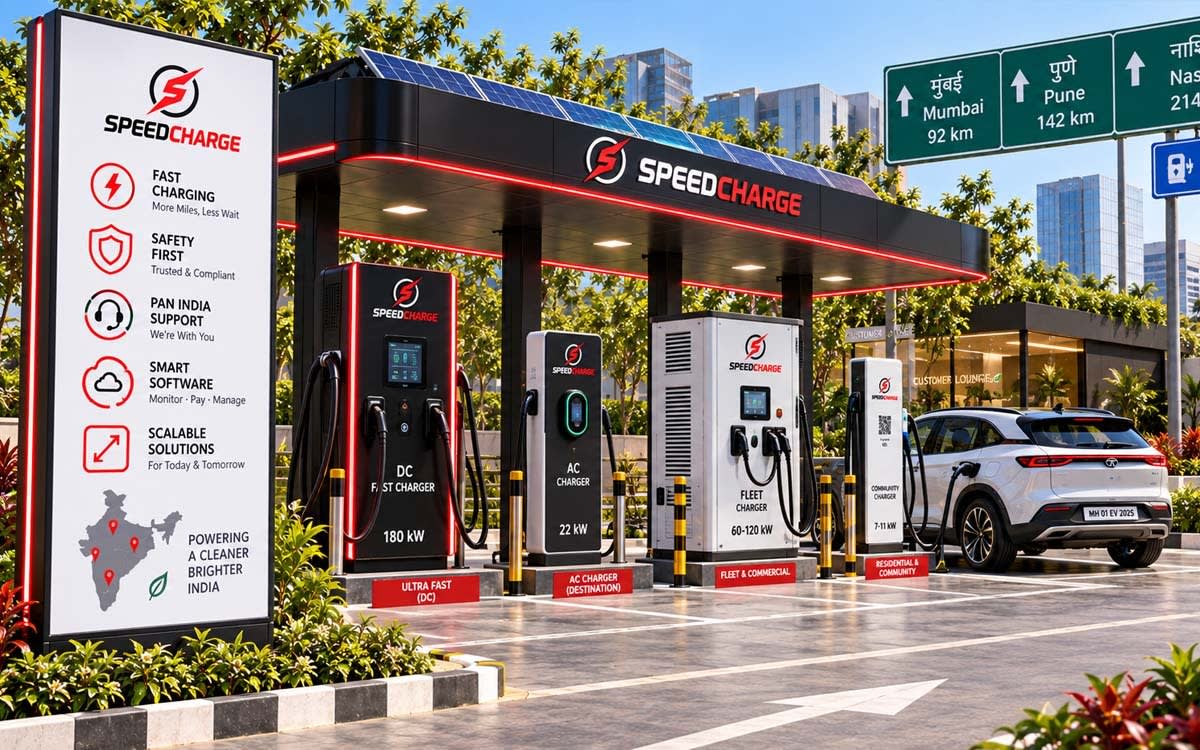
Charging infrastructure is one of the most important enablers of EV adoption in India because EV drivers need different charging options depending on where vehicles remain parked.
A healthy charging ecosystem cannot rely only on highway DC fast chargers.
It needs:
Home charging
Apartment charging
Workplace charging
Fleet/depot charging
Destination charging
Urban public charging
Highway fast charging
The Ministry of Power's 2024 charging guidelines explicitly cover private parking, offices, hospitals, Group Housing Societies, public locations, highways and expressways. The guidelines are designed to make charging safe, reliable and accessible while preparing the electricity grid for increased EV demand.
For the future of electric vehicles in India, charging infrastructure will need to become both denser and more dependable rather than simply increasing the number of map pins.
Where Different Charging Types Fit
Charging Location | Typical Role | Key Infrastructure Question |
|---|---|---|
Home | Routine overnight charging | Is sanctioned load sufficient? |
Apartment/RWA | Resident charging | How are load and billing managed? |
Workplace | Long-dwell daytime charging | How many vehicles charge simultaneously? |
Fleet depot | Operational charging | Can vehicles meet departure schedules? |
Mall/hotel | Destination charging | Does charging match customer dwell time? |
Urban public hub | Top-up / drivers without private charging | Is utilisation sufficient? |
Highway | Journey charging | Is power, reliability and redundancy adequate? |
Apartment owners can review EV Charging in Apartments & RWAs, while drivers looking for public charging can use the SpeedCharge Station Finder.
Challenge 1: Charging Access Will Remain Uneven
A national charger count can hide local differences.
A driver in a charging-dense urban area can have a very different ownership experience from someone who depends on one or two public chargers near home.
The challenge becomes even more important for apartment residents without private charging access.
Public-charging growth therefore needs to be evaluated through more than network size:
Location
Availability
Compatible connectors
Access hours
Charging power
Uptime
Successful session rate
Payment reliability
For intercity driving, route planning and backup charging remain important. See the EV Road Trip & Monsoon Guide.
Challenge 2: India's Power Grid Must Handle Charging at the Right Place and Time
Electricity generation alone is not the entire EV-grid problem.
The operational challenge can occur at the local level: a housing society, commercial property, depot or charging hub may not have enough spare capacity for the chargers proposed there.
The Ministry of Power's charging guidelines specifically include objectives around preparing the electricity grid for increased charging demand and encouraging charging during solar hours.
This makes smart charging and load management increasingly important.
Instead of every charger requesting its maximum power simultaneously, managed systems can allocate available capacity based on building load, charging priority or vehicle departure requirements.
They cannot create unlimited electrical capacity, but they can help use available infrastructure more intelligently.
For deeper planning, see Smart EV Charging & Load Management.
Challenge 3: Battery Localisation Is Still a Work in Progress
Battery cost and supply chains have a major influence on EV prices.
India's PLI scheme for Advanced Chemistry Cell battery storage has an outlay of ₹18,100 crore targeting 50 GWh of domestic ACC manufacturing capacity. As of March 2026, 40 GWh had been awarded to four beneficiary firms.
However, the Government also stated that domestic ACC demand was still being met largely through imports at that point.
That makes battery manufacturing both an opportunity and a challenge.
Local cell production can potentially improve:
Supply-chain resilience
Technology capability
Domestic value addition
Manufacturing employment
Integration with renewable energy storage
Long-term cost competitiveness
But announced or awarded capacity is not the same as fully commissioned production.
Investors and analysts should distinguish between:
target capacity → awarded capacity → installed capacity → actual commercial production
Challenge 4: Upfront EV Price Still Matters
India remains highly price sensitive.
An EV may deliver favourable operating economics over time, but buyers make the purchase decision based partly on what they need to pay today.
The calculation should therefore use total cost of ownership, not simply fuel savings.
A proper comparison can include:
Purchase price
Financing cost
Insurance
Home-charger cost
Electricity
Maintenance
Usage
Resale value
Applicable incentives
A high-mileage fleet and a private car driven only occasionally can reach completely different conclusions using the same EV model.
Future of Electric Vehicles in India: Opportunities and Challenges at a Glance
Area | Opportunity | Challenge |
|---|---|---|
EV adoption | Wider model availability and policy support | Different segments scale at different rates |
Operating cost | Electricity can improve high-mileage economics | Savings vary by tariff and charging method |
Public charging | Network footprint is expanding | Reliability and local density remain uneven |
Home charging | Convenient routine charging | Apartments and load constraints |
Grid | Smart charging improves capacity use | Local distribution upgrades can still be needed |
Batteries | Domestic manufacturing investment | Import dependence remains significant |
Vehicle manufacturing | PLI-backed advanced automotive investment | Localisation requires sustained execution |
Fleets | Predictable high utilisation | Depot capacity and scheduling |
Long-distance travel | More fast-charging infrastructure | Route redundancy and availability |
EV business | Growing charging/service ecosystem | Site economics are not automatically profitable |
The important message is that every challenge represents an infrastructure or technology requirement—not necessarily a reason the EV transition stops.
Opportunity 5: EV Manufacturing Can Become a Larger Industrial Story
The electric vehicle transition also affects manufacturing beyond final vehicle assembly.
India's PLI-Auto scheme covers Advanced Automotive Technology products including EVs and requires minimum domestic value addition for incentives.
As of March 31, 2026, approved applicants reported ₹44,326 crore in investment and 67,820 jobs generated under PLI-Auto.
The opportunity extends to:
Power electronics
Electric motors
Battery packs
Battery cells
Charging equipment
Thermal-management systems
Vehicle software
Energy-management systems
Recycling
Charging infrastructure
This is why the electric vehicle market should not be evaluated only from dealership sales.
Opportunity 6: Fleet Electrification Can Scale Faster Than Private Adoption in Some Use Cases
Commercial vehicles are evaluated more heavily on operating economics and utilisation than emotional purchase preferences.
A fleet that follows predictable routes can design charging around:
Depot return times
Vehicle shifts
Required daily energy
Charger availability
Electricity tariff
Route utilisation
Software can prioritise which vehicle charges first and help avoid charging bottlenecks.
But fleet electrification is not automatic. A depot can require substantial electrical capacity, and an oversized charging design can increase project cost unnecessarily.
Challenge 5: Charging Reliability Must Improve Alongside Charger Count
Adding chargers is not enough if drivers cannot successfully use them.
Public charging confidence depends on the complete session:
discover → arrive → connect → authenticate → charge → pay → leave
A failure at any stage damages trust.
Operators should track measures such as:
Charger uptime
Connector availability
Successful-session rate
Payment failures
Fault recurrence
Customer support response
Energy delivered
The SpeedCharge Blog can support related charging and ownership guides without relying on unsupported claims that one network universally solves reliability.
Challenge 6: Apartment Charging Needs to Scale
India's urban EV growth cannot depend entirely on detached homes with private driveways.
Apartment and RWA charging needs coordinated approaches to:
Parking access
Electricity connections
Common cable routes
Metering
Resident billing
Smart load management
Future expansion
A society that installs chargers one resident at a time may eventually discover that repeated cabling and electrical modifications are harder to manage.
That is why residential charging infrastructure should increasingly be treated as building infrastructure rather than only an individual appliance.
See EV Charging in Apartments & RWAs and the EV Charger Installation Guide.
What EV Growth Means for Different Stakeholders
Stakeholder | Biggest Opportunity | Main Due-Diligence Question |
|---|---|---|
Private EV buyer | Lower operating energy cost and improving charging ecosystem | Where will I charge routinely? |
Apartment resident | Convenient private/shared charging | Can the building support installation? |
Fleet operator | High-utilisation operating economics | Can charging meet vehicle schedules? |
Property owner | Charging as an amenity/business service | Is there real charging demand at this site? |
Charging operator | Expanding EV infrastructure requirement | Will utilisation support the asset? |
Franchise investor | Participation in charging infrastructure | What are actual site economics and contract terms? |
RWA | Future-ready residential infrastructure | How will load and billing scale? |
Manufacturer | Growing EV component ecosystem | Can localisation reach competitive scale? |
Different stakeholders should therefore use different metrics instead of treating “EV growth” as one generic opportunity.
EV Charging as a Business Opportunity
The growth of EVs creates opportunities for entrepreneurs and property owners, but charger deployment is not automatically a high-return business.
Station economics depend on:
kWh sold × retained contribution per kWh − operating costs − capital recovery
Important variables include:
EV traffic
Site access
Electricity cost
Rent
Charger utilisation
Hardware reliability
Software charges
Maintenance
Financing
Competition
A highway location can fail. A city location can succeed. A high-power charger can be underutilised. A lower-power fleet station can operate very efficiently.
Before considering a charging business, use How to Start an EV Charging Station Business in India rather than relying on a generic ROI claim.
Investors interested specifically in SpeedCharge can review the current SpeedCharge Franchise Program and its agreement.
Public Charging Will Need Better Digital Integration
The Ministry of Power's framework calls for a connected and interoperable charging network, which makes software increasingly important.
Drivers benefit when digital systems provide accurate:
Station location
Connector information
Charging power
Availability where supported
Pricing
Access information
Operators benefit from remote monitoring, fault management, session records and analytics.
The future charging experience will therefore depend on both physical infrastructure and digital reliability.
PM E-DRIVE: What Investors and Buyers Should Understand
PM E-DRIVE is not one universal cash rebate applied to every EV-related purchase.
The programme contains separate components for different vehicle categories, buses, charging infrastructure, testing agencies and other areas.
As of July 2026, its overall implementation had been extended through March 31, 2028, while specific category timelines differed.
Anyone making a purchase or investment decision should verify whether the relevant vehicle, charger, entity or project actually qualifies.
Do not include an unconfirmed subsidy in a financial model.
State EV Policy Will Continue to Matter
India has a national EV direction, but electricity and many transport implementation details remain state-sensitive.
BEE reported 29 States with notified EV Policies in its July 2026 update and maintains resources covering state EV tariffs and nodal agencies.
That means the same charging project can face different:
Electricity tariffs
Connection procedures
State incentives
Registration benefits
Building requirements
depending on location.
National articles should therefore avoid presenting one state's tariff or incentive as an India-wide rule.
What to Watch Between 2026 and 2030
Instead of relying on one speculative market-size forecast, track real indicators.
1. EV Penetration by Vehicle Segment
Two-wheelers, three-wheelers, cars, buses and commercial vehicles should be tracked separately.
2. Public Charging Utilisation
More chargers are useful, but kWh throughput and successful sessions show whether infrastructure is actually being used.
3. Home and Apartment Charging
Residential charging accessibility will strongly influence private-car adoption.
4. Domestic Battery Production
Watch actual commissioned cell capacity rather than only announcements.
5. Fast-Charging Corridors
Highway coverage matters for passenger-car confidence and commercial transport.
6. Distribution-Grid Readiness
Local transformer, feeder and property capacity will become increasingly important as EV density rises.
7. Software and Interoperability
Drivers should need less friction, not more apps and disconnected charging systems.
8. Fleet Electrification
High-mileage fleets can provide some of the strongest real-world economics.
9. Used-EV Market Development
Battery-health transparency and resale confidence will become more important as India's first larger EV cohorts age.
10. Policy Stability
Buyers and investors make long-term decisions more confidently when rules, incentives and electricity frameworks are predictable.
Where SpeedCharge Fits Into India's EV Infrastructure Story
SpeedCharge's relevant role in this topic is EV charging infrastructure rather than unsupported market leadership claims.
Drivers looking for charging locations can use the SpeedCharge Station Finder.
Property owners exploring charging at commercial sites can Partner With SpeedCharge.
Entrepreneurs evaluating an EV charging business can review the current SpeedCharge Franchise Program, while general EV and charging education is available through the SpeedCharge Blog.
The commercial decision should still depend on site demand, electrical feasibility, equipment, operating responsibilities and agreement terms—not on unverified charger counts, uptime percentages or guaranteed investment returns.
Final Thoughts
The future of electric vehicles in India looks increasingly like a broad infrastructure and industrial transition rather than simply a change from petrol cars to battery cars.
Vehicle adoption is being supported by government programmes, public charging is expanding, manufacturing investment is growing and States are developing their own EV frameworks. At the same time, real challenges remain in charging reliability, apartment access, grid capacity, battery localisation, upfront affordability and infrastructure economics.
The strongest EV decisions—whether made by a driver, fleet, RWA, property owner or investor—will come from matching the technology to a real use case.
India does not need every vehicle segment to electrify at the same speed. It needs each segment to reach the point where vehicle economics, charging access, electricity infrastructure and user experience work together.
Frequently Asked Questions
1. What is the future of electric vehicles in India?
India is moving toward broader EV adoption across two-wheelers, three-wheelers, passenger vehicles, fleets, buses and commercial transport. The pace will depend on vehicle affordability, charging access, battery manufacturing, electricity infrastructure and policy execution.
2. How many EV chargers are there in India in 2026?
The Government reported 67,657 EV chargers installed across States and Union Territories as of August 7, 2026, including 1,139 battery-swapping-station chargers. This should not be confused with the separate count of public charging stations.
3. How many public EV charging stations are there in India?
The Ministry of Heavy Industries reported 52,718 public charging stations as of July 21, 2026, of which 16,561 public stations had fast EV chargers for cars.
4. Is PM E-DRIVE still active in 2026?
Yes. The overall scheme is currently implemented up to March 31, 2028, although individual EV-category terminal dates and eligibility conditions differ.
5. Will EVs become cheaper than petrol cars?
There is no guaranteed timeline for purchase-price parity across all vehicle segments. Battery costs, localisation, production scale, vehicle specifications, taxes and manufacturer strategy all influence pricing.
6. Is India's power grid ready for mass EV adoption?
EV charging is already supported at scale, but local distribution capacity remains important. High concentrations of chargers can require load management, additional sanctioned capacity or other electrical upgrades.
7. Will India manufacture its own EV batteries?
India is actively developing domestic ACC manufacturing through the PLI scheme, but Government information in 2026 indicated that domestic ACC demand was still largely met through imports.
8. Is EV charging infrastructure a good business opportunity?
It can be at a strong location with sufficient demand and disciplined costs, but profitability is not guaranteed. Site utilisation, electricity, rent, hardware, maintenance and financing all affect returns.
9. Are electric vehicles practical for apartment residents?
They can be, but charging needs more planning than in an independent house. Residents may use private, separate-meter or society-managed charging depending on parking and electrical infrastructure.
10. Will public charging replace home charging?
Unlikely. Home, workplace, fleet, destination and public fast charging solve different needs. A mature EV ecosystem needs several charging types working together.