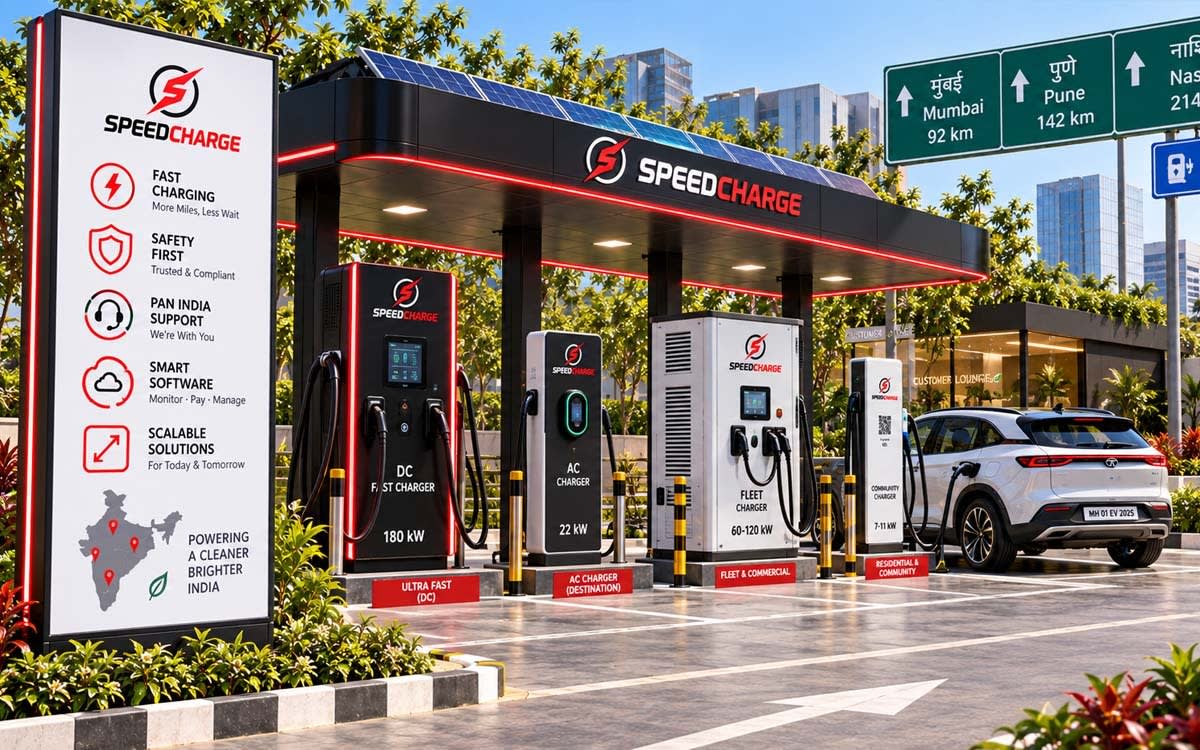
India needs significantly more public and commercial charging infrastructure to support the growing number of electric vehicles on its roads. Building that network requires investment not only in EV chargers but also in transformers, electrical connections, cables, civil work, charging software and ongoing maintenance.
To reduce some of these infrastructure barriers, the Central Government and several state governments have introduced financial and regulatory support for eligible EV charging projects.
The most important central programme in 2026 is the PM Electric Drive Revolution in Innovative Vehicle Enhancement Scheme, commonly known as PM E-DRIVE. The programme includes a ₹2,000 crore allocation for eligible public EV charging infrastructure across Indian cities and highways.
However, the phrase EV charging station subsidy in India is frequently misunderstood.
There is no universal subsidy automatically paid to every individual who purchases an EV charger. PM E-DRIVE follows a location-based funding structure, and proposals are routed through eligible government entities and appointed nodal agencies. Private businesses may participate in implementation, procurement, operation or site partnerships, but they should not assume that buying a charger independently guarantees reimbursement.
Understanding this distinction is essential before including subsidy in an EV charging business plan.
Is There an EV Charging Station Subsidy in India?
Yes, government support is available for eligible EV charging infrastructure in India.
The current incentive ecosystem includes:
PM E-DRIVE capital subsidy for eligible public charging infrastructure
Funding support for upstream electrical infrastructure
Support for eligible EV supply equipment or EVSE at specified locations
State-level capital subsidies
Concessional electricity tariffs in certain states
Land or site facilitation by government agencies
Support for battery charging and swapping infrastructure
Single-window or simplified approval mechanisms in selected states
Public-private charging infrastructure programmes
The type and value of support depend on the location category, ownership or control of the site, implementing agency, charger specifications, applicable benchmark costs and current scheme availability.
The Ministry of Heavy Industries has allocated ₹2,000 crore under PM E-DRIVE for public EV charging stations and associated charging infrastructure on a pan-India basis, including cities and highways.
This allocation should not be interpreted as a direct ₹2,000 crore grant pool that any private applicant can independently access.
PM E-DRIVE Charging Infrastructure Support
PM E-DRIVE is the Central Government’s principal programme supporting the next phase of public EV charging deployment.
Its charging component aims to improve infrastructure for:
Electric two-wheelers
Electric three-wheelers
Electric four-wheelers
Electric buses
Public charging locations
Highways and expressways
Battery swapping and battery charging stations
The original scheme provision envisaged approximately:
Vehicle or infrastructure segment | Indicative charging provision |
|---|---|
Electric two-wheelers and three-wheelers | 48,400 charging points |
Electric four-wheelers | 22,100 fast chargers |
Electric buses | 1,800 fast chargers |
Total | 72,300 charging points/chargers |
These are programme-level infrastructure provisions, not proof that every listed charger has already been installed or commissioned.
Investors should distinguish between:
Scheme targets
Approved proposals
Chargers under procurement
Energised charging stations
Operational public chargers
Combining these different figures can create misleading claims about India’s charging network.
PM E-DRIVE Subsidy Categories
The subsidy structure depends on where the charging station is installed and the type of infrastructure being funded.
Current Location-Based Subsidy Structure
Category | Eligible location type | Upstream infrastructure subsidy | EVSE subsidy |
|---|---|---|---|
Category A | Central or state government premises providing unrestricted public access | 100% | 100% |
Category B | Government-owned, controlled or managed public locations | 80% | 70% |
Category C | Other public locations, including malls, markets, streets and highways | 80% | Not specified under this category |
Category D | Battery swapping or battery charging stations at any location | 80% | Not specified under this category |
Category A: Government Premises
Category A includes eligible locations such as:
Government offices
Government residential complexes
Government hospitals
Government educational institutions
Central Public Sector Enterprises
Other eligible government establishments
For Category A support, the chargers must be available to private EV users without restrictive access. A charger used only for an internal government fleet should not automatically be treated as qualifying public-access infrastructure under this category.
Eligible Category A projects can receive up to:
100% subsidy on upstream infrastructure
100% subsidy on eligible EVSE
Actual funding remains subject to approved benchmark costs, proposal sanction and compliance with the operational guidelines.
Category B: Public Transport and Government-Controlled Locations
Category B can include:
Railway stations
Airports operated and maintained by the Airports Authority of India
Public-sector oil marketing company outlets
State transport undertaking bus stations
Metro stations
Municipal parking facilities
Public-sector ports
Government-controlled toll plazas
NHAI or state-controlled wayside amenities
Eligible projects can receive:
80% subsidy on upstream infrastructure
70% subsidy on eligible EVSE
This category is strategically important because these locations generally have significant vehicle movement and can improve charging access along major travel routes.
Category C: Other Public Locations
Category C covers public charging locations that do not fall under Categories A or B, including examples such as:
Shopping malls
Market complexes
Publicly accessible commercial locations
Streets
Highways
Expressways
Eligible Category C projects can receive 80% support for upstream infrastructure, subject to the operational guidelines and applicable benchmark costs.
The absence of a separately stated EVSE percentage under this category is important. A private property owner should not assume that 80% of the complete charging-station cost will be reimbursed.
Category D: Battery Charging and Swapping
Battery swapping stations and battery charging stations can receive 80% subsidy support for eligible upstream infrastructure.
The business must still comply with applicable electrical, safety, technical and operational requirements.
What Is Upstream Infrastructure?
Upstream infrastructure refers to the electrical system required to deliver adequate power to the charging equipment.
Depending on the project, it can include eligible components such as:
Distribution transformer
Electrical connection equipment
Cables
Panels
Protection systems
Metering infrastructure
Load enhancement work
Other approved electrical infrastructure between the grid connection and EVSE
It is different from EVSE.
EVSE, or Electric Vehicle Supply Equipment, is the equipment that manages and delivers electricity to the vehicle. This includes the charging unit, connectors, communication controls and associated charging hardware.
A project may require substantial upstream investment even when the charger itself is reasonably priced. This is especially relevant for multi-charger sites and DC fast-charging stations.
Property owners planning a project should review the complete EV charger installation process, cost and safety requirements instead of budgeting only for charger hardware.
Does Every Private Investor Receive the PM E-DRIVE Subsidy?
No.
This is the biggest misconception around the EV charging station subsidy in India.
According to the current PM E-DRIVE framework, entities eligible to submit public charging proposals and receive subsidy funding include:
Government of India ministries
Central Public Sector Enterprises
Autonomous bodies under Government of India ministries
State and Union Territory governments
Public-sector undertakings of states and Union Territories
These entities appoint nodal agencies to aggregate demand, submit proposals and oversee implementation.
A private business may participate through:
Charger supply
Engineering, procurement and construction
Charging Point Operator services
Site partnership
Operations and maintenance
Software and network management
Public-private partnerships
Procurement processes run by an eligible agency
But a private entrepreneur purchasing a charger independently should not treat PM E-DRIVE support as an automatic direct reimbursement.
Before investing, obtain written clarification from the relevant state nodal agency, implementing authority or tendering organisation.
Is the Subsidy Calculated on the Full Project Cost?
Not necessarily.
Funding is based on approved costs and benchmarks issued for upstream infrastructure and EVSE. The Bureau of Energy Efficiency provides relevant benchmark inputs under the national framework.
The following costs should not automatically be assumed to qualify:
Land purchase
Property lease
Refundable electricity deposits
Unapproved civil work
Branding and marketing expenses
Franchise charges
Financing costs
General business overheads
Equipment outside approved technical specifications
Costs exceeding applicable benchmarks
Therefore:
Subsidy percentage × total project cost is not a reliable subsidy calculation.
The correct calculation depends on the eligible cost base, benchmark limits, location category and sanctioned proposal.
PM E-DRIVE Application and Implementation Process
Individual projects may follow different procurement or tender procedures, but the broad process is:
An eligible government entity identifies charging demand.
A nodal agency is appointed.
Suitable public charging locations are identified.
Power and site feasibility are assessed.
A consolidated proposal is submitted through the PM E-DRIVE mechanism.
The Ministry of Heavy Industries evaluates the proposal.
Procurement is undertaken according to applicable rules.
Upstream electrical infrastructure is developed.
Compliant EV chargers are procured and installed.
The stations are commissioned and connected to the required digital platform.
Documentation is submitted for subsidy disbursement.
Compliance and utilisation requirements continue after deployment.
The operational guidelines also require relevant chargers to comply with the applicable Phased Manufacturing Programme, charging standards and documentation requirements.
Final subsidy claims require evidence that the approved charging stations have been commissioned or energised. Chargers must also be onboarded on the required Ministry of Heavy Industries unified platform.
Documents Commonly Required for an Eligible Project
The exact documents depend on the implementing agency and procurement route, but a proposal may require:
Site ownership or control documents
Location details
Public-access confirmation
Charging demand assessment
Electrical feasibility report
DISCOM demand note
Power connection documentation
Charger specifications
Applicable standards and compliance certificates
Phased Manufacturing Programme certificate
Procurement records
Payment receipts
Commissioning report
Energisation evidence
Geotagged installation details
Undertakings from the nodal agency
Utilisation certificate
Unified platform onboarding confirmation
Private businesses participating in an eligible project should confirm which party is responsible for each document before signing a supply, operating or site agreement.
Government Subsidy Is Not Guaranteed Project Revenue
Subsidy can reduce eligible capital expenditure, but it cannot create vehicle demand.
A charging station’s commercial performance depends primarily on:
Billable kWh × retained charging margin − electricity cost − rent − maintenance − software − financing − operating expenses
A heavily subsidised charger can still underperform if it has:
Poor location visibility
Low EV traffic
Inadequate power supply
Frequent downtime
Incorrect charger capacity
Weak maintenance support
High property costs
Incompatible connectors
Difficult entry or parking
Unreliable digital payments
Before selecting equipment, use a detailed guide to setting up an EV charging station in India to evaluate location, power, charger type, safety and operating requirements.
State-Level EV Charging Incentives in India
Central support is only one part of India’s charging-incentive ecosystem.
State EV policies may offer additional benefits, such as:
Capital subsidy on charging equipment
Fixed subsidy per charging point
Subsidy for fast-charging stations
Support for battery swapping
Concessional electricity tariffs
Reduced demand charges
Electricity-duty exemptions
Land at preferential rates
Support for renewable-energy integration
Single-window approval systems
Charging requirements in new buildings
Incentives for fleets and aggregators
The availability, eligibility period and quota can differ significantly between states.
For example, a state policy may announce support for the “first 100” or “first 500” charging stations. Once the quota is exhausted, the incentive may no longer be available even if the policy period continues.
Never model a state incentive without verifying:
Current policy validity
Remaining station quota
Eligible applicant category
Charger power requirement
Public-access requirement
Application deadline
Eligible cost definition
Approval-before-purchase condition
Disbursement process
Whether another subsidy can be combined with it
Concessional Electricity Tariffs
Several states and electricity regulators maintain separate tariff categories for EV charging.
A concessional or dedicated EV tariff can help charging businesses by improving operating economics. However, it should not be confused with capital subsidy.
The electricity bill may include:
Energy charges
Demand or fixed charges
Time-of-day charges
Taxes and duties
Metering charges
Connection costs
Penalties for exceeding sanctioned load
DC fast-charging sites can have substantial peak demand. Investors should obtain the current tariff order directly from the relevant State Electricity Regulatory Commission or DISCOM before calculating profitability.
Do not copy an old tariff figure from a previous state EV policy and present it as the current electricity rate.
Are Home EV Chargers Covered by PM E-DRIVE?
PM E-DRIVE should not be presented as a blanket central subsidy for personal home chargers.
Its charging-infrastructure component focuses on eligible public charging deployment through approved government entities and nodal agencies.
Some state or local programmes may separately support private or semi-public charging points, but availability must be verified for the property’s location.
Housing societies planning private or community charging can review the current government guidelines for EV charging in housing societies.
Even without a direct subsidy, residential EV charging may remain practical because vehicles generally stay parked for several hours and can often use lower-power AC charging.
AC Versus DC Charging Under Incentive Programmes
Government support should not determine charger capacity by itself.
AC charging is generally suited to:
Homes
Apartments
Offices
Hotels
Long-duration parking
Destination charging
DC fast charging is generally suited to:
Highways
Fuel stations
Commercial charging hubs
Taxi fleets
Bus depots
Logistics fleets
High-turnover public locations
A larger charger is not automatically a better investment. Available electrical load, vehicle compatibility, dwell time and expected billable energy demand should determine charger capacity.
Can a Franchise Investor Claim the Subsidy?
A franchise investor should not assume that joining an EV charging franchise automatically makes the project eligible for government subsidy.
Eligibility depends on:
Location category
Implementing authority
Nodal agency
Procurement route
Public-access conditions
Technical compliance
Sanctioned proposal
Benchmark costs
Current scheme availability
If a franchise seller advertises a subsidy, ask for:
The exact scheme name.
The official notification.
The eligible applicant category.
The sanctioned project or tender reference.
The eligible cost calculation.
The authority responsible for disbursement.
Written confirmation of whether the subsidy is approved or only expected.
The treatment of subsidy in the franchise agreement.
The party that receives the subsidy.
The consequence if the application is rejected.
Investors evaluating managed charging opportunities can review the SpeedCharge EV charging station franchise programme, but financial decisions should always follow project-specific due diligence.
EV Charging Subsidy Due-Diligence Checklist
Area | What to verify | Common mistake |
|---|---|---|
Scheme | Current official notification | Relying on an old news article |
Applicant | Eligible entity or nodal agency | Assuming individuals can apply directly |
Location | Correct subsidy category | Treating every commercial site as Category B |
Public access | Access conditions and operating hours | Calling a private captive charger public |
Upstream cost | Approved electrical components | Including every electrical expense |
EVSE | Applicable subsidy percentage | Assuming charger subsidy under every category |
Benchmark | Current BEE benchmark cost | Calculating subsidy on retail price |
Procurement | Required tender or purchase procedure | Buying equipment before approval |
Technical standard | Charger and connector compliance | Selecting hardware only by price |
PMP | Current domestic manufacturing requirements | Ignoring certification |
DISCOM | Load, connection and tariff | Buying the charger before power feasibility |
Disbursement | Milestones and documentation | Treating announced support as cash received |
Operations | Uptime and maintenance responsibilities | Ignoring long-term operating costs |
Financial model | Conservative utilisation assumptions | Using subsidy to hide poor site economics |
Common Mistakes to Avoid
1. Calling the subsidy automatic
Government support is conditional. It depends on eligibility, approval, benchmark cost and implementation compliance.
2. Saying every private charging station receives 80%
Category C support relates to eligible upstream infrastructure. It is not automatically 80% of the entire charging-station investment.
3. Treating subsidy targets as installed chargers
A programme target, sanctioned station, installed charger and operational charger are four different data points.
4. Buying hardware before verifying the scheme
Some programmes require approval, empanelment or procurement through an authorised process.
5. Ignoring electricity capacity
Subsidy cannot compensate for an unsuitable power connection or a commercially unreasonable transformer upgrade.
6. Publishing old state incentives as current
Policies, tariff orders, quotas and application windows can change.
7. Promising guaranteed returns
Subsidy reduces eligible capital cost; it does not guarantee utilisation, revenue, profit or investment recovery.
What Property Owners and Businesses Should Do Next
If you are planning an EV charging station, follow this order:
Identify the intended users.
Measure expected vehicle traffic and charging demand.
Assess parking dwell time.
Confirm electrical load availability.
Select an appropriate AC or DC charger.
Check the current state EV policy.
Contact the state nodal agency or DISCOM.
Verify PM E-DRIVE participation at the specific location.
Obtain written eligibility information.
Build financial projections with and without subsidy.
Finalise installation, software and maintenance responsibilities.
Proceed only after commercial and technical feasibility are clear.
Businesses, commercial property owners and fleet operators can also partner with SpeedCharge to explore suitable charging infrastructure for their locations.
Final Thoughts
The EV charging station subsidy in India can reduce the cost of eligible public charging infrastructure, but it must be understood correctly.
PM E-DRIVE provides a ₹2,000 crore central allocation and a location-based subsidy structure covering upstream electrical infrastructure and, in specified categories, EVSE. The highest support is available at eligible government premises offering unrestricted public access, while other public and commercial locations follow different funding conditions.
Most importantly, PM E-DRIVE is not a universal direct-to-investor subsidy. Eligible government entities and appointed nodal agencies aggregate demand, submit proposals and oversee implementation.
State policies can provide additional capital incentives, concessional electricity tariffs, land support and regulatory facilitation. However, every project must verify the current policy, quota, application procedure and eligible cost base.
A sound charging project should work under conservative utilisation assumptions even if subsidy is delayed or unavailable.
Verify the location. Confirm the power. Check eligibility in writing. Choose compliant equipment. Model billable kWh realistically.
Frequently Asked Questions
1. Is there an EV charging station subsidy in India in 2026?
Yes. PM E-DRIVE provides capital support for eligible public charging infrastructure, while several states offer additional incentives. Eligibility depends on the location, implementing entity, approved proposal, charger specifications and current scheme conditions.
2. How much subsidy is available for an EV charging station?
PM E-DRIVE support varies by location category. Eligible government premises can receive up to 100% support for upstream infrastructure and EVSE. Certain government-controlled public locations can receive 80% for upstream infrastructure and 70% for EVSE. Other public locations may receive 80% support for eligible upstream infrastructure.
3. Can an individual apply directly for PM E-DRIVE charging subsidy?
The current framework routes proposals through eligible government entities and their appointed nodal agencies. An individual private investor should not assume that a direct application or automatic reimbursement is available.
4. Does PM E-DRIVE cover private commercial charging stations?
Other public locations, including malls, markets, streets and highway sites, can fall under Category C. However, projects must be included in an approved proposal and satisfy the operational guidelines. The support should not be treated as an automatic private-investor subsidy.
5. Is the subsidy calculated on the total charging-station cost?
Not necessarily. Subsidy is calculated on eligible upstream infrastructure or EVSE costs using applicable benchmarks and category rules. Land, rent, refundable deposits and other non-eligible expenses should not automatically be included.
6. Are home EV chargers eligible for central government subsidy?
PM E-DRIVE focuses on eligible public charging infrastructure and should not be described as a blanket subsidy for personal home chargers. Separate state or local incentives may be available in certain locations.
7. What is upstream infrastructure for an EV charging station?
Upstream infrastructure is the electrical system needed to supply power to the charger. It may include eligible transformers, cables, panels, metering and connection-related equipment, subject to scheme benchmarks and approval.
8. Are DC fast chargers eligible for government subsidy?
Eligible DC fast-charging projects may receive support when they are included in an approved PM E-DRIVE or state-level programme and comply with the applicable technical, location and procurement requirements.
9. Can central and state EV charging subsidies be combined?
This depends on the conditions of both schemes. Applicants must verify whether combining benefits is permitted and ensure the same cost is not claimed twice.
10. Does receiving a subsidy guarantee that an EV charging station will be profitable?
No. Profitability depends on billable kWh, utilisation, electricity costs, uptime, rent, maintenance, pricing and financing. Subsidy can reduce eligible capital costs but cannot guarantee demand, revenue or returns.