As electric-car ownership grows in apartment communities, RWAs and Group Housing Societies increasingly need a repeatable process for resident chargers, shared charging points, metering and electrical upgrades.
Planning EV charging in housing society correctly is not about choosing between “allow” and “ban.” It is about separating private charging from community charging, checking the resident's parking and electrical route, confirming available load, applying the relevant state/DISCOM procedure and documenting who pays for what.
India continues to operate under the Ministry of Power's 2024 EV Charging Infrastructure Guidelines, and the Government confirmed their continued role in India's charging framework in August 2026. Setting up EV charging infrastructure is also treated as an unlicensed activity, subject to applicable technical and safety requirements.
Government Framework for EV Charging in Housing Society
An RWA should not rely on one circular, one court headline or one old subsidy table.
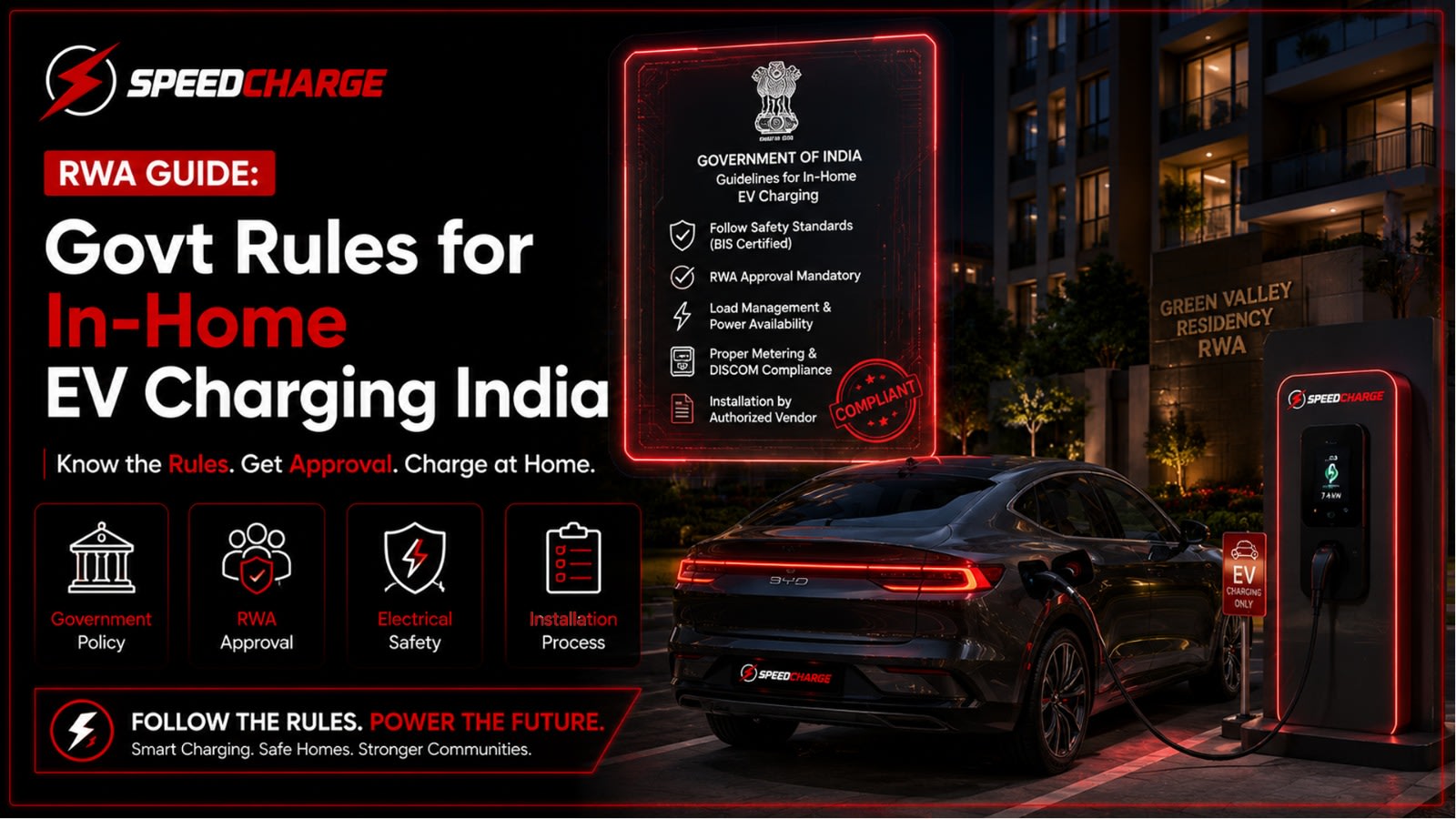
Several regulatory layers can apply:
Ministry of Power EV Charging Infrastructure Guidelines, 2024
Electricity (Rights of Consumers) Rules and amendments
Central Electricity Authority safety regulations
Applicable Indian Standards for the EVSE
State EV policy
State electricity regulations
DISCOM connection and metering procedures
Local building and fire requirements
Society bye-laws governing common property and parking
A practical EV charging in housing society policy should use the national framework as the baseline while checking the rules that apply in the property's own state, city and DISCOM area.
What the Ministry of Power Framework Means for RWAs
The national charging framework recognises residential charging as well as charging infrastructure in Group Housing Societies.
For an RWA, the most useful distinction is between private charging and community charging.
Private Charging Point
A charger primarily intended for an individual resident's EV, usually associated with that resident's designated or allotted parking space.
Community Charging Point
Shared infrastructure intended for multiple residents and, where the society decides and applicable rules permit, other authorised users.
The approval, access and billing model can be different for each.
EV Charging Is an Unlicensed Activity—But Rules Still Apply
The fact that EV charging is de-licensed removes one major regulatory misunderstanding.
A resident or society does not need to become an electricity distribution licensee simply because EV charging infrastructure is installed.
However, de-licensing does not mean:
No electrical assessment
No load check
No property permission
No safety requirements
No metering
No documentation
No local compliance
A compliant project still needs to fit the property's electrical and physical infrastructure.
Can a Resident Use an Existing Electricity Connection?
Potentially, yes.
The Electricity (Rights of Consumers) framework now also allows consumers to obtain separate electricity connections for EV charging.
The practical route can depend on:
Existing sanctioned load
Charger power
Available electrical capacity
Cable distance
Existing meter arrangement
Apartment electrical architecture
DISCOM procedure
Do not force every apartment resident into one universal connection model without first checking the applicable DISCOM framework.
Important: DISCOM Timelines Are Not RWA NOC Timelines
This is one of the most important corrections to older EV-charging articles.
The amended consumer rules reduced electricity-connection timelines to:
Area | Electricity Connection Timeline |
|---|---|
Metropolitan area | 3 days |
Other municipal area | 7 days |
Rural area | 15 days |
Rural hilly terrain | 30 days |
These are new or modified electricity-connection timelines, not a national RWA NOC deadline.
Do not write:
“Every RWA in India must approve an EV charger within 7 days.”
A society's internal approval timeline can depend on state-level cooperative rules, property procedures and the nature of the installation.
Where a state has issued a specific NOC timeline, cite that state instrument separately.
Can an RWA Refuse an EV Charger?
Avoid both extremes:
“An RWA can refuse any charger.”
and
“An RWA can never refuse any charger.”
The national charging framework supports residential and community charging, but an individual proposal can still raise legitimate questions about:
Parking entitlement
Common-area modification
Cable routing
Electrical capacity
Fire access
Structural interference
Equipment suitability
Incomplete technical information
A good society policy should use objective approval criteria.
The committee's main question should be:
Can this installation be made electrically safe, properly supplied, fairly metered and compatible with the property's common infrastructure?
If yes, the administrative process should aim to enable it rather than leave the request unresolved indefinitely.
For an actual legal dispute, obtain advice based on the relevant state law, society documents and facts rather than relying on a national SEO article.
What Documents Should an RWA Ask For?
Keep the application practical.
A standard resident request can include:
Resident and flat details
Parking details
Charger make/model
Rated charging power
Proposed electricity source
Cable-routing plan
Installer details
Load requirement
EVSE technical documentation
Restoration or maintenance undertaking where relevant
Avoid requesting unrelated paperwork merely to make approval difficult.
A standard application form is better than inventing new requirements for every resident.
Step 1: Confirm Parking and Cable Route
The first installation question is not charger brand.
It is:
Where will the charger go, and how will electricity reach it?
Review:
Designated/allotted parking
Distance to electrical source
Common-area crossings
Vehicle movement
Pedestrian movement
Fire/evacuation routes
Drainage
Cable protection
Maintainability
A suitable charger can still become a poor installation if the cable route creates safety or maintenance problems.
Step 2: Assess Electrical Capacity
The property should understand the additional load before energising charging equipment.
Check:
Sanctioned load
Existing peak demand
Transformer capacity
Distribution-board capacity
Available headroom
Charger rating
Expected future chargers
One 7 kW-class private charger and twenty simultaneous chargers are fundamentally different building-level projects.
Step 3: Decide the Metering Model
Possible arrangements can include:
Existing Resident Meter
Useful where the applicable electrical and DISCOM setup permits a direct connection.
Separate EV Connection
The consumer-rights framework permits a separate electricity connection for EV charging.
Community Connection
Shared charging infrastructure can use a centralised electricity and user-billing arrangement according to the applicable utility and property framework.
The correct option should be confirmed before installation.
Cost, Metering and Billing for EV Charging in Housing Society
A society charging policy should clearly separate private costs from common infrastructure costs.
Possible Private-Charger Costs
Charger hardware
Electrical cable
Protective equipment
Civil work
Metering
Load-related work
Restoration
Maintenance
Electricity consumption
Possible Community-Charging Costs
Shared chargers
Common panels
Electrical upgrades
Software
User authentication
Payment system
Maintenance
Electricity
Common cable infrastructure
Define responsibility before procurement.
Private energy consumption should not simply appear on the common-area electricity bill without a transparent cost-allocation mechanism.
Who Pays for a Private Apartment Charger?
There is no one national cost-allocation formula that covers every housing society.
The agreement can depend on:
Society policy
Parking arrangement
Connection type
Common-area work
Shared benefit
DISCOM process
A fair framework should distinguish:
resident-specific infrastructure
from
common infrastructure required for multiple residents or future expansion.
Do Not Hardcode Old State EV-Charger Subsidies
The uploaded draft included several fixed state subsidy amounts.
Those figures should not remain in a national evergreen article unless each one is checked against the current state notification and eligibility window immediately before publication.
Do not permanently state:
Delhi always gives ₹X per charger
Telangana always gives X%
Gujarat always gives ₹X lakh
Odisha always gives ₹X
State incentives can expire, be modified, change eligibility or run out of allocation.
Link to the current state EV-policy or administering-agency page instead.
PM E-DRIVE Is Not a Blanket Apartment-Charger Subsidy
PM E-DRIVE includes support for eligible public EV charging infrastructure, but subsidy proposals follow prescribed eligible-entity and nodal-agency routes.
The current government framework lists government ministries, public-sector/autonomous bodies, states/UTs and their PSUs among entities eligible to submit proposals for public EV charging support.
Therefore:
private apartment charger purchase ≠ automatic PM E-DRIVE subsidy
Never include PM E-DRIVE in an RWA project budget unless the exact project route has been confirmed.
Rooftop Solar Support Is Different From EV Charger Subsidy
PM Surya Ghar remains active in 2026.
The scheme framework has also recognised rooftop solar for Group Housing Societies/RWAs and common facilities including EV charging.
That should be described correctly:
This is rooftop-solar financial support, not a direct subsidy for purchasing an EV charger.
An RWA considering solar + charging should evaluate the two systems together but keep their incentive rules separate.
Safety Requirements for Society Chargers
The CEA's current safety archive lists:
Central Electricity Authority amendment regulations, 2026
as the current safety framework.
An RWA should require installations to follow:
Applicable CEA requirements
Applicable Indian Standard for the charger category
Manufacturer installation instructions
Proper electrical engineering
Appropriate protection
Proper earthing
Safe cable routing
Commissioning/testing
Required documentation
The committee does not need to invent electrical specifications itself.
Avoid Universal MCB, RCCB and Cable Specifications
Do not publish one fixed:
MCB size
RCCB type
Cable cross-section
Earthing pit design
for every apartment charger.
Correct protection depends on:
Charger rating
EVSE design
Built-in protections
Electrical system
Cable distance
Installation method
Manufacturer requirements
Applicable standards
Use a properly designed installation rather than an internet checklist.
Does Every Charger Need the Same BIS Certificate?
No.
The IS 17017 family covers multiple EV-charging configurations, and the applicable standard depends on the specific equipment category.
BIS also issued an updated IS 17017 (Part 23):2026 for DC EV supply equipment.
For a residential AC charger, do not simply copy the DC standard from another product.
Ask:
Which Indian Standard and conformity requirement apply to this exact model?
Model Building Bye-Laws: Important but Often Misquoted
MoHUA amended the Model Building Bye-Laws and urban-development guidelines in 2019 to incorporate EV charging infrastructure.
The official release explains that these provisions were issued as a guiding framework for States and Union Territories to incorporate into their own building bye-laws and planning regulations.
Therefore, avoid saying:
“The national Model Building Bye-Laws automatically apply identically to every housing society.”
Check the current local building rules.
Is There a National Single-Window Portal for Every RWA?
No universal portal should be promised.
Some states, cities or DISCOMs may offer digital or single-window processes, but availability and scope vary.
Before referring residents to one, confirm:
Portal is currently active
Property is eligible
Private residential charging is supported
Connection application is included
Subsidy, if any, is actually administered there
Do not write that a national portal automatically approves chargers and deducts subsidies.
A Better RWA Approval Process
Step 1 — Standard Application
Receive the resident's charger and parking details.
Step 2 — Parking Review
Check the bay and proposed cable route.
Step 3 — Electrical Feasibility
Confirm charger load and available capacity.
Step 4 — Metering Decision
Choose the applicable connection and billing arrangement.
Step 5 — Technical Review
Check equipment and installation documentation.
Step 6 — Conditional Approval
Record objective installation conditions where necessary.
Step 7 — Installation and Commissioning
Complete electrical work and testing.
Step 8 — Register the Charger
Keep basic property and maintenance records.
This makes approval repeatable and reduces unnecessary committee disputes.
What Should an RWA Charging Policy Include?
A written policy should cover:
Private vs community charging
Application procedure
Parking use
Common-area work
Cable routes
Electrical assessment
Metering
Cost responsibility
Installation responsibility
Maintenance
Damage/restoration
Emergency contact
Shared-charger access
Visitor charging
Future capacity
Load management
Keep the policy technology-neutral enough to accommodate future charger models.
Plan for More Than One EV
As adoption grows, EV charging in housing society should shift from isolated charger approvals toward building-level planning.
Future infrastructure can include:
Common cable trays
Central electrical distribution
Additional sanctioned load
Sub-metering
User authentication
Smart load management
Shared charging bays
Expansion rules
The first charger may be simple.
The twentieth charger usually requires a system architecture.
Smart Load Management
Managed charging can distribute available electrical capacity among several connected EVs.
It can help with:
Controlling simultaneous load
Supporting more charging points
User prioritisation
Charging schedules
Energy monitoring
But it does not create unlimited power.
A building can still require electrical upgrades when total EV demand grows beyond available capacity.
Read the Smart EV Charging & Load Management Guide for detailed planning.
Private vs Community Charger
Factor | Private Charger | Community Charger |
Main users | One resident/household | Multiple authorised users |
Parking | Designated/allotted | Shared charging bay |
Metering | Resident or dedicated arrangement | Shared/user-based billing |
Ownership | Resident/agreed party | Society/operator/partner |
Access control | Usually simple | Often required |
Load planning | Individual + building impact | System-level |
Maintenance | Resident/provider | Society/operator/provider |
Expansion | Individual | Portfolio-wide |
A mature society can support both.
Visitor Charging
A society may also evaluate visitor charging where its property rules and electricity/commercial arrangement permit it.
Before enabling paid visitor use, clarify:
Access rules
Parking
Charging tariff
Payment
Taxes
Customer support
Operating responsibility
Do not casually convert a common electrical outlet into an unmanaged paid charging service.
Basement EV Charging
Do not publish a blanket pan-India statement that EV charging is always allowed or always prohibited in basement parking.
The answer can depend on:
Local fire rules
Parking system
Building design
Electrical layout
Emergency access
Local authority requirements
Always check the competent local rules for the specific building.
Records an RWA Should Keep
Maintain a basic register containing:
Resident/user
Parking bay
Charger make/model
Rated power
Electricity source
Meter/sub-meter
Installation date
Installer
Relevant approvals
Maintenance contact
For shared chargers, also keep:
Billing rules
Access policy
Fault escalation
Maintenance contract
Common RWA Mistakes
Confusing DISCOM Timelines With Society NOC Timelines
They are separate processes.
Using a Blanket Ban
Use objective technical and property criteria.
Copying Another State's Rule
Verify the local framework.
Publishing Old Subsidy Numbers
Recheck incentives before quoting them.
Assuming Every Charger Has the Same Standard
Equipment categories differ.
Ignoring Future EV Adoption
Plan common infrastructure early.
Charging Private Electricity to the Common Account
Define billing before operation.
Promising Automatic Single-Window Approval
Verify the actual portal first.
Using Unverified Company Claims
Do not insert network size, uptime or similar numbers unless current evidence is available.
How SpeedCharge Can Support Housing Societies
Housing societies can review:
A charging partner should first assess:
parking + electrical load + cable routing + metering + expected future EV demand
before recommending hardware.
Do not choose a provider from unsupported network-size, uptime or “guaranteed compliance” claims.
RWA EV Charger Checklist
Check | Complete |
Parking rights understood | ☐ |
Cable route checked | ☐ |
Charger power documented | ☐ |
Electrical capacity assessed | ☐ |
Metering selected | ☐ |
Equipment documentation checked | ☐ |
Installer responsibility defined | ☐ |
Common-area restoration agreed | ☐ |
Electricity cost allocation defined | ☐ |
Maintenance contact recorded | ☐ |
State/DISCOM procedure checked | ☐ |
Future expansion considered | ☐ |
Final Thoughts
A successful EV charging in housing society programme does not require the managing committee to become an EV engineering department.
It needs a repeatable process built around:
parking rights + electrical feasibility + suitable equipment + safe installation + transparent metering + clear cost responsibility + future capacity
India's policy direction supports residential and community charging, but society procedures, state rules and property-specific constraints still need to be handled correctly.
Avoid blanket bans, blanket approvals and blanket technical specifications.
Create one evidence-based RWA policy, apply it consistently and update it as EV adoption grows.
Frequently Asked Questions
1. Can a resident install an EV charger in apartment parking?
India's national framework supports residential charging and charging infrastructure in housing societies. The specific installation must still comply with parking, electrical, property and local requirements.
2. Can an RWA completely ban EV chargers?
A blanket ban should not be treated as the default response. The better approach is to assess installations using objective parking, electrical, safety and common-property criteria.
3. Is an RWA NOC mandatory everywhere in India?
There is no single nationwide RWA approval procedure for every apartment. Requirements can depend on property arrangements, state rules, society bye-laws and DISCOM procedures.
4. How many days does an RWA have to approve an EV charger?
There is no one pan-India RWA approval deadline. The commonly quoted 3/7/15/30-day national timelines relate to electricity connections. A state may separately prescribe an RWA timeline.
5. Can residents use their existing electricity meter?
Potentially, yes, where the electrical system and applicable DISCOM arrangement allow it. Consumers can also seek a separate EV electricity connection.
6. Who should pay for a private apartment EV charger?
The applicable society policy should define this. Costs serving one resident should be distinguished from common electrical infrastructure intended to benefit multiple users.
7. Does every EV charger need the same BIS certification?
No. The applicable Indian Standard and conformity requirement depend on the charger category and exact equipment.
8. Does PM E-DRIVE subsidise private apartment chargers?
Do not assume so. PM E-DRIVE's charging-infrastructure funding follows specific public-charging eligibility and implementation routes.
9. Should an RWA install community chargers instead of private chargers?
Not necessarily. Private and community charging can coexist, depending on parking, resident demand, metering and available electrical capacity.
10. When does a housing society need smart load management?
It becomes useful when several charging points need to share limited electrical capacity. It can manage simultaneous demand but cannot replace electrical upgrades indefinitely if total demand continues to grow.