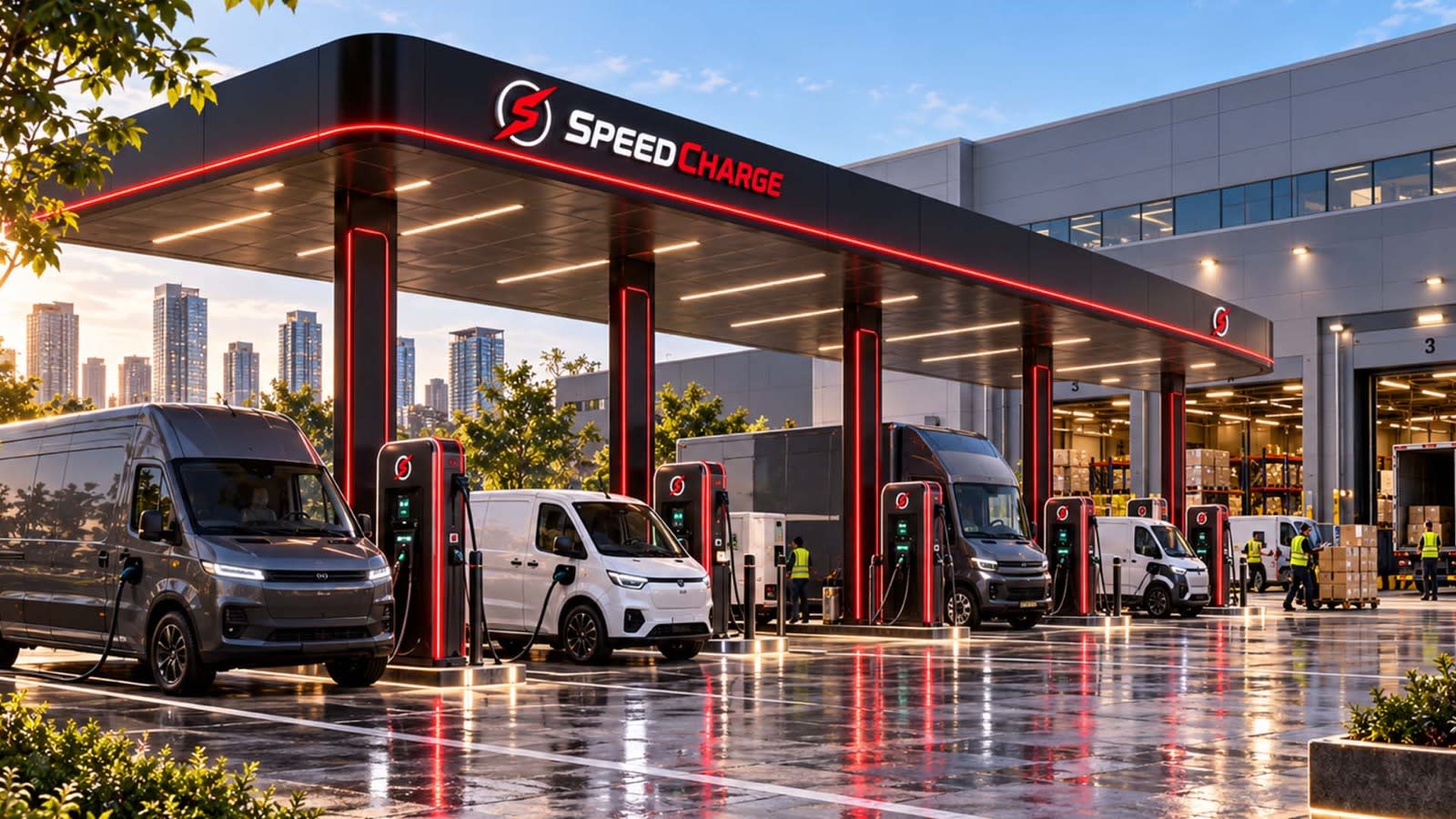
Electric fleets do not earn merely because chargers are installed at a depot. They create value when vehicles receive the energy required for their routes and leave on schedule. A charger that appears online but repeatedly fails sessions, delivers restricted power or creates queues can still disrupt operations.
Planning Fleet EV charging solutions in India therefore requires the fleet schedule, vehicle duty cycle and electrical system to be designed as one operating system. DC fast charging can reduce turnaround time, but higher charger power also increases capital cost, sanctioned-load requirements, peak demand and the consequences of equipment failure.
The objective is not to install the maximum possible kilowatts. It is to deliver the required daily energy at an acceptable cost while protecting vehicle availability, operational resilience and long-term asset performance.
This guide explains how fleet operators, logistics businesses, taxi companies, bus operators and charging partners can select the right DC charging architecture, improve uptime and evaluate return on investment responsibly.
For more implementation, infrastructure and policy guidance, review the SpeedCharge EV Charging Blog.
Quick Answer: How Can Fleets Maximise Uptime and ROI?
Effective Fleet EV charging solutions in India should be built around seven controls:
Measure the fleet’s daily and peak energy requirement.
Match charger power to actual vehicle dwell time.
Build redundancy around operationally critical departures.
Use smart charging and load management.
Monitor charger, connector and session performance remotely.
Maintain critical spares and documented response procedures.
Measure cost per delivered kWh and cost per operating kilometre.
DC fast charging improves fleet productivity when it shortens a genuine operational bottleneck. It may not be the most economical choice for every vehicle. A fleet that parks overnight may use lower-power charging for most energy and retain selected DC capacity for rapid top-ups, delayed arrivals or high-mileage vehicles.
ROI should be assessed through total operational value, not a promised percentage. Relevant benefits may include lower energy cost, improved vehicle utilisation, fewer missed departures, reduced charging queues and the ability to operate more routes with the available fleet.
Why Fleet Charging Is Different From Public Charging
Public charging depends on uncertain customer arrivals. Fleet charging can be planned around known vehicles, routes, shifts and depot windows.
A fleet operator can usually estimate:
Number of vehicles returning to the depot
Battery state of charge on arrival
Energy required for the next duty cycle
Earliest and latest departure times
Vehicles that can charge simultaneously
Maximum acceptable charging delay
Seasonal or route-related demand changes
This predictability creates an opportunity to schedule energy more efficiently. It also raises the service requirement: a public driver may choose another station, but a depot failure can affect an entire delivery, taxi or transport operation.
The official e-AMRIT guidance for businesses considering EV charging stations recognises fleet charging as an important charging-business driver.
For a broader implementation sequence, review How to Set Up an EV Charging Station in India.
Step 1: Calculate the Fleet’s Energy Requirement
Charger sizing should begin with energy demand, not a hardware catalogue.
Daily Energy Requirement
For each vehicle group, estimate:
Vehicles × average daily distance × energy consumption per kilometre
Then adjust for:
Route variation
Traffic and idling
Payload
Weather and auxiliary loads
Battery reserve requirement
Charging and electrical losses
Battery degradation
Future fleet expansion
Telematics and actual charging records are stronger inputs than manufacturer range figures. A fleet should collect several weeks of route and energy data where possible, including demanding operating days.
Charging Window
The usable window is the time between vehicle arrival and the energy deadline for its next departure. Vehicles may be parked for eight hours but unavailable for charging during inspection, loading, cleaning or driver handover.
A simplified average charging-power requirement is:
Energy required ÷ usable charging hours
This calculation is only a starting point. The final design must also account for overlapping arrivals, vehicle acceptance limits, charger sharing, power restrictions and contingency charging.
Peak-Concurrency Analysis
The depot should model at least three cases:
Normal operating day
High-demand or delayed-return day
Charger or connector unavailable
If the fleet can meet every route only when every charger works perfectly, the system has no operational resilience.
Step 2: Choose the Correct Mix of AC and DC Charging
DC fast charging transfers power directly to the vehicle battery and can reduce turnaround time. However, the vehicle controls how much power it accepts, and the charging rate normally changes during the session.
When DC Fast Charging May Fit
Vehicles operate multiple shifts
Depot dwell time is short
Route energy demand is high
Rapid top-ups protect scheduled departures
The site has suitable electrical capacity
One charger can serve several sequential vehicles
Opportunity charging is part of the operating plan
When Lower-Power Charging May Fit
Vehicles remain parked for long periods
Overnight energy can be scheduled
Route demand is predictable
Load limits make simultaneous high-power charging expensive
More connectors are needed than fast-turnaround sessions
Mixed Charging Architecture
Many fleets can combine:
Lower-power overnight charging for routine energy
DC fast charging for priority vehicles and top-ups
Mobile or portable contingency charging where technically suitable
Public-network access as a documented backup
The correct Fleet EV charging solutions in India configuration is the one that meets departure requirements with the lowest sustainable total cost and an acceptable failure margin.
Charger power should also match the vehicle’s charge curve and connector. Installing a 240 kW charger does not mean every vehicle will accept 240 kW throughout the session.
Step 3: Design for Redundancy Instead of Headline Power
One high-power charger can create a single point of failure. Several modular chargers or power cabinets may provide better resilience, but the right architecture depends on vehicle compatibility, site design and budget.
Practical Redundancy Options
N+1 capacity for operationally critical charging
Multiple dispensers connected to modular power cabinets
Independent charger feeds where practical
Spare connector or charging bay
Ability to reduce power and continue operating after one module fails
Pre-approved public charging fallback
Emergency vehicle-priority rules
Redundancy should be based on business impact. If one missed bus or delivery departure creates a significant penalty, the cost of backup capacity may be justified. If vehicles have long parking windows and flexible routes, scheduling may provide sufficient resilience without duplicating every asset.
Separate Charger Availability From Fleet Readiness
A charger may be technically available while the fleet is operationally constrained by:
Blocked charging bays
Incompatible connectors
Damaged cables
Payment or authentication failure
Network interruption
Reduced power output
Vehicle-side charging fault
Insufficient site power
The uptime model must therefore include successful energy delivery, not only equipment heartbeat data.
Step 4: Complete Electrical and Grid Feasibility
High-power charging can materially change a depot’s electrical requirements.
The feasibility assessment should verify:
Existing sanctioned load
Current maximum demand
Spare electrical capacity
Proposed coincident charging load
LT or HT supply requirement
Transformer capacity
Panel and switchgear capacity
Cable routes and voltage drop
Earthing and protection
Metering arrangement
Power quality
Auxiliary loads
DISCOM application timeline
Future expansion allowance
A software limit cannot compensate for unsafe or undersized electrical infrastructure. The charging-management system must operate within a professionally designed electrical system.
The official guidance on EV charging installation costs identifies transformers, cables, meters, installation, maintenance and electricity infrastructure among the relevant cost categories.
For installation planning, use the EV Charger Installation Guide 2026: Cost, Steps & Rules.
Step 5: Use Smart Charging and Load Management
Smart charging allocates available power according to vehicle need, departure time, tariff period and site limits.
A fleet charging-management system may use:
Vehicle arrival time
Current battery state of charge
Energy required
Departure deadline
Route priority
Charger and connector status
Site power limit
Electricity tariff period
Renewable-energy availability
Demand-response instruction where applicable
Priority-Based Charging
The system should not simply divide power equally. A vehicle leaving in 30 minutes may require priority over one parked for eight hours.
Possible priority rules include:
Earliest departure first
Lowest available range first
Critical route first
Contracted service level first
Emergency reserve first
Peak-Demand Control
Uncontrolled simultaneous DC charging can increase maximum demand and trigger infrastructure upgrades or higher electricity costs. Load management can cap aggregate power while still meeting departure deadlines.
The e-AMRIT page on electricity cost for charging explains why fixed or demand charges can influence charging-station economics, especially at lower utilisation.
The operator should verify the current tariff order and DISCOM schedule applicable to the actual depot. A national average electricity rate should not be used as a substitute for site-specific billing.
Step 6: Build an Uptime-Focused Maintenance System
Preventive maintenance should be based on equipment requirements, usage intensity, environment and fault history.
Preventive-Maintenance Scope
Connector and cable inspection
Enclosure and seal inspection
Cooling-system checks
Filter cleaning or replacement where applicable
Power-module health review
Earthing and protection checks
Emergency-stop testing
Communication and SIM status
Meter and session-record review
Firmware and security updates
Thermal inspection where appropriate
Bay, bollard and signage inspection
Critical Spare-Parts Strategy
The fleet should determine which components cause the longest outages and maintain an agreed spare strategy. Depending on charger design, this may include:
Connectors and cables
Communication devices
Auxiliary power components
Contactors or protection devices
Cooling-system components
Power modules
Screens or RFID devices
Inventory decisions should consider equipment warranty, technician capability, lead time and whether replacement work requires manufacturer authorisation.
Fault Escalation
The operating procedure should define:
Automatic fault alert
Remote diagnosis
Safe reset where authorised
Vehicle reassignment
Technician dispatch
Spare-part escalation
Root-cause analysis
Closure verification
Service-level agreements should define response and restoration targets, exclusions, operating hours, escalation contacts and reporting. A headline uptime percentage without measurement rules is not sufficient.
How Should Fleet-Charging Uptime Be Measured?
The strongest Fleet EV charging solutions in India use several operational metrics instead of one dashboard number.
KPI | What It Measures | Why It Matters |
|---|---|---|
Charger availability | Time charger can accept a session | Identifies equipment downtime |
Connector availability | Usable connector time | Detects partial charger failure |
Successful-session rate | Successful starts ÷ valid attempts | Captures authentication and communication problems |
Energy-delivery success | Sessions delivering required energy | Links charging to route readiness |
Mean time to acknowledge | Time from alert to response | Tests monitoring discipline |
Mean time to repair | Time from fault to restoration | Measures service capability |
Derated-operation time | Time operating below expected power | Exposes hidden performance loss |
Missed departure rate | Vehicles delayed by charging | Measures fleet impact |
Define the Uptime Formula in the SLA
A contract should specify:
Measurement source
Reporting period
Planned-maintenance treatment
Grid-outage treatment
Vehicle-side fault treatment
Communication-failure treatment
Partial connector failure
Reduced-power operation
Start and end of an outage
Without these definitions, two parties can report different uptime percentages for the same equipment.
Monitor Charging Through Software and Data
The charger-management system, energy meter, vehicle telematics and depot schedule should be reconcilable.
Useful dashboard data includes:
Charger and connector status
Session start and stop
Energy delivered
Power curve
Fault code
Vehicle or driver identity
State of charge where integration permits
Departure deadline
Electricity consumption
Tariff period
Maintenance history
Remote commands
User and administrator activity
Fleet systems are connected operational assets. Access should use role-based permissions, strong authentication, credential controls, software updates, logs, backups and incident-response procedures.
Fleet operators should also contractually define data ownership, API access, retention and access after service termination.
Calculate Fleet-Charging ROI Responsibly
ROI should compare the value created over a defined period with the complete investment and operating cost.
Capital Expenditure
Chargers and dispensers
Transformer and electrical infrastructure
Panels, switchgear and cabling
Civil and bay work
Software integration
Communication equipment
Installation and commissioning
Engineering and approvals
Initial spares
Contingency
Operating Expenditure
Electricity and demand charges
Software and connectivity
Preventive maintenance
Repairs and replacement parts
Field-service support
Insurance
Staff and depot operations
Financing and taxes
Operational Value
Energy-cost difference against the relevant baseline
Reduced vehicle downtime
Routes completed with the available fleet
Reduced reliance on public charging
Avoided towing or emergency charging
Better charger and vehicle utilisation
Service-level or productivity improvement
Useful Financial and Operating Formulas
Effective electricity cost per delivered kWh = total charging electricity bill ÷ energy delivered to vehicles
Charging cost per kilometre = total attributable charging cost ÷ fleet kilometres operated
Simple payback period = initial project investment ÷ annual post-expense cash benefit
Simple payback does not account for financing structure, tax, time value of money or asset replacement. A complete investment assessment should also consider cash-flow timing and downside scenarios.
No universal ROI percentage applies to every depot. Vehicle utilisation, power cost, infrastructure CAPEX, charging windows, maintenance and the baseline fleet determine the result.
DC Fleet-Charging Architectures Compared
Selecting Fleet EV charging solutions in India requires balancing power, resilience, flexibility and cost.
Architecture | Strength | Limitation | Suitable Operating Pattern |
|---|---|---|---|
Dedicated charger per vehicle | Simple assignment | Higher connector and infrastructure cost | Predictable long parking windows |
Shared DC fast chargers | High asset utilisation | Requires scheduling and vehicle movement | Multi-shift fleet with managed arrivals |
Central power cabinet with dispensers | Modular power allocation | Design and vendor dependence | Large depots with several bays |
AC base plus DC top-up | Cost and speed balance | More complex operating rules | Mixed dwell times and route demand |
Public-network backup | Reduces emergency-depot capacity | Availability and tariff are outside fleet control | Contingency and occasional route charging |
Architecture selection should include the failure case. A system that works only at perfect arrival times and full charger power may not survive normal operational variation.
Compliance and Equipment Due Diligence
India treats establishing EV charging stations as a de-licensed activity, but applicable electrical, safety, equipment, property and operating requirements remain relevant.
The Ministry of Power’s EV charging infrastructure guidelines describe the 2024 framework and the de-licensed status of charging-station deployment.
Fleet teams should verify:
Exact charger model and output rating
Vehicle and connector compatibility
Applicable Indian Standard
Model-specific certification or test documentation
Warranty and authorised-service conditions
Environmental rating
Electrical design and protection
Metering and tariff arrangement
Emergency procedures
Maintenance records
The official EV charging standards overview explains the Indian standards framework. The applicable part of the IS 17017 family depends on charger type and configuration.
The Central Electricity Authority’s electrical safety regulations should be reviewed with qualified engineering advice and current DISCOM requirements.
Government support must not be included as confirmed project funding before formal approval. Applicants should review the current PM E-DRIVE scheme guidelines and the applicable nodal-agency process.
Fleet-Charging SLA Checklist
An SLA should cover:
Availability
Charger and connector availability definition
Planned maintenance window
Derated-operation treatment
Grid and communication exclusions
Monthly reporting method
Support
Remote-monitoring hours
Fault acknowledgement time
Remote-response time
On-site response time
Restoration target
Escalation contacts
Maintenance
Preventive-maintenance frequency
Spare-parts responsibility
Consumable and wear-item treatment
Firmware and software updates
Warranty process
Root-cause reporting
Data
Fleet dashboard access
Session-level records
Energy-meter reconciliation
API availability
Data retention
Audit rights
Cybersecurity and incident reporting
Commercial Terms
Fixed and variable fees
Electricity responsibility
Service credits where agreed
Minimum-use commitments
Asset ownership
Agreement termination
Data and hardware transition
Fleet Charging Due-Diligence Checklist
Before approving Fleet EV charging solutions in India, confirm:
Vehicles and Routes
Is daily energy based on telematics or measured data?
Are arrival and departure windows documented?
Does each vehicle support the proposed connector and power?
Is route variation included?
Electricity
Is sanctioned load confirmed?
Are coincident charging and other depot loads modelled?
Are transformer, panel and cable costs included?
Are demand charges included?
Resilience
Can the depot operate with one charger or connector unavailable?
Is a public or secondary-site backup documented?
Are critical spares available?
Are vehicle-priority rules defined?
Operations
Who monitors faults?
What response and restoration targets apply?
Can the fleet audit session and downtime data?
Are maintenance windows coordinated with vehicle schedules?
Finance
Does the model use complete commissioned CAPEX?
Are software, maintenance and replacement included?
Is ROI based on site-specific operating data?
Has a delayed-deployment and downtime case been tested?
Common Fleet-Charging Mistakes
Buying chargers before measuring duty cycles
Selecting power from the charger rating alone
Ignoring the vehicle’s DC acceptance limit
Assuming all vehicles return at the same state of charge
Designing without a charger-failure scenario
Treating charger heartbeat as operational uptime
Excluding reduced-power operation from reports
Ignoring demand charges and electrical losses
Using manual first-come-first-served charging for critical routes
Omitting software and communication resilience
Keeping no critical spare-parts strategy
Applying one maintenance schedule to every usage level
Assuming subsidy approval
Presenting projected ROI as guaranteed
Failing to plan fleet expansion
How SpeedCharge Supports Fleet Charging
SpeedCharge can support fleet and commercial charging projects through:
Fleet energy and duty-cycle assessment
Site and electricity feasibility
AC and DC charger configuration
Depot layout and expansion planning
Installation coordination
Charger-management software integration
Remote monitoring
Preventive maintenance planning
Performance and energy reporting
Commercial partnership evaluation
Fleet operators and businesses can Partner With SpeedCharge for a site-specific technical and commercial assessment.
Drivers and fleet teams that require public-network backup can use the SpeedCharge Station Finder to review available SpeedCharge locations.
A site assessment can identify technical and commercial risks, but operating performance and financial return remain dependent on the executed design, electricity supply, vehicle demand, maintenance and contract terms.
Final Thoughts
Reliable Fleet EV charging solutions in India align vehicle routes, energy demand, charger power, grid capacity, software and maintenance. DC fast charging can protect high-utilisation operations, but it should solve a measured turnaround requirement rather than serve as an expensive default.
The strongest depot is designed for normal variation and credible failures. It can prioritise vehicles, continue operating when an asset is unavailable, identify reduced performance early and reconcile energy, session and maintenance data.
ROI improves when charging infrastructure keeps vehicles productive at a controlled total cost. It weakens when projects overbuild headline power, underestimate electrical work, ignore demand charges or rely on unsupported uptime and savings claims.
Frequently Asked Questions
1. Why is DC fast charging useful for electric fleets?
DC fast charging can reduce turnaround time when vehicles have short dwell periods, high daily energy needs or multiple operating shifts. It should be matched to vehicle acceptance limits and depot power capacity.
2. Does every fleet need DC fast chargers?
No. Fleets with long overnight parking may meet most energy demand through lower-power charging. Selected DC capacity can be retained for priority vehicles, top-ups and contingency use.
3. How should a fleet choose charger power?
The operator should assess energy required, usable charging window, simultaneous arrivals, vehicle charging capability, electrical capacity, redundancy and future expansion. Maximum charger output alone is not a sufficient basis.
4. What does charger uptime mean?
Uptime should define when a charger or connector can accept and successfully complete charging. The SLA should explain planned maintenance, partial failure, reduced power, grid outages and communication faults.
5. What is the most important fleet-charging KPI?
No single KPI is enough. Charger availability, successful-session rate, energy-delivery success, repair time and charging-related missed departures should be reviewed together.
6. How can smart charging reduce depot electricity costs?
Smart charging can allocate limited power according to departure priority, reduce unnecessary simultaneous peaks and shift flexible energy demand to suitable tariff periods, subject to the applicable electricity schedule.
7. Should a fleet install backup charging capacity?
Critical fleets should evaluate redundancy according to the operational cost of failure. Backup may involve additional connectors, modular power capacity, secondary depot access or documented public-network charging.
8. How is fleet-charging ROI calculated?
ROI compares complete project and operating costs with measurable financial and operational value, such as energy-cost differences, improved vehicle availability, route productivity and reduced emergency-charging dependence.
9. Which standards apply to DC fleet chargers in India?
The applicable standard depends on charger design, connector and configuration. The supplier should provide model-specific documentation and identify the relevant part of the IS 17017 family.
10. What should be included in a fleet-charging SLA?
The SLA should cover availability definitions, monitoring, fault response, restoration, preventive maintenance, spares, software updates, data access, security, reporting, commercial fees and termination responsibilities.