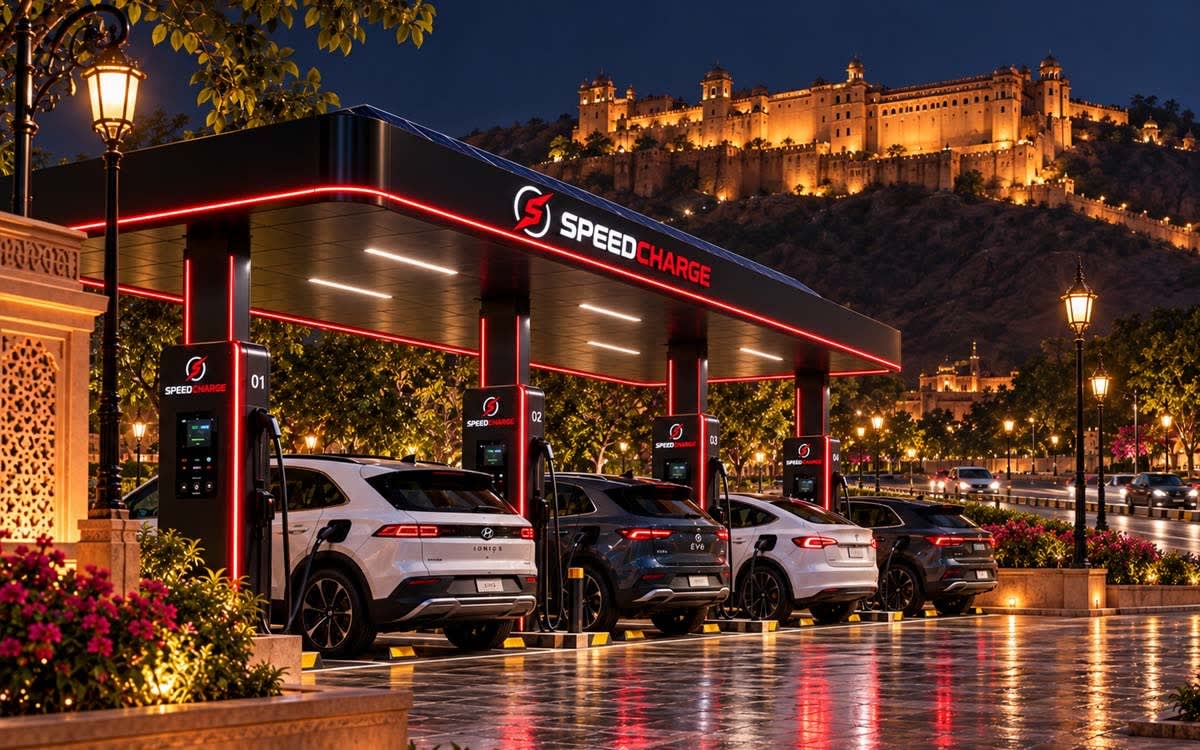
Is an electric car actually cheaper than a petrol car in India?
The answer is more complicated than comparing the price of one litre of petrol with one unit of electricity.
Many EV comparisons focus only on low electricity costs. Others focus entirely on the higher purchase price of an electric vehicle.
Both approaches miss the bigger picture.
To properly compare EV vs petrol car cost in India, you need to calculate the vehicle's Total Cost of Ownership (TCO) over the number of years and kilometres you realistically expect to own it.
That means considering:
Purchase price
Electricity or fuel
Home and public charging mix
Maintenance
Insurance
Financing
Resale value
Charger installation
Annual kilometres driven
The result can be very different for someone driving 8,000 km per year compared with someone driving 30,000 km per year.
And one factor frequently changes the calculation more than almost anything else:
Do you have reliable home charging?
If you are planning to charge at home, read the SpeedCharge home EV charging guide before calculating your ownership cost.
What Is Total Cost of Ownership for an EV?
Total Cost of Ownership measures everything you spend to purchase, operate and eventually sell a vehicle.
For a realistic electric car vs petrol car comparison, consider these six major components.
1. Purchase Price
Start with the actual on-road price of the two vehicles you are comparing.
Do not compare vehicles from completely different segments simply because one is electric and the other is petrol.
Compare models with similar:
Size
Equipment
Performance
Safety features
Seating capacity
Intended use
Also check the current road tax, registration benefits and state-specific EV incentives applicable to the vehicle category in your state.
EV policies and eligibility conditions can vary considerably between states and change over time.
Your calculation should therefore use:
Actual on-road EV price − applicable benefits
versus
Actual on-road petrol vehicle price
The difference is your initial EV purchase premium.
2. Energy Cost: Electricity vs Petrol
This is where electric cars often gain a substantial operating-cost advantage.
But you need to calculate electricity correctly.
A misleading comparison might use the cheapest available residential electricity rate even when the household actually pays more or frequently uses public fast chargers.
Your real EV charging cost depends on where and how you charge.
How to Calculate Petrol Car Running Cost Per Kilometre
The basic formula is:
Petrol cost per km = Petrol price per litre ÷ Real-world mileage
For example, consider a purely hypothetical vehicle that achieves:
14 km/l
If petrol costs:
₹100/litre
Then:
₹100 ÷ 14 = ₹7.14 per km
This example is illustrative only. Use the current petrol price in your city and your vehicle's actual real-world mileage.
City traffic, highway driving, air-conditioning, driving behaviour and vehicle loading can all change fuel economy.
How to Calculate EV Running Cost Per Kilometre
For an electric car, calculate how much electricity is actually drawn while charging.
A simplified formula is:
EV energy cost per km = Electricity consumed per km × Effective electricity rate
Suppose an EV requires approximately:
0.17 kWh per km from the electrical supply
and your effective electricity rate is:
₹8 per kWh
Then the energy cost would be approximately:
0.17 × ₹8 = ₹1.36 per km
Again, this is only an illustrative calculation.
Your actual cost depends on:
EV efficiency
Charging losses
Electricity tariff
Driving conditions
Battery temperature
AC usage
Home vs public charging
Don't Forget EV Charging Losses
The electricity reported by your vehicle as battery consumption is not necessarily the same amount of electricity drawn from your electricity meter.
Some energy is lost during:
AC-to-DC conversion
Battery charging
Thermal management
Charger electronics
Therefore, if you calculate charging cost using only the vehicle's dashboard consumption, your estimate can be too optimistic.
For an accurate TCO calculation, use electricity measured at the charger or electricity meter whenever possible.
If you are setting up your charger, the SpeedCharge EV Charger Installation Guide explains charger selection, electrical requirements and installation planning.
Home Charging vs Public Charging Changes the Calculation
Not every EV owner pays the same price for electricity.
Consider three charging environments.
Home Charging
For many owners, home charging is the most convenient and predictable way to charge an electric car.
The vehicle can remain plugged in overnight and normally start the next morning with sufficient range for daily travel.
Your actual electricity cost depends on your state's tariff structure and connection.
If you live in an apartment, installation may require additional planning. Read the SpeedCharge apartment EV charger guide for society approvals, electrical load and charging options.
Public AC Charging
Public AC charging can be useful at:
Offices
Hotels
Shopping centres
Parking facilities
Destination locations
Pricing depends on the charging operator and site.
Public DC Fast Charging
DC fast charging is valuable for:
Highway travel
Long-distance journeys
Quick top-ups
Drivers without dependable home charging
But relying heavily on paid public fast charging can increase your blended electricity cost.
Therefore, instead of calculating EV running cost using only your home tariff, estimate your actual charging mix.
For example:
70% home charging
10% destination charging
20% DC fast charging
Then calculate a weighted average charging cost.
For long-distance travel, you can use the SpeedCharge EV Charging Station Finder to identify charging locations before starting your journey.
EV vs Petrol Maintenance Cost
Maintenance is one area where the mechanical architecture of an EV can provide an advantage.
An electric drivetrain does not require several routine service items associated with an internal-combustion engine.
EVs generally avoid items such as:
Engine oil changes
Engine oil filters
Spark plugs
Clutch replacement on conventional manual drivetrains
Exhaust-system maintenance
Certain fuel-system maintenance
Timing-related engine components found on many ICE vehicles
Regenerative braking can also reduce friction-brake usage during normal driving.
However, an EV is not maintenance-free.
EV owners still need to maintain or replace items including:
Tyres
Suspension
Brake fluid
Brake components
Cabin filters
Air-conditioning system
Wipers
Wheel alignment
Thermal-management components where applicable
General wear items
Tyre wear can also vary depending on vehicle weight, torque, tyre specification and driving style.
Therefore, compare the actual scheduled-maintenance plans of the two specific vehicles rather than assuming a universal percentage saving.
What About EV Battery Replacement?
Battery replacement is one of the biggest concerns prospective EV buyers have.
But a realistic ownership-cost comparison should not automatically assume that every EV owner will replace the entire traction battery during normal ownership.
Instead, check:
Battery warranty period
Warranty kilometre limit
Capacity-retention terms
Exclusions
Transferability to the next owner
Manufacturer battery policy
If you plan to own the vehicle beyond the battery warranty period, then battery-related risk deserves greater weight in your long-term calculation.
Insurance should be compared using actual quotes for the exact vehicles.
An electric version may sometimes have a higher insured declared value or different repair economics than its petrol equivalent.
But this is model-specific, not a universal rule that every EV will always cost more to insure.
Before purchasing, obtain comparable quotes for:
Own-damage premium
Third-party insurance
Add-ons
Zero depreciation
Battery-related coverage where available
Roadside assistance
Then include the annual difference in your TCO calculation.
Resale Value: The Hardest Number to Predict
Resale value is one of the most uncertain elements in any EV vs petrol comparison.
India's used-EV market continues to develop, and resale depends on much more than the fuel type.
For an EV, buyers may consider:
Battery health
Remaining battery warranty
Vehicle age
Kilometres driven
Charging history where available
Software and technology relevance
Manufacturer support
Service network
New-car price movements
For a petrol car, resale can similarly depend on:
Brand
Model demand
Fuel regulations
Maintenance history
Age
Kilometres driven
City or state
Because future resale is uncertain, avoid making your entire EV business case depend on an aggressive resale assumption.
Financing Cost Also Matters
If you finance your vehicle, the purchase-price difference can affect total interest paid.
Suppose the EV costs more upfront and you finance most of that difference.
The higher principal can create additional financing cost over the loan period.
Therefore, your TCO calculation should use:
Total loan interest, not merely the EMI.
A lower running cost may still justify the higher purchase price, but financing should be included when calculating the true break-even point.
Don't Forget Home EV Charger Installation Cost
If you already have suitable electrical infrastructure, installing an EV charger may be relatively straightforward.
Other properties may require:
Dedicated wiring
Protection equipment
Distribution-board changes
Cable routing
Earthing work
Load enhancement
Charger mounting
Metering changes
These are part of EV ownership cost and should be included in the first-year calculation.
For a detailed overview, see the SpeedCharge guide to installing an EV charger in your parking space.
How to Calculate EV Break-Even Distance
This is the most useful calculation in the entire comparison.
Instead of asking:
"Are EVs cheaper than petrol cars?"
Ask:
"After how many kilometres does this particular EV become cheaper than the petrol car I am comparing it with?"
Step 1: Calculate the Upfront Price Difference
EV on-road price − Petrol on-road price = EV purchase premium
Apply only the incentives or tax benefits for which the vehicle and buyer are actually eligible.
Step 2: Calculate Petrol Cost Per Kilometre
Petrol price ÷ real-world mileage
Step 3: Calculate EV Electricity Cost Per Kilometre
Include your actual mix of:
Home charging
Public AC charging
DC fast charging
and account for charging losses.
Step 4: Calculate Energy Saving Per Kilometre
Petrol ₹/km − EV electricity ₹/km = Energy saving/km
Step 5: Add Maintenance Difference
Estimate annual scheduled and likely maintenance for both vehicles.
Convert the difference to a per-kilometre figure based on annual driving.
Step 6: Adjust for Insurance
If the EV costs more to insure, subtract that difference from the annual savings.
If it costs less, add the saving.
Step 7: Account for Financing and Charger Installation
Add relevant incremental upfront or financing costs.
Step 8: Calculate Break-Even Distance
A simplified formula is:
Break-even distance = Net EV upfront premium ÷ Net EV saving per kilometre
A Simple Hypothetical Example
Consider this illustrative example only:
Cost Factor | EV | Petrol |
|---|---|---|
On-road price | ₹15,00,000 | ₹12,50,000 |
Initial difference | ₹2,50,000 | — |
Energy/fuel cost per km | ₹1.50 | ₹7.00 |
Energy saving | ₹5.50/km | — |
Ignoring maintenance, insurance, financing, resale and charger installation for the moment:
₹2,50,000 ÷ ₹5.50 ≈ 45,455 km
In this simplified example, energy savings alone would recover the ₹2.5 lakh purchase difference after roughly 45,000 km.
If the owner drives:
15,000 km/year → around 3 years
If the owner drives:
7,500 km/year → around 6 years
This demonstrates why annual driving distance matters so much.
The same EV can make excellent financial sense for one driver and weak financial sense for another.
When Does an EV Usually Make More Financial Sense?
High Annual Kilometres
The more you drive, the more often the EV's lower energy cost can recover its upfront premium.
This is why high-utilisation applications can have compelling EV economics.
Reliable Home Charging
Home charging can make EV ownership easier and often more predictable financially.
If you're evaluating whether your home can support charging, see how to charge an EV at home in India.
Long Ownership Period
Keeping the vehicle for longer gives running-cost savings more time to accumulate.
Suitable Daily Driving Pattern
Drivers with predictable daily travel who can routinely charge at home or work generally use EV infrastructure more efficiently.
When Can a Petrol Car Still Make Financial Sense?
An EV does not automatically win every comparison.
A petrol car may remain competitive where:
Annual kilometres are very low
The EV purchase premium is large
Home or workplace charging is unavailable
Most charging would be expensive public fast charging
Ownership duration is short
The required EV does not suit the intended route or use
Financing costs materially increase the purchase premium
The correct decision depends on your individual use case rather than an industry-wide slogan.
Non-Financial Benefits of an EV
TCO is important, but ownership experience also matters.
Potential EV advantages include:
Home Charging Convenience
For owners with dedicated charging, the vehicle can charge while parked.
This can reduce routine visits to fuel stations.
Quiet Driving
Electric motors provide a quieter powertrain experience.
Smooth City Performance
Immediate torque and regenerative braking can make stop-start city driving comfortable.
No Tailpipe Emissions
Battery-electric vehicles do not produce exhaust emissions at the vehicle's tailpipe.
Practical Challenges of EV Ownership
Potential disadvantages should also be considered.
Long-Distance Charging Planning
Some journeys require advance planning around charger locations.
Use the SpeedCharge EV Charging Station Finder before longer trips.
Apartment Charging
Residents without access to private parking electrical infrastructure may need society approval and additional installation planning.
Public Charger Dependence
Drivers who cannot charge at home or work may spend more time and money using public charging.
Service Availability
Brand-specific service coverage should be checked if you frequently travel or live outside major urban centres.
Is an EV Cheaper Than a Petrol Car in India?
There is no universally correct answer.
For a driver with:
High annual kilometres
Reliable home charging
A reasonable EV purchase premium
Several years of ownership
an EV can have a strong total-cost case.
For someone with:
Very low annual driving
No home or workplace charging
Heavy dependence on public fast charging
Short vehicle ownership
the financial break-even may take considerably longer.
The smartest approach is therefore not to ask whether all EVs are cheaper than all petrol cars.
Calculate:
Your EV + your petrol alternative + your annual kilometres + your charging mix + your ownership period.
That produces a decision you can actually use.
How SpeedCharge Helps Reduce EV Charging Friction
The economics of EV ownership become significantly easier to understand when charging is predictable.
SpeedCharge provides information and charging solutions for EV owners across home, public and commercial charging use cases.
You can:
Understand EV charger installation requirements
Find an EV charging station for longer journeys
Explore more guides on the SpeedCharge EV Charging Blog
Final Thoughts
Comparing EV vs petrol car cost in India requires more than comparing electricity with petrol.
A proper calculation includes:
Purchase price
Applicable incentives and tax benefits
Real-world electricity or fuel consumption
Charging losses
Home vs public charging
Maintenance
Insurance
Charger installation
Financing
Resale value
Annual kilometres
Ownership period
Once these figures are included, calculate your break-even distance.
That number is far more useful than any generic claim that an EV or petrol car is automatically cheaper.
For many high-mileage drivers with convenient home charging, EV economics can be compelling. For low-mileage users who depend heavily on paid public charging, the financial advantage may be smaller and take longer to recover.
Frequently Asked Questions
1. Is an EV cheaper than a petrol car in India?
An EV can have a lower total cost of ownership when annual driving is high, home charging is available and the vehicle is owned long enough to recover its initial purchase premium. The exact result depends on the models being compared.
2. What is the running cost of an EV per kilometre?
EV running cost depends on vehicle efficiency, electricity tariff, charging losses and whether you charge at home or at paid public stations. Calculate electricity drawn per kilometre multiplied by your effective charging rate.
3. How do I calculate petrol running cost per kilometre?
Divide the current petrol price per litre by your vehicle's real-world fuel economy in kilometres per litre. For accurate comparisons, use your actual mileage rather than only the manufacturer's claimed figure.
4. Are EV maintenance costs lower than petrol cars?
EV drivetrains generally require fewer engine-related routine service items because they do not have an internal-combustion engine. However, tyres, suspension, brakes, air-conditioning, cabin filters and other wear components still require maintenance.
5. Does public fast charging make an EV expensive to run?
Frequent paid DC fast charging can increase an EV's blended energy cost compared with primarily charging at home. Owners should calculate their actual home-versus-public charging mix rather than assuming one electricity price.
6. How many kilometres does an EV take to break even?
There is no fixed break-even distance. Divide the additional upfront EV cost by the net per-kilometre saving after considering energy, maintenance, insurance and other relevant ownership costs.
7. Do I need to include home charger cost in EV ownership cost?
Yes. If you need to purchase and install dedicated charging equipment, include the charger, electrical work and any required load upgrades in your TCO calculation.
8. Is EV insurance always more expensive?
No. Insurance depends on the specific vehicle, insured value, insurer, location and selected coverage. Compare actual insurance quotations for the EV and petrol models being considered.
9. Is an EV worth buying if I cannot charge at home?
It can still work, particularly when dependable workplace or affordable public charging is available. However, exclusive reliance on public charging can reduce both the cost and convenience advantage, so calculate your charging options before buying.
10. What is the best way to compare an EV with a petrol car?
Compare similarly positioned vehicles and calculate their total cost over your expected ownership period. Include purchase price, fuel or electricity, charging losses, maintenance, insurance, financing, charger installation and estimated resale value.