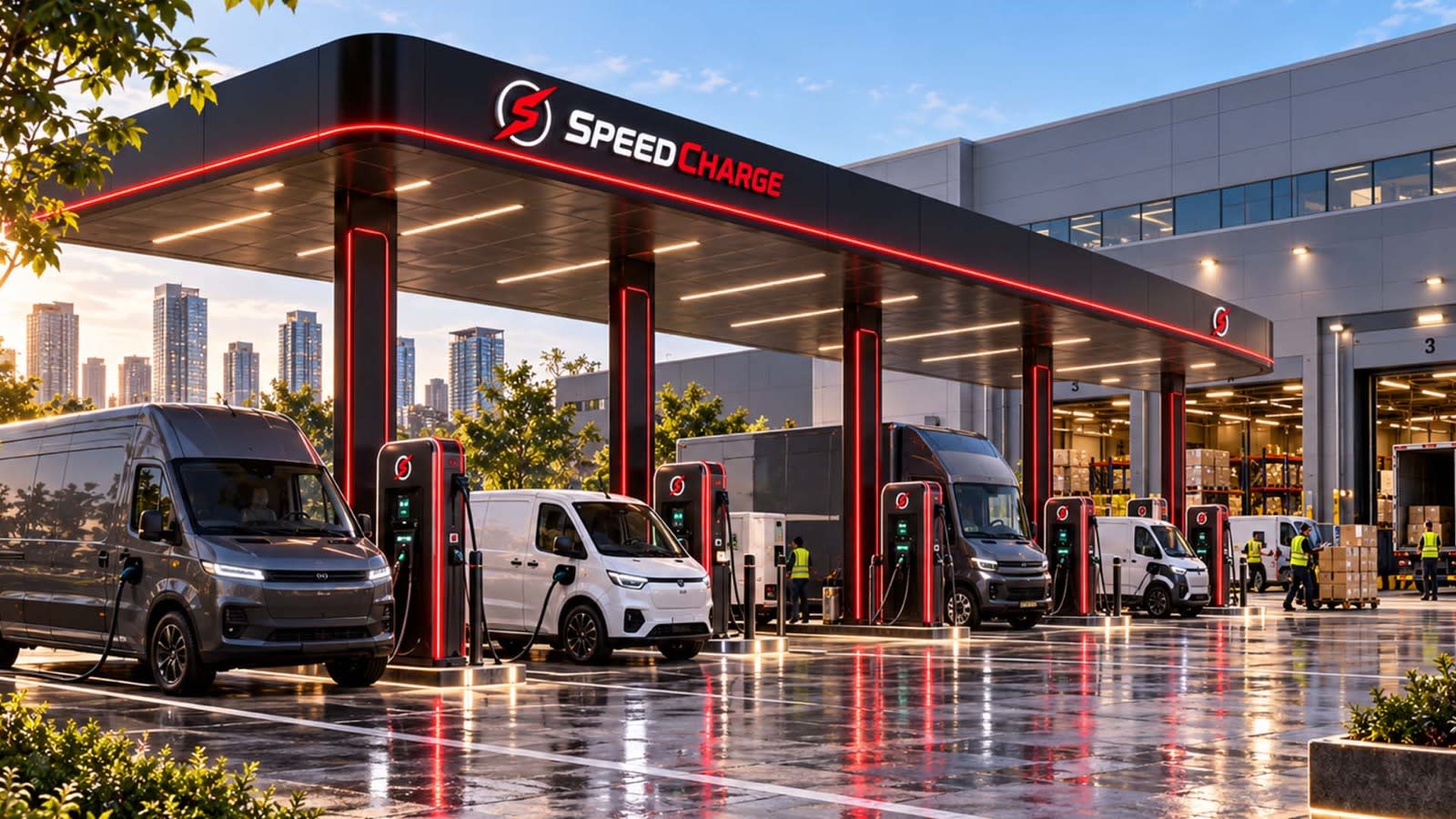
Electrifying a commercial fleet is not simply a matter of purchasing electric vehicles and installing one charger for every vehicle.
Planning fleet EV charging in India requires understanding when vehicles operate, how far they travel, how much energy they consume, when they return to base and how many hours are actually available for charging.
Unlike a public charging station, a fleet operation usually has one major advantage: much of the demand is predictable.
You often know:
Which vehicles operate
Daily kilometres
Typical routes
Payload
Return-to-base time
Next departure time
Available parking hours
Required daily energy
That predictability makes charging infrastructure much easier to model.
But it also makes mistakes expensive.
If a private EV finishes charging later than expected, the owner may face an inconvenience.
If a delivery van, staff bus, commercial three-wheeler or logistics vehicle cannot begin its scheduled shift because it was not charged, the business can lose productive vehicle hours and revenue.
That is why fleet charging should be designed around operational readiness, not simply charger count.
Businesses evaluating their charging requirements can also explore SpeedCharge commercial EV charging solutions before finalising depot infrastructure.
What Is EV Fleet Charging?
EV fleet charging refers to charging infrastructure designed to support multiple electric vehicles operated by a business or organisation.
Typical fleets include:
Last-mile delivery vehicles
Logistics vans
Commercial three-wheelers
Employee transport vehicles
Taxis
Ride-hailing vehicles
Corporate cars
Municipal vehicles
Electric buses
Trucks
Warehouse and industrial vehicles
Fleet charging can happen at:
Central depots
Warehouses
Distribution centres
Offices
Transport hubs
Parking yards
Logistics facilities
Public fast-charging stations
Battery-swapping stations
The appropriate infrastructure depends primarily on the fleet's duty cycle.
Why fleet EV charging in India Starts With the Duty Cycle
The most common planning mistake is:
50 vehicles = 50 high-power chargers.
Vehicle count alone does not tell you how much charging infrastructure is required.
Start with four numbers for every vehicle category:
Daily kilometres
Real-world electricity consumption
Energy required before the next shift
Hours available for charging
These variables determine charger power much more accurately than fleet size alone.
Calculate Daily Energy Requirement
A simplified formula is:
Daily Energy Required = Daily Distance × Vehicle Consumption
Suppose an electric delivery vehicle travels:
150 km/day
and its real-world energy consumption is:
0.20 kWh/km
Then:
150 × 0.20 = 30 kWh/day
The vehicle needs approximately 30 kWh of battery energy restored each operating day.
Installation planning should also allow for charging losses and practical operational headroom.
Charging Window Changes Everything
Now consider two identical vehicles requiring approximately 30 kWh.
Vehicle A
Available charging time:
10 hours
Average energy-delivery requirement:
30 ÷ 10 = 3 kW
Allowing practical headroom and charging losses, a relatively modest AC charging arrangement may comfortably restore the required energy overnight.
Vehicle B
Available charging time:
2 hours
Average requirement:
30 ÷ 2 = 15 kW
After allowing for losses, scheduling constraints and operational reserve, considerably higher charging power may be required.
Same vehicle.
Same daily kilometres.
Same battery.
Completely different charging infrastructure.
This is why single-shift return-to-base fleets can often be easier and less expensive to electrify than intensive multi-shift operations.
Overnight AC Depot Charging Is Often the Best Starting Point
For many return-to-base fleets, overnight AC charging is the most practical baseline.
Vehicles return after the final shift, remain parked for several hours and depart the following morning.
That long dwell period means each vehicle may not need very high charging power.
Benefits can include:
Lower charger hardware cost
Lower site power requirement
Easier electrical installation
Reduced charging complexity
More charging time
Better use of existing parking hours
Potential access to time-based tariff benefits where applicable
If a vehicle remains parked for 8–12 hours, the charging system has considerable flexibility to restore the energy consumed during the previous shift.
When Does a Fleet Need DC Fast Charging?
DC charging becomes more important when vehicles do not have enough time for overnight or long-dwell charging.
Potential use cases include:
Multi-Shift Fleets
A vehicle may finish one shift and need to begin another shortly afterwards.
Opportunity Charging
Vehicles can add energy during:
Lunch breaks
Loading periods
Driver changes
Scheduled depot stops
Mid-shift downtime
Emergency Recovery
A vehicle may return with less battery than planned because of:
Additional route distance
Traffic diversion
Heavy load
Weather
Driver behaviour
Unexpected assignment
A DC charger can provide operational backup.
High-Utilisation Commercial Vehicles
Some fleet vehicles simply cannot remain stationary for enough hours to rely entirely on lower-power charging.
For many fleets, therefore, the best architecture is not:
AC or DC
but:
AC for routine charging + strategically selected DC charging for operational flexibility.
Before selecting charger capacity, review the SpeedCharge EV Charger Installation Guide.
Dynamic Load Management Is Critical
Imagine a depot with:
40 chargers × 7 kW = 280 kW
That represents the theoretical maximum if every charger operates at full power simultaneously.
But do all 40 vehicles genuinely need 7 kW for the entire charging window?
Usually not.
Some vehicles may:
Arrive earlier
Depart later
Need only a small top-up
Already have significant battery remaining
Require different target charge levels
Dynamic load management allows charging power to be allocated according to the site's available capacity.
How Dynamic Load Management Works
Suppose the site permits a defined maximum EV charging load.
The charging-management system can distribute that power across vehicles according to factors such as:
Current battery requirement
Departure time
Vehicle priority
Charging duration
Available site capacity
Charger availability
Instead of every vehicle drawing maximum power immediately, the system can intelligently sequence and throttle charging.
Departure-Time Priority Is Better Than Equal Charging
A sophisticated fleet should not necessarily treat every connected vehicle equally.
Consider:
Vehicle A departs at 4 AM
Vehicle B departs at 8 AM
Vehicle A should normally receive priority.
A good charging-management strategy therefore works backwards from:
Required energy + departure deadline
rather than simply dividing power equally between every connected vehicle.
Load Management Can Reduce Grid Upgrade Requirements
One of the largest capital costs in fleet charging can be electrical infrastructure.
Depending on site conditions, expansion may involve:
Higher sanctioned load
Transformer capacity
HT infrastructure
Distribution panels
Cabling
Switchgear
Protection equipment
Civil work
If unmanaged charging creates an unnecessarily high theoretical peak, the site may be designed for far more capacity than operations actually require.
Smart load management can help reduce this problem.
It can also help control peak electrical demand where applicable commercial tariff structures include demand-related charges.
Check Grid Capacity Before Ordering Chargers
Do not buy charging hardware first and investigate electricity later.
The sequence should be:
Duty cycle → Energy requirement → Charging window → Site load → Grid assessment → Charger mix → Civil design
Ask the relevant technical team or electricity-distribution utility to confirm available capacity and connection requirements.
Determine:
Existing sanctioned load
Current peak demand
Available spare capacity
LT or HT implications
Transformer capacity
Load-enhancement requirements
Metering requirements
Applicable tariff category
For a broader infrastructure workflow, read How to Set Up an EV Charging Station in India.
The Real Cost of fleet EV charging in India
Do not calculate fleet economics using charger purchase price alone.
A proper model should include four cost groups.
1. Capital Costs
Include:
Chargers
Electrical installation
Distribution equipment
Cables
Conduit
Cable trays
Earthing
Protection systems
Civil work
Charger mounting
Bollards
Networking
Transformer or connection upgrades where required
Software setup
For many larger sites, the electrical connection and civil infrastructure can materially affect total project cost.
2. Recurring Costs
These may include:
Electricity
Applicable demand charges
Charging-management software
Connectivity
Maintenance contracts
Charger servicing
Insurance
Software subscriptions
Do not model electricity using only a headline ₹/kWh number if your actual commercial tariff includes other applicable components.
3. Operational Costs
Charging also consumes operational resources.
Examples include:
Driver time
Plugging and unplugging
Moving vehicles
Charging-bay management
Fault handling
Staff supervision
Cleaning and inspection
These costs may appear small individually but become meaningful at scale.
4. Downtime Risk
For a fleet, charger reliability has a direct commercial value.
Estimate the potential business impact of:
Charger failure
Power outage
Cable damage
Connector failure
Backend outage
Vehicle charging fault
Spare-part delay
The cheapest charger is not necessarily the lowest-cost charger over the operating life of the depot.
Compare Charging Cost With Fuel Savings
The business case for fleet electrification should compare total operating economics.
Potential EV benefits can include:
Lower energy cost per kilometre
Fewer engine-related service items
Regenerative braking
Reduced routine drivetrain maintenance
But calculate savings using actual operating data, not brochure figures.
Use:
Real route distance
Actual payload
Actual vehicle efficiency
Actual electricity tariff
Real charging losses
Planned charging mix
High-utilisation vehicles naturally accumulate operating-cost differences faster than low-mileage vehicles.
Good fleet EV charging in India Depends on Depot Design
The electrical system can be perfectly specified and the depot can still fail operationally if the physical layout is poor.
Charging should be designed around actual vehicle movement.
Plan for the Final Fleet Size
If you have:
20 electric vehicles today
but expect:
80 vehicles later
consider installing civil infrastructure for future capacity during the initial construction phase.
This can include:
Conduit
Cable trenches
Cable trays
Distribution-board space
Communication infrastructure
Reserved charger positions
You do not necessarily need to purchase all 80 chargers immediately.
But repeatedly digging up the same depot is inefficient.
Position Chargers Around Vehicle Inlets
Different commercial vehicles can have charging inlets in different positions.
Before fixing charger locations, check:
Left or right side
Front or rear
Vehicle length
Parking direction
Cable reach
Avoid designing the site around one demonstration vehicle if several models will eventually operate there.
Protect Charging Hardware
Busy commercial yards can be harsh environments.
Consider:
Bollards
Kerbs
Wheel stops
Protected mounting
Cable management
A charger located directly in a reversing path is an avoidable failure waiting to happen.
Provide Good Lighting
Fleet vehicles may connect late at night or early in the morning.
Charging locations should be sufficiently illuminated for safe connector handling, inspections and vehicle movement.
Keep Charging Cables Off the Ground
Dragging heavy charging cables across rough depot surfaces can accelerate wear.
Cable-management systems can help reduce:
Abrasion
Connector damage
Trip hazards
Contamination
Plan for Monsoon Drainage
Charging infrastructure and vehicle movement should remain practical through Indian monsoon conditions.
Consider:
Drainage
Standing water
Charger elevation
Cable routing
Surface condition
Weather protection
Use Charging Software for Operational Control
A fleet charging system should provide more than electricity.
Operators need visibility.
Useful functions can include:
Charger status
Vehicle charging status
Session history
Energy delivered
Fault alerts
Remote restart
User authentication
Charger availability
Scheduled charging
Load management
Energy reports
For managed multi-charger deployments, open communication standards and backend flexibility can also become important over the infrastructure's life.
Monitor Vehicles Against Departure Readiness
The most useful fleet dashboard does not simply say:
Charger online
It answers:
Will every required vehicle have enough energy when its next shift starts?
Alerts should ideally identify:
Vehicle not connected
Charging session failed
Charging slower than expected
Vehicle below required target
Charger offline
Expected completion after departure deadline
This turns charging from passive infrastructure into an operational system.
Make Plugging In Part of the Driver SOP
One surprisingly simple failure can defeat a sophisticated charging depot:
The driver forgets to plug in the vehicle.
Charging should therefore be a documented end-of-shift process.
A basic checklist might include:
Park in allocated bay
Apply parking procedure
Inspect connector visually
Connect charger
Confirm charging session starts
Report any charger fault immediately
Do not rely on memory.
Assign Responsibility for Charging Uptime
Someone should own charging operations.
Depending on fleet size, this may be:
Fleet manager
Depot supervisor
Facility manager
Charging operator
Maintenance contractor
The responsibility should include:
Fault monitoring
Escalation
Preventive maintenance
Cable inspection
Charger availability
Software alerts
Backup planning
If everyone is responsible, nobody is responsible.
Always Have a Charging Contingency Plan
Charging infrastructure can fail.
The fleet should know what happens next.
Plan for:
Charger Failure
Can the vehicle use another charger?
Depot Power Failure
Which vehicles have enough battery to operate?
Unexpectedly Low Battery
Where is the nearest compatible DC charger?
Cable or Connector Damage
Is a replacement available?
Backend Failure
Can charging continue locally?
Vehicle Failure
Can another vehicle cover the route?
Before operations begin, identify backup public chargers using the SpeedCharge EV Charging Station Finder.
Which Fleets Are Best Suited to Electrification?
Some operating patterns are particularly favourable.
Strong Candidates
Predictable daily routes
Return-to-base operations
Overnight parking
High daily utilisation
Urban driving
Regular stop-start operation
Known payload
Single-shift schedules
Examples can include:
Last-mile delivery
Urban logistics
Staff transport
Commercial three-wheelers
City distribution vehicles
Certain municipal fleets
These duty cycles can make charging and energy requirements easier to model.
More Challenging Fleets
Electrification requires more detailed planning when vehicles have:
Unpredictable long-distance routes
Minimal depot dwell
Multiple intensive shifts
No secure overnight base
Highly variable payload
Limited charging options along routes
This does not necessarily mean the fleet cannot electrify.
It means charger and vehicle selection must reflect the operational constraints.
Consider Battery Swapping for Suitable Fleets
For some electric two- and three-wheeler fleets, battery swapping can be an alternative to conventional plug-in charging.
Instead of waiting for a depleted battery to recharge, the user exchanges it for a charged compatible battery.
Potential benefits include:
Reduced vehicle downtime
Faster energy replenishment
Smaller charging requirement at the vehicle parking location
Battery management handled by the service provider in some models
Depending on the commercial model, swapping can also separate battery ownership or battery cost from the vehicle.
Battery Swapping Has Trade-Offs
Evaluate:
Vehicle compatibility
Battery standardisation
Swap-station coverage
Subscription or energy pricing
Provider reliability
Battery availability
Long-term contract terms
For a fleet, the deciding question is often:
How valuable is vehicle uptime?
If every hour off-road means lost revenue, swapping may deserve serious consideration.
Phase the Fleet Transition
Moving an entire large fleet to electric vehicles at once creates unnecessary risk.
A phased approach produces operating data before the full investment is committed.
Phase 1: Model the Fleet
Document:
Routes
Daily kilometres
Energy consumption assumptions
Dwell windows
Peak operations
Vehicle payload
Electricity infrastructure
Phase 2: Prepare Scalable Infrastructure
Where commercially sensible, size the difficult-to-change civil infrastructure for future expansion.
Examples:
Conduit
Cable trays
Panel space
Yard layout
Phase 3: Pilot the Best Route
Choose a route with:
Predictable kilometres
Comfortable EV range
Reliable depot return
Long charging window
The purpose is to learn.
Phase 4: Measure Everything
Track:
Real kWh/km
Charging time
Charger uptime
Route completion
Driver feedback
Charging failures
Vehicle availability
Cost/km
Phase 5: Scale Using Actual Data
Use pilot results to refine:
Charger quantity
Charger power
Connection capacity
Load-management rules
Vehicle selection
Operating procedures
Real depot data is more valuable than assumptions.
KPIs Every Electric Fleet Should Track
A fleet-charging system becomes easier to optimise when a small number of operational metrics are tracked consistently.
Energy Consumption
kWh per vehicle per day
Vehicle Efficiency
kWh/km or km/kWh
Charging Cost
₹/vehicle and ₹/km
Charger Uptime
Percentage of time chargers are available.
Charging Success Rate
Sessions that complete correctly versus sessions attempted.
Departure Readiness
Percentage of required vehicles ready with sufficient energy at scheduled departure.
Peak Charging Demand
Maximum depot charging load.
Charger Utilisation
How much each charger is actually used.
These numbers make future expansion much more accurate.
Common Fleet Charging Mistakes
Avoid these errors.
Installing One High-Power Charger Per Vehicle
Long dwell times may make that unnecessary.
Buying Chargers Before Checking Grid Capacity
Electrical supply can be the primary constraint.
Ignoring Load Management
This can create unnecessary peak demand and infrastructure cost.
Designing Only for Current Vehicle Count
Civil infrastructure may become expensive to redo.
Using Manufacturer Range Alone
Fleet planning should use actual loaded-route consumption.
No Backup Charging Plan
A single charger failure should not stop critical operations.
No Charging SOP
Drivers need a repeatable connection and fault-reporting process.
No Owner for Charger Uptime
Infrastructure needs operational accountability.
Charging-as-a-Service vs Owning the Infrastructure
Not every fleet operator wants to become a charging-infrastructure operator.
Depending on the provider and contract, a charging-as-a-service model may include:
Infrastructure funding
Charger installation
Software
Maintenance
Monitoring
Service support
The fleet operator then pays under an agreed commercial structure.
Potential benefits include:
Lower upfront infrastructure burden
Outsourced technical maintenance
Defined service responsibility
Faster deployment
Potential trade-offs include:
Long-term service cost
Less hardware control
Contract dependence
Pricing escalation
Provider dependency
What Should You Negotiate?
Before signing a long-term charging agreement, review:
Uptime commitment
Fault response time
Service escalation
Pricing mechanism
Electricity treatment
Hardware ownership
Contract duration
Exit terms
Expansion rights
Software/data access
What happens to equipment when the agreement ends
Uptime promises should be measurable.
Working With a Fleet Charging Partner
For operators evaluating fleet EV charging in India, a specialised charging partner can help coordinate charger selection, electrical design, software, load management, installation, operations and future expansion.
SpeedCharge works across commercial and property charging use cases. Businesses can explore SpeedCharge commercial EV charging solutions and review the EV Charging Station Setup Guide before planning infrastructure.
For technical installation considerations, see the SpeedCharge EV Charger Installation Guide.
More EV infrastructure and ownership guidance is available on the SpeedCharge EV Charging Blog.
Final Thoughts
Successful fleet EV charging in India is primarily an operations and energy-planning problem.
Do not start by counting vehicles and ordering the same number of chargers.
Start with:
Daily kilometres
Real vehicle efficiency
Daily kWh requirement
Charging window
Departure schedule
Grid capacity
Load management
Charger mix
Depot layout
Operational process
Reliability requirements
Expansion plans
For predictable return-to-base fleets, overnight AC charging can provide a cost-effective foundation.
Use DC fast charging where short turnaround times, opportunity charging or operational backup justify it.
Most importantly, use intelligent load management rather than designing electrical capacity around every charger operating at maximum output simultaneously.
A fleet gives you something public charging does not: predictable vehicles, predictable routes and predictable schedules.
Frequently Asked Questions
1. How many EV chargers does a fleet need?
There is no fixed one-charger-per-vehicle rule. Charger quantity should be calculated from daily energy requirement, charging window, vehicle schedules, charger utilisation and whether vehicles can share chargers across different arrival and departure times.
2. Is AC or DC charging better for an EV fleet?
AC charging is often suitable for vehicles with long overnight dwell times. DC charging becomes more useful for multi-shift fleets, short turnaround periods, opportunity charging and operational backup. Many depots can benefit from using both.
3. What is dynamic load management for fleet charging?
Dynamic load management controls how available electrical capacity is distributed across multiple connected EVs. It can prioritise vehicles according to energy requirements or departure times while keeping total site demand within a configured limit.
4. How do I calculate the required fleet charger power?
Estimate each vehicle's daily kWh requirement and divide it by the practical charging hours available. Then account for charging losses, operational reserve, charger efficiency, simultaneous charging demand and site electrical limitations.
5. Do EV fleets need a dedicated charging depot?
Not always. Return-to-base fleets often benefit from depot charging because vehicles remain parked for predictable periods. Other fleets may combine workplace, depot, public, opportunity or battery-swapping infrastructure depending on their operating model.
6. Can load management reduce fleet charging infrastructure cost?
It can help reduce unnecessary peak charging demand and may reduce the amount of additional electrical capacity required. Actual savings depend on existing grid capacity, tariff structure, fleet schedules and site design.
7. Is battery swapping better than charging for commercial EVs?
It can be attractive for compatible two- and three-wheeler fleets where vehicle downtime has high commercial value. The decision depends on swap-station availability, vehicle compatibility, provider pricing and operating routes.
8. What should a fleet monitor after electrification?
Track vehicle efficiency, kWh consumed, electricity cost, charger uptime, charging success rate, departure readiness, peak electrical demand, charger utilisation and route completion.
9. What happens if a fleet charger fails?
The depot should have a documented contingency plan involving alternate chargers, vehicle swapping, service escalation and nearby compatible public charging. Critical fleets should avoid relying on a single point of failure.
10. Should a company own fleet chargers or use charging-as-a-service?
Both models can work. Ownership offers more control but requires capital and technical responsibility. Charging-as-a-service can shift installation and maintenance responsibilities to a provider, depending on contract terms. Compare total long-term cost, uptime commitments, scalability and control before deciding.