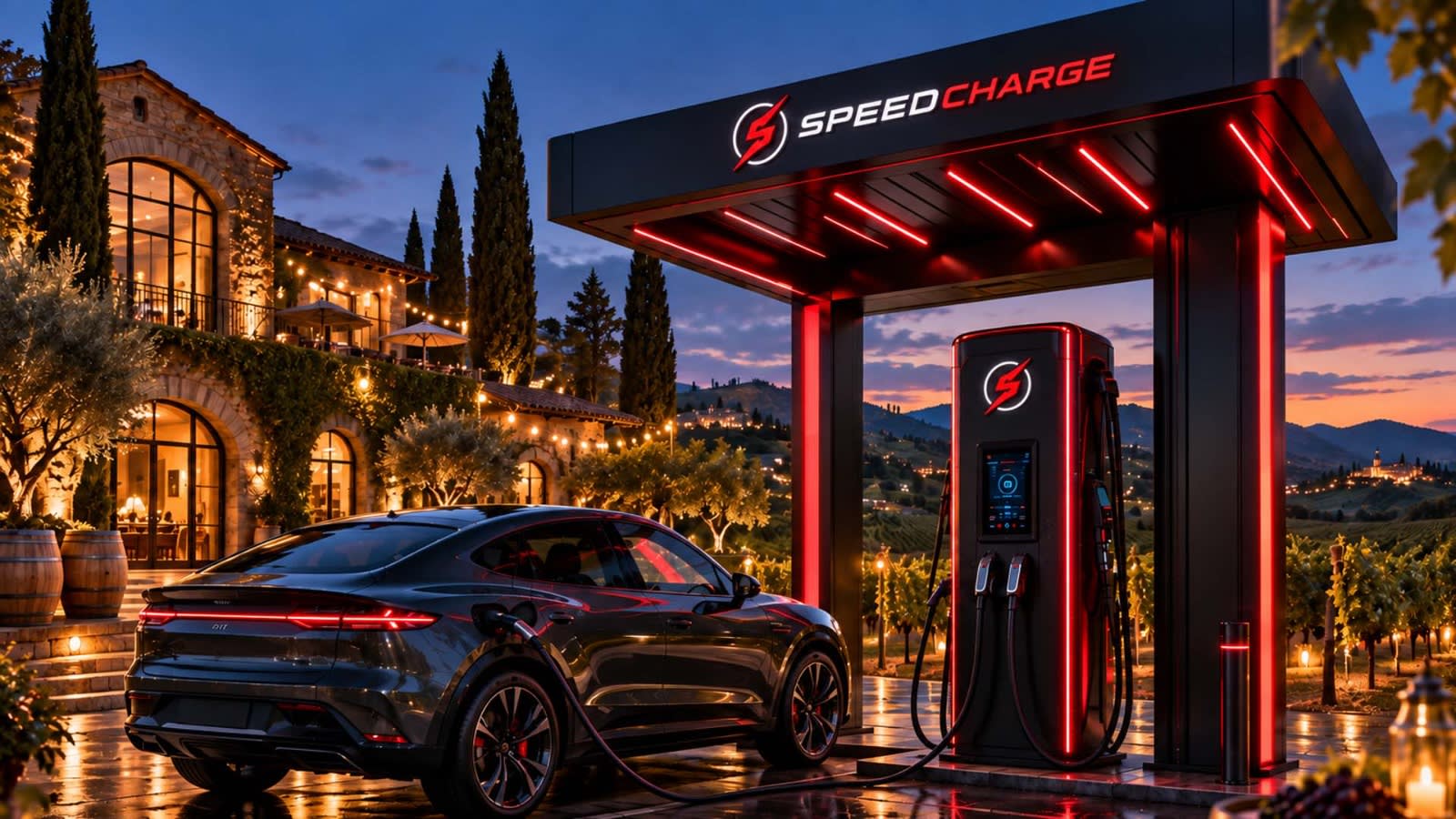
Indore is one of Madhya Pradesh's most important commercial, industrial and transport centres, with expanding residential areas, manufacturing activity, logistics, hospitality, corporate development and strong regional road connectivity. Madhya Pradesh's current EV policy also identifies Indore as a Model EV City. For entrepreneurs and infrastructure investors, an EV charging station franchise in Indore can therefore provide a structured route into the city's developing electric-mobility ecosystem.
However, charging infrastructure should not be evaluated like a conventional retail franchise.
Installing a high-capacity charger does not automatically create a profitable charging business. Commercial performance depends on whether the selected property generates enough billable energy.
The core business equation is:
Relevant EV Demand × Charger Utilisation × Billable kWh × Retained Economics
Before investing, evaluate:
Relevant EV traffic
Daily charging demand
Customer segment
Electrical capacity
Charger configuration
Parking
Entry and exit
Property economics
Electricity costs
Fleet demand
Charger uptime
Existing competition
Future expansion
A better investment sequence is:
Demand → Site → Electrical Feasibility → Charger → Commercial Model → Deployment
Why Indore Is an Important EV Charging Market
Indore has several characteristics that make it relevant for EV charging infrastructure.
Potential charging customers include:
Private electric-car owners
Electric two-wheelers
Electric three-wheelers
Electric taxis
Delivery vehicles
Corporate fleets
Logistics operators
Industrial vehicles
Corporate employees
Apartment residents
Hotel guests
Intercity EV travellers
The city's position within Madhya Pradesh is also important.
Indore connects with major regional destinations and industrial corridors including:
Pithampur
Dewas
Ujjain
Mhow
Bhopal-linked routes
Mumbai-facing highway connectivity
These different customer groups create opportunities for public, fleet, workplace, residential, destination and highway charging.
More importantly, the official Madhya Pradesh Electric Vehicle Policy 2025 identifies Indore, Bhopal, Jabalpur, Gwalior and Ujjain as Model EV Cities.
This makes Indore strategically relevant to the state's charging-infrastructure development, but city-level policy support should not be confused with guaranteed profitability for an individual property.
What Is an EV Charging Franchise?
An EV charging station franchise in Indore allows an investor, entrepreneur, business or eligible property owner to participate in charging infrastructure using some combination of an established charging operator's hardware ecosystem, software platform, network, brand and operating capabilities.
Different charging businesses can use different commercial structures, including:
FOCO — Franchise Owned, Company Operated
FOFO — Franchise Owned, Franchise Operated
Revenue Share
Location-host partnership
Charging-as-a-Service
Fleet charging partnership
The franchise label alone does not explain who owns the asset or who carries commercial risk.
Before investing, establish:
Who owns the charging equipment?
Who owns upstream electrical infrastructure?
Who pays for electricity?
Who handles customer billing?
Who operates the station?
Who maintains the charger?
How is Revenue Share calculated?
Who handles downtime?
Who pays for major repairs?
What happens when the agreement ends?
SpeedCharge's EV charging franchise business guide explains franchise structures, site selection, investment components, electricity feasibility, Revenue Share, operating risks and agreement due diligence.
Why Madhya Pradesh EV Policy 2025 Matters for Indore
Madhya Pradesh's current EV policy aims to develop accessible EV charging infrastructure and increase collaboration between government agencies and private-sector participants.
For Indore, one of the most important provisions is its designation as a Model EV City.
The policy framework addresses several areas relevant to charging infrastructure, including:
Public charging infrastructure
Model EV Cities
Workplace charging
Charging on government land
Charging-station incentives
Battery swapping
Private-sector participation
Charging accessibility
The policy also provides a framework for public charging-station incentives.
For eligible stations, the policy describes capital subsidy on charging equipment/machinery of:
Station Category | Policy Incentive Framework |
|---|---|
Small Charging Station | 25% for first 300 stations, maximum ₹1.5 lakh |
Medium Charging Station | 25% for first 100 stations, maximum ₹3 lakh |
Large Charging Station | 25% for first 100 stations, maximum ₹10 lakh |
These figures should not be treated as an automatic subsidy available to every private investor.
Actual eligibility depends on:
Applicable station category
Current scheme availability
Eligible equipment
Application requirements
Approval
Whether the allocation remains available
Applicable implementation procedure
Therefore, prepare the business case without assuming a subsidy. Treat an approved incentive as potential upside rather than essential revenue.
Franchise vs Independent EV Charging Business
An investor can either join an established charging network or build an independent operation.
Factor | Franchise / Network | Independent Station |
|---|---|---|
Brand | Existing network | Build your own |
Hardware | Usually standardised | Self-selected |
Software | Usually integrated | Must be arranged |
Customer billing | May be integrated | Self-managed |
Monitoring | Network backend | Own CSMS |
Maintenance | May be supported | Self-managed |
Operations | Model dependent | Investor managed |
Customer discovery | Network can support | Self-managed |
Technical workload | Generally lower | Generally higher |
Flexibility | Agreement dependent | Greater control |
Neither model automatically produces better returns.
A franchise/network model can suit investors seeking integrated technology, billing, monitoring, maintenance and operational support.
An independent station can provide greater control but requires stronger expertise across electrical infrastructure, hardware, software, payments, maintenance and customer acquisition.
EV Charging Station Investment in Indore
Investment in an EV charging station franchise in Indore should be calculated from complete commissioned-project CAPEX rather than only the charger quotation.
Major cost components can include:
Investment Component | What It Can Include |
|---|---|
Charger hardware | AC or DC EVSE |
Electricity connection | New connection/load enhancement |
Transformer | Where technically required |
Electrical panels | Distribution and protection |
Cabling | Power and communication cables |
Earthing | Electrical safety infrastructure |
Civil work | Foundation, trenching and bays |
Installation | Deployment and commissioning |
Software | CSMS/backend |
Connectivity | SIM/internet/networking |
Branding | Signage and bay markings |
Property | Rent, lease or Revenue Share |
Maintenance | Preventive/corrective support |
Operations | Station and customer management |
Two stations using the same charger can therefore require significantly different investments.
For example, Site A may already have sufficient electrical capacity.
Site B may require:
Load enhancement
New transformer
Additional electrical panels
Long cable runs
Extensive civil work
Site B's charger quotation could look identical while its total project cost is substantially higher.
SpeedCharge's EV charging station investment guide provides a broader framework for analysing CAPEX, electrical infrastructure, site economics and investment risk.
How Much Space Is Needed?
There is no single space requirement that applies to every charging project.
Space depends on:
Number of charging points
Vehicle category
Charger configuration
Electrical equipment
Transformer requirements
Parking layout
Entry and exit
Queueing
Customer amenities
Future expansion
A public fast-charging hub requires a different layout from an apartment AC charger or fleet depot.
Investors should avoid choosing a property merely because its total square footage appears sufficient.
The layout must support safe and convenient vehicle movement.
AC vs DC Fast Charging in Indore
Charger selection should follow customer behaviour.
AC Charging
AC charging can work effectively where vehicles remain parked for several hours.
Potential applications include:
Corporate offices
Hotels
Hospitals
Apartment complexes
Educational institutions
Long-stay parking
Commercial campuses
DC Fast Charging
DC charging is more relevant when drivers need shorter charging stops.
Potential applications include:
Public charging hubs
Fuel stations
Taxi hubs
Fleet depots
Logistics properties
Industrial corridors
Highway sites
A hotel guest staying overnight does not necessarily need the same charger as an intercity EV driver travelling between Indore and another city.
SpeedCharge's DC vs AC EV charging guide explains how vehicle segment, dwell time, power availability and expected utilisation should determine charger selection.
Best Locations for EV Charging Stations in Indore
Location selection can determine whether an EV charging station franchise in Indore develops sustainable utilisation.
The following areas should be treated as site-investigation zones, not guaranteed profitable locations.
Vijay Nagar
Vijay Nagar combines:
Commercial offices
Hotels
Restaurants
Shopping
Residential properties
Business activity
Potential models include:
Destination charging
Workplace charging
Public charging
Taxi charging
Parking and electricity availability are critical because a premium commercial location is not automatically a strong charging property.
Super Corridor
The Super Corridor is strategically interesting because of ongoing commercial, institutional and residential development and its connectivity toward the airport side.
Potential charging models include:
Public charging
Workplace charging
Destination charging
Fleet charging
Investment decisions should use current demand rather than relying only on future development projections.
AB Road
AB Road can support multiple charging use cases because of commercial properties, residential catchments and regional road connectivity.
Potential models include:
Public DC charging
Destination charging
Fleet charging
Intercity charging
A suitable site should offer convenient access without forcing drivers to make difficult detours.
Rau
Rau is worth investigating for city-edge and highway-oriented charging.
Potential customers include:
Local EV owners
Intercity travellers
Commercial vehicles
Fleet users
For highway-oriented charging, amenities and 24-hour accessibility become more important.
Nipania
Nipania's residential and commercial development can make selected properties suitable for:
Residential charging
Destination charging
Public charging
Customer dwell time and local EV ownership should determine charger configuration.
Palasia
Palasia has strong commercial and residential activity.
Potential charging use cases include:
Destination charging
Workplace charging
Public charging
Parking availability can be a significant constraint in dense commercial areas.
Scheme No. 54 and Scheme No. 78
These areas combine commercial, residential and office activity and can be evaluated for destination and workplace charging.
Dewas Naka
Dewas Naka can be particularly relevant for:
Commercial EV charging
Fleet charging
Logistics
Delivery vehicles
Intercity charging
Repeat fleet demand can materially improve utilisation where operations are predictable.
Indore–Dewas Corridor
This corridor can potentially serve:
Intercity EV users
Logistics vehicles
Commercial fleets
Passenger vehicles
Properties should be evaluated for power availability, safe road access and amenities.
Indore–Ujjain Corridor
With movement between two major Madhya Pradesh cities, suitable corridor properties can be evaluated for intercity fast charging.
Pithampur-Connected Corridor
Pithampur's industrial ecosystem makes this corridor relevant for future fleet and commercial charging.
The strongest properties would be those with measurable commercial EV demand rather than general industrial traffic alone.
SpeedCharge's EV charging station site selection guide explains how EV demand, electrical capacity, accessibility, parking, competition and property economics should be evaluated before committing to a site.
Indore EV Charging Site Selection Scorecard
Site Factor | Priority | What to Evaluate |
|---|---|---|
Relevant EV demand | Very High | Actual charging requirement |
Electrical capacity | Very High | Sanctioned load and spare capacity |
Fleet demand | High | Taxi, logistics and delivery EVs |
Entry/exit | High | Convenient vehicle movement |
Parking | High | Dedicated charging bays |
Dwell time | High | Match with charger power |
Competition | High | Nearby charger supply/utilisation |
Property economics | Very High | Rent/lease/Revenue Share |
Operating hours | High | Customer accessibility |
Visibility | Medium–High | Road frontage and signage |
Amenities | Medium–High | Food, washroom, waiting |
Safety | High | Lighting and surveillance |
Expansion | High | Additional chargers/power |
A site with high general traffic can still be commercially weak if relevant EV users cannot conveniently enter, charge and leave.
Electricity Connection and Electrical Feasibility
Electrical feasibility should be completed before charger procurement.
Verify:
Existing sanctioned load
Spare electrical capacity
Required charging load
Load enhancement
LT/HT requirement
Transformer capacity
Cable route
Electrical panels
Metering
Earthing
Protection systems
Future expansion
The official Ministry of Power Guidelines for Installation and Operation of Electric Vehicle Charging Infrastructure 2024 provide the national framework for charging infrastructure, electricity connections, public charging, tariffs and deployment.
The guidelines cover charging infrastructure at locations including:
Private parking
Office buildings
Educational institutions
Hospitals
Group Housing Societies
E-bus depots
Commercial complexes
Railway stations
Petrol pumps
Airports
Metro stations
Shopping areas
Municipal parking
Highways
Expressways
They also allow charging-station owners to opt for LT electricity connections for loads up to 150 kW, subject to the applicable framework.
For practical implementation considerations, see SpeedCharge's EV charging requirements guide.
Do You Need an Electricity Distribution Licence?
Setting up and operating an EV charging station is treated as an unlicensed activity from the electricity-distribution licensing perspective.
Private entities are allowed to establish, operate and maintain EV charging stations subject to applicable requirements.
This does not mean there are no technical or regulatory requirements.
Depending on the project, investors still need to address:
Electricity connection
Sanctioned load
Electrical safety
Earthing
Metering
Charger specifications
Property rights
Fire and safety requirements
Applicable DISCOM procedures
Local requirements
An EV charging station should therefore be treated as professional electrical infrastructure.
EV Charger Standards and Specifications
Charger selection should consider both vehicle compatibility and expected customer behaviour.
Investors should verify:
Connector type
Charger power
Output voltage
Number of charging guns
Vehicle compatibility
Customer dwell time
Expected daily energy
Software compatibility
Communication protocol
Safety systems
Expansion capability
The Bureau of Energy Efficiency EV Charging Infrastructure Specifications provides official information on EV charging configurations and specifications.
Do not select hardware merely because a higher kW figure looks more attractive.
The right charger is the one that matches the site's customer segment, electricity infrastructure and expected utilisation.
How EV Charging Station Revenue Works
Charging-station revenue is fundamentally driven by energy sold.
A simplified formula is:
Gross Charging Revenue = Billable kWh × Effective Customer Charging Price
This is gross revenue, not profit.
Operating economics can include:
Electricity cost
Property rent
Revenue Share
Maintenance
Software
Connectivity
Payment processing
Staffing
Financing
Taxes
Downtime-related losses
This distinction matters because a station can generate substantial gross revenue while still producing weak retained economics if operating expenses are high.
How EV Charging Station ROI Works
ROI from an EV charging station franchise in Indore depends on complete project CAPEX, billable energy, utilisation, electricity costs, operating expenses, uptime and the applicable commercial agreement.
There is no responsible universal ROI percentage for every Indore property.
Consider two hypothetical sites:
Metric | Site A | Site B |
|---|---|---|
Charger capacity | 120 kW | 60 kW |
Relevant EV demand | Low | Strong |
Fleet demand | Limited | Regular |
Parking | Difficult | Easy |
Entry/exit | Poor | Direct |
Uptime | High | High |
Utilisation | Low | Higher |
Commercial potential | Limited | Potentially stronger |
The key distinction is:
Installed kW = Maximum Charging Capability
Billable kWh = Energy Actually Sold
A consistently utilised 60 kW charger can potentially outperform an underutilised 120 kW asset.
SpeedCharge's EV charging station ROI guide explains how utilisation, CAPEX, energy throughput, electricity expenses and uptime influence charging-station returns.
Major Revenue Drivers in Indore
Daily Charging Sessions
Estimate actual paying customers rather than total road traffic.
Energy Delivered per Session
A customer purchasing 35 kWh creates different energy revenue from one purchasing 8 kWh.
Utilisation
Track how frequently the charger is actively delivering paid energy.
Electricity Cost
Electricity expense directly affects retained economics.
Property Cost
Higher rent increases the energy throughput required to reach break-even.
Charger Uptime
An unavailable charger cannot generate billable kWh.
Fleet Demand
Taxi, logistics, delivery and commercial fleets can provide repeat charging demand.
Customer Dwell Time
The charger should match the time customers naturally spend at the location.
Public vs Fleet vs Destination Charging in Indore
Indore can support multiple charging models.
Charging Model | Primary Customer | Main Site Requirement |
|---|---|---|
Public charging | Passenger EVs | Access + visibility |
Workplace charging | Employees | Long dwell time |
Fleet charging | Commercial fleets | Repeat energy demand |
Destination charging | Mall/hotel visitors | Natural parking |
Highway charging | Intercity EVs | Fast charging + amenities |
Residential charging | Apartment residents | Long/overnight dwell |
Taxi charging | High-mileage EVs | Fast turnaround |
Industrial charging | Commercial vehicles | Power + fleet access |
Logistics charging | Delivery/fleet EVs | Predictable charging windows |
A Vijay Nagar hotel guest and a commercial vehicle operating around Dewas Naka have fundamentally different charging patterns.
Hardware should follow the customer use case.
Fleet Charging Opportunity in Indore
Indore's industrial, logistics and commercial ecosystem makes fleet charging particularly worth investigating.
Potential fleet customers include:
Electric taxis
Delivery fleets
E-commerce vehicles
Corporate fleets
Commercial three-wheelers
Logistics vehicles
Institutional fleets
For fleet charging, analyse:
Number of vehicles
Daily kilometres
Battery capacity
Charging frequency
Return-to-base timing
Required turnaround
Daily kWh demand
Peak charging window
Predictable fleet demand can reduce reliance on random public charging sessions.
SpeedCharge's EV fleet charging guide explains how duty cycles, charging windows and infrastructure requirements differ from conventional public charging.
Madhya Pradesh Public Charging Incentives: What Investors Should Verify
The MP EV Policy 2025 provides an incentive framework for eligible public charging infrastructure.
However, there are three important distinctions:
Policy incentive ≠ automatic approval
Maximum subsidy ≠ guaranteed subsidy
Charging-sector growth ≠ guaranteed investor ROI
Before including an incentive in the business plan, verify:
Station classification
Eligible charger/equipment cost
Number of stations already approved
Remaining eligibility
Application procedure
Required documents
Approval authority
Commissioning requirements
Disbursement conditions
Current validity
The project's base economics should remain sensible without depending entirely on an incentive.
PM E-DRIVE and Public Charging Infrastructure
The Government of India's PM E-DRIVE programme includes ₹2,000 crore for public EV charging infrastructure.
The Ministry of Heavy Industries issued operational guidelines for deployment of EV Public Charging Stations on 26 September 2025.
Investors can review the official PM E-DRIVE Scheme Guidelines.
The framework provides different levels of support depending on the location category.
Eligible implementation is routed through specified government entities, States/UTs, CPSEs, PSUs and nodal agencies, with Charge Point Operators potentially engaged for deployment.
This means:
A private charging franchise should not assume that PM E-DRIVE funding is automatically payable directly to the investor.
Project-specific eligibility, location category, nodal agency and implementation structure must be established before any subsidy is included in the financial model.
Franchise Due-Diligence Checklist
Before signing an agreement for an EV charging station franchise in Indore, verify both the site and the commercial agreement.
Question | Why It Matters |
|---|---|
Who owns the charger? | Determines asset ownership |
Who owns electrical infrastructure? | Important at termination |
Who pays electricity? | Affects retained economics |
Who operates the station? | Determines investor workload |
Who handles billing? | Defines operational responsibility |
Who maintains equipment? | Influences uptime |
How is Revenue Share calculated? | Determines payout |
Is a minimum payout contractual? | Must be documented |
Who pays major repair costs? | Determines operating risk |
Who controls charging data? | Important for transparency |
What happens during downtime? | Defines responsibility |
What is the agreement period? | Determines commitment |
What happens at termination? | Important for asset recovery |
Never evaluate a franchise only from a headline ROI, monthly-income or investment figure.
The executed agreement determines the actual commercial structure.
SpeedCharge Franchise Model
SpeedCharge works with eligible investors, businesses, entrepreneurs and property owners through structured EV charging franchise and partnership models.
Depending on the applicable project and commercial structure, SpeedCharge can support functions such as:
Site feasibility
Electrical planning
DISCOM coordination
Civil execution
Charger installation
Testing and commissioning
Charging software
Network integration
Remote monitoring
Driver billing
Customer support
Preventive maintenance
Fault management
Performance reporting
Under a FOCO structure, the investor owns the applicable charging infrastructure while SpeedCharge manages specified operational functions according to the executed agreement.
SpeedCharge also supports FOFO arrangements depending on location, investment preference and the approved commercial structure.
Any Revenue Share or Minimum Guaranteed Monthly Payout should be understood strictly according to the applicable project proposal and executed agreement.
A Minimum Guaranteed Monthly Payout is not the same as guaranteed profit or guaranteed ROI.
Investors can review the SpeedCharge EV charging station franchise programme before requesting a site-specific proposal.
Step-by-Step: How to Start an EV Charging Station in Indore
Step 1: Define the Customer
First decide whether the station will primarily serve:
Private EV owners
Taxis
Corporate employees
Delivery fleets
Commercial vehicles
Apartment residents
Hotel guests
Intercity travellers
Step 2: Analyse Local EV Demand
Measure actual EV movement around the proposed location.
Do not use general traffic alone.
Step 3: Analyse Existing Charging Competition
Map nearby stations and compare:
Charger capacity
Connector type
Customer pricing
Accessibility
Parking
Operating hours
Reliability
Customer usage
Step 4: Shortlist Properties
Compare potential properties using:
Relevant EV demand
Parking
Entry/exit
Visibility
Dwell time
Fleet activity
Competition
Property economics
Step 5: Complete Electrical Feasibility
Verify:
Sanctioned load
Spare capacity
Load enhancement
LT/HT requirements
Transformer capacity
Cable route
Metering
Earthing
Expansion potential
Step 6: Select the Charger
Choose the charger according to:
Vehicle segment
Customer behaviour
Dwell time
Expected energy demand
Electrical capacity
Utilisation forecast
Step 7: Calculate Complete CAPEX
Include:
Charger
Electrical infrastructure
Civil work
Installation
Software
Connectivity
Branding
Property-related costs
Step 8: Build a Conservative Financial Model
Estimate:
Charging sessions
Average kWh/session
Monthly billable energy
Customer charging price
Electricity expense
Property expense
Maintenance
Software
Revenue Share
Financing
Downtime
Do not build the base case using maximum theoretical utilisation.
Step 9: Finalise Franchise Terms
Confirm:
Asset ownership
Electricity responsibility
Revenue Share
Operations
Maintenance
Settlement process
Agreement duration
Termination provisions
Step 10: Install and Commission
Typical deployment activities can include:
Foundation work
Electrical panels
Cabling
Earthing
Charger installation
Networking
Backend integration
Testing
Commissioning
SpeedCharge's EV charging station setup guide explains the broader installation and commissioning process.
Step 11: Activate the Charging Network
After commissioning, the station should be integrated with the relevant charging backend, payment system, monitoring tools and customer-discovery channels.
Step 12: Monitor Performance
Track:
Charging sessions per day
kWh delivered
Charger utilisation
Uptime
Peak charging periods
Repeat customers
Operating expenses
Revenue
Fault frequency
A station should be managed using actual performance data rather than initial projections alone.
Suitable Property Types in Indore
Property Type | Potential Charging Model |
|---|---|
Corporate office | Workplace charging |
Apartment complex | Residential charging |
Mall | Destination charging |
Hotel | Destination charging |
Taxi hub | DC fast charging |
Delivery hub | Fleet charging |
Industrial property | Commercial fleet charging |
Fuel station | Public fast charging |
Highway property | Intercity fast charging |
Logistics hub | Fleet/commercial charging |
Restaurant | Destination/highway charging |
The property should determine the charging model—not the other way around.
How to Analyse Charging Competition
Nearby chargers should be treated as market intelligence.
Evaluate:
Number of stations
Number of charging guns
Charger capacity
AC/DC availability
Connector compatibility
Customer price
Operating hours
Accessibility
Parking
Reliability
Reviews
Queueing
Fleet activity
Competition is not automatically bad.
A busy nearby charging station can demonstrate established demand.
Several underutilised chargers may indicate weak demand, poor accessibility or excess local supply.
Common EV Charging Business Mistakes
Buying the Charger Before Selecting the Site
Hardware should follow demand and electrical feasibility.
Choosing the Cheapest Property
Low rent cannot compensate for weak utilisation.
Paying Premium Rent for Visibility
Charging revenue comes from energy sales, not billboard exposure.
Confusing Traffic With Charging Demand
Passing vehicles are not necessarily charging customers.
Ignoring Electrical Upgrade Costs
Transformer, load enhancement, panels and cabling can materially increase CAPEX.
Oversizing the Charger
Higher charger power does not automatically create higher revenue.
Ignoring Fleet Opportunities
Repeat commercial charging can improve utilisation at suitable sites.
Ignoring Downtime
Every unavailable hour can reduce billable energy.
Assuming Subsidies Are Guaranteed
Verify current eligibility and approval before including incentives.
Treating ROI as Fixed
Returns depend on actual site performance and commercial economics.
Is Indore a Good City for an EV Charging Business in 2026?
Indore has several structural characteristics relevant to charging infrastructure:
Model EV City status under MP EV Policy 2025
Major commercial economy
Industrial ecosystem
Pithampur connectivity
Logistics activity
Delivery fleets
Residential expansion
Corporate development
Hospitality
Regional highway connectivity
Connections toward Dewas and Ujjain
Growing electric-mobility ecosystem
These characteristics make Indore a city worth evaluating for charging infrastructure.
But city-level potential does not guarantee site-level success.
A stronger investment equation is:
Relevant EV Demand × Billable Energy × Uptime × Retained Economics
rather than:
City Traffic × Installed Charger Capacity
The individual property remains the most important unit of analysis.
Final Investment Checklist
Before committing capital, verify:
Legal property tenure
Target customer segment
Relevant EV demand
Nearby charging competition
Fleet opportunities
Parking
Entry and exit
Electrical capacity
LT/HT requirement
Transformer requirement
Charger configuration
Complete project CAPEX
Applicable electricity tariff
Property expense
Maintenance responsibility
Software/backend costs
Revenue Share
Settlement process
Uptime responsibility
Agreement duration
Termination provisions
Current incentive eligibility
Future expansion potential
If the site fails demand, electrical or commercial feasibility, reconsider the location before ordering charging equipment.
How SpeedCharge Can Support Indore Investors
A commercial charging project requires coordination between the property, electricity infrastructure, charger hardware, software and ongoing operations.
Depending on the applicable project and agreement, SpeedCharge can support:
Site assessment
Electrical feasibility
Charger planning
DISCOM coordination
Civil execution
Charger installation
Software integration
Network monitoring
Customer billing
Operations
Technical maintenance
Property owners who want their location evaluated can explore SpeedCharge location partnership opportunities.
Investors seeking a structured franchise model can review the SpeedCharge franchise programme.
Conclusion
Starting an EV charging station franchise in Indore can provide investors with a structured route into Madhya Pradesh's developing EV charging ecosystem.
Indore's designation as a Model EV City, combined with its commercial economy, residential expansion, industrial ecosystem, logistics activity and connectivity with Pithampur, Dewas, Ujjain and major highways, creates multiple charging use cases.
But a sustainable charging business still depends on individual site economics.
The strongest formula is:
Right Customer + Right Location + Electrical Feasibility + Appropriate Charger + High Utilisation + High Uptime + Sustainable Commercial Terms
Validate the demand first, verify electrical feasibility second and select the charger and commercial model only after the site's complete economics are clear.
Frequently Asked Questions
1. How can I start an EV charging franchise in Indore?
Start by defining the customer segment, identifying suitable properties and analysing local EV demand. Complete electrical feasibility and competition analysis before selecting charging hardware and finalising a franchise agreement.
2. How much does an EV charging station cost in Indore?
There is no universal project cost. Total CAPEX depends on charger capacity, electrical connection, transformer requirements, panels, cabling, civil work, software, installation, property and site conditions.
3. Is Indore a good city for an EV charging station?
Indore is designated as a Model EV City under Madhya Pradesh EV Policy 2025 and has significant commercial, industrial, residential and regional transport activity. Individual site feasibility still determines commercial performance.
4. Which locations are suitable for EV charging in Indore?
Vijay Nagar, Super Corridor, AB Road, Rau, Nipania, Palasia, Dewas Naka and suitable Indore–Dewas, Indore–Ujjain and Pithampur-connected properties are worth investigating. Every property requires separate feasibility analysis.
5. Does Madhya Pradesh provide incentives for public EV charging stations?
MP EV Policy 2025 contains a capital-subsidy framework for eligible small, medium and large public charging stations. Actual eligibility, availability and approval should be verified before including any incentive in project economics.
6. Do I need an electricity distribution licence to operate an EV charging station?
Setting up and operating EV charging stations is treated as an unlicensed activity from the electricity-distribution licensing perspective. Applicable electricity, safety, property and technical requirements still need to be satisfied.
7. Should I install AC or DC charging in Indore?
It depends on customer behaviour. AC can suit offices, hotels and residential properties with longer dwell times. DC fast charging can better suit public hubs, taxis, fleets and highway locations requiring faster turnaround.
8. What determines EV charging station ROI in Indore?
ROI depends on complete CAPEX, billable kWh, utilisation, electricity costs, property expenses, maintenance, Revenue Share, financing and charger uptime. Installed charger capacity alone does not determine returns.
9. Can a private franchise automatically claim PM E-DRIVE subsidy?
No. PM E-DRIVE EVPCS support follows defined location categories, eligible entities, nodal agencies and implementation procedures. Project-specific eligibility should be established before assuming any subsidy.
10. What should I verify before choosing an EV charging franchise?
Verify asset ownership, electrical infrastructure, electricity responsibility, hardware, software, maintenance, operations, Revenue Share, settlement mechanism, downtime responsibility, agreement duration and termination provisions.