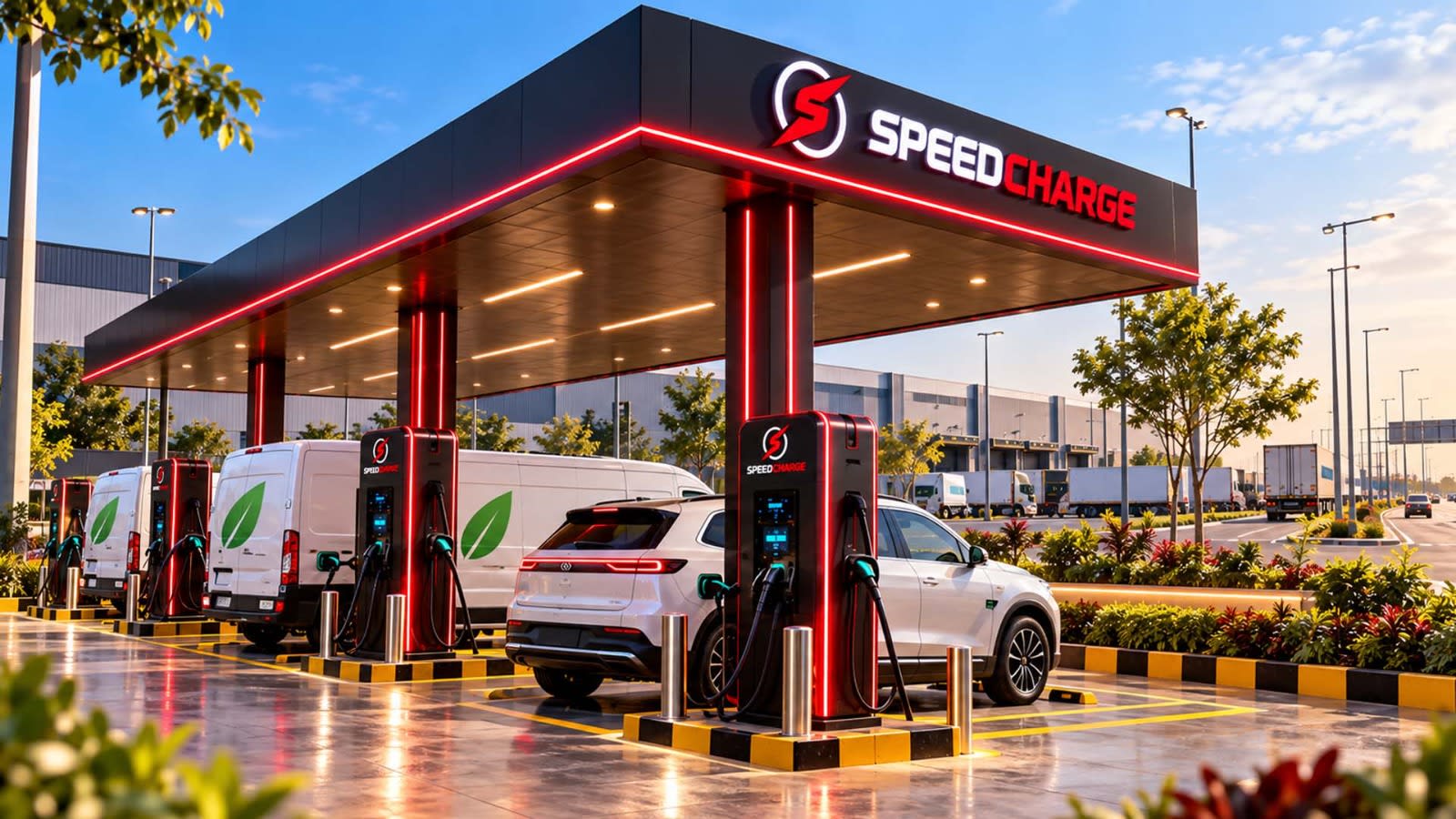
Panipat should not be viewed simply as another stop between Delhi and Chandigarh. It has two commercially important characteristics for EV charging: a large industrial economy and a strategic national-highway position. The district administration describes Panipat as about 90 km north of Delhi and 169 km south of Chandigarh and identifies it as the “City of Weavers” and “Textile City,” with major textile, carpet and handloom activity.
For an investor evaluating EV Charging Franchise in Panipat, that combination creates a potentially stronger business case than relying only on random highway traffic. Charging demand can come from intercity EVs, employees, local businesses, commercial vehicles, hotels, restaurants, fleets and residents who need dependable public charging.
The official Panipat district profile and industrial overview also highlights the district’s industrial character, while Samalkha is known for agricultural-instrument foundries. That makes Panipat particularly suitable for a strategy built around anchor demand plus public charging, rather than a station that waits entirely for walk-in customers.
Why Panipat Needs a Two-Engine EV Charging Model
A practical business case for EV Charging Franchise in Panipat can be divided into two demand engines.
The first engine is predictable local demand. This includes factories, textile businesses, offices, warehouses, employees, commercial fleets, hotels and local EV owners.
The second engine is transit demand. This includes EV drivers moving through the Panipat corridor who need a dependable charging stop during a longer journey.
These two groups behave differently.
Demand Segment | Typical Behaviour | Suitable Strategy |
|---|---|---|
Industrial employees | Long parking duration | AC + managed charging |
Fleet vehicles | Predictable schedule | Duty-cycle-based DC |
Local private EVs | Mixed dwell time | AC + moderate DC |
Hotel guests | Overnight | AC + selected DC |
Restaurant visitors | 30–90 minutes | 60 kW-class DC |
Highway travellers | Short stop | Faster DC |
Commercial vehicles | Operationally driven | Fleet-specific setup |
The most resilient Panipat site may therefore be one that earns part of its energy throughput from predictable local users and another part from public or highway customers.
That is fundamentally different from opening a charger only because “traffic is high.”
Panipat's Industrial Economy Can Create Anchor Charging Demand
Panipat’s official district information emphasises textiles, carpets, blankets, handloom activity and shoddy yarn, while Samalkha has an agricultural-equipment foundry base.
For EV infrastructure, the significance is not simply that these industries exist.
Industrial activity creates repeat travel patterns.
Employees arrive and remain parked for hours. Company vehicles often follow scheduled routes. Delivery vehicles may return to the same facility. Contractors and business visitors repeatedly use industrial properties.
That creates a very different charging opportunity from an anonymous roadside customer.
Example: Employee Charging
Imagine an industrial property where 25 employees eventually use EVs.
If most vehicles remain parked between 9 AM and 6 PM, those cars do not necessarily need ultra-fast charging.
Several managed AC points or a combination of AC and moderate-power DC chargers can potentially use capital and grid capacity more efficiently.
Example: Commercial Fleet Charging
Now consider a logistics operator whose EVs return at 8 PM and depart at 5 AM.
The station has approximately nine hours to restore the energy required for the next operating cycle.
Rather than asking “What is the fastest charger available?”, calculate:
Total Fleet Energy Required ÷ Available Charging Hours
That produces a much more useful infrastructure requirement.
Use NH-44 Demand Carefully
Panipat’s highway position creates an obvious fast-charging opportunity, but road traffic alone should never determine investment.
Haryana’s EV framework encourages fast-charging infrastructure on highways and prominent roads and specifically discusses intercity charging networks.
If the property is being selected primarily for corridor traffic, SpeedCharge’s EV charging stations on highways in India guide should be reviewed before finalising the plot because highway stations depend heavily on road access, charger uptime, electricity infrastructure and amenities.
A successful highway property should ideally offer:
Requirement | Why It Matters |
|---|---|
Easy entry | Reduces driver friction |
Easy route re-entry | Avoids unnecessary detours |
Visible location | Improves discovery |
Dedicated EV bays | Prevents ICE blocking |
Reliable power | Protects uptime |
Food/restrooms | Makes charging time useful |
Lighting/security | Supports night charging |
Expansion space | Allows future capacity |
A location 300 metres from the highway may perform poorly if drivers must travel several kilometres to make a U-turn.
A slightly less visible property may perform better if it provides direct access in the dominant direction of traffic.
Samalkha Should Be Studied Separately
Samalkha should not automatically be grouped with central Panipat.
The district government identifies Samalkha as a separate subdivision and notes its agricultural-instrument foundry activity.
This creates at least three potential charging cases.
First, industrial properties may have employees and commercial vehicles with predictable parking schedules.
Second, road-oriented properties may benefit from through traffic.
Third, local businesses could use charging as a customer amenity.
A Samalkha opportunity should therefore be assessed using a different demand mix from a city-centre mall or hotel.
Don't Select the Property Before Completing a Site Score
Location selection is often where EV charging projects either become commercially strong or structurally weak.
SpeedCharge’s EV Charging Site Selection Guide India can be used before lease signing to evaluate electricity capacity, customer dwell time, road access, parking, competition and actual EV demand.
For Panipat, a useful 100-point framework is:
Site Factor | Weight |
|---|---|
Verified EV demand | 18 |
Electricity feasibility | 18 |
Highway/local accessibility | 15 |
Anchor fleet potential | 15 |
Customer dwell time | 10 |
Parking capacity | 8 |
Existing competition | 5 |
Amenities | 5 |
Visibility | 3 |
Expansion space | 3 |
Total | 100 |
The unusual feature here is the 15-point anchor-demand score.
That is intentional.
In a manufacturing-heavy market, a property with a predictable fleet or employee base can potentially create more dependable energy sales than one relying only on passing traffic.
Which Areas and Property Types Should Investors Study?
Rather than publishing a misleading “top five locations” without surveying each plot, investors should shortlist location types.
Highway Restaurants and Food Properties
These can be strong charging hosts because customers already have a reason to stop.
A 30–60 minute meal can overlap with charging.
The charging operator therefore does not need to create customer dwell time from scratch.
Hotels
Hotels create both destination and transit opportunities.
Overnight guests can use slower charging, while short-stay or highway customers may prefer DC fast charging.
That creates a possible mixed AC/DC model.
Industrial Properties
Industrial sites can be attractive where employees, company vehicles or commercial fleets provide anchor utilisation.
Electricity capacity, however, must be verified carefully because existing industrial loads may already consume much of the property's sanctioned capacity.
Commercial Centres
Retail properties can offer charging to shoppers and local residents.
These sites need particular attention to EV-bay enforcement because charging bays that become ordinary parking spaces cannot generate energy sales.
Fleet Yards
These can produce high-quality demand when vehicle schedules are known.
The commercial model should be designed around:
Vehicle count × daily energy need × operating days
rather than general population or road traffic.
Choosing Charger Power: Start With Time, Not kW
One of the most expensive mistakes in charging infrastructure is selecting hardware before understanding customers.
A better equation is:
Energy Needed ÷ Available Parking Time = Required Charging Power
Suppose an EV requires 30 kWh.
If the vehicle is parked for eight hours, it has an entirely different charging requirement from a highway EV whose driver wants to leave quickly.
Location | Likely Dwell Pattern | Charger Mix to Consider |
|---|---|---|
Factory | Long | AC / managed charging |
Hotel | Long | AC + DC |
Restaurant | Medium | 30–60 kW+ DC |
Fleet depot | Scheduled | Duty-cycle based |
Highway hub | Short | 60–180 kW+ DC |
Mall | Medium | AC + moderate DC |
Do not interpret these as fixed specifications.
Actual charger selection should follow vehicle demand and electrical feasibility.
How Much Investment Can Be Required?
The total investment for EV Charging Franchise in Panipat should be treated as a complete infrastructure project, not merely the price printed on the charger quotation.
SpeedCharge’s EV Fast Charger Price in India 2026 guide currently gives broad market-planning ranges starting around ₹4–8 lakh for lower-power commercial DC equipment and rising to ₹35–60 lakh or more for high-power systems. Those figures are indicative hardware ranges, not fixed franchise prices.
A typical planning table looks like this:
DC Capacity | Indicative Hardware Range |
|---|---|
30 kW | ₹4–8 lakh |
60 kW | ₹7–12 lakh |
90–120 kW | ₹12–22 lakh |
150–180 kW | ₹17–30 lakh |
200–240 kW | ₹24–40 lakh |
300–360 kW+ | ₹35–60 lakh+ |
Hardware is only the first layer.
A complete project may also require panels, protection equipment, cables, earthing, civil construction, sanctioned-load enhancement, transformer infrastructure, software, networking, payment integration, signage, parking development and working capital.
For this reason, SpeedCharge’s EV Charging Station Investment in India guide is a more useful reference for total project planning than comparing charger prices alone.
A 60 kW Example Shows Why Site Cost Matters
Consider two 60 kW projects.
Site A already has enough spare sanctioned load, a suitable panel nearby and a cable run of only 15 metres.
Site B needs significant load enhancement, a transformer solution, new panels and a much longer cable route.
Both buy the same charger.
Their total commissioned costs can still be very different.
A conceptual project budget might include:
Component | Planning Consideration |
|---|---|
Charger | Core hardware |
Panels/protection | Site dependent |
Cabling | Highly distance dependent |
Civil work | Depends on property |
Transformer/load upgrade | Can be substantial |
Software | Initial + recurring |
Connectivity | Recurring |
Property | Rent/deposit/Revenue Share |
Maintenance | Recurring |
Working capital | Needed during ramp-up |
This is why a technically ready property can sometimes justify higher rent.
A “cheap” location that requires major upstream electrical work is not necessarily cheaper.
Electricity Feasibility Must Come Before Charger Purchase
Before launching EV Charging Franchise in Panipat, obtain the site's electricity details in writing wherever possible.
The HERC EV charging infrastructure regulations for Haryana apply to EV charging infrastructure, tariffs and related regulatory matters across the state. The regulations establish the state-level framework within which charging projects operate.
For every candidate property, identify:
Existing sanctioned load
Actual peak load
Spare electrical capacity
Proposed charging load
LT or HT supply
Transformer capacity
Panel capacity
Metering
Cable route
Earthing
Load-enhancement timeline
Applicable tariff treatment
Do this before ordering equipment.
A station proposal is incomplete until the electrical side is understood.
National Charging Guidelines Affect the Setup Too
Haryana regulation is not the only framework that matters.
The Ministry of Power Guidelines for Installation and Operation of Electric Vehicle Charging Infrastructure 2024 apply to private, semi-public and public EV charging infrastructure, including offices, hospitals, commercial complexes, petrol pumps and highway or expressway locations.
The guidelines aim to improve charging safety, accessibility, connection processes and network planning and also address electricity-supply considerations for charging stations.
For investors who want the entire project sequence in one place, SpeedCharge’s How to Set Up an EV Charging Station in India 2026 guide can be used alongside the national regulatory framework when moving from site study to installation.
What Haryana's EV Policy Means for Panipat
The Haryana Electric Vehicle Policy 2022 states that development of widespread and accessible charging infrastructure is one of the policy objectives and applies incentives to enterprises setting up charging infrastructure under the conditions defined in the policy.
The policy also states that petrol pumps should be encouraged to provide charging depending on demand and viability and calls for fast-charging infrastructure on highways and prominent roads.
This is particularly relevant to Panipat because a franchise investor can potentially evaluate both city properties and transit-oriented properties.
However, policy support should never be confused with guaranteed commercial demand.
Government policy can support infrastructure development.
It cannot make an inaccessible property profitable.
What Charging Incentive Does Haryana Policy Mention?
The Haryana policy includes specific incentives for qualifying privately owned public charging stations.
It describes a one-time subsidy of 20% of Fixed Capital Investment, capped at ₹5 lakh, for the first 200 qualifying privately owned public charging stations with FCI above ₹25 lakh.
It also describes another category for the first 2,000 qualifying installations in specified residential, commercial and institutional properties, subject to conditions.
Do not automatically subtract that amount from your investment calculation.
Eligibility, beneficiary caps and current scheme availability should be confirmed before including any benefit in ROI.
A safer model is:
Base Case: No unconfirmed incentive
Upside Case: Eligible incentive after confirmation
Build Panipat Economics Around Energy Throughput
Traditional retail properties are often evaluated using footfall.
EV charging needs another metric:
kWh throughput.
A station may have hundreds of cars visiting the property without generating meaningful charging revenue.
The business model should therefore begin with:
Monthly Charging Revenue = Monthly Billable kWh × Effective Charging Revenue per kWh
Operating contribution then needs to account for:
Electricity + Property + Software + Payment Charges + Maintenance + Operations + Financing
The most important operational metrics are average session energy, sessions per connector, daily billable kWh, uptime, failed sessions, peak-hour utilisation and repeat-customer share.
Installed charger capacity tells you how much energy the station could deliver.
Throughput tells you what customers actually buy.
The Anchor + Public Model Can Reduce Risk
Panipat's industrial characteristics make an anchor-demand strategy especially interesting.
Assume a public site receives uncertain highway customers during its first year.
If the same property also signs an arrangement with a nearby commercial fleet or business whose vehicles charge regularly, the station gains a more predictable utilisation floor.
This does not eliminate demand risk, but it changes the economics.
An ideal structure might look like:
Morning: local fleets
Day: public and business users
Evening: highway traffic
Night: fleet or hotel demand
The same physical infrastructure can potentially serve different users at different times.
This is a more sophisticated model than simply placing a charger beside a highway.
Compare Competing Chargers Properly
When surveying Panipat, do not record only the number of nearby stations.
Record:
Competitor Factor | Why It Matters |
|---|---|
Charger power | Determines speed |
Connector count | Determines capacity |
Actual uptime | Determines reliability |
Entry/exit | Determines convenience |
Parking | Determines usability |
Pricing | Influences customer choice |
Amenities | Important for highway users |
Operating hours | Matters at night |
Queueing | Indicates possible unmet demand |
Existing competition can actually be positive evidence.
If a nearby fast charger is regularly occupied, there may be room for additional capacity.
If several chargers sit unused throughout the day, that is a warning signal that deserves investigation.
Don't Copy Gurugram's Charging Model
Panipat and Gurugram are both in Haryana, but their market structures differ substantially.
Gurugram has dense corporate, technology, premium commercial and taxi activity.
Panipat has a stronger industrial-textile identity combined with corridor traffic.
Investors comparing Haryana opportunities can use SpeedCharge’s Gurugram EV charging stations location page as a useful comparison of a metropolitan corporate market against Panipat's more industrial and highway-oriented proposition.
SpeedCharge’s EV charging station locator can also be used during competitor research and route planning rather than inventing a Panipat-specific SpeedCharge location URL that is not present in the supplied sitemap.
Franchise vs Independent Charging Operation
A strong EV Charging Franchise in Panipat should be evaluated through the written commercial agreement, not just a presentation showing charger capacity and projected earnings.
The agreement needs clarity on charger ownership, property responsibility, electrical infrastructure, electricity bills, pricing authority, software, customer payments, Revenue Share, maintenance, spare parts, uptime, insurance, relocation and termination.
An investor should specifically ask:
Who owns the physical charger after installation?
Who pays if additional electrical work is required?
Who controls the customer tariff?
Who receives customer payments first?
How frequently is Revenue Share settled?
Who bears downtime losses?
What happens if the location fails?
Can the charger be moved?
Those answers can matter more than a small difference in franchise fee.
SpeedCharge’s EV Charging Station Franchise in India guide is the appropriate internal reference for comparing the broader franchise structure before committing capital.
PM E-DRIVE Should Be Evaluated Separately
Central support should not be mixed into Haryana's policy assumptions.
The official PM E-DRIVE EV public charging station scheme guidelines page lists the operational guidelines for deployment of EV public charging stations released on 26 September 2025, along with subsequent FAQs.
Those FAQs clarify that charging locations under the scheme fall into defined categories and that supported sites must meet applicable public-access and nodal-agency requirements.
Therefore, never write “PM E-DRIVE subsidy available” as a guaranteed benefit for a privately selected Panipat franchise property.
Eligibility must first be established for the specific implementation structure.
Use Three Financial Scenarios
Do not build the proposal around one utilisation figure.
Conservative Case
Assume EV adoption at the site grows slowly, public sessions are limited and no large fleet agreement is secured immediately.
Base Case
Use observed charging demand, conservative highway conversion and realistic repeat-customer assumptions.
Growth Case
Add fleet partnerships, increasing EV penetration and additional corridor utilisation.
The station should not require the growth case merely to survive.
If the project works only when every optimistic assumption happens, reconsider the property or project cost.
SpeedCharge’s EV Charging Station ROI in India guide provides a useful internal framework for thinking about utilisation, electricity infrastructure, uptime and staged expansion rather than assuming that a higher-power charger automatically delivers higher returns.
A Different 30-Day Panipat Validation Plan
Before committing to EV Charging Franchise in Panipat, use one month to test the investment thesis.
Days 1–5: Map Demand Sources
Instead of only counting cars, identify why EVs would come to the property.
Map factories, warehouses, hotels, restaurants, offices, commercial centres and fleet operators.
Days 6–10: Observe Road Behaviour
Record vehicles and EVs by time period.
For highway-oriented properties, separately measure traffic in each direction.
Days 11–15: Audit Existing Chargers
Visit nearby charging stations physically.
Check actual access, parking, charger rating, uptime and apparent utilisation.
Days 16–20: Interview Anchor Customers
Speak with businesses and fleets.
Ask how many EVs they operate today, how far those vehicles travel, where they currently charge and what time they are available.
Days 21–25: Complete Electrical Feasibility
Confirm sanctioned load, transformer availability, metering, cable route and upgrade requirements.
Days 26–30: Build the Investment Model
Calculate complete CAPEX, monthly fixed costs and three utilisation scenarios.
Only after that should the final charger configuration be selected.
Launch With One Capacity Plan and One Expansion Plan
Another mistake is designing the final five-year station on day one.
Suppose your research supports two 60 kW charging points initially but the property has room for six.
Design the electrical and civil infrastructure so that additional capacity can be added later without rebuilding the entire property.
This is staged CAPEX.
It can be particularly valuable in emerging charging markets where EV adoption is growing but exact site-level demand remains uncertain.
The investor avoids overbuilding while maintaining the ability to expand when utilisation proves itself.
The First 90 Days Should Answer Five Questions
After commissioning, measure whether the original assumptions were correct.
You need to know:
Who is actually charging?
When are they charging?
How much energy are they buying?
How often are they returning?
Which hours have unused capacity?
Do not judge performance only by revenue during launch month.
A new station takes time to be discovered.
Instead, watch whether daily kWh, repeat users and sessions per connector are trending upward.
If weekend highway demand is strong but weekday demand is weak, pursue fleet or business partnerships.
If daytime demand is high but evenings are empty, consider local residential marketing.
Data should determine the next investment.
Conclusion
Panipat's strongest EV charging proposition comes from combining its industrial base with its intercity road position rather than relying on either one in isolation.
A textile or manufacturing cluster can create repeat employee and fleet demand. A well-positioned hotel or restaurant can capture intercity charging. A mixed commercial property can add local public demand.
For EV Charging Franchise in Panipat, the strongest sequence is:
Anchor Demand → Public Demand → Road Access → Dwell Time → Electricity Feasibility → Charger Mix → Commercial Agreement → CAPEX/OPEX → Utilisation → Expansion
Frequently Asked Questions
1. Is Panipat suitable for an EV charging business in 2026?
Panipat is worth evaluating because it combines industrial activity, local urban demand and an important intercity road position. Actual viability depends on the individual property, electrical capacity and measurable charging demand.
2. Why is Panipat different from Karnal for EV charging?
Both can benefit from corridor traffic, but Panipat's textile and manufacturing economy creates additional industrial and employee-charging opportunities.
3. What charger capacity should be installed?
The answer depends on vehicle type and dwell time. Long-stay employees may not require the same power as highway travellers or commercial fleets.
4. How much can a 60 kW charger cost?
SpeedCharge's current market-planning range is roughly ₹7–12 lakh for 60 kW DC hardware, while complete project cost can be higher after electrical and civil infrastructure.
5. Is a highway restaurant a good location?
It can be if EV demand exists and the property offers easy entry, safe parking, sufficient electricity, useful amenities and convenient route re-entry.
6. Does Haryana support privately owned public charging stations?
The Haryana EV Policy includes incentive provisions for qualifying private public-charging projects, subject to eligibility and beneficiary limits.
7. Should I install the highest-power charger possible?
No. Higher charger power means higher potential throughput but can also increase hardware and electrical-infrastructure requirements. Power should match customer behaviour.
8. Can textile and industrial businesses create charging demand?
Potentially yes, particularly through employees, business visitors, commercial fleets and company vehicles. Actual demand must be measured at the specific industrial cluster.
9. Should government incentives be included in ROI immediately?
No. Build the base financial case without unconfirmed support and add any eligible incentive only after project-specific confirmation.
10. What is the most important pre-investment check?
Site demand and electricity feasibility should be established before significant money is committed to hardware or a long-term property agreement.