
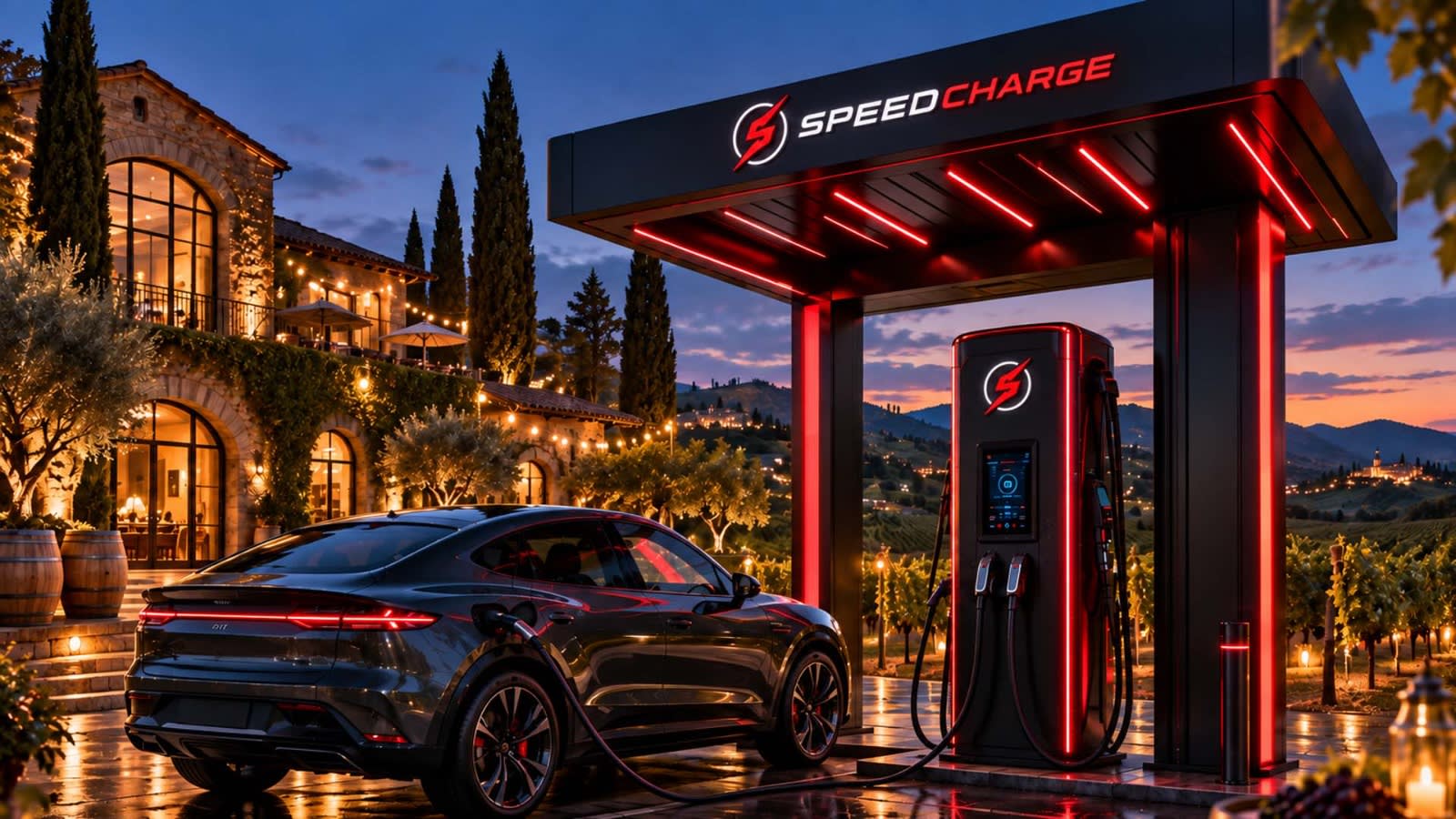
Nashik is not a typical city charging market.
It combines an urban population with vineyards, wineries, resorts, hotels, religious tourism, nature destinations and significant weekend road travel from other Maharashtra cities. Maharashtra Tourism describes Nashik as the “Wine Capital of India” and identifies vineyards and wineries as an important part of the destination's tourism appeal.
That creates a different opportunity for an EV charging station franchise in Nashik.
Instead of building every charging station around the traditional idea of a driver arriving with a low battery, charging as quickly as possible and leaving, Nashik allows investors to consider another model:
Destination charging.
The customer may already be spending:
Two hours at a restaurant
Three hours at a vineyard
A full day at a resort
One night at a hotel
Several hours sightseeing
A weekend travelling around Nashik
During that time, the EV is already parked.
This creates an opportunity to turn parked time into charging time.
For Nashik, the important business question may therefore be less about:
“How quickly can we charge the vehicle?”
and more about:
“How much useful energy can we deliver while the customer is already enjoying the destination?”
Why Nashik Creates a Different Charging Opportunity
The official Maharashtra Touris m Nashik destination guide highlights the city's combination of vineyards, religious destinations, forts, trekking, nature and tourism.
The tourism ecosystem includes destinations such as:
Vineyards and wineries
Gangapur Dam
Trimbakeshwar
Anjaneri
Religious sites
Nature destinations
Hotels and resorts
Restaurants
Recreational properties
This matters because EV charging demand does not always need to originate from local residents.
A destination charging site can also serve EV owners arriving from:
Mumbai
Thane
Navi Mumbai
Pune
Nearby Maharashtra districts
Other intercity routes
The visitor arrives primarily for the destination.
Charging becomes an additional service.
That is fundamentally different from a conventional public fast-charging station.
Destination Charging Starts With the Reason for the Visit
For an EV charging station franchise in Nashik, tourism properties should first understand why customers visit and how long their vehicles remain parked.
Consider four examples.
Vineyard Visitor
The customer may remain for a tour, meal, tasting experience or recreational visit.
Resort Guest
The vehicle may remain parked for many hours or overnight.
Hotel Guest
The EV may remain unused from evening until the following morning.
Highway Restaurant Customer
The customer may stop for only 30–90 minutes.
All four properties can potentially offer EV charging.
But they should not necessarily install the same charger.
The difference is dwell time.
The Nashik Destination Charging Formula
A useful way to think about tourism charging is:
Reason to Visit + Parking Time + Available Power + EV Demand = Destination Charging Opportunity
This is different from highway charging, where the formula is closer to:
Traffic + Charging Need + Fast Turnaround + Easy Access = Highway Charging Opportunity
The distinction matters because charging infrastructure should match customer behaviour.
A vineyard should not automatically copy the charger configuration of a highway fuel station.
A resort should not automatically copy a taxi charging hub.
A hotel should not automatically assume that the most powerful DC charger produces the best customer experience.
What Exactly Is Destination EV Charging?
Destination charging means providing EV charging at a property where the driver is already planning to spend time for another purpose.
Typical examples include:
Hotels
Resorts
Wineries
Restaurants
Shopping destinations
Offices
Tourist attractions
Hospitals
Event venues
Long-stay parking
The vehicle charges during the customer's normal visit.
For example:
Hotel: Sleep + Charge
Restaurant: Eat + Charge
Vineyard: Experience + Charge
Resort: Stay + Charge
Office: Work + Charge
SpeedCharge's destination EV charging guide for hotels, malls and businesses explains how this model differs from high-throughput public fast charging.
Why Wine Tourism Fits Destination Charging
Wine tourism creates something valuable for EV charging infrastructure:
planned dwell time.
A visitor does not normally drive into a vineyard, spend five minutes and leave.
The destination itself encourages the customer to remain on the property.
That can create time for the EV to receive useful energy without requiring the traveller to make a separate charging stop later.
The official Maharashtra Tourism Gangapur Dam guide describes the surrounding landscape as being dotted with vineyards and identifies wineries and other recreational attractions around the Gangapur area.
For charging investors, this creates a broader tourism catchment rather than just a single charging point.
Potential destination properties can include:
Vineyard parking
Winery hospitality areas
Resorts
Boutique hotels
Restaurants
Recreation properties
Event venues
Tourism parking areas
The commercial opportunity is not simply to sell electricity.
It is to make the property more useful to an EV-driving visitor.
Think in “Useful Energy During the Stay”
A destination property should calculate how much energy can realistically be delivered during the customer's normal parking period.
A simplified formula is:
Useful Energy = Charging Power × Effective Charging Time
For example, ignoring charging losses and vehicle-side limits purely for illustration:
A vehicle connected to an 11 kW AC charger for four hours could theoretically receive:
11 × 4 = 44 kWh
A vehicle connected for eight hours could theoretically receive:
11 × 8 = 88 kWh
In reality, the vehicle may accept less power, the battery may not require that much energy and charging behaviour varies.
The point is not the exact number.
The point is that time can substitute for charging speed.
A vehicle parked overnight may not need a high-power DC charger to receive meaningful energy.
AC vs DC Charging for Nashik Tourism Properties
This is where destination charging becomes commercially interesting.
Property | Typical Dwell Pattern | Charging Approach to Evaluate |
|---|---|---|
Vineyard | 2–4 hours | AC / selected DC |
Winery restaurant | 1–3 hours | AC or appropriate DC |
Resort | Several hours/overnight | AC |
Hotel | Overnight | Managed AC |
Highway hotel | Mixed | AC + DC |
Tourist attraction | 1–4 hours | AC / selected DC |
Premium restaurant | 1–2 hours | AC/DC based on demand |
Event venue | Several hours | AC |
Highway restaurant | Short | DC |
Long-stay parking | Several hours | Managed AC |
This is a planning framework, not a fixed hardware specification.
The correct configuration depends on:
Customer EV mix
Parking duration
Existing electrical capacity
Number of charging bays
Expected sessions
Vehicle charging capability
Public access
Intercity demand
SpeedCharge's AC vs DC EV charging guide provides a deeper comparison for commercial properties.
Why the Biggest Charger Is Not Always the Best Charger
Imagine a hotel guest arriving at 8 PM and departing at 8 AM.
The vehicle has approximately 12 hours of potential parking time.
Now imagine installing a high-power DC charger that finishes charging much earlier.
If the fully charged vehicle remains in the same bay overnight, the expensive fast charger cannot necessarily serve another customer.
The infrastructure has delivered energy quickly—but that extra speed may have created little additional commercial value.
For long-dwell destination properties, the better question is:
“What is the lowest practical charging power that reliably delivers the energy our customer needs before departure?”
This can potentially reduce:
Charger CAPEX
Electrical infrastructure requirements
Peak demand
Transformer requirements
Unnecessary oversizing
while still delivering a useful guest experience.
Highway Hotel vs Destination Resort: Same Industry, Different Charging Business
Consider two Nashik hospitality properties.
Property A: Highway Hotel
Customer behaviour:
Short food breaks
Intercity travellers
Quick turnaround
Passing traffic
Charging priority:
Speed
Potential strategy:
DC fast charging
Property B: Vineyard Resort
Customer behaviour:
Overnight stay
Long parking
Planned visit
Leisure travel
Charging priority:
Convenience
Potential strategy:
AC destination charging
Both are hospitality businesses.
Both can serve EV drivers.
But their charging economics are fundamentally different.
This is why charger selection should follow customer dwell behaviour, not simply property category.
Build a Tourism Charging Journey
Instead of thinking about one charger, consider the EV traveller's complete Nashik journey.
A visitor might:
Leave Mumbai → Drive to Nashik → Visit Vineyard → Check into Resort → Explore Local Attractions → Stay Overnight → Return Home
Charging opportunities exist at different stages.
En-Route Charging
Priority:
Fast energy replenishment.
Vineyard Charging
Priority:
Charge during the experience.
Hotel/Resort Charging
Priority:
Overnight energy replenishment.
Restaurant Charging
Priority:
Add useful range during a meal.
This suggests that Nashik's charging ecosystem can contain complementary charging models, rather than every station competing for exactly the same customer session.
The “Charge While You Experience Nashik” Model
For an EV charging station franchise in Nashik, one of the more distinctive concepts is to integrate charging into the tourism experience.
Instead of marketing:
“EV Charger Available”
a hospitality property can communicate:
“Your EV charges while you enjoy Nashik.”
The difference is subtle but important.
The charger becomes part of the visitor experience.
Examples:
Stay + Charge
Hotel or resort package includes charging access.
Dine + Charge
Restaurant customers can charge while eating.
Visit + Charge
Tourism venue offers charging during the visit.
Event + Charge
Event attendees reserve charging bays.
Weekend + Charge
A resort provides overnight charging as part of the guest stay.
This creates opportunities beyond direct charging revenue.
Destination Charging Can Create More Than Charging Revenue
A hotel or resort should not evaluate EV charging only through:
Charging Price − Electricity Cost
The infrastructure can potentially create indirect value through:
Guest acquisition
Property differentiation
Repeat visits
Premium packages
Longer dwell
Customer convenience
Corporate bookings
EV-friendly branding
Event packages
Restaurant visits
For example, suppose an EV owner is choosing between two similar hotels.
Hotel A has reliable overnight charging.
Hotel B does not.
The charger may influence the booking decision even if direct charging revenue is relatively small.
That booking value should be considered separately from charger energy revenue.
Measure Booking Influence, Not Just Charger Sessions
Traditional charging stations track:
Sessions
kWh
Revenue
Utilisation
Tourism properties should track additional metrics.
Metric | What It Tells the Property |
|---|---|
Charging sessions | Direct charger usage |
kWh delivered | Energy throughput |
EV guest bookings | Charging-related hospitality demand |
Repeat EV guests | Customer retention |
Average guest spend | Broader customer value |
Charging-package bookings | Product demand |
EV parking occupancy | Infrastructure demand |
Weekend utilisation | Tourism pattern |
Weekday utilisation | Baseline demand |
Enquiries about charging | Future demand signal |
A charger that generates modest direct revenue but helps secure high-value room bookings can still create meaningful property value.
Use Charging as a Booking Filter
Hotels and resorts can ask guests during booking:
“Will you require EV charging?”
This simple question creates useful data.
The property can begin tracking:
EV guests per month
Vehicle models
Arrival state-of-charge where voluntarily provided
Overnight charging demand
Number of simultaneous EVs
Weekend peaks
Holiday peaks
Over time, the property can expand charging infrastructure using actual guest demand rather than assumptions.
Reservation-Based Charging for Hotels
A common destination-charging problem appears when multiple guests arrive expecting to charge but only a limited number of bays are available.
A reservation system can help.
Example:
Guest books room.
↓
Guest selects EV Charging Required.
↓
Property records expected arrival.
↓
Charging bay is allocated.
↓
Guest receives charging instructions.
↓
Vehicle charges during stay.
This can be more useful for a hotel than installing a large number of chargers that remain unused most of the year.
As demand grows, additional bays can be added.
Destination Charging Needs Parking Discipline
An EV charger is useless if its bay is occupied by a non-EV.
Properties should define:
EV-only bay signage
Charging eligibility
Guest vs non-guest access
Reservation rules
Vehicle movement after charging
Overnight parking policy
Idle policy where appropriate
Hotels may reasonably allow an EV to remain parked after completing an overnight charge.
A restaurant with limited parking may need a different policy.
Charging-bay rules should reflect the property's normal parking operations.
Gangapur Tourism Belt as a Site-Study Area
The Gangapur Dam and surrounding tourism ecosystem deserves site-level investigation for an EV charging station franchise in Nashik.
Maharashtra Tourism describes the area around Gangapur Dam as containing vineyards, scenic attractions, temples and recreational activities.
This creates multiple possible charging-demand sources:
Vineyard visitors
Resort guests
Restaurant customers
Recreational visitors
Weekend travellers
Local EV owners
Hotel guests
However, the presence of tourism does not automatically make every property viable.
Each candidate site still needs to be evaluated for:
EV arrivals
Parking duration
Electrical capacity
Entry/exit
Public accessibility
Existing chargers
Property cost
Seasonality
Operating hours
A destination cluster is an opportunity to investigate—not a profitability guarantee.
Tourism Demand Is Seasonal
This is one area where a Nashik charging model differs from a normal commuter site.
Maharashtra Tourism identifies October through March as a particularly favourable period for visiting Nashik, with pleasant conditions for outdoor activities and vineyard tourism.
That means tourism-oriented charging demand may vary across the year.
An investor should therefore avoid calculating annual utilisation from only a strong winter weekend.
Instead, model:
Peak Season
High tourism and weekend demand.
Shoulder Season
Moderate visitor activity.
Low Season
Lower destination demand.
Then calculate annual economics using the full demand cycle.
The Weekend Problem
A tourism charger can appear highly successful on Saturday and Sunday but remain underutilised Monday through Thursday.
That creates a utilisation challenge.
One solution is to identify weekday demand around the same property.
Potential weekday customers could include:
Local EV owners
Employees
Hotel business travellers
Corporate fleets
Taxis
Nearby residents
Restaurant customers
The strongest tourism charging property can potentially combine:
Weekend Tourism Demand + Weekday Local Demand
This produces a more balanced asset-utilisation profile.
Create a 7-Day Charging Calendar
Before investing, map expected demand across the week.
Day | Tourism Demand | Local Demand | Potential Strategy |
|---|---|---|---|
Monday | Low | Medium | Local/workplace |
Tuesday | Low | Medium | Local/workplace |
Wednesday | Low | Medium | Local/workplace |
Thursday | Medium | Medium | Mixed |
Friday | High | Medium | Tourism + local |
Saturday | Very High | Medium | Tourism priority |
Sunday | Very High | Medium | Tourism priority |
This table is illustrative.
Actual demand should be measured at the individual property.
The objective is to identify whether the charger has a business case seven days a week, not just during tourist peaks.
Event-Based Charging Demand
Nashik's vineyard and hospitality ecosystem also hosts:
Weddings
Corporate events
Private functions
Conferences
Tourism events
Weekend experiences
Events can create temporary charging peaks.
A property should ask:
How many vehicles attend?
What percentage are EVs?
How long do they remain parked?
Can charging be reserved?
Can temporary demand be handled without overbuilding permanent infrastructure?
Charging can potentially become an additional event amenity.
For premium hospitality properties, that may become increasingly valuable as EV adoption grows.
Charging Packages for Hotels and Resorts
A hospitality business can experiment with different commercial models.
Complimentary Guest Charging
Charging included with the room.
Paid Per kWh
Guest pays directly for energy delivered.
Stay + Charge Package
Room and charging bundled.
Premium EV Parking
Reserved charging bay included in a premium package.
Loyalty Charging
Repeat guests receive charging benefits.
Restaurant Spend + Charging
Charging benefit linked to dining spend.
There is no universal best model.
The correct strategy depends on:
Hotel positioning
Customer profile
Electricity cost
Charger utilisation
Parking scarcity
Charging CAPEX
Competitive environment
Public Access vs Guest-Only Charging
A resort can decide whether chargers are:
Guest Only
or
Publicly Accessible
or
Hybrid
Guest-Only
Advantages:
Better guest availability
Easier parking control
Premium amenity
Disadvantage:
Lower potential utilisation
Public Access
Advantages:
Additional charging sessions
Greater network visibility
Potential new visitors
Disadvantages:
Public vehicles may compete with guests
Parking management becomes more complex
Hybrid
Example:
Guest priority overnight.
Public access during selected daytime hours.
This can improve asset utilisation without sacrificing the guest experience.
The Charger Can Become a Customer-Acquisition Channel
A publicly discoverable charger can potentially introduce EV drivers to a property they had not previously considered.
Imagine a traveller searching for charging near Nashik.
They discover:
Hotel + Restaurant + EV Charging
The driver may stop to charge and then:
Eat
Book a room
Use the café
Explore the property
Return later
This is why destination charging can function partly as physical infrastructure and partly as customer acquisition.
Properties should ensure charging information is accurate on relevant digital discovery platforms.
Electricity Planning for Hospitality Properties
Before finalising an EV charging station franchise in Nashik, tourism properties should assess their existing electrical demand.
Hotels and resorts already operate equipment such as:
Air conditioning
Kitchens
Water heating
Pumps
Lighting
Elevators
Laundry equipment
Event facilities
Charging load must therefore be planned alongside building demand.
Check:
Sanctioned load
Peak building demand
Spare electrical capacity
Transformer capacity
Proposed charging load
Simultaneous charging
Cable route
Panels
Earthing
Protection
Metering
Future expansion
A charger should not be selected before this assessment.
SpeedCharge's EV charging station setup guide covers the broader sequence from demand and site feasibility through electrical planning, installation and commissioning.
Maharashtra EV Policy 2025 and Tourism Charging
The official Maharashtra Electric Vehicle Policy 2025 provides an important policy backdrop for charging expansion.
The policy includes measures for:
Public charging expansion
Highway charging
Charging infrastructure incentives
State-level integrated charging planning
Charging-station identification/signage
A one-window system for charging-infrastructure permissions
For eligible charging infrastructure, the policy also sets out incentive frameworks for specified DC charging categories, subject to the policy's conditions, limits and implementation requirements.
These provisions should not be interpreted as an automatic subsidy for every hotel, vineyard or private franchise project.
Any incentive should be included in an investment model only after confirming:
Current eligibility
Applicable charger category
Location requirements
Application process
Available allocation
Approval
Operational conditions
Highway Charging Can Complement Destination Charging
Maharashtra EV Policy 2025 also supports charging expansion along highways.
For Nashik, this matters because tourism visitors often arrive by road.
A traveller may use:
Fast Charging During Journey + Destination Charging During Stay
These models are complementary.
Highway fast charging helps the traveller reach the destination.
Destination charging can help the vehicle leave the destination with useful range.
This reduces the need for every hotel or resort to behave like a highway fast-charging hub.
PM E-DRIVE and Tourism Properties
The official PM E-DRIVE EV Public Charging Station Guidelines include eligible public-sector location categories such as government-operated hotels, resorts, tourism-development-corporation properties and highway wayside amenities under the scheme's public charging framework.
The scheme also requires location feasibility to consider factors such as:
Location selection
Charger configuration
Charger rating
Private tourism properties should not assume that they automatically qualify for PM E-DRIVE support.
Eligibility depends on the scheme category, eligible entity, nodal agency, public-access requirements and other applicable conditions.
The broader lesson is useful:
Charging infrastructure should follow a location-specific feasibility study.
Charger Standards and Vehicle Compatibility
The official Bureau of Energy Efficiency EV Charging Infrastructure Specifications lists current charging configurations including CCS fast charging and Type-2 AC charging.
For a tourism property, hardware selection should consider:
Expected EV models
AC charging capability
DC charging requirement
Connector compatibility
Charger reliability
Outdoor installation
Remote monitoring
Payment system
Network connectivity
Do not buy a charger simply because its advertised kW number is high.
The charger must solve the property's actual customer requirement.
Tourism Properties Need Better Charger Signage
Destination charging is useless if guests cannot find it.
The customer journey should be obvious:
Property Entrance → EV Charging Sign → Parking Direction → Charging Bay
Hotels should also train:
Front-desk staff
Security staff
Parking attendants
Guest-relations teams
They should know:
Where the charger is
Who can use it
How charging starts
How payment works
What happens if the charger fails
Who provides support
A premium property with a confusing charging experience loses much of the amenity's value.
Reliability Matters More Than Marketing
Imagine a hotel advertises:
“EV Charging Available.”
An EV-driving family chooses the hotel partly because of that promise.
They arrive with limited battery.
The charger does not work.
The problem is now bigger than one lost charging session.
It can affect:
Guest satisfaction
Hotel review
Travel plans
Brand trust
Destination charging therefore needs:
Remote monitoring
Fault alerts
Preventive maintenance
Customer support
Clear backup procedures
A charger should be treated as guest infrastructure, not decorative equipment.
Charging Should Be Visible Before the Guest Books
Hospitality properties can display EV charging information on:
Website
Booking page
Property amenities
Maps/listings
Confirmation message
Pre-arrival communication
Useful information includes:
Number of charging points
AC/DC
Charger power
Guest eligibility
Public availability
Pricing
Reservation requirement
Operating hours
This reduces uncertainty for EV travellers.
A New Hospitality KPI: EV Guest Conversion
One useful metric for Nashik properties is:
EV Guest Conversion Rate
Conceptually:
EV Guests Who Book ÷ EV Guests Who Enquire About Charging
If many potential guests ask about charging but do not book because charging is unavailable, the property has evidence of lost demand.
That is much stronger investment evidence than a generic claim that EV adoption is increasing.
Tourism Charging Revenue Should Be Split Into Two Buckets
A destination property can measure:
Direct EV Revenue
Charging fees
Parking fees
Charging packages
Influenced Hospitality Revenue
Room bookings
Restaurant spend
Events
Repeat visits
Longer stays
Then evaluate:
Total EV-Influenced Value = Direct Charging Revenue + Attributable Hospitality Value
Attribution should be conservative.
Not every guest who charges selected the property because of the charger.
But tracking the question can reveal whether charging is influencing customer decisions.
Don't Use Highway ROI Logic for a Resort Charger
A highway DC station can be judged heavily on:
kWh/day
Sessions/day
Charger utilisation
Revenue/kWh
A resort charger may also create value through:
Guest acquisition
Retention
Premium experience
Booking differentiation
This means two chargers with identical monthly energy sales can have different business value.
Context matters.
Build for Expansion, Not Overcapacity
A tourism property may begin with limited EV demand.
Instead of installing excessive capacity immediately:
Prepare for Expansion → Install Initial Capacity → Measure Demand → Add Chargers
During initial construction, consider:
Additional conduits
Spare panel capacity
Reserved parking
Cable routes
Space for additional equipment
This can reduce future civil work while avoiding unnecessary upfront charger CAPEX.
Site Selection for a Tourism Charging Property
The right site for an EV charging station franchise in Nashik should be evaluated differently from a normal roadside charger.
Important factors include:
Factor | Why It Matters |
|---|---|
Natural visitor demand | Creates charging customers |
Guest dwell time | Determines useful charging window |
EV visitor share | Indicates current demand |
Parking control | Protects charging bays |
Electrical capacity | Determines charger configuration |
Public access | Influences utilisation |
Hotel/resort occupancy | Supports recurring demand |
Weekend traffic | Important for tourism |
Weekday demand | Balances utilisation |
Digital discoverability | Helps EV travellers find site |
Reliability | Protects guest experience |
Expansion space | Supports future EV adoption |
SpeedCharge's EV charging station site selection guide provides a broader framework covering demand, grid feasibility, dwell time, parking, access, competition and site tenure.
Destination Property Scorecard
Before investing, score the property out of 100.
Category | Maximum Score |
|---|---|
EV guest/visitor demand | 20 |
Dwell-time suitability | 15 |
Electrical feasibility | 15 |
Parking control | 10 |
Tourism attractiveness | 10 |
Weekend + weekday balance | 10 |
Access and visibility | 5 |
Charger discoverability | 5 |
Expansion potential | 5 |
Site tenure | 5 |
Total | 100 |
Suggested interpretation:
80–100: Strong candidate for deeper technical and commercial diligence
65–79: Potentially viable; resolve identified weaknesses
50–64: Caution; stronger evidence required
Below 50: Investigate alternative properties before major CAPEX
This is a planning framework, not a guarantee of financial returns.
Run a Tourism Demand Pilot Before Large CAPEX
A hotel, vineyard or resort can collect useful data before installing large charging infrastructure.
For 30–60 days, record:
EVs arriving
Guest EV enquiries
Vehicle models
Weekend EV count
Weekday EV count
Parking duration
Guests asking for charging
Corporate EV visitors
Event EV arrivals
Ask customers:
“Would EV charging influence your decision to visit or stay here again?”
This creates property-specific demand evidence.
Franchise vs Location Partnership
Not every tourism property needs to become the charging-asset investor.
There are two different strategic questions.
Investor Question
Do I want to own charging infrastructure?
A franchise/investment structure may be relevant.
Property Owner Question
Do I want EV charging at my property without necessarily owning the charging asset?
A location-partnership structure may be more appropriate.
SpeedCharge's location partnership programme is designed for eligible properties interested in hosting charging infrastructure, while investors can evaluate the SpeedCharge EV charging station franchise programme.
The correct model depends on property ownership, investment objectives and the applicable commercial agreement.
SpeedCharge Franchise Due Diligence
Before committing to an EV charging station franchise in Nashik, an investor should verify both the tourism demand and the franchise structure.
Review:
Charger ownership
Electrical-infrastructure ownership
Property responsibility
Electricity responsibility
Installation scope
Operations responsibility
Software
Customer billing
Maintenance
Revenue Share
Settlement mechanism
Uptime responsibility
Insurance
Agreement tenure
Termination
Equipment treatment at exit
SpeedCharge's EV charging franchise investor guide provides a broader framework for franchise due diligence, asset ownership, operating responsibilities and site feasibility.
A Practical Nashik Tourism-Charging Launch Plan
Phase 1: Understand the Guest
Identify:
Local vs intercity visitor
EV share
stay duration
vehicle parking duration
charging need
Phase 2: Analyse the Property
Verify:
Parking
access
electrical capacity
site control
connectivity
safety
Phase 3: Choose the Charging Experience
Decide whether charging will be:
Guest-only
Public
Hybrid
Complimentary
Paid
Package-based
Phase 4: Size Infrastructure
Select charger power based on:
Dwell time
EV mix
expected simultaneous demand
building electrical capacity
Phase 5: Make Charging Discoverable
Publish accurate charging information.
Phase 6: Train Property Staff
Make the charging experience simple.
Phase 7: Track Tourism-Specific KPIs
Measure:
EV guests
kWh
bookings
utilisation
weekend demand
weekday demand
repeat users
Phase 8: Expand From Evidence
Add chargers only when actual demand supports additional capacity.
Common Mistakes in Tourism EV Charging
Installing DC Fast Charging Only Because It Sounds Premium
High power does not automatically create higher value at a long-dwell property.
Hiding the Charger
A guest should not need to search the entire property.
Not Reserving EV Bays
Parking conflicts can destroy the experience.
Ignoring Weekend Peaks
Tourism demand can arrive simultaneously.
Ignoring Weekday Utilisation
Strong Saturday usage does not guarantee good monthly economics.
Advertising Charging Without Maintaining It
An unreliable charger can damage guest trust.
Treating Every Guest as a Public Charging Customer
Hospitality economics extend beyond energy sales.
Overbuilding Too Early
Install for measured demand while preparing for expansion.
Assuming Government Incentives
Verify eligibility before including any incentive in ROI calculations.
Ignoring the Booking Journey
Guests should know charging is available before arriving.
What Could Make Nashik a Strong Destination-Charging Market?
Several characteristics support deeper investigation:
Wine tourism
Vineyard experiences
Hotels and resorts
Gangapur tourism ecosystem
Religious tourism
Weekend travel
Intercity road connectivity
Long guest parking durations
Maharashtra charging-infrastructure expansion
But none of these guarantees that an individual charger will generate attractive returns.
The site still needs:
Real EV Visitors + Useful Dwell Time + Reliable Electricity + Controlled Parking + Appropriate Charger + Sustainable Economics
Conclusion
An EV charging station franchise in Nashik can be approached differently from a conventional city charging business.
Nashik's vineyards, wineries, hotels, resorts, religious attractions and weekend tourism create an environment where EV charging can become part of the destination rather than a separate stop on the journey.
That changes the infrastructure strategy.
A hotel guest does not necessarily need the fastest charger.
They need a vehicle that is ready when they leave.
A vineyard visitor does not necessarily want to wait beside a charger.
They want the vehicle to charge while they enjoy the destination.
A resort does not need to evaluate the charger only through electricity sales.
It can also measure whether charging influences bookings, guest satisfaction and repeat visits.
For destination properties, the most useful sequence is:
Understand Visitor → Measure Dwell Time → Verify EV Demand → Check Electrical Capacity → Choose Charger → Design Guest Experience → Track Results → Expand
The central idea is simple:
Don't make the tourist wait for the EV. Let the EV charge while the tourist experiences Nashik.
Frequently Asked Questions
1. Is destination EV charging suitable for Nashik?
Yes, it is worth evaluating because Nashik has hotels, resorts, vineyards, wineries, religious tourism and recreational destinations where vehicles can remain parked for meaningful periods. Individual property feasibility still needs to be verified.
2. What is destination EV charging?
Destination charging means providing EV charging at places where drivers already intend to spend time, such as hotels, resorts, restaurants, vineyards, offices or tourist attractions.
3. Is AC or DC charging better for a Nashik hotel?
It depends on customer dwell time. Overnight guests can often be served effectively by appropriately sized AC charging, while highway hotels serving short-stop travellers may also need DC fast charging.
4. Can a vineyard install an EV charging station?
A vineyard or winery property can potentially install charging infrastructure subject to property rights, electrical feasibility, parking, applicable permissions, safety requirements and commercial viability.
5. Can EV charging help a hotel attract guests?
Potentially. EV-driving guests may value reliable overnight charging when selecting accommodation. Hotels should track charging enquiries and EV-related bookings to determine whether it actually influences their customers.
6. Should a resort make its chargers public?
It depends on its strategy. Guest-only charging protects availability, public charging can improve utilisation, and a hybrid model can combine guest priority with selected public access.
7. Does Maharashtra support EV charging infrastructure?
Maharashtra EV Policy 2025 includes charging-infrastructure expansion measures and incentive frameworks for specified eligible charging categories. Eligibility and approval should be verified before including incentives in an investment model.
8. Is Gangapur Road or the vineyard belt automatically a profitable charging location?
No. The tourism ecosystem makes the area worth investigating, but each property needs separate analysis of EV arrivals, dwell time, electricity, parking, competition, operating hours and economics.
9. How many chargers should a Nashik hotel or resort install?
There is no universal number. Start with measured EV demand, expected simultaneous vehicles, guest dwell time and electrical capacity. Designing for future expansion can be more efficient than overbuilding initially.
10. What should investors verify before developing tourism EV charging in Nashik?
Verify visitor EV demand, dwell time, electrical capacity, parking control, charger configuration, seasonality, weekday utilisation, property tenure, operating costs, maintenance responsibilities and the applicable franchise or partnership agreement.
