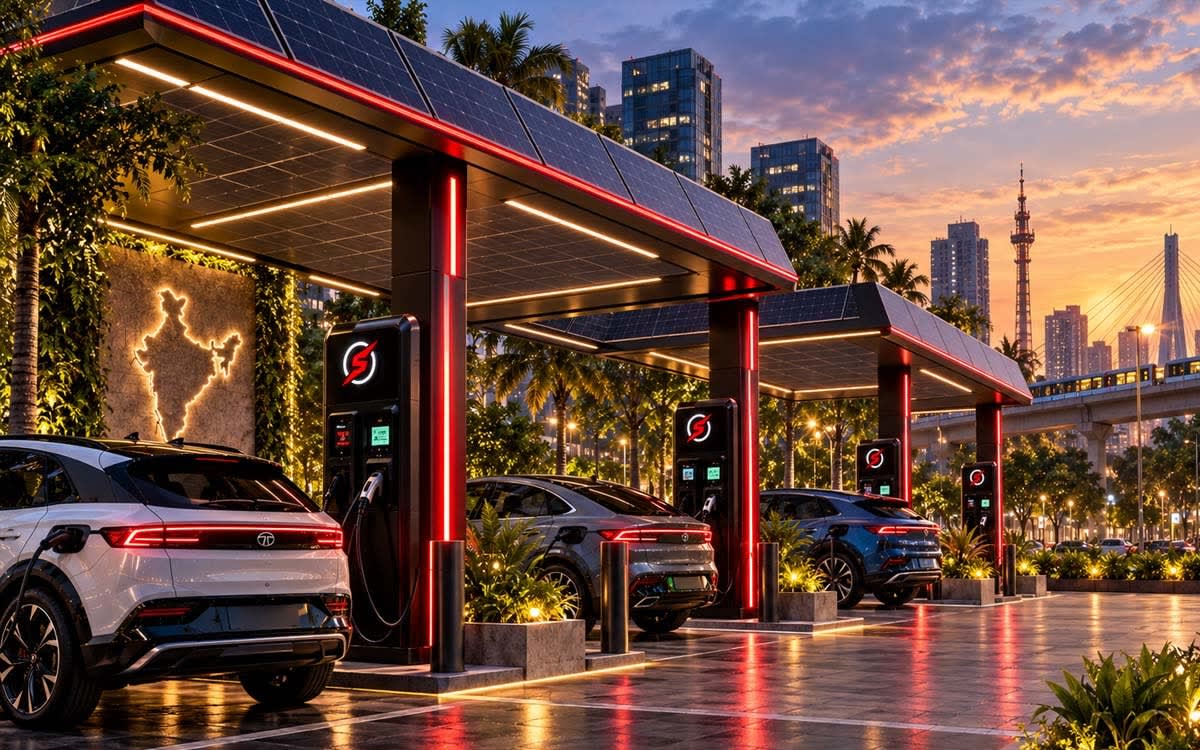
Pairing rooftop solar with an electric vehicle sounds almost ideal.
Your rooftop generates electricity from sunlight, your electric car uses electricity instead of petrol or diesel, and a larger share of your daily mobility can potentially be powered by energy generated at your own property.
For Indian EV owners, the combination can be particularly attractive because the country has strong solar potential and rooftop solar is increasingly being adopted by homes, housing societies and commercial properties.
But there is an important detail that determines whether solar EV charging in India actually works well for you:
When is your electric vehicle parked where the solar power is being generated?
Solar generation is highest during daylight hours. Many private vehicles, however, leave home in the morning and return in the evening.
That timing mismatch is the most important issue to understand before sizing a rooftop solar system specifically around EV charging.
If you are still deciding how to set up charging at your property, start with the SpeedCharge home EV charging guide to understand charger types, electrical load and installation requirements.
How Does Solar EV Charging Actually Work?
In a typical grid-connected rooftop solar installation, solar panels generate DC electricity.
An inverter converts that electricity into AC power that can be used by your home or commercial property.
Your EV charger then draws power from the property's electrical system just like another electrical load.
This means that in a standard grid-connected setup, there generally isn't a separate physical electricity path running directly from:
Solar panel → EV battery
Instead, the solar system, building loads, EV charger and electricity grid operate as one connected energy system.
When solar generation is greater than the property's current electricity consumption, surplus electricity may be exported to the grid depending on your metering arrangement.
When solar generation is insufficient, electricity is imported from the grid.
A smart EV charger can make this arrangement more efficient by scheduling or adjusting charging according to available solar generation.
The Biggest Challenge: Solar Generation and EV Charging Timing
Solar panels generate electricity during daylight.
Generation generally rises after sunrise, becomes strongest around the middle portion of the day under suitable weather conditions, and declines toward evening.
Now compare that with a typical commuter's schedule:
Leave home around 8–9 AM
Car remains at the workplace through the day
Return home around 6–8 PM
Plug the EV in overnight
The rooftop solar system may therefore be producing electricity when the vehicle is not at home.
By the time the EV returns, solar generation may be very low or finished for the day.
This does not mean rooftop solar is useless for an EV owner. It means your financial and energy outcome depends on your charging pattern and electricity metering arrangement.
When Solar EV Charging Works Particularly Well
Solar and electric vehicle charging naturally align when your EV is parked near the solar installation during daylight.
Examples include:
Work-From-Home Households
If you work from home and your EV stays parked during the day, it can charge while the rooftop system is actively generating electricity.
This provides an excellent opportunity to increase direct solar self-consumption.
Families With Two Vehicles
If one vehicle remains at home during the day, its charging schedule can potentially be aligned with rooftop generation.
Weekend-Use Vehicles
A vehicle used mainly on evenings or weekends may spend substantial daylight time parked at home.
You can schedule charging for sunny daytime hours rather than automatically charging overnight.
Businesses With Daytime Vehicles
Some businesses have vehicles returning to a depot, office or facility during the day.
Those vehicles can potentially consume rooftop solar electricity directly.
Workplace EV Charging
Workplace charging is one of the strongest use cases for combining EV charging and rooftop solar.
Employee vehicles usually arrive in the morning, remain parked for several hours and leave toward the end of the working day.
That closely matches the solar generation window.
Businesses considering this model can explore SpeedCharge commercial EV charging solutions.
What Does Net Metering Change?
A common misunderstanding is that solar electricity is simply "lost" if your EV is not at home during the day.
With a grid-connected solar system, surplus electricity can be exported to the electricity grid according to the metering framework applicable to your connection.
However, it is important to distinguish between net metering, net billing and gross metering, because these arrangements are not financially identical.
Net Metering
Under a net-metering arrangement, a bi-directional meter records electricity imported from and exported to the grid.
The applicable accounting and carry-forward rules depend on the regulations followed by your state electricity regulator and DISCOM.
This can allow daytime rooftop solar exports to offset part of your electricity imports during the relevant billing or settlement period.
Net Billing
Under net billing, electricity imported from the grid and excess solar exported to the grid may be financially accounted for differently.
Surplus generation can be purchased by the DISCOM according to the applicable tariff or settlement mechanism.
Gross Metering
Under gross metering, solar generation may be exported separately and compensated according to the applicable tariff rather than being consumed directly to offset the property's electricity usage.
Why This Matters for EV Owners
Your EV might charge at night while your solar system exports electricity during the day.
Whether that arrangement is almost equivalent to direct solar charging or financially less attractive depends on your state's current metering and settlement rules.
Therefore:
Do not calculate solar EV savings using a generic national export rate.
Check your specific DISCOM and State Electricity Regulatory Commission rules before making an investment decision.
Is Direct Solar EV Charging Better?
From an energy-management perspective, consuming solar electricity when it is being generated can be attractive because it reduces the amount of electricity that needs to be exported and later imported.
But the exact financial advantage depends on your tariff and metering arrangement.
If exported units receive full or favourable adjustment under your net-metering rules, the timing penalty may be limited.
If exported energy is compensated differently from imported electricity under net billing or another settlement structure, increasing direct self-consumption can become considerably more valuable.
The key lesson is:
The financial value of solar self-consumption depends on your actual electricity tariff and rooftop solar settlement mechanism.
How Much Solar Do You Need to Charge an EV?
There is no single rooftop solar size that is correct for every electric vehicle owner.
The required system depends on:
Annual kilometres driven
Vehicle efficiency
EV battery size
Charging losses
Existing household electricity consumption
Available roof area
Roof orientation and shading
Local solar generation
Sanctioned electrical load
State rooftop solar regulations
A better approach is to calculate the EV's annual electricity requirement first.
Step 1: Estimate Annual Driving
Suppose your EV travels:
15,000 km per year
Step 2: Estimate Real-World Efficiency
Assume the vehicle delivers approximately:
6 km per kWh
The electricity used by the vehicle would approximately be:
15,000 ÷ 6 = 2,500 kWh per year
Step 3: Account for Charging Losses
Electricity drawn from your charger is normally higher than the energy that eventually reaches the battery because charging and conversion are not perfectly efficient.
For planning purposes, adding a reasonable allowance for charging losses gives a better estimate than using battery consumption alone.
For example, the household may need roughly 2,750–2,875 kWh annually to support the example EV usage after allowing for approximately 10–15% additional charging energy.
This is only an illustrative calculation.
Your actual consumption should be based on real charging data whenever available.
A smart charger or charging application that tracks kWh consumption makes this significantly easier.
Don't Size Solar for the EV Alone
Your solar system normally supplies the entire property rather than only your electric vehicle.
Therefore, sizing should consider:
Existing household consumption + EV charging consumption + future electrical loads
Future loads may include:
Additional EVs
Air conditioning
Heat pumps
Induction cooking
Home office equipment
Additional appliances
At the same time, blindly installing the largest possible rooftop system is not necessarily the best decision.
Available roof space, sanctioned load, DISCOM requirements, metering regulations and your expected self-consumption should all be considered.
If installing the EV charger itself requires electrical upgrades, the SpeedCharge EV charger installation guide explains site assessment, sanctioned load, safety equipment and installation planning in more detail.
Do You Need a Battery for Solar EV Charging?
A home battery seems like the obvious solution to the timing problem.
Solar panels generate electricity during the day.
The battery stores it.
Your EV returns home in the evening.
Stored energy is then used later.
Technically, this can work.
Financially, the decision is more complicated.
Advantages of Home Battery Storage
A battery can:
Store excess daytime solar generation
Increase solar self-consumption
Provide backup electricity during outages
Reduce dependence on the electricity grid
Support energy shifting
Help manage certain time-of-day tariff structures
Make solar generation available after sunset
For households that already value backup power, these benefits can make battery storage more attractive.
Disadvantages of Battery Storage
Battery storage adds another major capital expense.
You also need to consider:
Battery usable capacity
Cycle life
Warranty
Degradation
Round-trip efficiency
Inverter compatibility
Replacement cost
Installation requirements
Every time electricity is converted and stored, some energy is also lost.
Therefore, adding a stationary battery simply to move solar energy from afternoon to nighttime EV charging may not always produce the strongest financial return.
Try Smart Charging Before Buying a Battery
Before investing in stationary storage, see whether you can shift your EV charging behaviour.
Even partial daytime charging can increase direct solar utilisation.
Potential opportunities include:
Weekends
Work-from-home days
Public holidays
Afternoon charging
Days when the EV is not being used
Charging a second household vehicle
Scheduled charging during solar hours
Smart chargers can make this easier.
Rather than plugging in the vehicle and immediately charging at full power, a smart charging system can schedule sessions according to the owner's preferred time.
More advanced energy-management systems may also coordinate charging with solar generation.
If you are evaluating charger hardware, read the SpeedCharge EV charger installation guide before finalising the electrical setup.
Rooftop Solar + Workplace EV Charging
For many properties, workplace charging may be an even stronger solar use case than residential charging.
Consider an office:
Employees arrive between 8 AM and 10 AM.
Cars remain parked until approximately 5 PM or later.
Solar panels are generating electricity throughout much of that period.
EVs therefore create a flexible daytime electrical load that can absorb rooftop solar generation.
This can potentially help the property increase self-consumption while also providing a useful amenity for employees.
Other Commercial Properties That Can Benefit
The same principle can apply to:
Shopping Centres
Vehicles may remain parked while customers shop, dine or watch a movie.
Hotels
Guest and fleet charging can create predictable charging demand.
Hospitals
Staff and visitor vehicles may remain parked for extended periods.
Educational Campuses
Faculty, staff and student vehicles can have substantial daytime dwell time.
Office Parks
Large parking areas combined with rooftop or carport solar can create a natural charging opportunity.
Fleet Depots
The opportunity depends on fleet operating schedules.
Vehicles returning during daylight may consume solar directly, while fleets returning predominantly at night may depend more heavily on the electricity grid or storage.
Businesses planning multi-charger infrastructure should also read how to set up an EV charging station in India before finalising site capacity.
Practical Setup for Solar EV Charging
A good solar-plus-EV setup involves more than buying panels and a charger.
Consider the complete energy system.
1. EV Charger Capacity
Choose a charger that matches:
Vehicle AC charging capability
Available electrical load
Daily driving distance
Available charging time
A larger charger isn't automatically better.
If your vehicle remains parked for ten hours every night, an appropriately sized AC charger may be more practical than installing unnecessary capacity.
2. Solar-Aware Charging
Where supported, a solar-aware charger or home energy-management system can vary charging according to available rooftop generation.
For example:
Strong solar production → higher charging power
Lower generation → reduce charging rate
Insufficient solar → pause or supplement from grid
This can increase direct solar utilisation.
3. Charging Schedules
Even without sophisticated solar tracking, basic charger scheduling can help.
Instead of charging immediately after plugging in, schedule daytime sessions whenever the vehicle is available at home.
4. Energy Monitoring
Your monitoring system should ideally separate:
Solar generation
Household consumption
EV charging consumption
Grid import
Grid export
Without this data, it is difficult to determine whether the solar system is actually covering a meaningful share of EV consumption.
5. Inverter Capacity
The inverter and electrical architecture must be appropriate for the solar installation and property loads.
A qualified solar installer should evaluate system design rather than assuming the EV charger and rooftop solar can simply be added independently.
6. Sanctioned Electrical Load
Your EV charger can create a significant additional electrical load.
Check your sanctioned load before installing a higher-power charger.
This is particularly important if your home simultaneously operates:
Multiple air conditioners
Water heaters
Induction cooking
Pumps
Other high-power appliances
7. Rooftop Shading
Indian rooftops commonly contain:
Water tanks
Parapet walls
Satellite equipment
Nearby buildings
Trees
Utility structures
Partial shading can materially affect solar output.
Get a proper rooftop assessment before relying on a theoretical system-size calculation.
8. Panel Cleaning and Maintenance
Dust, pollution, bird droppings and other contamination can reduce solar generation.
Panels should be installed with safe maintenance and cleaning access.
A solar array that cannot be maintained conveniently may underperform over time.
How to Calculate Solar EV Charging Savings
Avoid relying on generic claims such as:
"Drive your EV for free using solar."
A more accurate savings calculation requires your own electricity data.
Step 1: Find Your EV's Annual Charging Consumption
Use charger data if available.
Otherwise estimate annual driving distance divided by real-world efficiency and add charging losses.
Step 2: Find Your Electricity Tariff
Check your electricity bill and applicable tariff schedule.
Depending on the state and connection type, domestic electricity pricing may use:
Consumption slabs
Fixed charges
Time-of-day pricing
Dedicated EV tariffs
Other charges
Step 3: Check Your Solar Metering Arrangement
Determine whether your property operates under:
Net metering
Net billing
Gross metering
Another approved settlement mechanism
Then check how imports, exports and surplus generation are treated.
Step 4: Estimate Direct Solar Consumption
Determine how much EV charging can realistically happen while the rooftop system is generating.
Do not assume 100%.
If your vehicle is away every weekday, your direct solar charging share could be very different from that of someone working from home.
Step 5: Include Existing Household Consumption
Solar electricity may already be consumed by:
Air conditioning
Refrigeration
Pumps
Appliances
Electronics
The EV is only one part of the total load.
Step 6: Compare Investment With Annual Savings
Your evaluation should include:
Solar system cost
Eligible subsidy or assistance
Charger installation cost
Electrical upgrades
Expected annual solar generation
Electricity savings
Maintenance
Battery cost, if applicable
This produces a much more realistic payback estimate than marketing claims based only on peak solar generation.
Government Policy and Solar-Hour EV Charging
India's EV charging policy increasingly recognises the relationship between electric mobility and renewable electricity.
The Ministry of Power's Guidelines for Installation and Operation of Electric Vehicle Charging Infrastructure–2024 specifically include encouraging EV charging during solar hours among their objectives.
For rooftop solar, residential consumers should also review current Ministry of New and Renewable Energy programmes and their state DISCOM's rooftop solar requirements.
Because regulations, subsidies, metering arrangements and settlement conditions can change, verify the current rules applicable to your state before purchasing equipment.
Common Myths About Solar EV Charging
Myth 1: Solar Panels Mean Completely Free EV Charging
Not automatically.
Solar systems require an upfront investment, and your actual charging economics depend on how much solar generation is used directly, exported or offset through your metering arrangement.
A better phrase is:
Rooftop solar can reduce the effective electricity cost associated with EV charging.
Myth 2: The EV Must Be Connected Directly to the Solar Panels
Not in a typical grid-connected system.
Solar generation normally supplies your premises through the inverter and electrical distribution system.
The EV charger draws electricity through that same infrastructure.
Myth 3: You Need a Battery Before You Can Charge an EV From Solar
No.
An EV can be charged when rooftop solar is generating without adding a stationary battery.
Battery storage mainly allows electricity generated earlier to be used later.
Myth 4: A Bigger Solar System Is Always Better
Not necessarily.
A larger solar installation should be justified by:
Property consumption
EV usage
Available roof space
Metering rules
Sanctioned load
Financial return
Oversizing without considering export treatment can produce weaker economics than expected.
Myth 5: Cloudy Weather Means Solar Panels Produce Nothing
Clouds and seasonal weather can reduce output substantially, but rooftop solar generation does not necessarily drop to zero whenever the sky becomes cloudy.
Annual planning should therefore use realistic generation estimates rather than the output achieved on one ideal sunny day.
Is Solar EV Charging Worth It in India?
For many EV owners, yes — but the value depends heavily on usage pattern and property conditions.
It is especially attractive when:
You already plan to install rooftop solar
Your EV remains at home during daylight
You work from home
You own multiple vehicles
You can shift charging into daytime
Your electricity consumption is substantial
Your rooftop has good solar exposure
The case can also be particularly strong for:
Offices
Hotels
Shopping centres
Housing societies
Educational campuses
Commercial parking sites
Fleet facilities with daytime vehicle dwell
For a commuter whose only vehicle leaves home every morning and returns after sunset, rooftop solar can still reduce total household grid consumption, but the economics depend more heavily on the applicable metering and settlement structure.
Public Charging Still Matters
Installing rooftop solar does not eliminate the need for public EV charging.
Home solar is excellent for routine charging when the vehicle is available, but longer journeys still require access to charging infrastructure away from home.
Before travelling, use the SpeedCharge EV Charging Station Finder to search for available charging locations along your journey.
A practical EV charging strategy can therefore combine:
Home charging + rooftop solar + public charging when travelling.
How SpeedCharge Can Help
SpeedCharge supports EV charging requirements across residential, commercial and public locations.
EV owners can learn more through the SpeedCharge home EV charging guide and understand installation requirements through the EV charger installation guide.
Businesses, workplaces, hotels, parking operators and commercial property owners looking to deploy EV charging can explore SpeedCharge commercial EV charging solutions.
For more EV charging guides, infrastructure insights and practical explainers, visit the SpeedCharge EV Charging Blog.
Final Thoughts
Solar panels and electric vehicles can be an excellent combination, but the quality of the result depends on more than simply installing enough solar capacity.
The most important factor is when your EV charges relative to when your solar system generates electricity.
If the vehicle is available during daylight hours, direct solar charging can increase self-consumption considerably.
If the vehicle is away during the day, your rooftop system can still contribute to reducing electricity costs, but the outcome depends more strongly on net metering, net billing or the other settlement arrangement applicable to your electricity connection.
Before investing:
Measure your household electricity usage.
Estimate annual EV charging consumption.
Check your sanctioned load.
Review your state's rooftop solar regulations.
Understand your metering arrangement.
Evaluate when the EV is actually available to charge.
Compare smart charging with battery storage.
Size the rooftop solar system around realistic total consumption.
Frequently Asked Questions
1. Can I charge my electric car directly from rooftop solar panels?
Yes, rooftop solar electricity can contribute to charging your EV, but in a standard grid-connected setup the panels normally feed your property's electrical system through an inverter. Your EV charger then draws power through that system rather than being wired directly from the panels to the vehicle.
2. How many solar panels are needed to charge an EV in India?
There is no universal number. It depends on annual kilometres driven, EV efficiency, charging losses, household electricity consumption, panel output, rooftop conditions and local solar generation. Calculate annual EV electricity demand before deciding system capacity.
3. Can rooftop solar charge my EV at night?
Solar panels do not generate electricity at night. Night charging therefore requires grid electricity, stored energy from a battery, or an accounting offset through the applicable rooftop solar metering arrangement.
4. Do I need a battery for solar EV charging?
No. A battery is not required if your EV can charge while solar generation is available. Battery storage becomes relevant when you want to shift daytime solar energy for use after sunset or want backup power.
5. Is it better to charge an EV during the day when I have solar panels?
Charging during solar generation can increase direct self-consumption. Whether it produces a major additional financial benefit depends on your electricity tariff and the applicable net-metering or net-billing rules.
6. Does net metering allow me to use daytime solar for nighttime EV charging?
Net metering can allow exported daytime solar units to offset imported electricity according to the applicable state and DISCOM accounting rules. Exact carry-forward, settlement and billing arrangements vary, so check your local regulations.
7. Is rooftop solar worth installing only for an electric car?
It can be, but solar sizing should normally consider total household electricity consumption rather than the EV alone. The financial case depends on roof suitability, electricity tariff, annual driving and solar generation.
8. Can businesses use rooftop solar for EV charging stations?
Yes. Offices, hotels, shopping centres, hospitals, campuses and fleet depots can combine rooftop solar with EV charging. Properties where vehicles remain parked during daylight can have particularly good alignment between solar production and charging demand.
9. Does a solar EV charger work when it is cloudy?
Solar output generally falls during cloudy conditions but may not stop completely. The grid can supplement charging in a grid-connected system when solar generation is insufficient.
10. Can I use both rooftop solar and public EV chargers?
Yes. Many EV owners can use rooftop or home charging for normal daily travel and rely on public charging during longer journeys. The SpeedCharge EV Charging Station Finder can help locate charging stations when travelling.