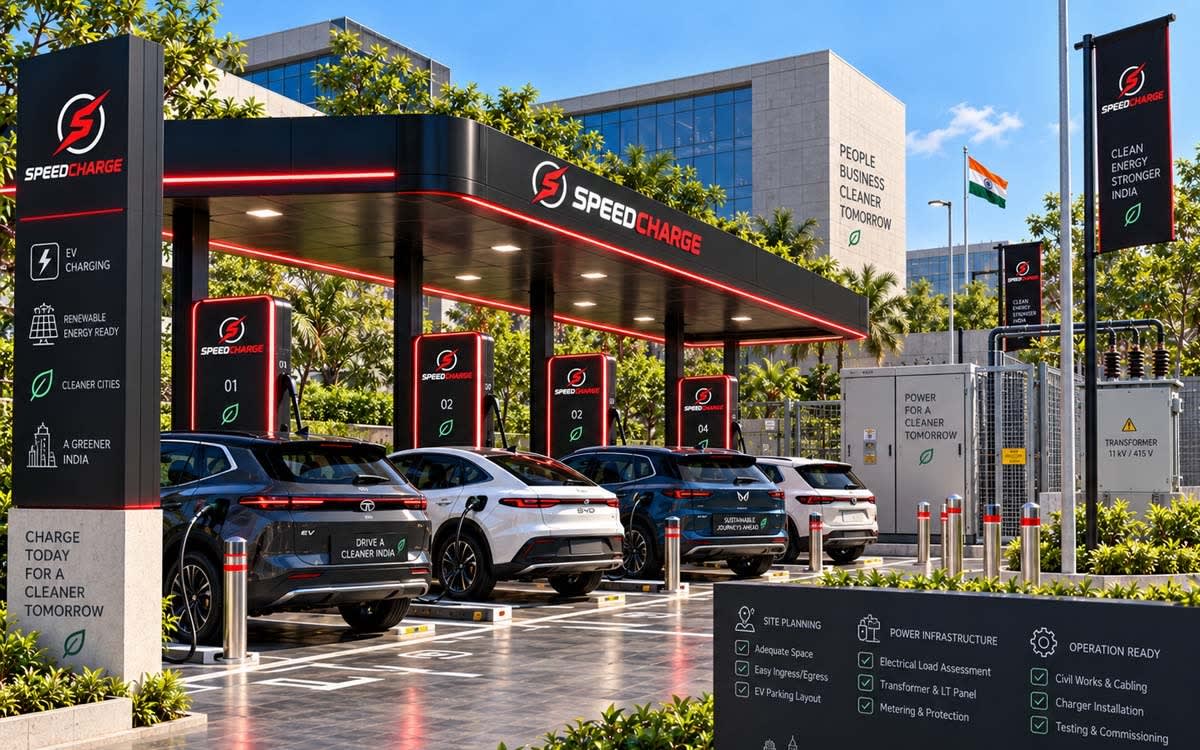
As India’s public charging network becomes more software-driven, Charge Point Operators need to evaluate much more than charger power, connector type and installation cost. OCPP 2.0.1 matters because the communication layer between charging stations and the Charging Station Management System directly affects remote operations, transaction handling, security, device management and smart-charging capabilities.
For an Indian CPO operating dozens or thousands of chargers, backend interoperability can influence procurement flexibility, network uptime and the ability to manage mixed hardware fleets. The protocol is therefore not simply an IT specification. It is part of the operating architecture of a charging network.
The Open Charge Alliance released version 2.0.1 in 2020. OCA currently supports versions 1.6, 2.0.1 and 2.1. Version 2.1 was released in January 2025 and is the newer version, so operators should not describe 2.0.1 as the latest release. OCA continues to support the older versions.
Indian CPOs comparing versions should review the official supported OCPP versions and compatibility guidance from the Open Charge Alliance.
Quick Answer: Why Should Indian CPOs Care?
For Indian CPOs, OCPP 2.0.1 can provide a more capable foundation than older implementations when the charger and CSMS actually support the required functional profiles.
Key benefits include:
Richer device management
Improved transaction handling
Stronger security capabilities
Advanced smart-charging functionality
Support for ISO 15118-related functions
Better monitoring and diagnostics
More structured charger configuration
However, “OCPP compatible” is not enough.
A procurement team should verify:
Exact protocol version
Implemented functional blocks
Certification status
Security profile
Backend compatibility
Smart-charging functionality
Real-world interoperability testing
The important question is not merely whether a charger claims OCPP support, but what has actually been implemented and tested.
What Is OCPP?
Open Charge Point Protocol is an open application protocol used for communication between a charging station and a central management system.
A simplified network architecture looks like:
EV Charger ↔ OCPP ↔ CSMS / Backend
The backend can then support functions such as:
Charger status
User authentication
Remote start and stop
Charging-session records
Transaction information
Fault monitoring
Configuration
Firmware operations
Smart charging
Reporting and analytics
The Open Charge Alliance’s official OCPP protocol overview explains the supported versions and major protocol capabilities.
This is different from OCPI.
OCPP primarily connects:
Charger ↔ Charging Management Backend
OCPI primarily addresses communication between:
Charging Networks ↔ Mobility/roaming platforms
For a detailed comparison, review SpeedCharge’s OCPP vs OCPI: EV Charging Protocols Explained for India.
What Changed From OCPP 1.6?
The move from 1.6 to OCPP 2.0.1 is not a simple incremental upgrade.
Open Charge Alliance states that the two versions are not backward compatible. The newer architecture introduced significant changes including an improved transaction model, device management, enhanced security, additional smart-charging functionality and ISO 15118 support.
For CPOs, the practical differences include:
Area | OCPP 1.6 | 2.0.1-Era Capability |
|---|---|---|
Device management | More limited | Richer device model |
Transaction handling | Older architecture | Improved transaction model |
Security | Basic capabilities | Expanded security framework |
Smart charging | Supported | More advanced functionality |
ISO 15118 | Limited integration | More explicit support |
Monitoring | More basic | Greater component-level visibility |
A CPO should therefore not assume that an existing 1.6 backend can simply communicate with a newer charger without software integration and testing.
The Device Model Is a Major Operational Improvement
One of the biggest architectural changes is the device model.
A modern charging station can contain:
Multiple EVSEs
Connectors
Electricity meters
Power modules
Communication modules
Temperature sensors
Displays
Controllers
Firmware components
The device model gives a CSMS a more structured way to represent charger components and their variables.
For operators, this can support more granular:
Configuration
Monitoring
Diagnostics
Inventory visibility
Remote maintenance
This matters particularly at scale.
A CPO with hundreds of charging stations needs to know more than whether a charger is simply “online” or “offline.”
The backend should ideally help identify:
Which component is reporting a fault
Which parameter changed
Whether a connector is unavailable
Whether remote intervention is possible
Whether field service is required
Better Transaction Handling Matters for Public Networks
Public charging transactions are not always as simple as:
Plug in → Start → Stop
A session may involve:
Local authorization
Remote authorization
Changing connector states
Temporary connectivity loss
Meter-value updates
Payment interaction
Different transaction start triggers
Different transaction stop triggers
OCPP 2.0.1 introduced redesigned transaction handling intended to manage these scenarios more flexibly.
For a CPO, better transaction records can support:
Billing reconciliation
Customer complaints
Revenue reconciliation
Charger utilisation reporting
Session investigation
Fleet billing
Operational analytics
But the charger and CSMS still need to interpret and implement the protocol consistently.
Security Is a Procurement Requirement, Not a Checkbox
Connected EV chargers are networked infrastructure.
They can:
Receive remote commands
Communicate transaction information
Handle authentication
Receive firmware
Exchange operational telemetry
Connect to payment or customer systems
That means cybersecurity cannot be treated as an optional software feature.
CPOs should evaluate:
TLS configuration
Certificate management
Client authentication
Secure firmware updates
Access controls
Credential rotation
Logging
Vulnerability management
Network segmentation
Incident response
OCA’s certification framework also includes security-related functionality and an Advanced Security profile.
Indian operators should additionally review official CERT-In cybersecurity directions covering information-security practices and cyber-incident prevention, response and reporting.
For charging-specific implementation considerations, review SpeedCharge’s EV Charging Station Security: Cybersecurity Guide for India.
Smart Charging Can Help Control Site Demand
As charging hubs scale, multiple chargers may compete for limited electrical capacity.
Smart charging can potentially allocate power according to:
Site limits
Charger limits
Vehicle requirements
Priority rules
Electricity tariff periods
Fleet schedules
Departure requirements
Suppose a charging hub has several high-power chargers.
That does not necessarily mean every charger must continuously operate at maximum rated output.
An appropriately designed charging-management system may distribute available site power dynamically between sessions.
OCA’s certification programme includes a Smart Charging profile for the 2.0.1 protocol family.
Operators should verify the exact smart-charging functionality implemented by both charger and CSMS rather than relying on a generic “smart charging supported” claim.
For grid and load-management planning, review SpeedCharge’s Smart EV Charging in India: Grid & Load Management Guide.
ISO 15118 Support and Plug & Charge
Another important capability is interaction with ISO 15118.
OCA identifies ISO 15118 support among the added capabilities available in the 2.0.1 ecosystem. Its certification programme also includes an ISO 15118 Support profile.
This is relevant to capabilities such as Plug & Charge.
With a properly implemented ecosystem, compatible systems can support automated authorization between:
Vehicle
EV charger
Backend
Certificate infrastructure
However, CPOs should avoid assuming that OCPP support alone makes Plug & Charge operational.
A complete deployment requires compatible:
Vehicle hardware
EVSE
CSMS
Certificate infrastructure
Software
Commercial workflow
Protocol support is only one layer.
Certification Matters More Than a Marketing Claim
A charger supplier may write:
“OCPP supported”
on a brochure.
That statement is not enough for enterprise procurement.
Open Charge Alliance operates an independent OCPP 2.0.1 certification programme. OCA states that the Core profile is mandatory, while additional functionality can be certified through other profiles.
Before purchasing equipment, ask:
Is this exact charger model certified?
Which protocol version was certified?
Which profiles were tested?
Is the CSMS certified or independently validated?
Has this charger-and-backend combination been tested?
Are the required functions part of the certified profile?
Is the certification applicable to the firmware version being supplied?
OCPP 2.0.1 certification can reduce implementation uncertainty, but certification does not mean every optional capability is included.
OCPP Compliance Does Not Automatically Guarantee Interoperability
Two products can claim support for the same protocol and still require integration work.
Differences may result from:
Optional feature implementation
Configuration choices
Security settings
Certificate handling
Vendor extensions
Firmware behaviour
Backend assumptions
Therefore, interoperability testing should be part of procurement.
A practical test plan should include:
Charger boot and registration
Authorization
Session start
Session stop
Meter values
Remote start
Remote stop
Fault reporting
Connectivity loss
Connectivity recovery
Firmware update
Configuration changes
Smart-charging commands
Security workflows
This becomes especially important when a CPO wants to run chargers from multiple manufacturers through one CSMS.
Why OCPP Matters for Vendor Independence
Without an open communication layer, a charging operator can become dependent on one charger manufacturer or backend provider.
A standardised protocol can make it easier to design an architecture where:
Hardware comes from multiple manufacturers
CSMS software can evolve independently
New chargers can be tested before rollout
Network expansion is not tied completely to one closed ecosystem
However, open-protocol support does not automatically eliminate vendor lock-in.
Lock-in can still occur through:
Proprietary extensions
Closed APIs
Non-exportable operational data
Proprietary payment workflows
Vendor-specific firmware tools
Custom backend functionality
The objective should therefore be:
tested interoperability + data portability + documented integrations
—not merely a protocol logo.
For broader software architecture context, review SpeedCharge’s How EV Software in India Is Making Electric Mobility Easier.
What Indian CPOs Should Ask Charger Vendors
Protocol
Ask:
Which OCPP version is implemented?
Is the implementation officially certified?
Which certification profiles are included?
Which transport and communication architecture is used?
Which CSMS platforms have been tested?
Security
Ask:
Which TLS configuration is supported?
How are certificates installed?
How are certificates renewed?
How are credentials protected?
Are firmware updates cryptographically secured?
Which security logs are available?
Device Management
Ask:
Which charger components are exposed?
Which variables can be monitored?
Can configuration be changed remotely?
Can faults be diagnosed remotely?
Can component health be monitored?
Transactions
Ask:
How are interrupted sessions handled?
What happens during connectivity loss?
Are meter values buffered?
How are offline transactions synchronized?
Smart Charging
Ask:
Which charging profiles are supported?
Can the CSMS enforce a site power ceiling?
Can multiple chargers share available capacity?
Can charging priorities be configured?
Has the function been tested under real load?
Charger Software Should Be Evaluated Before Hardware Procurement
Many infrastructure buyers still follow this process:
Choose charger → buy hardware → select backend later
That can create integration problems.
A better procurement process is:
Define operating architecture → define CSMS requirements → define protocol requirements → test compatible hardware → procure
The software layer should be evaluated for:
Charger management
Customer authentication
Remote diagnostics
Payment integration
Tariff management
Energy reporting
Site management
Fleet management
Data export
APIs
User roles
Security
This is particularly important for CPOs building multi-city networks.
CPO Migration Strategy: Do Not Replace Everything at Once
A large CPO may already operate a significant OCPP 1.6 installed base.
Migration should therefore be planned rather than treated as an overnight replacement.
Phase 1 — Inventory Existing Assets
Document:
Charger model
Charger manufacturer
Firmware
Current protocol version
Backend
Security configuration
Remaining asset life
Phase 2 — Define Required Functions
Separate:
Must-have capabilities
from:
Future capabilities
This prevents unnecessary migration expenditure.
Phase 3 — Pilot
Test a limited number of:
Chargers
Firmware versions
Backend integrations
Security configurations
Phase 4 — Validate
Measure:
Successful sessions
Remote-command success
Fault reporting
Recovery after network loss
Smart-charging behaviour
Backend stability
Phase 5 — Scale
Expand only after the target charger/backend combination passes acceptance testing.
OCPP 2.1 Is Newer—So Why Discuss 2.0.1?
Open Charge Alliance released OCPP 2.1 in January 2025.
The newer version builds on the 2.0.1 application logic and adds capabilities such as:
ISO 15118-20 support
Bidirectional charging
Vehicle-to-Everything functionality
Distributed Energy Resource control
Battery-swapping support
Additional authorization options
The official OCPP 2.1 release explains these additions and confirms that older supported protocol versions continue to be supported.
For a CPO, the correct procurement question is therefore not:
“Is version 2.0.1 the latest?”
It is not.
The better question is:
“Which version and certified feature set best matches our hardware lifecycle, backend roadmap and interoperability requirements?”
For many operators, OCPP 2.0.1 can therefore remain a valid procurement baseline when its certified capabilities match the network roadmap.
Indian Standards and Electrical Safety Still Apply
OCPP is a communication protocol.
It does not replace:
EVSE product standards
Electrical protection requirements
Installation standards
Earthing requirements
Electrical testing
DISCOM requirements
Equipment safety compliance
The Bureau of Indian Standards maintains an official EV charging standards overview for EV charging infrastructure. BIS also updated IS 17017 (Part 23):2026 for DC EV supply equipment, including requirements designed for Indian operating conditions.
CPOs should separately review Central Electricity Authority electrical safety regulations, including the 2026 amendment listed by CEA.
Protocol compliance and electrical compliance solve different problems.
A commercial charging system needs both:
reliable digital communication + compliant electrical infrastructure
CPO Procurement Decision Matrix
Question | Why It Matters |
|---|---|
Is the exact charger certified? | Reduces ambiguity around protocol implementation |
Which profiles are certified? | Optional functionality may not be included |
Which CSMS was tested? | Same-version support does not guarantee integration |
Is stronger security supported? | Public chargers are connected infrastructure |
Is smart charging implemented? | Important for multi-charger sites |
Are remote diagnostics available? | Can reduce unnecessary field service |
Can firmware be updated securely? | Critical across charger asset life |
Can data be exported? | Reduces platform lock-in |
Is there a migration roadmap? | Helps future network planning |
Has the full system been acceptance-tested? | Tests the real charger/backend combination |
OCPP Procurement Checklist
Before signing a charger procurement contract:
Hardware
Exact charger model identified
Firmware version documented
Connector configuration confirmed
Electrical standards verified
Protocol
Version documented
Certification checked
Certification profiles checked
Optional functionality documented
CSMS
Backend compatibility tested
Charger onboarding tested
Transaction workflows tested
Remote control tested
Fault reporting tested
Security
TLS configuration reviewed
Certificate process documented
Firmware update mechanism reviewed
Security logs available
Incident workflow defined
Smart Charging
Site power control tested
Charger-level limits tested
Priority logic tested
Recovery behaviour tested
Operations
Remote diagnostics available
SLA documented
Vendor support defined
Firmware support period confirmed
Data export process documented
Common Mistakes Indian CPOs Should Avoid
Avoid:
Treating “OCPP compatible” as sufficient evidence
Assuming 1.6 and 2.0.1 are backward compatible
Assuming every optional function is certified
Purchasing hardware before backend testing
Ignoring certificate lifecycle management
Ignoring firmware-update security
Depending heavily on proprietary extensions
Failing to test connectivity-loss recovery
Ignoring backend data portability
Treating OCPP as a substitute for BIS compliance
Treating OCPP as a substitute for CEA requirements
Assuming the newest protocol version is automatically the best option for every deployment
How SpeedCharge Approaches Connected Charging Infrastructure
Modern charging infrastructure combines:
EVSE hardware
Communication protocols
Charging-management software
Electrical infrastructure
Payment systems
Monitoring
Maintenance
Operational processes
SpeedCharge’s connected ecosystem is designed around charging infrastructure, smart software and CSMS-based network management.
Businesses, fleet operators, property owners and infrastructure partners evaluating connected charging deployments can Partner With SpeedCharge to discuss network-management and infrastructure requirements.
Final Thoughts
For Indian operators, OCPP 2.0.1 is important because it moves charger/backend communication toward richer device management, improved transaction handling, stronger security and more advanced smart-charging capabilities.
But protocol version alone does not create a reliable charging network.
Indian CPOs should evaluate:
certification + implemented profiles + cybersecurity + CSMS compatibility + interoperability testing + lifecycle support
before committing to large-scale hardware procurement.
The strongest infrastructure decision is not the charger with the longest feature list.
It is the hardware-and-software combination that can be:
Tested
Monitored
Secured
Updated
Integrated
Operated reliably
throughout the asset lifecycle.
Frequently Asked Questions
1. What does OCPP mean in EV charging?
OCPP stands for Open Charge Point Protocol. It provides a standardised communication framework between EV charging stations and central charging-management systems.
2. Is version 2.0.1 the latest OCPP release?
No. Open Charge Alliance released version 2.1 in January 2025, making it the newer supported version.
3. Is OCPP 1.6 compatible with version 2.0.1?
No. Open Charge Alliance states that the two versions are not backward compatible.
4. Why is OCPP useful for a Charge Point Operator?
It can support remote charger management, transaction processing, monitoring, configuration, smart charging and communication between charging hardware and a CSMS.
5. Does OCPP certification guarantee every feature?
No. Certification applies to defined profiles and functions. CPOs should check which profiles were actually tested and certified for the exact product.
6. Can OCPP support smart charging?
Yes. Smart-charging functionality is available, but operators should verify the exact implementation, protocol version and certification profile.
7. Does OCPP make every charger compatible with every backend?
Not automatically. Standardisation helps, but interoperability testing remains important because optional functions, configurations and implementations can differ.
8. Does OCPP replace Indian EV charger safety standards?
No. Communication-protocol support is separate from BIS equipment standards, CEA electrical-safety requirements and other applicable installation obligations.
9. Should an Indian CPO replace every existing OCPP 1.6 charger immediately?
Not necessarily. Migration should depend on asset life, required features, backend strategy, interoperability testing and business requirements.
10. What should a CPO verify before buying an OCPP-enabled charger?
Verify the exact protocol version, certification, supported profiles, security architecture, device-management functions, smart-charging capabilities, CSMS compatibility and successful interoperability testing.