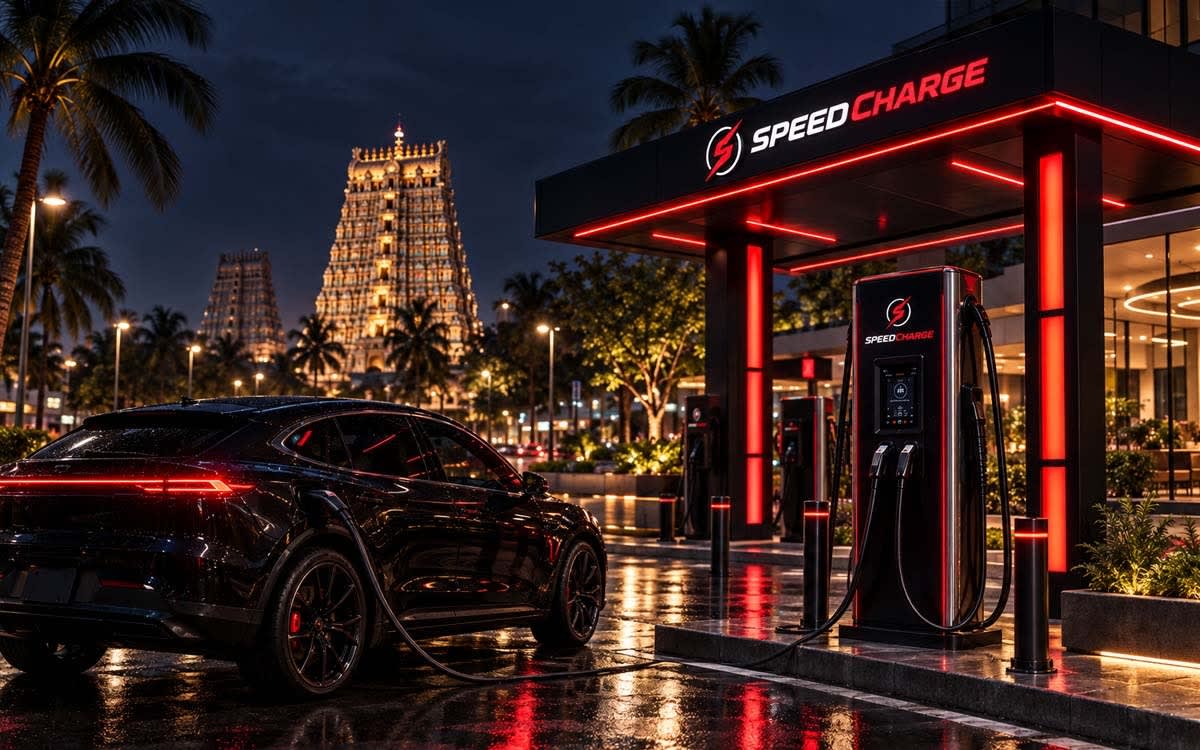
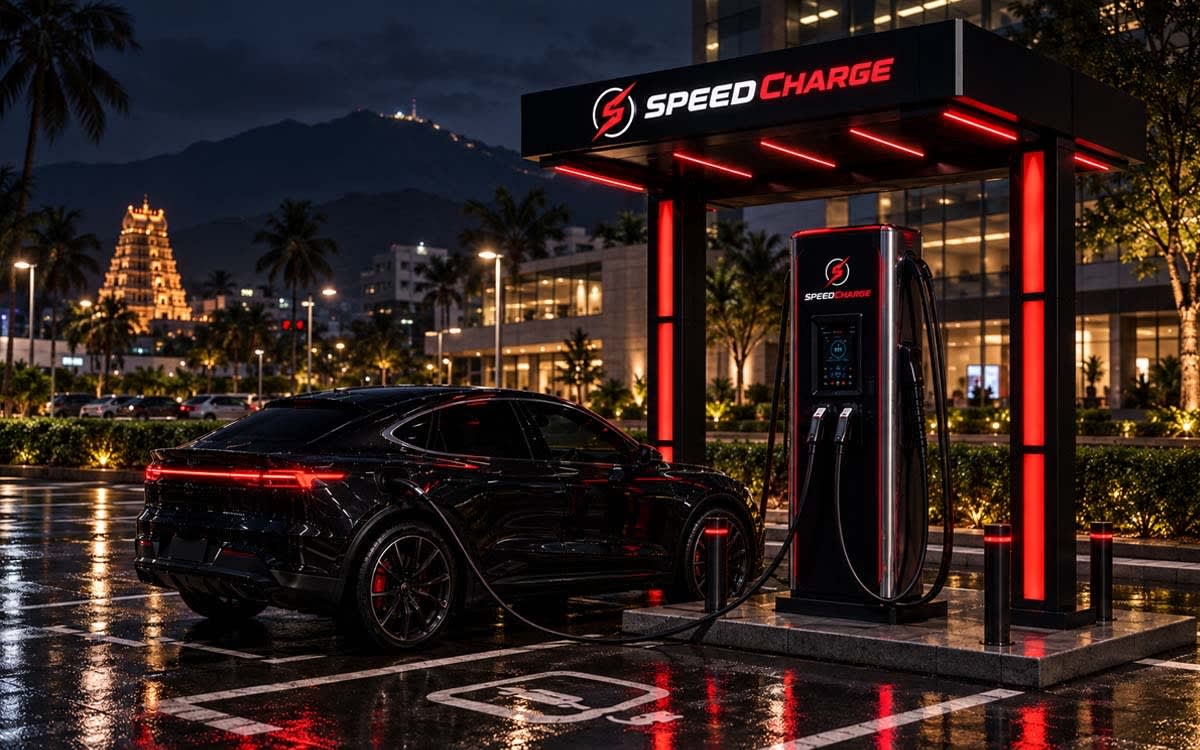
Pondicherry is different from a typical industrial EV-charging market because charging demand can come from local residents, hotels, resorts, restaurants, taxis, intercity travellers and commercial properties. For investors evaluating EV Charging Station Setup in Pondicherry, the first decision should therefore be the customer profile and parking behaviour, not simply the charger power.
Official tourism information describes Puducherry as a major visitor destination with hotels, beach resorts, restaurants and strong road access from cities such as Chennai and Bengaluru. That creates an important opportunity for destination charging, where drivers charge while they are already staying, eating, shopping or visiting an attraction.
Investors who want the broader implementation workflow should first review SpeedCharge’s How to Set Up an EV Charging Station in India guide before finalising a local project.
Why Pondicherry Needs a Destination + Corridor Charging Model
Puducherry’s official tourism information highlights its hotels, resorts, restaurants and strong road accessibility from Chennai and other southern cities. That makes destination charging especially relevant: a driver may already be parked for one to several hours at a hotel, restaurant, resort or commercial property. For EV Charging Station Setup in Pondicherry, this means a mixed strategy can often be more practical than copying a metro fast-charging hub.
You can review the official Puducherry tourism profile when assessing the region’s visitor, hospitality and road-travel characteristics.
A Pondicherry project can broadly serve four demand pools:
Demand Type | Suitable Locations | Charging Approach to Evaluate |
|---|---|---|
Destination visitors | Hotels, resorts, restaurants | AC or mixed AC/DC |
Urban users | Commercial parking, retail, hospitals | Mixed charging |
Taxis & fleets | Fleet yards, transport clusters | Scheduled DC/AC |
Intercity travellers | Major road-access properties | DC fast charging |
The key point is that dwell time should determine charging power. An overnight hotel guest does not necessarily need the same hardware as a driver making a short intercity stop.
SpeedCharge’s EV Charging Station Location Guide explains how grid availability, dwell time, access, parking and local demand should be assessed before committing to a property.
Start With a Site Score, Not a Charger Catalogue
A common mistake is choosing the charger first and then trying to find a property that can support it.
Use the opposite process:
Customer → Dwell Time → Site → Electricity → Charger → Software → Business Model
A Pondicherry property should be assessed for:
Observable EV traffic and parking
Nearby hotels, restaurants, offices or fleet activity
Existing charging competition
Dedicated parking availability
Safe entry and exit
Operating-hour restrictions
Night-time lighting and security
Existing electrical capacity
Space for additional charging bays
A visually prominent road location can still be commercially weak if drivers cannot park easily or if electrical upgrades are too expensive.
Electricity Feasibility Comes Before Charger Purchase
Before finalising EV Charging Station Setup in Pondicherry, confirm the existing sanctioned load, current peak demand, spare capacity, cable route, panel capacity, earthing, protection architecture and whether load enhancement is required.
This is particularly important in Puducherry because the Joint Electricity Regulatory Commission has a dedicated tariff category for EV charging stations.
For FY 2026–27, the approved Puducherry tariff schedule lists LTEV-I EV charging stations at a fixed charge of ₹35/kVA per month and an energy charge of ₹6.05/kVAh. The same schedule lists HTS-VI EV charging stations at ₹100/kVA per month and ₹6.05/kVAh. Actual billing can include other applicable components, so the current tariff order and project-specific connection category should be checked before building the financial model.
Use the Puducherry Electricity Department tariff order for FY 2025-26 to FY 2029-30 for the official tariff schedule.
SpeedCharge’s EV Charging Station Installation Requirements in India guide is also useful for understanding sanctioned load, property rights, cable routing and electrical checks before equipment procurement.
Setup Cost Should Be Built in Layers
A realistic EV Charging Station Setup in Pondicherry budget should separate charger hardware from the rest of the project.
Commercial charging investment can include:
Cost Layer | What It Can Include |
|---|---|
Charger hardware | AC/DC EVSE, connectors, cables, modules |
Electrical infrastructure | Panels, protection, metering, earthing |
Power upgrade | Sanctioned-load enhancement or transformer work |
Civil work | Foundation, trenching, bollards, markings |
Software | CSMS, monitoring, billing, payments |
Connectivity | SIM, LAN or internet connection |
Site cost | Rent, lease or Revenue Share |
Operations | Electricity, maintenance, insurance, support |
For indicative hardware planning, SpeedCharge currently reports broad commercial DC charger ranges such as roughly ₹4–8 lakh for 30 kW, ₹7–12 lakh for 60 kW, and ₹12–22 lakh for 90–120 kW, depending on specification and scope. These are indicative equipment ranges rather than complete installed project quotations.
For total-cost modelling, refer to the EV Charging Station Cost and Profit in India guide.
A Better Pondicherry Setup Strategy: Build in Phases
Instead of installing the maximum possible charging capacity on day one, a commercial property can use a staged rollout.
Phase 1 — Prove Demand
Install enough capacity to serve the expected initial customer base and measure actual usage.
Track daily energy delivered, session frequency, customer type, peak charging hours and charger uptime.
Phase 2 — Add the Right Capacity
If the site is attracting hotel guests and long-dwell users, additional destination charging may make sense.
If taxi or intercity demand is stronger, additional DC capacity may be more valuable.
Phase 3 — Expand Only After Utilisation Is Visible
Prepare electrical conduits, parking layout and panels for future expansion during the first installation so additional chargers can be added without rebuilding the entire site.
This approach can reduce premature CAPEX while keeping the property scalable.
What Charger Type Works for Different Pondicherry Properties?
Hotels and Beach Resorts
Guest vehicles can remain parked for several hours or overnight. AC chargers or a combination of AC and moderate-power DC charging may therefore make commercial sense.
Restaurants and Cafés
Restaurants can provide destination charging, but charger power should reflect actual customer dwell time. A charger that is too slow may add little useful range during a short meal, while an oversized charger may not achieve enough utilisation.
Commercial Parking
Commercial parking can serve multiple user groups and may benefit from mixed AC/DC infrastructure.
Taxi and Fleet Sites
Fleet charging should be designed around duty cycles rather than general road traffic. Operators should know when vehicles arrive, how much energy they require and when they must leave.
Intercity Road Locations
Drivers travelling between Puducherry and surrounding cities may value faster charging, predictable uptime, toilets, refreshments and easy road access.
The EV Charging Business Model in India guide explains destination, fleet, public, host-site and network charging models in more detail.
Central Charging Guidelines You Should Check
India’s Ministry of Power framework covers charging infrastructure installed in private parking, offices, hospitals, housing societies, commercial complexes, petrol pumps, airports, public parking and highway locations.
Before installation, review the official Guidelines for Installation and Operation of Electric Vehicle Charging Infrastructure 2024.
The framework is important because commercial charging involves more than buying EVSE. Electricity connections, safety, equipment standards, metering and operating requirements all need to be considered.
Build the Business Model Around Utilisation
The commercial success of EV Charging Station Setup in Pondicherry depends more on paid energy throughput, uptime and repeat users than on the maximum kW printed on the charger.
A simple revenue framework is:
Monthly Charging Revenue = Billable Energy Sold × Effective Charging Price
Then subtract relevant operating costs such as:
Electricity + Rent + Software + Maintenance + Payment Charges + Staff + Financing
The most useful KPIs are not just revenue and customer count. Track:
kWh sold per day
Sessions per charger
Average kWh per session
Charger uptime
Repeat-user percentage
Electricity cost per billable kWh
Revenue per charging bay
Failed charging sessions
A lower-power charger operating consistently can produce better commercial economics than an expensive high-power charger with weak utilisation.
Independent Station or Franchise Model?
An independent operator may need to separately arrange charger hardware, software, electricity infrastructure, installation, payment systems, customer acquisition and maintenance.
A franchise or network model can combine some of these functions, but commercial structures vary.
Before signing, check who owns the charger, who pays electricity, who controls pricing, who maintains the equipment, how Revenue Share is calculated and what happens when the agreement ends.
SpeedCharge’s EV Charging Franchise Business in India guide explains the due-diligence questions investors should review before choosing a franchise arrangement.
Policy, Tariff and Scheme Checks for 2026
For EV Charging Station Setup in Pondicherry, investors should verify the current local electricity category, central charging guidelines and any scheme eligibility before signing a lease or ordering hardware.
NITI Aayog’s India Electric Mobility Index 2025 profile notes Puducherry’s introduction of electric buses and recommends strengthening charging infrastructure and putting in place a more comprehensive EV-policy framework.
The NITI Aayog India Electric Mobility Index 2025 is useful for understanding Puducherry’s broader e-mobility context.
For central public-charging support, investors should also review the PM E-DRIVE EV Public Charging Station operational guidelines. The operational guidelines were issued by the Ministry of Heavy Industries on 26 September 2025.
Do not treat scheme support as guaranteed subsidy income. Eligibility depends on the current scheme structure, site category and implementation conditions.
Common Setup Mistakes to Avoid
Avoid buying the charger before checking available power. Do not choose a site only because it has high general vehicle traffic. Do not assume every hotel requires fast DC charging, and do not assume a highway model will work identically at a destination property.
Also avoid calculating ROI from an optimistic utilisation figure from the first month. A new location may take time to build awareness and repeat usage.
Finally, leave room for expansion. Civil work and electrical infrastructure are expensive to rebuild later, so future cable routes, parking bays and electrical capacity should be considered during the initial design.
2026 Commercial Setup Checklist
Before commissioning the station, confirm:
Target customer group
Expected dwell time
Daily charging-demand estimate
Property rights and parking availability
Existing sanctioned electrical load
Load enhancement requirements
Charger capacity and connectors
Electrical protection and earthing
Civil-work scope
CSMS and remote monitoring
Payment integration
Electricity tariff category
Property rent or Revenue Share
Maintenance and warranty
Expansion capacity
Conservative, base and growth utilisation scenarios
Conclusion
A successful EV Charging Station Setup in Pondicherry should be designed around the city’s specific mix of tourism, destination parking, local mobility and intercity traffic.
The strongest project is not automatically the one with the largest charger. A better model aligns customer demand, dwell time, electricity capacity, charger power, property cost and utilisation.
For Pondicherry, that often means combining destination-charging opportunities at hotels and commercial properties with selective faster charging for taxis, fleets and intercity travellers.
Build the station in the right sequence:
Demand → Property → Electricity → Charger → Software → Commissioning → Utilisation → Expansion
Frequently Asked Questions
1. How much does it cost to set up a commercial EV charging station in Pondicherry?
Cost depends on charger power, quantity, electrical infrastructure, civil work, sanctioned-load requirements, software and property conditions. A site-specific survey should be completed before treating any figure as a final project cost.
2. What electricity tariff applies to EV charging stations in Puducherry?
For FY 2026–27, the approved JERC schedule lists LTEV-I EV charging at ₹35/kVA per month fixed charge and ₹6.05/kVAh energy charge. Investors should still verify the category applicable to their exact connection and any additional billing components.
3. Is a 60 kW charger suitable for a hotel?
It can be, but charger selection should depend on guest dwell time and demand. Hotels with long overnight parking may also benefit from AC charging or a mixed AC/DC setup.
4. Does every commercial EV station require a transformer?
No. Transformer requirements depend on existing supply, sanctioned load, charger count, simultaneous demand and local electricity requirements.
5. Is Pondicherry suitable for destination EV charging?
Its hotel, resort, restaurant and tourism ecosystem creates relevant destination-charging use cases, but each property should still be evaluated for EV demand and electrical feasibility.
6. Can a private business operate an EV charging station?
Private businesses can participate in EV charging subject to the applicable electricity, safety, property and charging-infrastructure framework.
7. Which is better for Pondicherry: AC or DC charging?
Neither is universally better. AC suits longer dwell periods, while DC is more appropriate when faster turnaround is commercially important.
8. Should I choose a franchise or independent setup?
Compare total investment, equipment ownership, operations, software, maintenance, electricity responsibility, Revenue Share and contract terms before deciding.
9. What is the most important factor for profitability?
Consistent paid energy utilisation is one of the most important variables, along with electricity cost, property expense, uptime and total project CAPEX.
10. Should subsidy be included in the ROI calculation?
Only after actual eligibility is confirmed under the current scheme. An unconfirmed subsidy should not be used to make the base financial case work.