Installing an EV Charging Station at Petrol Pump premises offers fuel retailers an opportunity to serve electric vehicle owners while continuing their existing petrol and diesel operations. As India's transport ecosystem gradually diversifies, conventional fuel outlets can evolve into multi-energy destinations offering both traditional refuelling and electric vehicle charging services.
Petrol pumps already possess several commercial advantages, including road visibility, established customer access, operating staff, parking infrastructure and, in many cases, convenience stores, restaurants and washrooms. These facilities can support the longer waiting periods associated with electric vehicle charging.
However, installing a charger at a petroleum retail outlet requires considerably more planning than installing one at an ordinary commercial property.
Petroleum storage tanks, fuel dispensers, hazardous zones, electrical infrastructure and vehicle movement must all be considered. The petrol pump dealer must also establish whether the dealership agreement permits a third-party charging operator to install and operate equipment.
A successful project therefore begins with petroleum safety compliance, commercial permissions, electrical feasibility and realistic charging demand rather than simply selecting a high-power DC charger.
Can You Install an EV Charger at a Petrol Pump?
Yes, petrol pump owners in India can install EV charging infrastructure, subject to applicable Petroleum and Explosives Safety Organisation (PESO) requirements, oil marketing company permissions, electrical safety regulations and site feasibility.
The charger and dedicated EV parking area must remain outside hazardous zones, maintain prescribed safety distances and avoid interfering with existing petroleum retail operations. Suitable electricity infrastructure and commercial operating arrangements are also required.
EV Charging Station at Petrol Pump: Government Rules and Legal Requirements
India's Ministry of Power recognises petrol pumps as suitable categories of locations for developing public electric vehicle charging infrastructure.
The official Ministry of Power EV charging infrastructure guidelines, issued on 17 September 2024, establish the national framework for public, private and semi-public charging installations.
The framework treats the establishment and operation of charging stations as a de-licensed activity. However, this does not exempt a fuel retailer from petroleum safety requirements or other applicable approvals.
Annexure III(B) specifically identifies PESO approval among the documents to be obtained by the Charge Point Operator when seeking an electricity connection for chargers at petrol pumps or gas stations.
The regulatory distinction is important because petrol pump owners operate within an existing licensed petroleum environment. Adding another commercial activity may require changes to the authorised site layout and cooperation from the petroleum licence holder.
Before approving equipment procurement, the project team should identify the relevant approving authorities, review the dealership agreement and confirm the process applicable to the proposed installation.
PESO Safety Guidelines for EV Charging at Fuel Stations
PESO issued dedicated guidelines on 20 January 2025 addressing electric vehicle charging and battery-swapping facilities at petroleum service stations.
The official PESO guidelines for EV charging at petroleum retail outlets establish specific conditions for integrating these facilities into existing fuel stations.
The principal requirements include locating charging equipment and dedicated EV parking outside hazardous zones, maintaining prescribed separation distances and ensuring uninterrupted vehicle circulation. Charging equipment must not be positioned above underground petroleum storage tanks.
The circular also permits approval of multiple charging facilities where the property has sufficient space and safety requirements are satisfied.
These provisions make the approved site drawing particularly important. A dealer should never assume that an apparently vacant corner of the forecourt is automatically suitable for charger installation.
EV Charging Station at Petrol Pump: Mandatory PESO Safety Distances
The following table summarises the separation distances specified in PESO's January 2025 circular.
Petroleum Facility | Prescribed Safety Distance |
|---|---|
Underground petroleum tank filling point | 3 metres |
Underground petroleum tank vent | 4 metres |
Petrol, diesel, ALDS, CNG or LNG dispenser | 6 metres |
Auto LPG dispensing installation fencing | 9 metres |
LNG installation fencing | 9 metres |
CNG installation fencing | 6 metres |
LPG unloading point and tank-truck unloading platform centre | 9 metres |
LNG unloading point and tank-truck unloading platform centre | 9 metres |
Meeting one distance does not automatically establish compliance with the entire site layout. Hazardous-area classification, dedicated parking, vehicle movement and other applicable safety requirements must also be satisfied.
The final arrangement should be reviewed by qualified engineering professionals and the relevant authorities before installation.
Why Petrol Pumps Are Attractive Locations for EV Charging Businesses
Fuel stations already serve motorists who are travelling between residential areas, offices, commercial centres and highways. This established relationship with road transport can provide a useful starting point for developing public charging infrastructure.
Unlike a newly developed standalone charging location, an existing petrol pump may already have recognised road access, lighting, security personnel, customer facilities and an established commercial identity.
These advantages can reduce some aspects of site-development expenditure. However, the actual business opportunity depends on the number of electric vehicles passing the location and their reasons for stopping.
Highway fuel outlets
Highway petrol pumps can serve intercity EV drivers who need additional battery range before continuing their journeys. Restaurants, clean washrooms and safe waiting facilities can make a location more attractive during longer charging stops.
The business should examine traffic direction, alternative charging stations, road access and the real driving distance between charging opportunities before investing in fast-charging equipment.
Urban petrol pumps
City outlets may serve electric taxis, commuters, apartment residents without private charging facilities and commercial vehicles.
Repeat customers can be particularly valuable at urban charging locations. Nevertheless, restricted forecourt space, higher property costs and congested entry points may limit how much charging capacity can be accommodated.
For example, SpeedCharge's EV charging franchise guide for Delhi examines the relationship between urban charging demand, property selection and electricity infrastructure.
Can a Petrol Pump Dealer Install a Third-Party EV Charger?
A petrol pump dealer should not assume that having permission to sell petroleum products automatically provides unrestricted rights to install third-party charging infrastructure.
Different retail outlets operate under different ownership arrangements. The property may belong to the oil marketing company, the dealer or another landowner. The petroleum licence holder may also be different from the party managing daily operations.
Where a dealer operates under an oil marketing company agreement, introducing another commercial operator can involve contractual restrictions concerning branding, property usage, electrical modifications and revenue-generating activities.
The dealer should establish whether written consent is required from the oil marketing company, landowner or petroleum licence holder. Any existing exclusive charging arrangement should also be reviewed.
If another charging company already holds contractual rights at the outlet, introducing a competing network could create a commercial dispute.
These issues are best resolved before signing a charging agreement or spending money on site preparation. Government permission and private contractual permission are separate matters; obtaining one does not necessarily satisfy the other.
EV Charging Station at Petrol Pump: Installation and Infrastructure Requirements
A fuel-station charging project should be planned as an integrated electrical and petroleum-retail development.
The charging equipment is only one component of the installation. Electricity supply, electrical protection, cable routing, vehicle parking and the relationship between existing fuel operations and the new charging facility must all be addressed.
Electrical load and grid connection
A petrol pump's existing electricity supply may have been designed primarily for dispensers, lighting, office equipment, signage and auxiliary systems.
Adding commercial DC charging can substantially increase electrical demand.
The project engineer should assess the existing sanctioned load, recorded peak consumption, transformer availability and the additional power required for charging. An existing commercial connection does not necessarily have sufficient spare capacity for a 60 kW or 120 kW charger.
Depending on the site, a dedicated electricity connection, sanctioned-load enhancement or new electrical infrastructure may be required.
SpeedCharge's EV charging station transformer cost guide explains why transformer requirements and upstream infrastructure can materially influence the complete project budget.
Equipment compliance and electrical safety
The charging installation must use equipment that satisfies applicable technical standards. Electrical protection, earthing, isolation, inspection and commissioning should be completed by appropriately qualified professionals.
The Central Electricity Authority regulations on electrical safety provide the wider regulatory framework for safe electrical installations, including additional requirements applicable to EV charging facilities.
A charger should not be energised until the relevant engineering checks and approvals have been completed. This is particularly important at fuel outlets because both electrical and petroleum-related risks must be managed.
Dedicated parking and vehicle circulation
EV charging bays must be treated as functional parking infrastructure rather than decorative space around a charger.
Vehicles should be able to enter, park and leave without interrupting ordinary petrol and diesel sales. The proposed layout should also preserve safe access for fuel tankers, maintenance personnel and emergency operations.
A location with substantial total land area may still have limited usable charging space once petroleum infrastructure and existing vehicle movement are considered.
Which EV Charger Is Best for a Petrol Pump?
There is no universal charger capacity suitable for every fuel station. The correct configuration depends on customer dwell time, vehicle compatibility, available electrical capacity and expected charging demand.
AC charging equipment
AC charging can be useful at properties where vehicles remain parked for several hours. At an ordinary petrol pump, however, slow charging may not match the expectations of drivers making short roadside stops.
AC equipment may be more suitable as a complementary service at a fuel station with a hotel, restaurant complex or other long-dwell destination.
30 kW DC charger
A 30 kW DC charger can be considered for locations with moderate charging demand or limited electrical capacity. It may suit properties where customers are likely to spend longer periods using associated retail or hospitality facilities.
The main limitation is slower vehicle turnover during periods of high demand.
60 kW DC charger
A 60 kW configuration can provide a practical starting point for many urban or roadside commercial charging projects. It can deliver meaningful energy within a relatively short stop while potentially requiring less upstream infrastructure than larger charging systems.
Its suitability should still be established through a site-specific assessment.
120 kW and higher-power DC charging
Higher-power equipment can be commercially attractive at busy highway destinations or fleet-oriented locations where customers value faster turnaround.
However, greater rated capacity can increase electrical infrastructure expenditure. Some vehicles also cannot accept the full output of a high-power charger.
The investment decision should therefore follow the expected vehicle mix and actual charging curves rather than the assumption that the largest available charger will always generate the highest return.
How Much Does It Cost to Install an EV Charger at a Petrol Pump?
The complete investment depends on whether the outlet already possesses suitable parking, electrical capacity and supporting infrastructure.
A project requiring only a charger and limited electrical work may cost substantially less than a location requiring a new transformer, dedicated grid connection and major civil modifications.
The budget should distinguish between equipment expenditure and site-specific costs.
Important components include:
AC or DC charging equipment and compatible connectors.
Electricity connection and utility-related deposits.
Transformer, switchgear, metering and associated electrical works.
Charger foundations, parking development and civil restoration.
Safety assessments, engineering and applicable approvals.
Charging-management software and payment infrastructure.
Insurance, maintenance and customer-support arrangements.
Initial working capital and contingency provisions.
Consider a hypothetical single-charger project with a preliminary charger quotation of ₹9 lakh. The investor allocates another ₹4 lakh for electrical work, ₹2 lakh for civil and parking development, ₹1 lakh for software, engineering and commissioning, and ₹2 lakh for contingency and initial liquidity.
The resulting initial budget would be ₹18 lakh.
This is an illustrative budgeting exercise, not a SpeedCharge quotation or a standard national installation price. A transformer upgrade, substantial utility work or additional safety-related modifications could increase the final expenditure.
A detailed bill of quantities and written commercial proposal should determine the actual investment.
How Petrol Pump Owners Can Earn From EV Charging
Fuel retailers do not necessarily have to purchase charging equipment themselves. Different commercial models allocate investment, operating responsibility and income differently.
Property-hosting model
Under a hosting arrangement, the petrol pump provides suitable space while a charging company funds or arranges infrastructure deployment according to the commercial agreement.
The property owner may receive negotiated rent, revenue-linked compensation or another agreed payment.
The primary advantage is that the dealer may participate in charging-related income without independently building a complete charging operation. However, the exact capital responsibilities and payment obligations depend on the final contract.
Franchise investment model
A dealer or separate infrastructure investor can fund the charging assets while an established network manages defined operating activities.
The agreement should specify ownership, customer billing, maintenance, electricity payments, settlement procedures and asset-removal rights.
This approach may appeal to investors who want exposure to charging infrastructure without developing their own charging software and service organisation.
Independent charging model
The petrol pump owner can also evaluate establishing an independently operated charging business, subject to permissions and compliance requirements.
This provides greater commercial control but places responsibility for equipment procurement, customer acquisition, technical maintenance, payment systems and network operations on the investor.
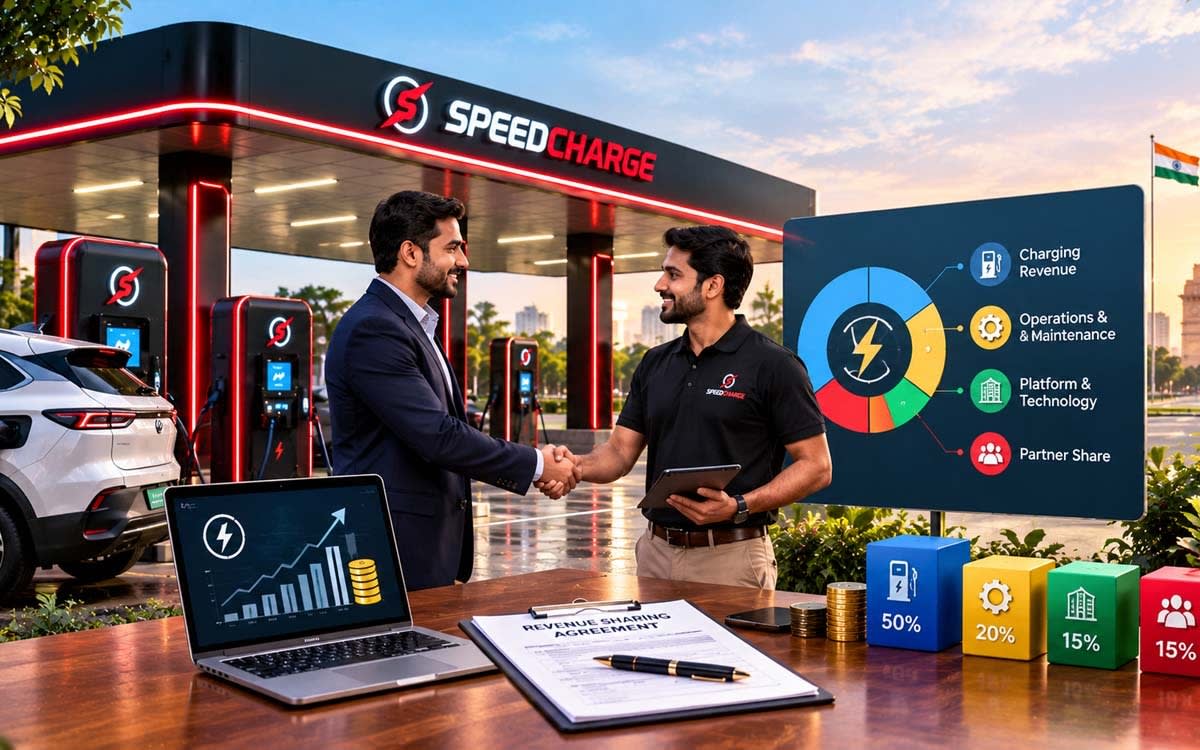
SpeedCharge's guide to EV charging station revenue-sharing models explains how fixed payments, per-kWh settlements and revenue-linked arrangements can allocate charging income between different commercial participants.
How to Calculate Potential Monthly Charging Revenue
The charging business should be modelled using actual expected energy sales rather than the charger's maximum theoretical output.
Consider a hypothetical petrol pump installing a 60 kW DC charger. Assume the location serves ten EV charging customers per day, with an average session of 25 kWh.
Daily energy sales would be:
10 × 25 kWh = 250 kWh
Over a 30-day month, the station would dispense 7,500 kWh.
Assuming an illustrative realised charging rate of ₹18 per kWh, excluding GST for simplicity, monthly charging revenue would be:
7,500 × ₹18 = ₹1,35,000
If the effective electricity-related variable cost is assumed to be ₹8 per billable kWh, the corresponding electricity expense would be ₹60,000.
This leaves ₹75,000 before other operating expenses.
The operator would still need to account for maintenance, software, payment costs, contractual property payments, insurance and other applicable expenditure. Assuming these additional operating expenses total ₹25,000, the simplified operating surplus would be ₹50,000 before financing, depreciation, tax and other business-level costs.
The example demonstrates why ₹1.35 lakh in customer charging revenue should not be advertised as monthly profit.
Actual results can differ considerably, particularly during the initial demand-building period.
A petrol pump hosting a charger under a separate property agreement would receive its contractual payment rather than automatically retaining the entire station's operating surplus.
Government Support and the PM E-DRIVE Scheme
Government-supported EV infrastructure deployment can create opportunities for established fuel-retail locations.
The Ministry of Heavy Industries has allocated ₹2,000 crore under PM E-DRIVE for the development of public EV charging infrastructure. The programme includes categories of publicly accessible locations that can involve retail outlets operated by public-sector oil marketing companies.
The official PM E-DRIVE public charging infrastructure guidelines explain the programme's implementation framework and eligibility conditions.
However, an independently owned petrol pump should not interpret the scheme as an automatic entitlement to financial support.
The relevant implementation agency, location category, project approval and eligible expenditure determine whether support is available.
A prudent investor should first establish whether the charging project is commercially feasible without subsidy. Approved government assistance can subsequently improve the investment structure, but unconfirmed funding should not be treated as committed capital.
Urban vs Highway Petrol Pumps: Where Is the Better Opportunity?
The commercial potential of a petrol pump charging project depends on its customer catchment rather than simply whether the outlet is located inside or outside a city.
An urban petrol pump may generate repeat demand from electric taxis and residents. Its main challenge could be congestion or limited parking.
A highway outlet may serve fewer repeat local customers but attract larger charging sessions from vehicles travelling long distances. The availability of food, washrooms and other amenities can influence the decision to stop.
A location near an airport corridor can face another type of demand, including commercial taxis and vehicles completing multiple trips each day.
The important distinction is between passing traffic and charging demand. A busy petrol pump selling substantial quantities of diesel does not automatically attract enough compatible electric vehicles to support a high-power charging hub.
SpeedCharge's Kochi EV charging infrastructure guide provides additional context on evaluating destination, commercial and intercity charging opportunities within a specific regional market.
Before selecting equipment, the investor should observe actual EV movement, identify existing competitors and examine whether drivers can conveniently stop at the proposed outlet.
How to Protect Existing Petrol and Diesel Operations
A charging installation should complement the existing fuel business rather than interfere with it.
Conventional refuelling generally involves a short stop, whereas an EV charging session may occupy a parking bay for considerably longer. Combining both customer flows without adequate planning can create congestion and reduce the efficiency of the existing petrol pump.
A sensible project should preserve the operating capacity of petroleum dispensing equipment, maintain approved vehicle routes and prevent charging-related queues from obstructing normal operations.
The Oil Industry Safety Directorate standards include standards addressing petroleum storage, handling and dispensing at retail outlets. The charging project should be assessed within the existing petroleum-safety framework rather than as an isolated electrical installation.
Customer-support procedures should also be coordinated between the fuel retailer and charging operator. Petrol pump personnel should know whom to contact when charging equipment reports a fault, while technical repairs should remain the responsibility of appropriately trained personnel.
Managing charging queues during busy periods
Where charging demand grows, additional vehicles may arrive before an occupied charger becomes available.
Providing accurate connector status, appropriate waiting arrangements and charging-completion notifications can reduce unnecessary congestion.
SpeedCharge's guide to managing queues and charging bay turnover explains how reservations, waiting-time estimates and parking coordination can improve the productivity of existing charging infrastructure.
For fuel retailers, effective queue management can protect both EV charging operations and the original petroleum business.
Step-by-Step Process to Install EV Charging Infrastructure at a Fuel Outlet
Step 1: Establish commercial authority
Review the dealership agreement, property ownership and existing contractual restrictions. Obtain written consent from the relevant parties before making binding installation commitments.
Step 2: Conduct a charging-demand assessment
Study the surrounding EV market, vehicle movements, travel patterns, competing charging stations and likely customer dwell time.
Step 3: Complete a professional site assessment
Review the approved petroleum layout, hazardous-area classification, available parking and electrical infrastructure. Determine whether a compliant charging installation can be accommodated without interrupting existing operations.
Step 4: Obtain the applicable approvals
Coordinate the required submissions with the petroleum licence holder, charging operator, electrical professionals and relevant authorities.
Confirm the requirements for PESO approval, electricity connection and other applicable clearances before installation.
Step 5: Finalise investment and operating responsibilities
Agree on the charger configuration, ownership structure, project funding, electricity payments, maintenance obligations, insurance and commercial settlement process.
Step 6: Install, inspect and commission
Engage qualified professionals to complete the approved electrical and civil work. Energise the installation only after the applicable testing, inspection and commissioning requirements have been satisfied.
Step 7: Launch and monitor performance
Make the station discoverable through relevant charging applications and navigation services. Monitor customer demand, energy sales, charging success, bay utilisation and technical performance.
This phased approach reduces the likelihood of purchasing unsuitable equipment or committing capital before the property has been approved for the proposed development.
How to Partner With SpeedCharge for Petrol Pump EV Charging
Petrol pump dealers and commercial property owners interested in EV charging can explore the SpeedCharge location partnership programme to submit their property for feasibility assessment.
A useful initial enquiry should contain the outlet's location, property details, available parking area, existing petroleum layout, electricity information and details of the party authorised to approve charging infrastructure.
SpeedCharge also offers an EV charging station franchise programme for investors interested in a structured charging infrastructure business.
The appropriate arrangement depends on whether the petrol pump owner wishes to host charging equipment, invest directly in the infrastructure or participate through another agreed commercial model.
The project-specific proposal should document the applicable responsibilities, equipment configuration, financial obligations and operating arrangements.
Conclusion
Installing electric vehicle charging infrastructure at an existing petrol pump can create a complementary business opportunity while allowing fuel retailers to participate in India's evolving mobility market.
The commercial advantages of established road access, customer facilities and existing operations must be balanced against petroleum safety requirements, electrical feasibility, contractual permissions and realistic EV charging demand.
The most important starting point is an approved and professionally assessed site layout. Equipment capacity and investment should be decided only after the property has been evaluated for safety and business feasibility.
Petrol pump owners considering this opportunity can approach SpeedCharge for a site-specific assessment and explore a charging partnership or franchise model suited to their property and investment requirements.
Frequently Asked Questions
Can petrol pump owners install EV charging stations in India?
Yes. Existing fuel retailers can develop electric vehicle charging infrastructure subject to petroleum safety requirements, applicable PESO approval, electrical regulations and relevant dealership or property permissions. The installation must be compatible with the approved outlet layout and must not interfere with ordinary petroleum operations.
Is PESO approval required for EV charging at a petrol pump?
The Ministry of Power's electricity-connection documentation identifies PESO approval for EV charger installations at petrol pumps and gas stations. The project team should coordinate with PESO and the petroleum licence holder to establish the applicable approval and site-layout requirements before commissioning.
Can an EV charger be installed near a petrol dispenser?
Charging facilities must remain outside hazardous zones and satisfy the prescribed separation requirements. PESO's January 2025 circular specifies a six-metre distance from relevant fuel dispensing units. A qualified engineering assessment must also establish compliance with the complete approved site layout.
How much does a petrol pump EV charging installation cost?
There is no universal installation price. Total expenditure depends on charger capacity, electricity availability, transformer requirements, civil work, safety assessments and operating arrangements. Existing infrastructure can reduce some costs, whereas substantial electrical upgrades can materially increase the complete project investment.
Which charger is suitable for highway petrol pumps?
A 60 kW or 120 kW DC charger can be considered where customer demand, vehicle compatibility and grid capacity support fast charging. Smaller chargers may suit longer-dwell locations. Final equipment selection should reflect expected session volume, charging duration and available electrical infrastructure.
Can a petrol pump earn money without purchasing an EV charger?
Potentially, yes. A property-hosting partnership can allow a charging company to develop infrastructure at an eligible outlet under an agreed commercial arrangement. Property compensation may take the form of fixed rent, revenue-linked payments or another negotiated structure.
Can a petrol pump receive an EV charging subsidy?
Eligible projects may receive support under applicable government infrastructure programmes, including PM E-DRIVE. However, an individual petrol pump does not automatically qualify for funding. Eligibility depends on the project category, implementing agency, formal approval and scheme conditions.
Does every petrol pump require a new transformer for EV charging?
No. Some properties may already have sufficient approved electrical capacity. Others may require a dedicated connection, transformer installation or sanctioned-load enhancement. A qualified electrical engineer should assess existing demand and the proposed charging configuration before determining the infrastructure requirement.
Can an EV charger operate alongside petrol, diesel and CNG facilities?
Yes, subject to applicable safety requirements and approval of the proposed layout. The charging equipment and dedicated parking must remain outside hazardous areas, maintain prescribed separation distances and avoid obstructing existing fuel-retail and vehicle-movement operations.
How can a petrol pump owner apply for a SpeedCharge partnership?
The property owner or authorised dealer can submit a location-partnership enquiry through SpeedCharge's website. Providing accurate property information, available space, electricity details, dealership permissions and the existing outlet layout can support a more effective feasibility assessment before a commercial proposal is developed.