
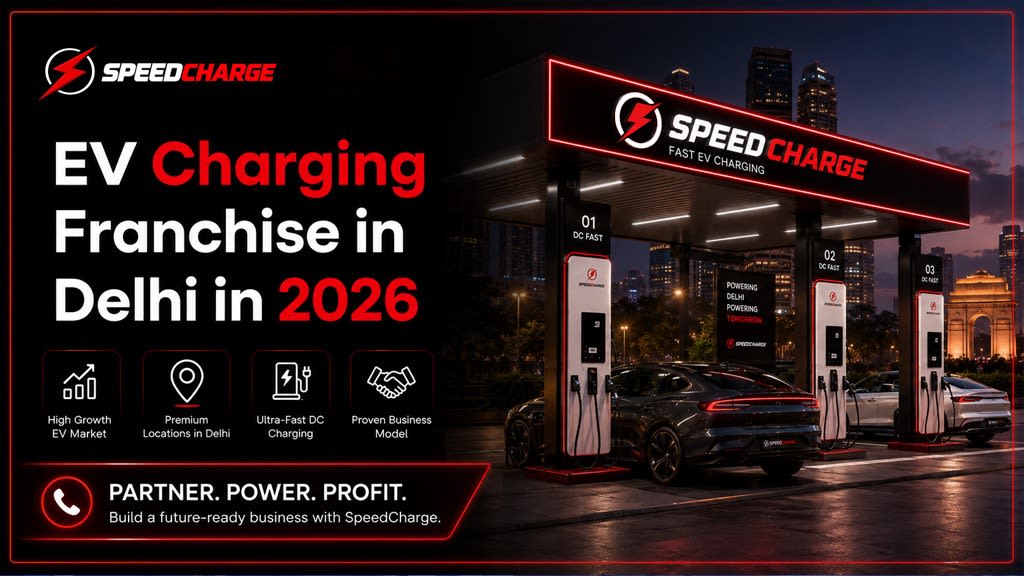
Delhi has entered a more mature phase of electric mobility. The city already has an established network of public, community and private charging points, while the new Delhi EV framework puts fresh emphasis on expanding reliable charging infrastructure. For an investor, this makes an EV charging station franchise in Delhi a potentially attractive infrastructure opportunity—but only when the location, electricity supply, charger configuration and commercial model are validated together.
The biggest mistake is to treat an EV charging franchise like an ordinary retail outlet. A strong brand and a busy road are not enough. Charging revenue depends on how many useful kilowatt-hours the site can deliver, how reliably the chargers operate, what it costs to supply electricity and whether drivers have a genuine reason to charge at that location.
This guide answers the commercial questions Delhi investors are actually searching for in 2026:
What does an EV charging station cost?
Which Delhi locations should investors evaluate?
Is a licence required?
What changed under Delhi EV Policy 2026?
How does a charging franchise earn money?
Which charger capacity should you choose?
What should be checked before signing an agreement?
How does the SpeedCharge franchise model work?
Why Delhi Is a Strong EV Charging Market in 2026
The Delhi EV Policy 2026 came into effect on 1 July 2026 and is intended to remain in force until 31 March 2030. The policy supports the development of comprehensive public and private EV charging infrastructure across Delhi.
Delhi Transco Limited has been assigned responsibility for planning, coordinating and implementing public charging and battery-swapping infrastructure. The policy also encourages DISCOMs, private entities, real-estate developers and other eligible stakeholders to participate in charging-station deployment.
For investors evaluating an EV charging station franchise in Delhi, this matters because charging demand is being supported not only by vehicle adoption but also by a formal infrastructure-development framework.
However, Delhi is not an empty first-mover market. Existing infrastructure must be treated as competition.
The official Switch Delhi charging station locator already lists operational charging locations across different parts of the city. Before investing, use this data to understand where charging supply already exists and where genuine service gaps may remain.
What Delhi EV Policy 2026 Means for Charging Businesses
Delhi’s latest policy strengthens the institutional framework around charging infrastructure.
Important provisions include:
Delhi Transco Limited acting as the nodal agency for public charging deployment
Aggregation of charging locations and electricity-load requirements
System-level planning for grid readiness
Development of standard operating procedures
A digital platform for onboarding, approvals, monitoring and reporting
A proposed single-window facility for charge-point operators
Participation by private entities and real-estate developers
Support for community and private charging
Coordination with DISCOMs
Potential use of PM E-DRIVE support through the prescribed framework
The commercial takeaway is important:
Delhi supports charging infrastructure, but policy support does not make every charging station profitable.
Investors still need to validate the exact property.
How Much Does an EV Charging Franchise Cost in Delhi?
There is no single government-approved franchise price.
The total investment in an EV charging station franchise in Delhi depends on charger capacity, number of connectors and—critically—the electrical infrastructure already available at the site.
Your complete project budget may include:
Franchise or commercial fee
EV charging hardware
AC/DC charger configuration
Number of charging guns
Electrical panels
Protection equipment
Power cables
Earthing
Civil foundation
Trenching
Parking-bay modification
Bollards and safety equipment
Signage and branding
Communication hardware
CSMS integration
Payment integration
Electricity connection
Sanctioned-load enhancement
Transformer work where required
Utility deposits
Property deposit
Rent
Insurance
AMC and maintenance
Spare parts
Working capital
This is why comparing franchises only through an advertised “starting investment” can produce the wrong decision.
Two stations using exactly the same charger can have completely different project costs.
One property may already have sufficient spare electrical capacity.
Another may require a transformer upgrade, new panel, long cable route and major civil work.
Before purchasing hardware, review SpeedCharge’s EV Charging Station Setup Guide to understand the complete setup sequence from demand analysis and power feasibility to installation and commissioning.
Check Electricity Before Buying the Charger
Electrical feasibility should come before final charger selection.
A site survey should identify:
Existing sanctioned load
Existing peak demand
Spare electrical capacity
Proposed charging load
Number of chargers
Simultaneous demand
LT or HT configuration
Transformer availability
Panel capacity
Metering arrangement
Cable route
Earthing
Protection requirements
Expansion capacity
Do not assume that every DC fast charger automatically needs a separate transformer.
The requirement depends on the property’s existing infrastructure, proposed charging demand and applicable DISCOM conditions.
The national Guidelines for Installation and Operation of Electric Vehicle Charging Infrastructure-2024 provide the current central framework for private, semi-restricted, public and highway charging infrastructure.
The guidelines also provide for LT connections up to 150 kW in specified circumstances when a separate LT connection is sought for an EV charging station. Exact site feasibility still needs to be confirmed with the relevant distribution licensee.
Do You Need a Licence for an EV Charging Station in Delhi?
Setting up an EV charging station is treated as a de-licensed activity under India’s electricity framework.
This means an operator does not need to become an electricity distribution licensee merely to provide EV charging.
However:
De-licensed does not mean unregulated.
A commercial station may still need to address:
DISCOM connection requirements
Sanctioned load
Metering
Electrical safety
Charger standards
Property permissions
Parking rights
Fire and site safety
Commercial registrations
Applicable taxes
Public-access requirements
Local project-specific approvals
Read SpeedCharge’s EV Charging Station License in India Guide before treating “no licence required” as “no approvals required.”
Which Charger Should You Choose: AC or DC?
The highest-powered charger is not automatically the most profitable charger.
Your charger should match the behaviour of customers using the site.
AC Charging Works Well When Dwell Time Is Long
Examples include:
Offices
Hotels
Apartment communities
Long-stay parking
Corporate campuses
Drivers remain parked for several hours, so ultra-fast charging may not be necessary.
DC Fast Charging Works Better When Turnaround Matters
Examples include:
Taxi hubs
Highway corridors
Intercity traffic
Fleet charging
High-utilisation public stations
Short-stop commercial locations
The correct commercial question is not:
“How many kW can I afford?”
It is:
“How many kWh can this location sell reliably every day?”
Best Locations for EV Charging in Delhi NCR
Location quality should be based on charging behaviour, not only road traffic.
When assessing an EV charging station franchise in Delhi, investigate the use case first.
1. Taxi and Fleet Hubs
Fleet charging can generate recurring demand because vehicles operate predictable routes and frequently consume substantial energy.
Potential users include:
Electric taxis
Delivery fleets
Corporate fleets
Logistics companies
Rental fleets
Anchor fleet demand can make utilisation easier to forecast than relying entirely on walk-in charging.
2. Hotels and Restaurants
Hotels and restaurants naturally provide dwell time.
They can be particularly useful on:
Intercity routes
Airport corridors
Business districts
Highway approaches
A mixed AC/DC configuration can sometimes be more appropriate than installing only high-power chargers.
3. Commercial Parking Facilities
Parking facilities already provide something EV charging requires: a vehicle that remains stationary.
Assess:
Average dwell time
EV traffic
Parking fees
Operating hours
Power availability
Existing nearby chargers
4. Shopping Centres and Malls
Customers may stay long enough to add useful energy while shopping, dining or watching a movie.
5. Office Districts
Employee parking can support predictable weekday charging behaviour.
6. Residential Clusters
Residential areas can be attractive where apartment residents lack dedicated home charging access.
7. Highway Approaches
Fast-charging demand can be stronger where Delhi traffic connects toward major intercity corridors.
Delhi NCR Areas Worth Studying
Do not publish claims such as “Dwarka guarantees high ROI” or “Noida is the best charging location” without actual utilisation data.
Instead, conduct feasibility studies around:
Dwarka
Rohini
South Delhi commercial centres
East Delhi
Central Delhi parking clusters
Aerocity and airport corridor
Noida business districts
Noida Expressway
Greater Noida
Gurugram commercial districts
NH-48
Faridabad commercial and industrial areas
These are areas to study, not guaranteed high-performing locations.
How to Check Competition Before Finalising a Site
Use the official Delhi charging station database as one of your competition-mapping tools.
For each candidate property:
Map nearby chargers.
Check charger capacity.
Identify connector types.
Visit competing locations.
Check actual accessibility.
Observe queues.
Compare operating hours.
Compare customer pricing.
Check parking fees.
Identify fleet-heavy locations.
Look for unreliable or undersupplied areas.
Estimate whether another station can add useful capacity.
A map pin does not tell you how useful a competitor actually is.
How Does an EV Charging Franchise Make Money?
The simplest revenue formula is:
Charging Revenue = Billable kWh Delivered × Realised Customer Charging Price
But gross revenue is not profit.
Costs can include:
Electricity
Fixed or demand charges
Charging losses
Site rent
Revenue sharing
Payment gateway charges
Software
Connectivity
Maintenance
Field service
Insurance
Security
Staff
Taxes
Financing
Downtime
A 120 kW charger does not automatically make twice as much money as a 60 kW charger.
A powerful charger with weak utilisation is still an underutilised asset.
For detailed revenue and profitability modelling, internally link readers to SpeedCharge’s EV Charging Business Model in India guide.
The Metric Investors Should Watch: kWh Throughput
Charger rating tells you potential output.
It does not tell you actual utilisation.
Commercial performance depends on:
Sessions per day
Average energy per session
Vehicle mix
Customer dwell time
Station availability
Repeat usage
Charging price
Competition
Fleet contracts
Local demand
A well-used 60 kW charger can outperform a poorly located 120 kW charger.
How SpeedCharge’s Franchise Model Works
SpeedCharge offers structured franchise and partnership models for investors, entrepreneurs, businesses and property owners.
For someone evaluating an EV charging station franchise in Delhi, the right process starts with site feasibility—not with buying a pre-selected charger package.
Investors can review the SpeedCharge EV Charging Station Franchise programme for the current franchise structure, station configuration process and site requirements.
A typical process includes:
Step 1: Submit Your Location
Share:
City
Property
Available space
Investment preference
Existing power information
Step 2: Site Feasibility
Evaluate:
EV traffic
Accessibility
Parking
Electricity
Nearby charging competition
Commercial demand
Step 3: Station Configuration
The charger rating and number of charging points should be selected according to the site.
Step 4: Commercial Proposal
Define investment, infrastructure scope and operating structure.
Step 5: Agreement and Planning
Lock:
Responsibilities
Commercial terms
Project design
Installation scope
Step 6: Installation
Complete:
Civil work
Electrical work
Charger installation
Testing
Step 7: Network Activation
Integrate the station with the charging network and backend systems for live commercial operation.
SpeedCharge Revenue Share and Minimum Payout
Under SpeedCharge’s current commercial structure provided for the programme, the standard revenue share is:
₹7 per eligible kWh
The current structure also provides a:
₹20,000 Minimum Guaranteed Monthly Payout per eligible month for the first three years
Where actual monthly revenue share is below ₹20,000 during an eligible month, the applicable mechanism provides for the shortfall required to reach the minimum payout.
Where actual revenue share is ₹20,000 or more, no top-up is required.
These should be described as contractual commercial terms, not as guaranteed profit or guaranteed ROI.
Always use the final executed agreement for:
Eligibility
Exclusions
Settlement
Commencement date
Applicable kWh definition
Term
Other legal conditions
Minimum Payout Is Not Guaranteed ROI
This distinction is important.
A minimum monthly payout does not automatically guarantee:
Investment recovery
A specific ROI percentage
A fixed payback period
Station utilisation
Asset appreciation
Total project profitability
Actual returns can still depend on:
Total CAPEX
Financing
Property cost
Taxes
Electrical infrastructure
Agreement terms
Other investor obligations
FOCO vs FOFO
Do not choose a franchise only because of the label.
FOCO — Franchise Owned, Company Operated
Generally, the investor owns or funds defined infrastructure while the company manages agreed operational functions.
FOFO — Franchise Owned, Franchise Operated
Generally, the franchisee also assumes a greater share of operational responsibility.
The agreement should specify who handles:
Electricity
Rent
Maintenance
Customer support
Pricing
Charger uptime
Software
Insurance
Staff
Tax
Revenue settlement
Equipment replacement
The contract is more important than the acronym.
How to Calculate Profit and ROI
Do not calculate ROI from gross charging revenue.
First calculate total invested capital.
Include:
Franchise/commercial payment
Charger
Electrical infrastructure
Transformer where required
Civil work
Utility deposits
Site deposits
Financing
Pre-opening expenses
Then estimate annual net cash flow after operating costs.
A basic ROI formula is:
ROI = Annual Net Cash Flow ÷ Total Invested Capital × 100
Always model at least three scenarios.
Conservative Scenario
Use:
Lower charging sessions
Slower demand ramp
Conservative uptime
Full site costs
Base Scenario
Use:
Site-study data
Real electricity assumptions
Contract terms
Realistic session volume
Strong Scenario
Use higher utilisation only when supported by:
Fleet demand
Anchor users
Comparable station data
Proven traffic
What About PM E-DRIVE Subsidy?
The Government’s PM E-DRIVE scheme guidelines include operational guidelines for deployment of EV public charging stations released on 26 September 2025.
However, private investors should not assume that purchasing a franchise automatically qualifies them for direct subsidy.
The PM E-DRIVE framework works through eligible government entities and designated nodal agencies, and proposed sites are subject to eligibility and feasibility requirements.
Therefore:
Do not include subsidy in your ROI calculation until the exact project route and eligibility have been confirmed.
What Standards Should Charger Hardware Follow?
Charger procurement should include technical-standard verification.
The Bureau of Indian Standards EV charging infrastructure overview provides information on the Indian standards landscape for charging equipment.
BIS also published the revised IS 17017 (Part 23):2026 covering DC Electric Vehicle Supply Equipment, including electrical protection, vehicle communication, emergency disconnection and other technical requirements.
Hardware due diligence should include:
Applicable Indian Standard
Charger manufacturer
Exact model
Connector
Rated power
Warranty
Service support
Spare-part availability
Software compatibility
Firmware support
What to Verify Before Signing a Franchise Agreement
Before paying for an EV charging station franchise in Delhi, verify the technical and commercial scope in writing.
Company and Contract
Check:
Legal entity
Agreement tenure
Renewal
Termination
Transfer rights
Dispute resolution
Hardware
Confirm:
Manufacturer
Model
Charger rating
Connector count
Ownership
Warranty
Electrical Infrastructure
Confirm responsibility for:
DISCOM connection
Sanctioned load
Transformer
Panels
Cabling
Earthing
Utility deposit
Property
Confirm:
Rent
Lease term
Lock-in
Escalation
CAM
Parking charges
Site access
Revenue
Confirm:
Revenue-share definition
Eligible kWh definition
Minimum payout conditions
Settlement frequency
Tax treatment
Deductions
Operations
Confirm:
Maintenance
Uptime definition
SLA
Customer support
Spare parts
Insurance
CMS access
Data access
Do not rely only on a sales presentation.
Compare Before You Commit
Investors researching the wider market can also review SpeedCharge’s Top 10 EV Charging Station Franchises in India comparison.
Compare providers on:
Business model
Operating responsibility
Site support
Charger hardware
Software
Maintenance
Network support
Agreement terms
Do not compare only advertised ROI.
Property Owner vs Franchise Investor
A property owner with a strong charging location does not necessarily need to purchase a franchise.
There are two fundamentally different opportunities.
Franchise Investor
The investor contributes capital toward charging infrastructure according to the commercial model.
Location Partner
A landowner or commercial property owner contributes a suitable site.
This can be relevant for:
Hotels
Dhabas
Petrol pumps
Commercial parking
Highway land
Malls
Offices
Roadside commercial properties
Property owners can explore SpeedCharge’s commercial EV charging partnership options instead of assuming a full franchise investment is always the right structure.
Step-by-Step: How to Start in Delhi
Step 1 — Identify an Exact Property
Do not start with:
“I want a station somewhere in Delhi.”
Start with a specific site.
Step 2 — Validate Demand
Study:
EV traffic
Nearby fleets
Businesses
Residential demand
Competing chargers
Step 3 — Check Power
Complete an electrical feasibility survey before ordering chargers.
Step 4 — Identify the Customer
Decide whether you intend to serve:
Taxis
Private cars
Fleets
Hotel guests
Office users
Highway travellers
Residential EV owners
Step 5 — Select Charger Configuration
Match charging power to customer behaviour.
Step 6 — Obtain a Complete Commercial Proposal
Separate:
Hardware
Electrical work
Civil work
Utility work
Site costs
Software
Ongoing operating costs
Step 7 — Audit the Agreement
Make sure every financial assumption matches the contract.
Step 8 — Install and Commission
Test:
Actual EV charging
Authentication
Billing
Payments
Remote monitoring
Safety functions
Network connectivity
Step 9 — Measure the Right KPIs
Monitor:
Daily charging sessions
kWh delivered
Charger utilisation
Uptime
Revenue per charger
Fault frequency
Repeat customers
Conclusion
An EV charging station franchise in Delhi can provide a structured route into one of India’s most active EV markets in 2026.
Delhi’s new EV policy, single-window charging direction, fleet electrification and continuing infrastructure development create genuine opportunities.
But Delhi-wide EV growth alone is not an investment thesis.
A strong project requires:
Verified charging demand + correct location + sufficient electrical capacity + appropriate charger configuration + realistic total cost + high uptime + clear commercial terms
The location should therefore be validated before the charger is selected and before a long-term franchise or property agreement is signed.
SpeedCharge investors should use the site feasibility process and final commercial agreement to determine the exact infrastructure configuration, investment responsibility and payout structure rather than relying only on generic revenue projections.
Frequently Asked Questions
1. Is an EV charging franchise profitable in Delhi?
It can be, but profitability depends on charger utilisation, daily energy delivered, electricity cost, property cost, uptime, complete project CAPEX and the commercial agreement.
2. How much does an EV charging franchise cost in Delhi?
There is no universal price. Total cost depends on charger capacity, number of connectors, electrical infrastructure, civil work, utility requirements, software, site cost and franchise structure.
3. Do I need a licence to open an EV charging station in Delhi?
A separate electricity distribution licence is not required merely to provide EV charging services. The site must still satisfy applicable electricity, safety, property and charging-infrastructure requirements.
4. Which location is best for an EV charging station in Delhi?
There is no universally best area. Strong sites usually combine measurable EV demand, suitable dwell time, easy vehicle access, adequate power capacity and manageable property costs.
5. Is DC fast charging better for a franchise?
Not always. DC fast charging suits high-turnover applications such as taxis and highway users. AC charging can be more appropriate for offices, hotels and other long-dwell locations.
6. How does an EV charging franchise earn money?
The main revenue comes from billable energy delivered through charging sessions. Actual profitability depends on operating expenses including electricity, rent, maintenance, software, payment costs and financing.
7. Can a private charging franchise get PM E-DRIVE subsidy?
Not automatically. PM E-DRIVE charging support follows a prescribed implementation mechanism involving eligible entities, nodal agencies and qualifying sites.
8. What is FOCO in an EV charging franchise?
FOCO generally means Franchise Owned, Company Operated. The investor owns or funds defined infrastructure while the company handles agreed operational responsibilities. The final agreement determines the exact division of responsibilities.
9. Can I provide my land instead of investing in charging equipment?
Potentially, yes. Suitable property owners can explore a location-partner structure involving rent, revenue sharing or another commercial arrangement depending on the operator and site.
10. What should I check before investing?
Check site demand, electrical feasibility, total installed cost, charger hardware, agreement terms, revenue-share calculations, payout conditions, maintenance, uptime, electricity responsibility, property obligations and exit provisions.
