
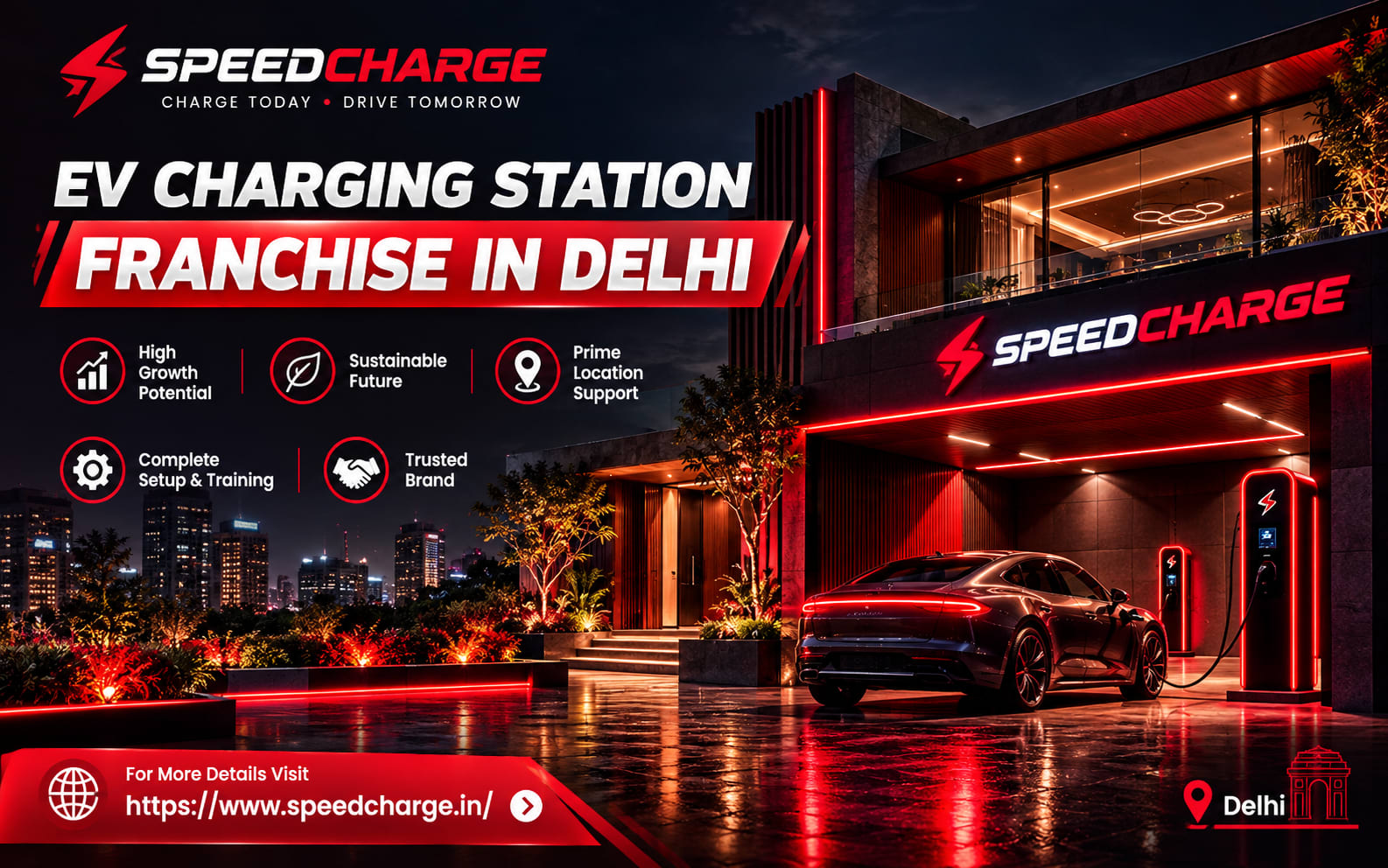
Delhi is running one of the most aggressive EV infrastructure pushes in the country right now — and the numbers make the opportunity impossible to ignore. As of early 2026, the capital has around 8,849 public charging points against an actual requirement of 36,150, leaving a shortfall of over 27,000 charging points still to be built. The government's own EV Policy 2.0 is targeting 30,000+ public charging points city-wide, with 7,000 new points planned in 2026 alone.
That gap between demand and supply is exactly where a franchise investor steps in. If you're searching for an EV charging station franchise in Delhi, this guide covers investment, expected earnings, ROI timeline, space requirements, the current Delhi charging market, and how the opportunity compares to other operators active in the city.
Quick Answer: An EV charging station franchise in Delhi typically requires an investment of ₹15 Lakh to ₹2 Crore, needs 500 sq. ft. of space, and delivers ROI within 8 to 24 months, with monthly earning potential of ₹1.5 Lakh to ₹10 Lakh depending on location and charger capacity — backed by a city-wide shortfall of 27,000+ charging points that Delhi still needs to fill.
Why Delhi Is One of India's Best Cities to Start an EV Charging Franchise
Delhi isn't just another city for EV charging — it's the policy and demand epicentre of India's EV transition. Here's what makes it stand out for a franchise investor specifically:
A documented infrastructure gap. Delhi currently has roughly 8,849–9,000 public charging points against a real requirement of 36,150 — a shortfall north of 27,000 points. Very few cities in India have this scale of unmet, government-acknowledged demand.
Delhi EV Policy 2.0 is actively incentivising this exact business. The revised policy (expected to be notified alongside the central PM E-DRIVE scheme) is designed to fast-track private charging infrastructure, with incentives disbursed via Direct Benefit Transfer (DBT).
A "charger within 3 km" accessibility mandate. Delhi's policy direction aims for a public charging facility within 3 km of any location in the city — which means demand is being deliberately spread across zones, not just concentrated in a few hotspots.
New-building mandates favour charger-ready sites. Regulations now require 20% of parking in new buildings to be EV-charger-ready, creating a steady pipeline of new host sites for franchise partners.
Highway and NCR connectivity. Delhi sits at the intersection of high-traffic corridors like NH48 (Delhi–Jaipur) and the Yamuna Expressway (Delhi–Agra), both of which already have DC fast-charging demand from intercity EV traffic — plus dense NCR spillover from Gurugram and Noida.
Uneven coverage across zones. South and Central Delhi have relatively strong charger density, but zones like East Delhi (Preet Vihar, Mayur Vihar) are still comparatively under-served — meaning first-mover advantage is still very much available if you pick the right locality.
In short: Delhi isn't a "maybe it'll grow" market. It's a market where the government has already quantified the shortfall and is actively funding the fix — which is precisely the demand backdrop a franchise investor wants before committing capital.
If you're exploring pan-India franchise options, check out our detailed guide on EV Charging Station Franchise in India (Investment ₹15 Lakh–2 Cr) covering investment, ROI, and space requirements.
Franchise Investment Details for Delhi
Parameter | Details |
|---|---|
Investment Range | ₹15 Lakh – ₹2 Crore |
Expected Monthly Earning | ₹1.5 Lakh – ₹10 Lakh (based on investment tier) |
Expected ROI | 8 – 24 Months |
Space Required | 500 Sq. Ft. |
Expansion Availability | Delhi NCR + Pan-India |
How Investment Tiers Work in Delhi
Entry-level (₹15–30 Lakh): Ideal for a single-gun or dual-gun DC charger in a residential society, IT park, or neighbourhood commercial market — areas like Rohini, Dwarka, Preet Vihar, or Mayur Vihar where coverage is still catching up.
Mid-tier (₹30 Lakh–₹1 Crore): Suited to arterial-road or ring-road-facing sites, multi-storey parking complexes, and malls in high-footfall zones like South Delhi, Central Delhi, or Connaught Place-adjacent commercial belts.
Premium (₹1–2 Crore): Positioned for NH48 and Yamuna Expressway-facing sites, logistics hubs near Delhi's transport corridors, and large-format sites capable of serving both private EVs and commercial fleet charging.
Delhi's dense population, high vehicle ownership, and government-mandated accessibility targets mean even entry-level, compact stations can achieve strong utilisation — you don't need a highway mega-site to make the numbers work.
Expected ROI: 8 to 24 Months
Delhi's franchise ROI window of 8 to 24 months compares well against the market-wide averages reported for EV charging franchises across India, where most established brands quote 2 to 5 years for payback, depending on charger capacity and site type.
Three factors drive how fast you hit that 8–24 month mark in Delhi specifically:
Zone-level demand density — sites in currently under-served pockets (East Delhi, outer ring areas) can still see fast utilisation growth simply because there's less existing competition, even with moderate footfall.
DISCOM tariff and open-access options — Delhi's multiple power distribution companies (BSES Rajdhani, BSES Yamuna, Tata Power-DDL) each set commercial/EV tariffs; picking a site with a favourable sanctioned load and tariff category directly protects your margin.
Policy-linked incentives — as Delhi EV Policy 2.0 rolls out DBT-based incentives and further charging infrastructure support, early movers stand to benefit from reduced effective setup costs.
Understanding the EV Charging Franchise Business Model
An EV charging franchise is fundamentally different from a typical retail franchise — you're not restocking inventory, you're operating a metered utility asset. Revenue is essentially: (units sold to EV customers × billing rate) minus (units purchased from the DISCOM × procurement rate) minus operating costs.
In Delhi, this spread matters more than in most cities because of the metro's tiered commercial power tariffs and multiple DISCOM jurisdictions — the same investment can produce very different margins depending on which utility area and tariff category your site falls under.
Typically, the franchisor provides the technology layer — hardware, billing software, app integration, and remote monitoring — while the franchisee provides the land/leased space and manages daily site operations and local visibility. This is the same structural split you'll find across Tata Power's CPO model, Statiq's FOCO franchise, and ChargeZone's DOCO model — and it's the model this franchise follows too.
Space Requirement: Just 500 Sq. Ft.
You need only 500 sq. ft. to set up a fully operational EV charging franchise station — a genuinely low bar in a city like Delhi, where real estate is expensive and large plots are hard to secure. This footprint fits:
Residential society and apartment complex parking areas
Small commercial plots along Delhi's arterial and ring roads
Existing petrol pump forecourts looking to diversify
Mall, hospital, and hotel parking bays
Compact plots near Delhi Metro stations and transit hubs (which are themselves expanding charging infrastructure)
A 500 sq. ft. requirement also means faster DISCOM power sanction and quicker civil work — both critical in a dense city where large-format land is scarce and expensive.
Delhi NCR Expansion: Beyond a Single Station
This franchise isn't limited to a single Delhi location — you can scale across Delhi NCR and pan-India, including:
High-density South and Central Delhi commercial belts
Under-served zones like East Delhi and outer Delhi neighbourhoods
NCR extensions into Gurugram, Noida, Ghaziabad, and Faridabad
Highway-facing sites along NH48 and the Yamuna Expressway
Given Delhi's policy-driven demand curve — 7,000 new points targeted in 2026 alone, scaling toward 30,000+ — building a multi-location portfolio in and around the capital over the next 2–3 years is a realistic growth path for franchise partners who start early.
How This Franchise Compares to Other EV Charging Brands Active in Delhi
Delhi's charging market includes national networks like Tata Power EZ Charge, Statiq, BPCL Pulse, HPCL HP Charge, Jio-bp Pulse, ChargeZone, and Zeon Charging, among others. Here's how their publicly disclosed franchise terms compare with this offer:
Franchise Brand | Investment Range | Space Required | Expected ROI | Delhi/NCR Presence |
|---|---|---|---|---|
This Franchise | ₹15 Lakh – ₹2 Crore | 500 Sq. Ft. | 8 – 24 Months | Delhi NCR + All India |
Tata Power EZ Charge | ₹5 Lakh – ₹2 Crore (varies by source/site) | 250 – 500 Sq. Ft. | Not publicly disclosed | Strong — one of Delhi's largest networks |
Statiq (FOCO model) | ₹30 Lakh – ₹3 Crore+ | Varies by bay count | Not publicly disclosed | Active in Delhi NCR |
Zeon Charging | ₹20 Lakh – ₹4 Crore (state-wise plans) | 500 – 5,000 Sq. Ft. | 3 – 4 Years | Expanding, select states |
ChargeZone | ₹25 Lakh – ₹10 Crore | 550 Sq. Ft. – large footprint | 2 – 5 Years | Pan-India, growing NCR footprint |
What This Means for a Delhi Investor
Lower or comparable entry investment. At ₹15 Lakh, entry is at or below most Delhi-active competitors — several of which, like Statiq's FOCO model, start entry investment closer to ₹30 Lakh.
Significantly faster projected ROI. The 8–24 month window undercuts the 2–5 year payback timelines typically quoted by larger, higher-capacity networks.
Same compact footprint, lower capital requirement. 500 sq. ft. matches the smallest formats offered by bigger brands, without requiring their higher minimum investment.
Direct benefit from Delhi's own policy tailwinds — the 3 km accessibility mandate and 27,000-point shortfall apply equally to every operator, but a lower entry cost means you can secure a site sooner rather than waiting to raise larger capital.
Established brands bring the advantage of existing network scale and years of operating data — that's real value. But if your priority in Delhi specifically is a faster payback and lower capital commitment while the city's charger shortfall is still wide open, this franchise is built around exactly those two levers.
What's Included in Franchise Support
Site feasibility assessment — footfall analysis and DISCOM power sanction feasibility specific to your Delhi zone
Design and engineering support — station layout and electrical planning suited to compact urban plots
Charger procurement and installation — access to approved charger brands with quality assurance
Billing and payment infrastructure — automated, GST-compliant billing via an integrated app
24×7 remote monitoring — real-time uptime tracking across your Delhi/NCR sites
Marketing support — visibility on the charging network app so Delhi's EV drivers can find your station easily
Ongoing operational guidance — performance reviews and ROI tracking throughout the franchise term
Eligibility Criteria for Delhi Franchise Partners
Land ownership or a valid, litigation-free lease for a minimum 500 sq. ft. site in Delhi NCR
Location in a high-footfall or under-served zone — residential societies, commercial markets, arterial roads, or highway frontage
Adequate access and turning radius for four-wheelers
Power connection feasibility — existing sanctioned load or ability to secure one from BSES Rajdhani, BSES Yamuna, or Tata Power-DDL
Investment capital matching the chosen tier (₹15 Lakh to ₹2 Crore)
Willingness to follow brand standards for signage, pricing, and customer service
Basic on-site amenities (parking, lighting, safety arrangements) where feasible
No prior EV or energy-sector experience is required — this is designed as an accessible entry point whether you're a first-time investor or an established Delhi business owner diversifying into infrastructure.
Step-by-Step: How to Start Your EV Charging Franchise in Delhi
Submit your enquiry — share your preferred Delhi/NCR location, available space, and investment budget.
Site evaluation — our team assesses traffic potential, DISCOM power availability, and zone-level demand for your proposed site.
Investment finalisation — based on the assessment, you're guided to the right investment tier (₹15 Lakh to ₹2 Crore).
Setup and installation — chargers, civil work, branding, and electrical infrastructure are installed and commissioned.
Launch and operations — your station goes live and starts generating revenue, with ongoing technical and operational support.
Scale within Delhi NCR — use your first station's performance to plan your next site as Delhi's charger network continues expanding toward its 30,000-point target.
Who Should Consider This Franchise in Delhi?
Petrol pump owners in Delhi looking to diversify their fuel retail business
Owners of commercial plots or parking areas near ring roads, arterial roads, or highway corridors (NH48, Yamuna Expressway)
Residential society management bodies and RWAs exploring EV-ready amenities
Mall, hospital, and hotel operators wanting to add a high-utility visitor amenity
First-time entrepreneurs looking for a scalable business with a defined ROI window
Existing multi-unit franchise owners diversifying into infrastructure-backed revenue
Frequently Asked Questions
Q1. How much investment is required for an EV charging station franchise in Delhi?
Investment ranges from ₹15 Lakh to ₹2 Crore, depending on charger capacity, site type, and target monthly earnings.
Q2. How much can I earn monthly from an EV charging franchise in Delhi?
Monthly earnings typically range between ₹1.5 Lakh and ₹10 Lakh, based on the investment tier, charger capacity, and location footfall.
Q3. What is the expected ROI period for an EV charging franchise in Delhi?
The expected ROI period is 8 to 24 months — faster than the 2–5 year payback windows typically quoted by several larger EV charging networks operating in the city.
Q4. How many EV charging points does Delhi currently have?
As of early 2026, Delhi has approximately 8,849–9,000 public charging points against an estimated requirement of 36,150, leaving a shortfall of over 27,000 points that the government is actively working to close.
Q5. How much space is needed to set up an EV charging station in Delhi?
Only 500 sq. ft. of space is required — a footprint that fits residential societies, small commercial plots, petrol pump forecourts, and mall or hospital parking areas.
Q6. Which areas in Delhi are best for an EV charging franchise?
High-footfall zones like South and Central Delhi have strong existing demand, while under-served zones such as East Delhi (Preet Vihar, Mayur Vihar) and outer Delhi neighbourhoods offer first-mover advantage with less existing competition. Highway-facing sites along NH48 and the Yamuna Expressway also see strong intercity charging demand.
Q7. Is prior business or EV-industry experience required?
No. The franchise model is designed to support first-time investors as well as experienced business owners, with no prior EV or energy-sector experience necessary.
Q8. How does this franchise compare to Tata Power, Statiq, ChargeZone, or Zeon Charging in Delhi?
This franchise offers a comparable or lower entry investment (starting ₹15 Lakh vs. ₹20–30 Lakh+ for several competitors), the same 500 sq. ft. minimum footprint as the smallest formats offered by larger brands, and a notably faster projected ROI window of 8–24 months against the 2–5 year timelines typically quoted by bigger, established networks.
Q9. Does Delhi's EV policy offer any incentives for charging station operators?
Delhi's EV Policy 2.0, aligned with the central PM E-DRIVE scheme, is designed to accelerate private charging infrastructure with incentives disbursed via Direct Benefit Transfer (DBT). New commercial buildings are also mandated to keep 20% of parking EV-charger-ready, expanding the pipeline of potential host sites for franchise partners.
