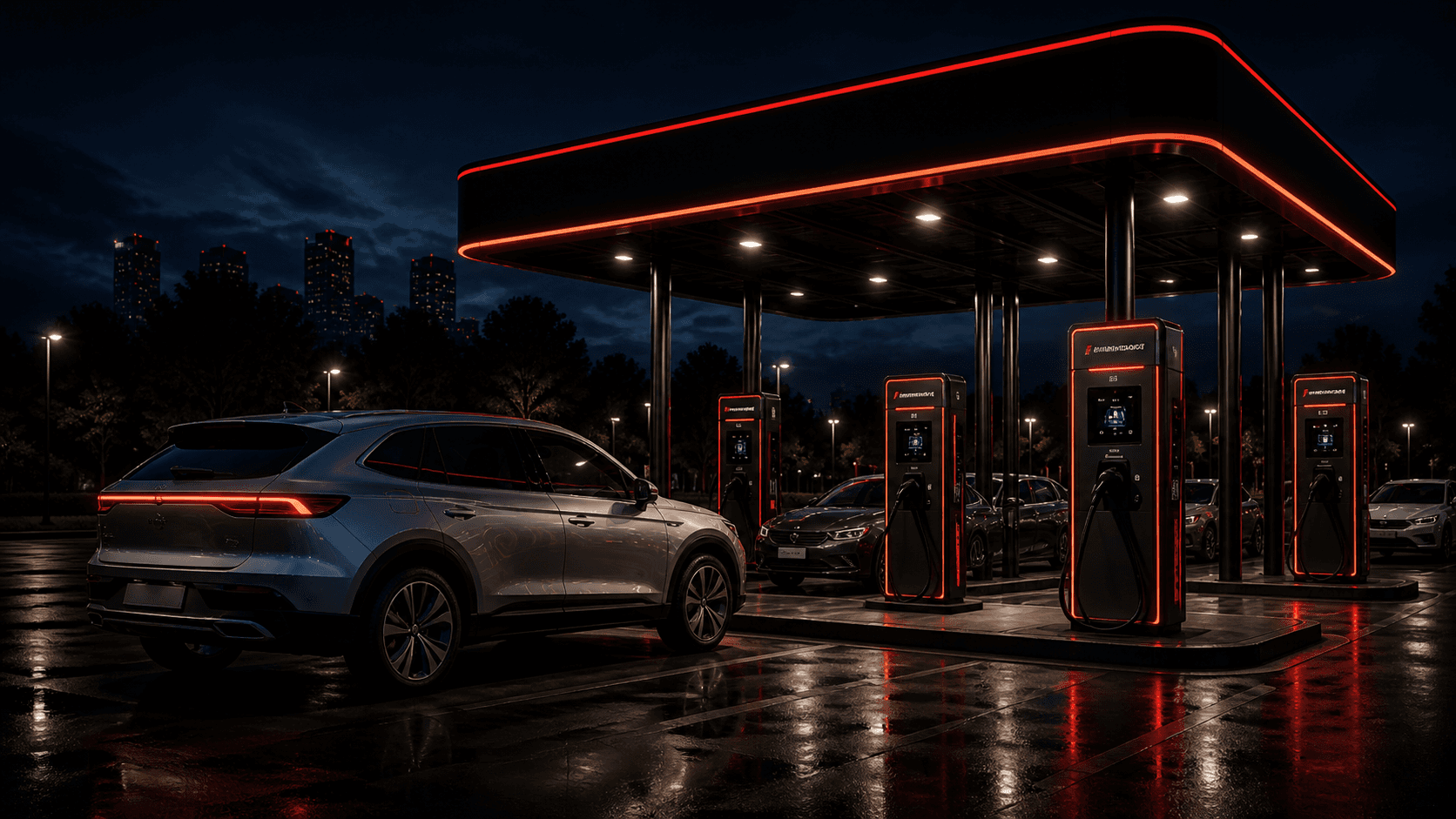

Short answer: fast charging solves a problem most drivers have a few times a year. Slow charging solves the problem they have every day. A network of many affordable AC points, spread widely, does more for EV adoption in India than a smaller number of expensive DC chargers, because it addresses the actual constraint: most Indians have nowhere to plug in overnight.
Fast charging deserves its place, but it has absorbed a disproportionate share of attention and capital. This is the case for the unglamorous alternative.
The parking problem nobody designs around
Almost all EV charging guidance implicitly assumes the driver has a dedicated parking space with access to power. In India, that assumption fails for a very large share of vehicle owners.
Consider the housing reality. Apartment residents may have an allotted slot but no power point, and need committee approval to change that. Many have unassigned parking, making a fixed charger impossible. Residents of older neighbourhoods often park on the street. Two-wheeler owners frequently have no designated parking at all. Commercial drivers may park wherever they can find space near where they operate.
For these drivers, the home charging model simply does not exist. And that is not a niche: it describes a substantial proportion of urban Indian vehicle owners.
This is the actual constraint on EV adoption, and no amount of highway fast charging addresses it. Someone who cannot charge where they park does not have a range problem; they have a daily access problem, and it makes ownership impractical regardless of how good the highway network becomes.
What slow charging actually costs to deploy
The economics are the argument. An AC charging point is a fundamentally different class of investment from a DC one.
The hardware is far cheaper. The electrical work is usually within existing supply capacity, avoiding the load enhancement and possible transformer costs that dominate DC projects. Civil work is minimal, since units are typically wall or pole mounted rather than requiring a foundation. Installation takes days rather than weeks or months. And crucially, there is often no discom process at all beyond confirming headroom.
The practical consequence is that the capital required for one DC fast charger can deploy a substantial number of AC points. That is the trade to think about carefully: one location serving perhaps ten to fifteen vehicles daily, or many locations collectively serving far more, spread across the areas where people actually live and park.
For a network operator trying to build coverage rather than showcase capability, the arithmetic strongly favours breadth.
Matching charging to how vehicles are actually used
The other half of the argument is behavioural. Most vehicles spend most of their time parked.
A private car in an Indian city typically drives well under 50 km a day and is stationary for over twenty hours. A vehicle parked that long does not need speed; it needs availability. A 3.3 kW point delivers a full day's driving in a few hours of that idle time, and a 7.2 kW point does it in half that.
Speed only becomes valuable when the vehicle needs to be moving again soon, which is the highway case and the commercial fleet case. For everything else, charging speed is solving a problem that does not exist, at considerable cost.
There is also a battery argument. AC charging is gentler on cells than repeated high-power DC sessions, generating less heat and contributing less to long-term degradation. A vehicle charged predominantly on AC will generally retain capacity better over its life than one relying on daily fast charging.
Where affordable AC points belong
Deployment logic differs from fast charging, which chases through-traffic. Slow charging chases dwell.
- Residential parking areas, including society parking, street-side bays in dense neighbourhoods, and dedicated residential charging clusters. This is the highest-value category because it addresses the core problem directly.
- Workplaces. Vehicles sit for eight or nine hours, and daytime charging aligns with solar generation. This is arguably the second-best place to charge after home.
- Retail and hospitality. Malls, restaurants, cinemas and hotels, where visits run to hours rather than minutes.
- Transport interchanges. Metro station car parks and commuter lots, where vehicles sit for a full working day.
- Two- and three-wheeler clusters. Markets, delivery aggregation points and transport hubs, where small batteries and low power requirements make AC points ideal.
The pattern across all of these is the same: people are already stopping for a reason unconnected to charging. The infrastructure simply captures idle time that was going to happen anyway.
Two- and three-wheelers change the arithmetic entirely
Any assessment of India's charging needs that focuses on cars is measuring the wrong thing. Two- and three-wheelers dominate vehicle numbers, and their electrification is far further along than passenger cars.
Their batteries are small, typically 2 to 12 kWh, which means low-power AC charging is not a compromise for them; it is entirely sufficient. A scooter charges fully overnight from an ordinary socket. A three-wheeler needs a few hours at modest power.
This makes the value proposition of affordable charging points dramatically better than car-focused analysis suggests. The same investment that serves a handful of cars can serve many two-wheelers, and those riders often have a more acute need because they are least likely to have private charging access.
For anyone planning a network, or a site, counting only four-wheelers systematically undervalues low-power charging infrastructure.
The safety argument
There is a reason to deploy accessible charging that has nothing to do with convenience or economics.
Where formal charging is unavailable, people improvise. Extension cables run from windows and shops to vehicles parked outside. Unbranded chargers of unknown provenance. Batteries carried indoors and charged in living spaces or stairwells. Charging in unventilated enclosed areas.
These practices cause genuine incidents, and the pattern is consistent: the danger comes from improvisation, not from the vehicles. Every properly installed, accessible charging point removes some of that improvisation.
This reframes affordable AC charging as a public safety measure rather than only an amenity, which is a more compelling argument for housing societies, municipal bodies and employers than convenience alone.
The grid argument for going slow
There is a network-level case for AC charging that is independent of cost, and it concerns when power is drawn rather than how much.
DC fast charging is, by definition, concentrated demand. A single high-power session draws heavily for a short period, and several simultaneous sessions can create a load spike that local distribution infrastructure was never designed for. This is precisely the pattern that triggers expensive grid reinforcement.
AC charging is the opposite. Individually small, spread across many hours, and highly flexible about timing. A vehicle charging overnight at 3.3 kW can start at any point across an eight-hour window and still be ready by morning. That flexibility is exactly what a grid with growing renewable generation needs, because the load can be moved to wherever the clean supply is.
Aggregate a large number of slow, flexible, schedulable charging points and you have something closer to a useful grid resource than a burden. Aggregate a smaller number of inflexible fast chargers and you have a peak management problem.
This matters for planning. Deploying widely distributed AC infrastructure not only costs less to install; it defers or avoids network reinforcement costs that ultimately land on everyone's electricity bills.
What this means for different decision-makers
If you run a housing society, the highest-value action is not approving one resident's fast charger. It is establishing a framework: conduit routes, spare distribution capacity, a metering policy, and a modest bank of two-wheeler points. That serves far more residents, costs less, and removes the unsafe improvised charging already happening in your building.
If you are an employer, AC charging at scale is the correct specification. Employees park for eight or nine hours, so speed adds nothing, and daytime charging aligns with solar generation. Size at roughly one point per three to five EV drivers and lay cable for several times that.
If you run a retail or hospitality business, AC points matched to typical visit duration are an amenity that draws customers who will spend while they wait. A DC unit is usually the wrong tool unless you also serve passing highway traffic.
If you are building a charging network, the temptation is to lead with visible high-power sites. Coverage acquired through many affordable points tends to build a user base faster, because it solves daily access rather than occasional range anxiety. The fast chargers then serve those users on the journeys where they genuinely need them.
If you are a policymaker or municipal planner, the leverage sits in enabling residential and kerbside charging: EV-ready building norms, simplified society approval processes, and permitting for street-side points in dense neighbourhoods. These unlock ownership for people currently excluded from it.
What a balanced network looks like
None of this argues against fast charging. It argues against fast charging as the default answer to every infrastructure question.
A functional network has DC fast charging on intercity corridors and at high-turnover urban hubs, where speed genuinely determines whether a journey is possible. It has AC charging densely distributed wherever vehicles sit for hours, which is most places, most of the time. And it has very low-power points in large numbers serving the two- and three-wheelers that make up the bulk of India's fleet.
The mistake is treating these as a hierarchy with fast charging at the top. They serve different needs, and the base of the pyramid, the cheap, numerous, unglamorous points, carries most of the actual load.
Networks that build only the visible tier end up with impressive assets and poor coverage. Networks that build breadth first tend to acquire users faster, because they solve the problem people actually have.
The objections, addressed
The case for slow charging attracts predictable pushback. Each objection has a reasonable answer.
"Drivers want fast charging." Drivers want convenience, and convenience usually means never having to think about charging at all. A vehicle that fills overnight where it parks is more convenient than one that requires a trip to a fast charger, however quick that charger is. Fast charging is a solution to the absence of the better option, not a preference in itself.
"Slow chargers occupy parking for hours." True, and it matters in constrained locations, which is why AC belongs where parking is already long-duration. In an office car park or residential parking area, the vehicle was occupying that space regardless. The concern applies to high-turnover retail parking, where policy and pricing should manage it.
"There is no money in slow charging." There is less revenue per session, certainly. But there is also far less capital at risk, no grid upgrade cost, and often more predictable utilisation. Judged on return relative to invested capital rather than revenue per unit, AC deployments frequently compare well. And for hosts, the value is often footfall or tenancy rather than energy margin anyway.
"It will not support long journeys." Correct, and it is not meant to. Intercity travel needs DC on corridors. The argument is about where the bulk of charging demand actually sits, which is daily local driving, not annual road trips.
"Fast charging is the future as batteries improve." Larger batteries and higher charging speeds do not change the fundamental point that vehicles spend most of their time parked. If anything, larger batteries make overnight AC charging more capable, since more range accumulates in the same idle hours.
Getting the balance right in practice
For an operator or planner deciding where to allocate a fixed budget, a reasonable starting heuristic is to work backwards from where vehicles spend time in your target area.
Map where the vehicles you want to serve actually park, and for how long. Residential parking, workplace parking and commercial vehicle staging areas will typically dominate. Those locations want AC, in numbers.
Then identify the few points where vehicles genuinely need to be moving again quickly: highway junctions on intercity routes, high-turnover urban locations, and fleet depots with tight shift patterns. Those want DC, sized properly, with the grid work budgeted honestly.
The proportion between the two will vary by area, but in almost every Indian urban context the count of useful AC locations vastly exceeds the count of viable DC ones. Budgets that invert that ratio are usually optimising for visibility rather than for drivers.
Key takeaways
- The real constraint on Indian EV adoption is lack of somewhere to plug in overnight, not highway coverage.
- AC points cost a fraction of DC ones and rarely need grid upgrades, so the same capital buys far more coverage.
- Most vehicles are parked over twenty hours a day; they need availability, not speed.
- AC charging is gentler on batteries than habitual fast charging.
- Two- and three-wheelers have small batteries, making low-power charging fully sufficient for the majority of India's fleet.
- Accessible charging displaces genuinely dangerous improvised charging.
- Build DC on corridors and hubs, AC everywhere people already park.
Fast charging is what people talk about. Slow charging is what makes ownership work. A network built around the second, with the first placed carefully where it is genuinely needed, serves far more drivers per rupee than the reverse.
Frequently Asked Questions
Is slow charging bad for an EV?
No, it is generally better for the battery. AC charging generates less heat than repeated high-power DC sessions and contributes less to long-term capacity degradation. A vehicle charged predominantly on AC will typically retain battery health better over its life than one relying on daily fast charging.
Why does India need more slow chargers rather than fast chargers?
Because the actual constraint on adoption is that a large share of Indian vehicle owners have nowhere to plug in where they park. Highway fast charging does not address that daily access problem. AC points cost a fraction as much, rarely need grid upgrades, and can be deployed far more widely for the same capital.
How long does slow charging take?
A 3.3 kW point delivers a typical day's driving in a few hours, and a 7.2 kW point in about half that. Since most private vehicles are parked for over twenty hours a day, this is comfortably sufficient. Electric two-wheelers charge fully overnight from an ordinary socket.
Where should AC charging points be installed?
Wherever vehicles already sit for hours: residential parking areas, workplaces, malls, restaurants, hotels, metro station car parks, and two- and three-wheeler clusters such as markets and delivery aggregation points. The logic is to capture idle time that was going to happen regardless.
Are slow chargers enough for electric two-wheelers and three-wheelers?
Yes, entirely. Their batteries range from roughly 2 to 12 kWh, so low-power AC charging is fully sufficient rather than a compromise. Since these vehicles dominate India's fleet and their owners are least likely to have private charging, low-power points serve far more vehicles per rupee than car-focused infrastructure.
Does accessible charging improve safety?
Yes. Where formal charging is unavailable, people improvise with extension cables to street-parked vehicles, unbranded chargers, and charging batteries indoors or in stairwells. Incidents consistently trace back to these practices rather than the vehicles themselves, so every properly installed accessible point removes some of that risk.
Should charging networks stop building fast chargers?
No. Fast charging is essential on intercity corridors and at high-turnover urban hubs where speed determines whether a journey is possible. The argument is against treating it as the default answer everywhere, since most charging demand is served better and far more cheaply by widely distributed AC points.