


Short answer: EVs are not a problem for India's total electricity supply. Even substantial adoption adds a modest percentage to annual consumption. The problem is when that demand arrives. If every vehicle charges at 7pm, local distribution infrastructure fails long before national generation does. Smart charging shifts the load rather than adding capacity, and it is far cheaper than rebuilding the network.
That distinction, energy versus peak, is the single most misunderstood aspect of this topic, and everything practical follows from it.
Why total energy is not the issue
Consider the arithmetic at a household level. A car driven 40 km a day consumes roughly 8 kWh. That is comparable to running an air conditioner for a few hours, and Indian households have been adding air conditioners at scale for years without the grid collapsing.
Aggregate this across a large EV fleet and the additional annual consumption is real but manageable, spread across a year and across the country. Generation capacity is planned on exactly these timescales, and there is nothing about EV adoption rates that outruns that planning cycle.
The reason grid engineers still worry is that electricity is not like water in a tank. It must be generated at the instant it is consumed, and the network must be sized for the worst moment, not the average one.
Why timing is the issue
Indian residential demand peaks in the evening, roughly between 6pm and 10pm, as people return home, switch on lights, cooling and appliances. This is already the most stressed period for distribution networks.
Now add EV charging with no coordination. Drivers arrive home between 6pm and 8pm and plug in immediately, because that is the natural behaviour. Charging therefore stacks precisely on top of the existing peak.
The consequence is local rather than national. A distribution transformer serving a colony was sized for the historical load profile of those households. Add fifteen vehicles each drawing 7 kW simultaneously and you have added over 100 kW to a transformer that may have little headroom. The failure is a tripped transformer or degraded voltage for that neighbourhood, not a national shortfall.
This is why the solution is coordination rather than capacity. The same fifteen vehicles charging across the whole night, sequenced sensibly, are almost invisible to the network.
What smart charging actually means
The term covers several distinct capabilities, and they are worth separating because they solve different problems.
Time-shifting
The simplest and most valuable. Rather than charging on arrival, the vehicle charges later at night when demand is low. The driver sets a departure time; the system decides when to draw power. Nothing is lost, since the car sits idle either way, and the peak is avoided entirely.
Dynamic load management
Where multiple chargers share one connection, this distributes available capacity between active sessions instead of assuming all points draw full power at once. For an apartment complex or office car park this is transformative: it lets a site support many more charging points than its sanctioned load would otherwise permit, and it avoids an expensive transformer upgrade.
Price-responsive charging
Where time-of-day tariffs exist, charging automatically follows cheaper periods. The user saves money, the utility gets load moved away from peak, and no behaviour change is required beyond setting a preference once.
Grid-responsive charging
The most advanced tier, where the utility can signal chargers to reduce draw during stress events. In exchange participants typically receive a tariff benefit. This turns a fleet of vehicles into a controllable resource rather than an unpredictable load.
Vehicle-to-grid: promise and reality
V2G reverses the flow, allowing a parked vehicle to discharge back into the grid or a building during periods of high demand.
The appeal is obvious. A large EV battery holds enough energy to run a household for a day or more, and a fleet of them represents substantial distributed storage, precisely what a grid with growing solar generation needs to smooth its evening ramp.
The obstacles are equally real. It requires bidirectional hardware, which costs more than standard chargers. It requires vehicle support, which most models sold in India do not yet have. It requires regulatory frameworks for exporting to the grid, metering and compensation, which are still developing. And it raises questions about battery warranty and cycle life that manufacturers have not uniformly resolved.
Realistic assessment: V2G will matter, and pilots in India are worth watching, but simple time-shifting delivers most of the available grid benefit today at a fraction of the complexity. Organisations planning infrastructure should optimise for smart charging now and keep V2G in view for later.
The renewable energy connection
India's growing solar capacity creates a specific and well-documented shape in the supply curve: abundant generation during the day, a steep ramp as solar falls away in the evening exactly when demand rises.
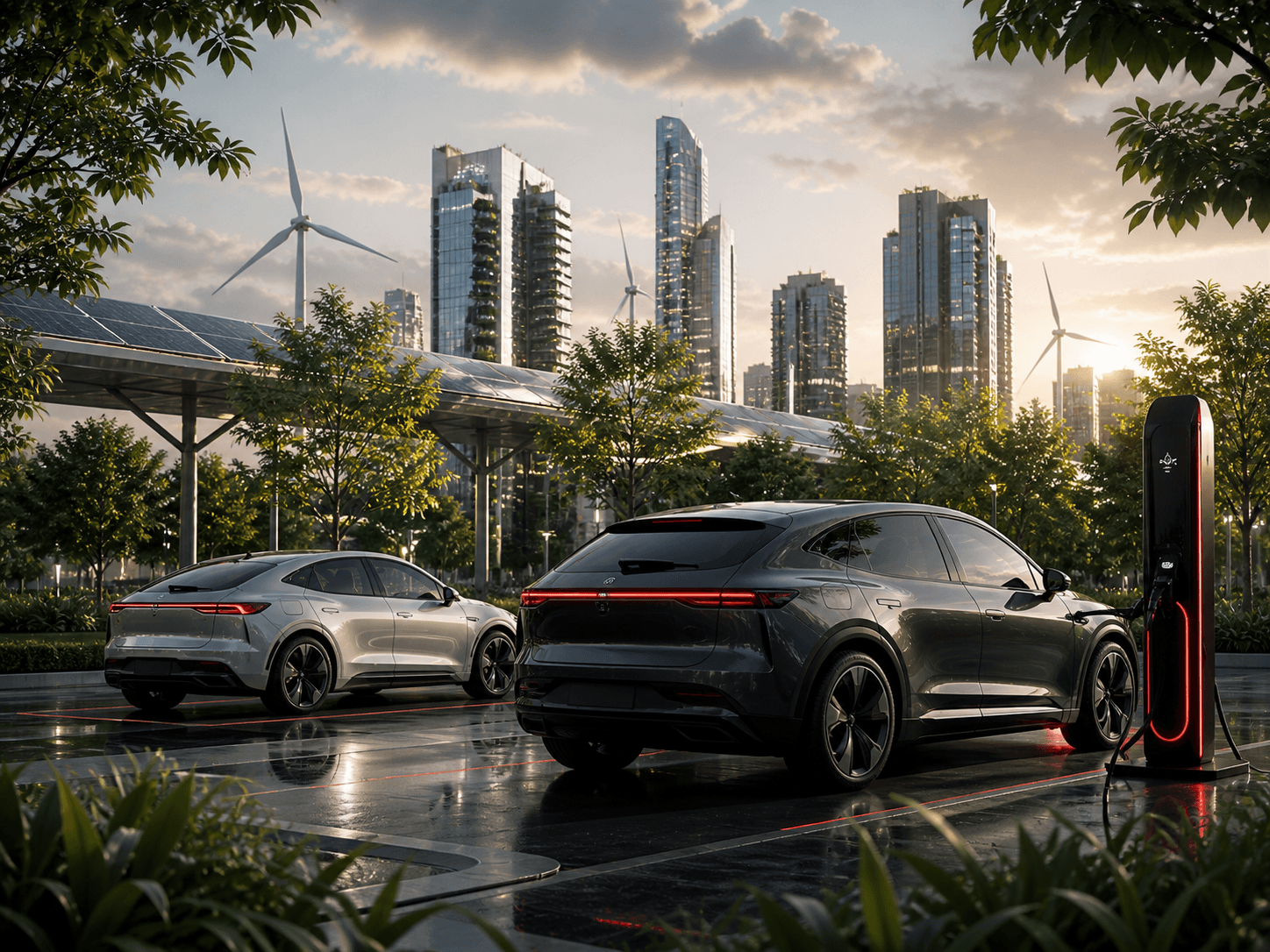
EV charging is unusually well suited to helping with this, because much of it is genuinely flexible. A car parked at an office from 9am to 6pm can absorb solar generation during the middle of the day. A car parked at home overnight can absorb wind generation and low-demand baseload.
This reframes the relationship. Uncoordinated EV charging worsens the evening ramp problem. Coordinated EV charging helps solve it, by providing demand that can be moved to wherever the clean generation is. The vehicles become a tool for integrating renewables rather than an additional burden.
Workplace charging is particularly valuable here, and it is an underrated argument for employers: daytime charging aligns almost perfectly with solar generation.
What this means if you are installing chargers
The grid discussion has direct, practical consequences for anyone specifying infrastructure.
- Insist on load management capability. This is the highest-value feature in any multi-point installation. It frequently removes the need for a grid upgrade, which is often the largest cost in the project.
- Insist on OCPP compliance. Grid-responsive programmes and time-of-day tariffs will be delivered through management platforms. Proprietary hardware cannot participate.
- Enable scheduling by default. If users must actively opt in to delayed charging, most will not. Default to charging overnight with an override available.
- Check for a time-of-day tariff. Where available, these directly reduce operating cost, and the saving compounds across a portfolio.
- Size the connection for managed load, not theoretical maximum. Twenty 7.2 kW points do not need 144 kW if the system never allows that draw. Designing for the theoretical peak wastes capital.
- Talk to your discom early. Some offer specific EV connection categories, concessional tariffs or streamlined processes. These change project economics and are easy to miss.
Battery storage at charging sites
There is a second way to decouple charging demand from grid demand, and it is becoming increasingly practical: putting a battery at the charging site itself.
The principle is straightforward. A stationary battery charges slowly from the grid during off-peak hours, then discharges quickly into vehicles when they arrive. The grid sees a smooth, modest, continuous draw. The vehicle sees high-power fast charging. The mismatch between them is absorbed by the buffer.
This solves a specific and expensive problem. A DC fast charger at a site with a weak connection would normally require a costly grid upgrade, and in some locations that upgrade is simply unavailable within any reasonable timeframe. Battery buffering can make such a site viable without touching the connection at all.
It also directly addresses demand charges. Where a commercial tariff bills on peak draw, a buffered site never presents a high peak to the meter, which can transform operating economics regardless of the grid capacity question.
The trade-offs are capital cost, physical space, and the battery's own degradation over time. Buffered sites make most sense where grid capacity is genuinely constrained, where demand charges are punitive, or where the site combines charging with on-site solar generation. They are not a default choice, but they belong in the assessment for any site where the connection upgrade looks prohibitive.
Second-life batteries, repurposed from vehicles after their automotive service life, are a natural fit for this application, since stationary storage is far less demanding than vehicle use. This is an emerging area in India worth watching.
What individual drivers can do
Most of this discussion concerns operators and planners, but individual behaviour aggregates into exactly the peak that causes the problem, so it is worth stating what actually helps.
Use the departure timer. Nearly every EV and most home chargers let you set when you need the car ready rather than charging immediately on plug-in. This single setting moves your load off the evening peak and costs you nothing, because the car is parked either way.
Do not fast charge out of habit. Public DC charging is for when you genuinely need speed. Using it routinely when the vehicle sits idle overnight anyway adds cost, adds heat to the battery, and adds demand at exactly the times networks are busiest.
Charge at work if you can. Daytime charging aligns with solar generation and avoids the residential evening peak entirely. If your employer offers charging, using it is genuinely the best option available on almost every measure.
Check whether your discom offers a time-of-day tariff. Where these exist, the saving from shifting charging to off-peak periods is immediate and requires no change in behaviour beyond one setting.
None of this requires sacrifice. The load is flexible by nature; it simply needs someone to tell it when to run.
What the utilities are doing
Indian discoms have moved from treating EVs as a threat to treating them as a manageable and even useful load. Several have introduced dedicated EV tariff categories, some with concessional rates and time-of-day structures that explicitly encourage off-peak charging.
Smart meter rollout matters here too, since time-of-day pricing depends on metering that can record when energy was consumed, not just how much. As that infrastructure spreads, price-responsive charging becomes practical for ordinary consumers rather than only large commercial users.
The direction of travel is clear: flexible load will be rewarded and inflexible load will not. Infrastructure specified today should assume that.
The distribution transformer problem, concretely
It is worth being specific about where the failure actually occurs, because the national-level framing obscures it.
A residential distribution transformer serves a defined cluster of households and was sized against their historical demand profile, with some margin. That margin was calculated for a world in which the largest domestic loads were cooling and cooking, both of which are diverse: not every household runs them simultaneously at full power.
EV charging is less diverse than planners are used to. Vehicles arrive home within a narrow window, and a charger draws its full rated power continuously rather than cycling like an air conditioner. Fifteen vehicles at 7 kW represent a sustained load that behaves very differently from fifteen air conditioners.
The visible symptoms are voltage drop across the cluster, transformer overheating, reduced transformer life, and in the worst case protective tripping. These are neighbourhood-level failures, and importantly they affect everyone on that transformer, not only the EV owners.
This is why the problem is often first noticed as a local complaint rather than a national statistic, and why coordination at the level of individual buildings and streets matters more than generation planning. It is also why housing societies and employers who install many charging points without load management can create problems that extend beyond their own premises.
Planning charging for a building, practically
For anyone specifying infrastructure at a housing society, office or commercial complex, the grid discussion reduces to a short sequence of decisions.
Establish your actual available capacity before designing anything. This means the sanctioned load, the current peak demand, and therefore the genuine headroom, not an assumption about it.
Design for managed simultaneous load, not connected load. The relevant question is not how many chargers you install but how much power the system will ever allow to flow at once. With load management these are very different numbers, and designing against the second wastes money.
Default to overnight scheduling. In a residential building this alone resolves most of the local peak concern, because vehicles have eight or more idle hours to absorb what they need.
Instrument it. Metering that shows actual usage patterns turns the next expansion decision into arithmetic rather than argument, which matters when you have to persuade a committee or a finance team.
Talk to the discom before you build, not after. A load enhancement discussed early is a process; discovered late it is a delay of months with equipment already purchased.
Buildings that follow this sequence routinely support far more charging than their occupants expect, without any upgrade at all.
Key takeaways
- EVs add modest total energy demand but concentrate it dangerously if charging is uncoordinated.
- The failure point is local distribution infrastructure, not national generation.
- Time-shifting charging to overnight solves most of the problem at almost no cost.
- Dynamic load management lets a site support far more charging points than its sanctioned load suggests.
- V2G is promising but constrained today by hardware, vehicle support and regulation; smart charging delivers most of the benefit now.
- Daytime workplace charging aligns well with solar generation and helps the evening ramp problem.
- Specify OCPP-compliant hardware with load management, and design for managed load rather than theoretical peak.
The grid question is often framed as a reason to slow EV adoption. It is better understood as a reason to be deliberate about charging infrastructure. Vehicles that charge intelligently are among the most useful loads a modern grid can have, precisely because, unlike almost everything else, they do not care exactly when they are served.
Frequently Asked Questions
Can India's grid handle widespread EV adoption?
Total energy demand from EVs is manageable and well within normal generation planning. The real challenge is timing: if most vehicles charge during the 6pm to 10pm residential peak, local distribution transformers can be overwhelmed. Coordinated charging solves this without adding generation capacity.
What is smart EV charging?
A set of capabilities that control when and how fast vehicles charge. It includes time-shifting to off-peak hours, dynamic load management that shares capacity between multiple chargers, price-responsive charging that follows cheaper tariff periods, and grid-responsive charging that reduces draw during utility stress events.
What is dynamic load management and why does it matter?
It distributes available electrical capacity across active charging sessions rather than assuming every point draws full power simultaneously. For sites with multiple chargers this often allows many more points on an existing connection and avoids an expensive transformer upgrade, which is usually the largest single project cost.
Is vehicle-to-grid (V2G) available in India?
Only in pilots at present. V2G needs bidirectional charging hardware, vehicle support that most models sold in India lack, and regulatory frameworks for grid export, metering and compensation that are still developing. Simple smart charging delivers most of the available grid benefit today at far lower complexity.
Does EV charging work well with solar power?
Yes, particularly daytime charging. India's growing solar capacity produces abundant midday generation and a steep evening ramp as it falls away. Vehicles parked at workplaces during the day can absorb solar generation directly, which makes workplace charging unusually valuable for grid integration.
Should I charge my EV at night?
Generally yes. Overnight charging avoids the evening residential demand peak, is easier on local distribution infrastructure, and is cheaper where time-of-day tariffs apply. Setting a departure time and letting the charger schedule itself achieves this without any inconvenience.
What should I look for in a charger to be grid-ready?
OCPP compliance, so the hardware can participate in future grid-responsive programmes and time-of-day tariff schemes, and dynamic load management support confirmed at the hardware level. Also enable scheduled charging by default, since most users will not opt in manually.