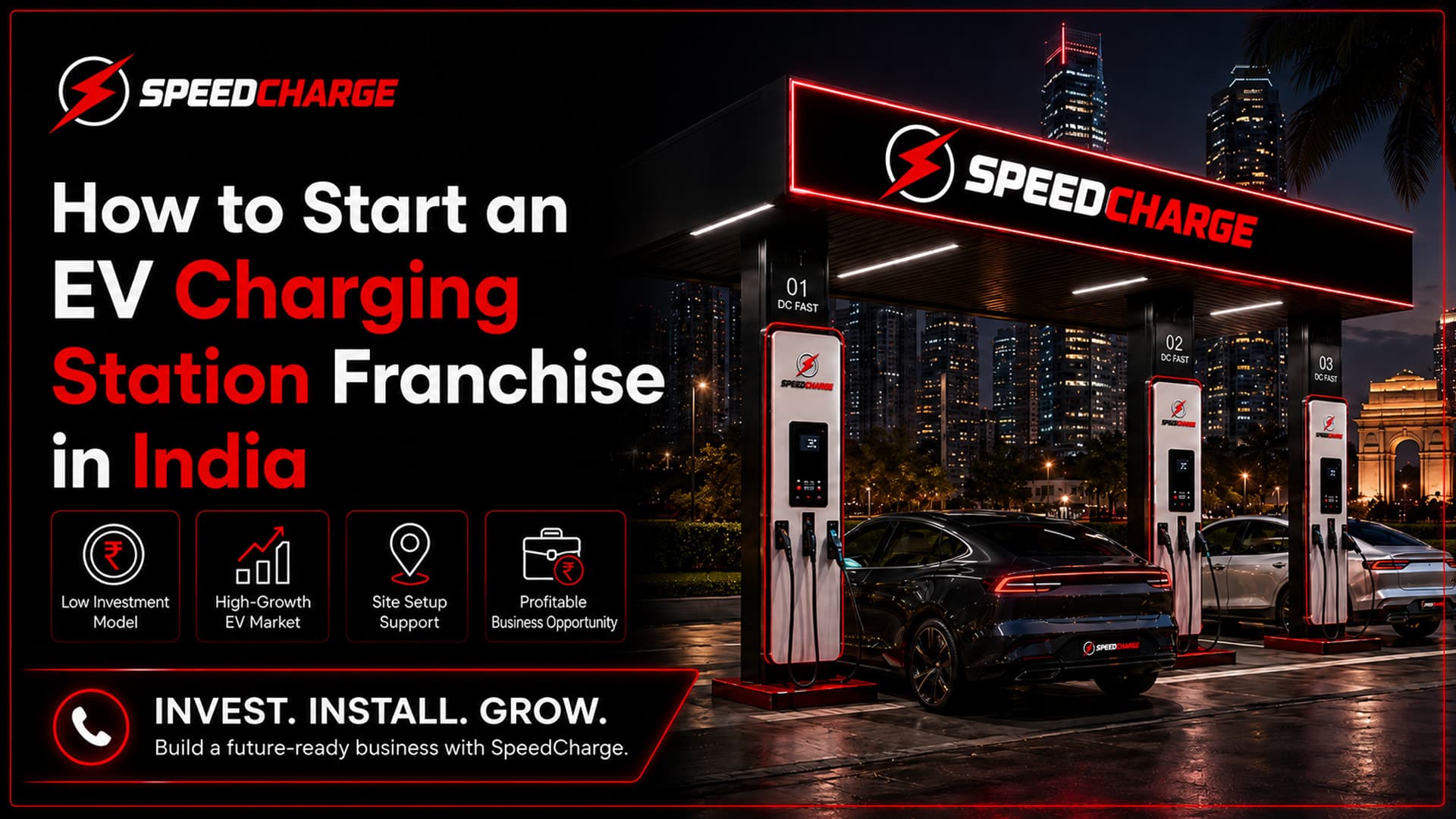

Starting an EV charging station franchise in India in 2026 is one of the few business opportunities where government policy, consumer demand, and commercial infrastructure are all moving in the same direction at the same time. With over 3.2 million EVs on Indian roads as of 2024 and the EV charging market projected to reach Rs. 1.8 trillion by 2030, the gap between charging demand and available infrastructure is real and growing fast. This guide walks you through exactly how the franchise model works, what it costs, what returns to realistically expect, and what to check before you commit.
Whether you own a commercial plot near a highway, manage a parking facility at a mall or office complex, or are a salaried professional looking for a second income stream with genuine long-term upside, this guide is written for you.
What Is an EV Charging Station Franchise and How Does It Work in India
Before evaluating any franchise opportunity, it helps to understand precisely what you are buying into. An EV charging station franchise in India is a partnership arrangement between a charger network operator and an entrepreneur or property owner, where the franchise holder benefits from the operator's technology, brand, and customer base without needing to build any of it themselves. The specific structure that has gained the most traction in India's EV charging sector is the FOCO model: Franchise Owned, Company Operated.
Under the FOCO model, you invest in the infrastructure and own the asset, while the operating company manages everything from charger installation and software integration to customer support and billing settlement. This is a meaningful distinction from a conventional franchise where the owner also runs day-to-day operations. In EV charging, the technical complexity of managing a CMS (Charge Management System), handling OCPP protocol connectivity, and maintaining consistent uptime makes operator-managed models genuinely attractive for investors who do not come from an EV or energy background.
The franchise owner earns revenue from each charging session at their station. The network operator handles marketing, app visibility, payment collection, and technical maintenance. Revenue is split according to a pre-agreed formula, and the franchise owner receives automated settlement reports through a real-time dashboard. No prior experience in the EV industry is required to participate, which makes this accessible to a wide range of investors across India.
The FOCO Model Explained for Indian Franchise Investors
The FOCO structure places the financial risk of asset ownership with the franchise investor while placing the operational risk with the experienced network operator. For most investors evaluating an EV charging franchise in India, this is a better arrangement than a FOFO (Franchise Owned, Franchise Operated) model because EV charging station management involves real-time network monitoring, grid connectivity management, and software-driven billing. These are not skills most new investors bring to the table. The FOCO arrangement means the chargers are running, maintained, and generating revenue from day one of operation, not after a learning curve.
Who Is the Right Candidate for an EV Charging Franchise in India
The franchise model is built for several specific profiles. Landowners with unused or underutilised commercial plots near highways, malls, fuel station forecourts, or office parks are the most obvious fit, because location is the single most important variable in charging station revenue. Salaried professionals seeking a second income with limited hands-on involvement find the operator-managed model particularly suitable. Fuel station owners and automotive retailers facing long-term demand transition to electric vehicles are increasingly converting part of their forecourts. Institutional investors and real estate developers adding EV charging as an amenity find the network partnership model more attractive than purchasing standalone charger hardware without a managed network behind it.
How Much Does It Cost to Start an EV Charging Station Franchise in India
The investment required to start an EV charging station franchise in India depends on which station format you choose. There are two primary models currently available through established network operators, and the cost, space, and revenue potential differ substantially between them.
A Fast Charging Station starts at Rs. 20 lakhs and requires a minimum of 550 sq. ft. of space, accommodating at least two car parking bays. This model uses 30 kW to 60 kW DC fast chargers with CCS2 compatibility and is suited to residential society parking areas, office campuses, urban retail car parks, and smaller commercial plots. A Super Charging Station requires 1,000 to 2,500 sq. ft. depending on the number of charging bays and the power output configuration, and is designed for high-traffic locations: highway service areas, large malls, fuel station forecourts, and transport hubs.
The table below summarises the key financial parameters across both franchise formats.
Parameter | Fast Charging Station | Super Charging Station |
|---|---|---|
Starting investment | Rs. 20 lakhs | Higher (based on configuration) |
Space required | 550 sq. ft. (2 car parks min.) | 1,000 to 2,500 sq. ft. |
Charger output | 30 kW to 60 kW DC | 60 kW to 360 kW DC |
Connector type | CCS2 | CCS2 |
Monthly revenue (Metro Tier 1) | Rs. 6.5 to 12.0 lakhs (indicative) | Higher, location-dependent |
Monthly EBITDA (estimated) | Rs. 2.8 to 3.6 lakhs | Higher, configuration-dependent |
Projected ROI | 28% to 36% | 28% to 36% |
Payback period | 2.0 to 3.5 years | Location-dependent |
Installation timeline | 2 to 4 weeks (standard) | 4 to 6 weeks |
Franchise model | FOCO | FOCO |
These figures are indicative and based on Metro Tier 1 performance data. Actual revenue depends on footfall, location type, daily charging sessions, and local EV penetration. An honest evaluation of any franchise opportunity requires looking at the payback period and ROI range together, not the monthly revenue figure in isolation.
What Drives the ROI Range for EV Charging Franchises in India
The projected ROI range of 28% to 36% is driven by three variables that every franchise investor should model before committing. The first is location quality: a station at a busy highway service stop or a mall with 2,000 daily visitors will generate significantly more charging sessions per day than a station at a quieter residential complex. The second is EV density in the catchment area. Cities with higher EV penetration, typically metros and Tier 1 cities such as Bengaluru, Pune, Delhi NCR, Hyderabad, and Chennai, generate more predictable daily session volume. The third is charger utilisation rate. A 60 kW dual-gun DC charger generating 10 sessions per day at an average session revenue of Rs. 300 to Rs. 500 per session produces a meaningfully different monthly figure than the same charger with 4 sessions per day.
Does the Investment Include Government Subsidies or Incentives
India's FAME II scheme and the PM e-DRIVE programme have provided direct subsidies for EV charging infrastructure deployment, and several state DISCOMs offer concessional power tariffs and grid connection support for registered EV charging operators. BEE star-rated charger certification also makes certain equipment eligible for subsidy treatment. The exact subsidy applicability depends on the charger specifications, the operational entity structure, and the state in which the station is being set up. Franchise investors should verify the current status of applicable incentives with the network operator before finalising investment plans, as subsidy programmes are periodically updated.
Step-by-Step Guide to Starting an EV Charging Station Franchise in India
The process of setting up an EV charging franchise follows a predictable sequence that experienced network operators have already refined across multiple deployments. Understanding each step in advance allows you to prepare the right documents, ask the right questions during partner discussions, and avoid the delays that typically slow down first-time applicants.
Step 1: Evaluate your location honestly before approaching any franchise partner.
Location is the single most consequential decision in an EV charging franchise. Before contacting any network operator, assess your site against the following criteria: average daily footfall or vehicle throughput, proximity to EV-heavy residential or commercial catchments, available power load from the local DISCOM (a minimum of 30 kW to 60 kW sanctioned load is typically required for a Fast Charging Station), physical space to accommodate the minimum 550 sq. ft. for two car park bays, and safety clearances for electrical installation. A location that fails on power load or physical access will face delays or additional cost regardless of which network operator you partner with.
Step 2: Shortlist and evaluate franchise network operators.
Not all EV charging franchise operators in India offer the same quality of support, technology, or financial transparency. Evaluate potential partners on the following: network size and uptime record, CMS dashboard quality and real-time reporting capability, charger hardware specifications (CCS2 compatibility, IP55 weather rating, RFID and app-based payment support), settlement transparency, marketing support, and whether they provide a dedicated 24/7 technical support channel. An operator with 2,500+ live charging points across 45+ cities and a documented 99.9% network uptime gives you a meaningfully different risk profile than a smaller operator with limited operational history.
Step 3: Submit a franchise application and complete the site assessment.
Once you have identified a preferred partner, the formal process begins with a franchise application. The operator's team will conduct a site visit or a detailed remote assessment covering power load feasibility, physical layout, grid connection requirements, and proximity to competing charging infrastructure. This step typically takes 5 to 10 business days depending on the operator and the complexity of the site.
Step 4: Finalise the franchise agreement and investment structure.
Review the franchise agreement with specific attention to the revenue-sharing formula, the settlement frequency, the maintenance and AMC (Annual Maintenance Contract) terms, the escalation clause for future hardware upgrades, and the exit conditions. All charging units should carry a minimum one-year warranty. AMC options should be available for post-warranty maintenance. The FOCO arrangement means the operator manages day-to-day operations, but you should understand your rights as the asset owner if the operator changes their pricing model or service terms.
Step 5: Complete the power connection and DISCOM approval process.
The DISCOM (Distribution Company) power connection is the most commonly underestimated step in the installation process. Depending on your state and local DISCOM (BESCOM in Karnataka, MSEDCL in Maharashtra, BSES and Tata Power in Delhi, KSEB in Kerala, and others), the load sanction and meter installation process can take 2 to 6 weeks. The network operator typically guides this process, but you need to ensure your property documents, electrical drawings, and NOC from the building authority are ready before the application is filed. Delays in this step are the primary reason franchise installation timelines stretch beyond the standard 2 to 4 weeks for a Fast Charging Station.
Step 6: Hardware installation and network commissioning.
Once the power connection is live, the hardware installation itself is typically completed in 2 to 4 weeks for a standard Fast Charging Station and 4 to 6 weeks for larger partner deployments. This includes charger mounting, electrical wiring, earthing and safety systems, CMS integration, RFID reader commissioning, app connectivity testing, and QR code payment activation. The station goes live on the network's app immediately after commissioning, making it discoverable to EV drivers in the area from day one.
Step 7: Launch and monitor through the real-time dashboard.
After commissioning, the station is live on the network's charging map and app. As the franchise owner, you access a real-time dashboard showing kWh throughput per session, revenue per day, charger utilisation rate, active session status, and automated settlement reports. Dynamic pricing, where session rates adjust based on demand patterns and grid tariff windows, is typically managed by the operator's CMS. Your role at this stage is to monitor performance, ensure the physical site remains accessible and well-maintained, and coordinate with the operator's support team if any hardware issue arises.
Choosing the Right Location for an EV Charging Franchise in India
Location selection for an EV charging franchise in India is not simply about choosing a busy area. It is about matching charger type to use-case and ensuring that EV owners in your catchment have a genuine reason to charge at your station rather than at home or at a competitor site. The best performing EV charging franchise locations in India share a set of common characteristics that experienced operators have identified across thousands of deployed sites.
Highway service areas and fuel station forecourts are the highest-revenue locations for fast DC charging because highway drivers have no alternative: they cannot charge at home on a long-distance journey, and the next charger may be 80 to 120 kilometres away. A 150 kW or higher DC charger at a well-positioned highway stop on a major national corridor (NH48, NH44, NH8, and others) generates consistent session volume even at off-peak hours.
Office parks, IT campuses, and commercial business districts are strong locations for mid-power DC and high-power AC chargers because the average dwell time of 4 to 8 hours at an office parking bay aligns well with AC and mid-speed DC charging. Employees who charge at work eliminate their need for public DC fast charging entirely, which creates a captive, repeat-use audience.
Malls, retail destinations, and premium hotels are ideal for fast DC chargers because the average retail dwell time of 1 to 2.5 hours is sufficient for a meaningful charge at 30 kW to 60 kW, and the EV-owning demographic in urban India is strongly correlated with the premium retail and hospitality visitor profile.
Residential societies with 100 or more homes and strong EV penetration are suited to the Location Partner programme rather than a full Fast Charging Station franchise, particularly in Mumbai, Bengaluru, and Pune where flat owners without dedicated parking cannot install home chargers and depend entirely on shared charging infrastructure.
What Franchise Investors in Tier 2 Cities Should Know
Tier 2 cities including Jaipur, Lucknow, Coimbatore, Nagpur, Indore, and Chandigarh are experiencing rapid EV adoption growth driven by rising fuel costs, increasing EV model availability in the Rs. 8 lakh to Rs. 18 lakh segment, and state government EV policies. The franchise investment case in Tier 2 cities differs from metros in one important way: session volume per charger is currently lower, but so is competition from other charging networks, and the growth trajectory over the next 3 to 5 years is steeper. Investors in Tier 2 cities should model their payback period at the upper end of the 2.0 to 3.5 year range during the initial phase, with significant upside as local EV density grows.
What Support Does an EV Charging Franchise Network Provide in India
One of the most important questions a franchise investor must ask before signing is not about the investment amount but about the support infrastructure behind the franchise. The value of a franchise over an independent charger installation lies almost entirely in what the operator brings: brand recognition that drives app-based discovery, a CMS that manages uptime and billing automatically, technical support that responds to hardware failures before your station loses revenue, and marketing that brings EV drivers to your location rather than to a competitor.
Credible EV charging franchise operators in India provide 24/7 technical support, a real-time revenue and usage dashboard, dynamic pricing optimisation through the CMS, smart billing and automated settlements, marketing assistance through the network's app and digital channels, and modular hardware scalability so your station can be upgraded to higher power output as demand grows without replacing the entire installation. The AMC (Annual Maintenance Contract) structure after the standard one-year warranty period is a detail that many franchise investors overlook until hardware servicing becomes relevant, so it should be reviewed in the franchise agreement before signing.
SpeedCharge, operating across more than 45 cities with over 2,500 live charging points, provides this full support stack under its FOCO franchise model. The network's Charge Cloud platform gives franchise partners real-time visibility into every session, every kilowatt-hour delivered, and every revenue settlement from a single dashboard. For investors who are evaluating their first EV charging franchise in India, SpeedCharge's no-prior-EV-experience requirement and fully managed operational model removes the technical barrier that would otherwise make this a specialists-only investment.
Is the Location Partner Programme a Better Starting Point Than a Full Franchise
Not every property owner needs to take on the full financial commitment of a Fast Charging Station franchise. The Location Partner programme offered by established EV charging networks is a zero-investment entry point for property owners who have suitable space but prefer not to deploy capital.
Under the Location Partner model, the network operator covers 100% of installation costs and operational expenses. The property owner provides the space and the power connection access. Revenue is shared between the operator and the property owner, or alternatively, the property owner receives a fixed monthly rental payout regardless of charging session volume. This model is particularly relevant for owners of commercial buildings, housing society management committees, petrol pump operators, and parking facility owners who want to add EV charging without absorbing any capital risk.
The Location Partner programme does not provide the same financial upside as owning a franchise outright, but it requires zero investment and generates income from assets that would otherwise be generating none. For property owners who are new to the EV charging space and want to understand how a charging station performs at their specific location before committing to a full franchise investment, the Location Partner programme is a logical starting point.
How Indian EV Charging Franchise Investors Are Building Long-Term Passive Income
The EV charging franchise opportunity in India is not a short-cycle investment. The payback period of 2.0 to 3.5 years is comparatively favourable against most commercial real estate investments, and the underlying demand driver (India's EV fleet growing from 3.2 million vehicles today toward a target of 30 million EVs on Indian roads by 2030) is structural rather than speculative. A charging station installed today at a well-chosen location is building a customer base and session history that compounds in value as EV penetration in the local area grows.
The most successful EV charging franchise investors in India treat the first station as a proof-of-concept. Once the CMS dashboard confirms session volume, revenue per month, and charger utilisation rate at the target levels, expanding to a second or third station becomes a data-driven decision rather than a speculative one. Network operators typically extend preferential expansion terms to existing franchise partners with a strong performance record, which creates a scalable passive income model for investors who start conservatively and expand based on verified returns.
The franchise investment also carries an asset value that pure equity investments do not: the physical charging infrastructure, once installed and generating revenue, has a realised asset value that can be transferred, leased, or included in a business valuation. For NRI investors and institutional property owners, this tangibility is an important characteristic.
Visit Speed Charge to review the current franchise models, indicative financial projections, and the application process in detail.
What to Confirm Before You Sign an EV Charging Franchise Agreement in India
Signing a franchise agreement without verifying these specifics is the most avoidable risk in this investment category. Before committing, confirm the following in writing from your network operator partner.
The revenue settlement terms must specify the exact revenue-sharing formula, the settlement frequency (weekly, fortnightly, or monthly), and the payment method. Automated CMS-based settlement is the standard with credible operators; manual reconciliation is a red flag.
The warranty and AMC structure must be documented. Standard charging units should carry a one-year warranty. AMC pricing and response time commitments for post-warranty maintenance should be written into the franchise agreement, not left as verbal assurances.
The charger upgrade pathway must be clear. EV charging technology is evolving, and a 30 kW charger installed today may need to be upgraded to 60 kW or 120 kW within three to five years as EV battery capacities and owner expectations increase. Modular hardware that supports upgrade without full replacement protects your investment value.
The exclusivity terms must be reviewed. Some franchise agreements include a catchment exclusivity clause preventing the operator from deploying competing stations within a defined radius of your location. Understand whether this applies to your agreement and what the enforcement mechanism is.
The exit terms must specify what happens to the hardware if the franchise relationship ends. Since this is a FOCO model where you own the asset, the hardware disposition and any buyout or transfer terms must be clearly documented before you sign.
The EV Charging Network Making It Possible for Indian Entrepreneurs to Enter the Sector
SpeedCharge is a Gurugram-based EV charging infrastructure company operating 2,500+ live charging points across 45+ cities in India, with a mission to deploy 10,000+ fast-charge points by 2027. The network has served over 2 million customers, delivered more than 10 million clean kWh, and maintains 99.9% uptime across its deployed infrastructure. Franchise and location partner opportunities are available to entrepreneurs, landowners, salaried professionals, and institutional investors across India, with starting investment from Rs. 20 lakhs under the FOCO model. The SpeedCharge app, available on Google Play and the Apple App Store, gives EV drivers real-time charger discovery, slot booking, live session monitoring, and digital payment. Trusted industry partners include Tata Motors, Mahindra, Shell, Adani, DLF, and BluSmart. For anyone evaluating where to place their first EV charging infrastructure investment in India, SpeedCharge's verified network track record, transparent franchise support model, and rapid national expansion make it one of the most operationally credible options in the market right now. Learn more or apply at Website
What the Right Franchise Decision Looks Like
The EV charging franchise opportunity in India is real, the demand trajectory is confirmed, and the government policy environment continues to support infrastructure investment. Three decisions determine whether your franchise generates the returns it is capable of.
First, location quality is non-negotiable. A well-located station at a high-footfall highway stop or a busy office park consistently outperforms a poorly located station regardless of charger brand or network quality. Spend more time evaluating location than evaluating any other variable.
Second, choose a franchise partner with a verified operational track record, not just a promising pitch deck. Network uptime data, real-time CMS quality, settlement transparency, and existing franchise partner references tell you more about what your daily experience will look like than any financial projection document.
Third, plan for the DISCOM power connection process before you begin. Delays in grid connection approval are the most common reason franchise timelines slip. Having your property documents, electrical drawings, and NOC prepared in advance compresses this step by weeks.
The payback period of 2.0 to 3.5 years and projected ROI of 28% to 36% are achievable with a good location and a credible operator partnership. Use the EV Calculator at speedcharge to model your specific location's revenue potential before making a final decision, and reach out to the franchise team at Support@speedcharge.in to begin the application process.
Frequently Asked Questions
How much does it cost to start an EV charging station franchise in India?
The starting investment for a Fast Charging Station franchise in India is Rs. 20 lakhs, which covers a minimum configuration of two car park bays with 30 kW to 60 kW DC fast chargers and CCS2 connectivity. Super Charging Station configurations with higher power output and more bays require a larger space of 1,000 to 2,500 sq. ft. and correspondingly higher investment. Both formats operate under a FOCO model where the operator manages daily operations.
What is the monthly income from an EV charging station franchise in India?
Monthly revenue from a Metro Tier 1 Fast Charging Station is estimated at Rs. 6.5 to 12.0 lakhs (indicative), with an estimated monthly EBITDA of Rs. 2.8 to 3.6 lakhs. Actual income depends on location quality, daily session volume, EV density in the catchment area, and charger utilisation rate. These figures are indicative and based on Metro Tier 1 operational data.
How long does it take to set up an EV charging franchise station in India?
A standard Fast Charging Station installation takes 2 to 4 weeks once the DISCOM power connection is live. Larger partner deployments take 4 to 6 weeks. The DISCOM load sanction and meter installation process, which happens before hardware installation begins, can take an additional 2 to 6 weeks depending on the state and local utility. Total timeline from application to first session is typically 6 to 12 weeks for a well-prepared site.
Do I need EV industry experience to start an EV charging franchise in India?
No prior EV industry experience is required for most established EV charging franchise programmes in India. Under the FOCO model, the network operator manages all technical operations including charger maintenance, software integration, billing, and customer support. The franchise owner's primary responsibilities are owning the asset, providing the site, and monitoring performance through the CMS dashboard.
What types of locations work best for an EV charging franchise in India?
The highest-performing locations for EV charging franchises in India are highway service areas and fuel station forecourts, followed by office parks, IT campuses, malls, and premium hotels. Residential societies with high EV penetration are better suited to the Location Partner programme. The key variables are daily footfall, EV density in the catchment, available DISCOM power load, and physical space for the minimum 550 sq. ft. required for a two-bay Fast Charging Station.
What is the payback period for an EV charging station franchise in India?
The typical payback period for an EV charging franchise in India is 2.0 to 3.5 years, depending on location type, session volume, and the investment model chosen. Metro Tier 1 locations with high EV density tend to reach payback at the lower end of this range. Tier 2 city locations with growing but currently lower EV density tend to operate closer to the upper end of the range, with stronger revenue trajectory over years 3 to 5.
What is the projected ROI on an EV charging franchise in India?
The projected ROI range for EV charging franchise models in India is 28% to 36% across both Fast Charging Station and Super Charging Station formats. This range reflects Metro Tier 1 and well-located Tier 2 city performance data. ROI is driven by charger utilisation rate, session revenue per kWh, and operating cost structure, all of which are managed by the network operator under the FOCO arrangement.
Is there a government subsidy available for EV charging franchise investment in India?
Yes, India's FAME II scheme and PM e-DRIVE programme have offered subsidies for EV charging infrastructure deployment, and several state DISCOMs provide concessional power tariffs for EV charging stations. BEE star-rated charger equipment may attract additional incentive treatment. Subsidy availability and eligibility vary by state, charger specification, and operational structure. Franchise investors should confirm current incentive status with the network operator and the relevant state DISCOM before finalising their investment decision.