
How EV Software in India Is Making Electric Mobility Easier
EV software in India has become one of the strongest drivers of electric vehicle adoption because charging, payments, route planning, battery performance, fleet management and user confidence all depend on digital systems. An EV is not just a vehicle with a battery. It is a connected mobility product that needs software at almost every stage of the ownership journey.
For Indian EV users, the real question is no longer only about vehicle range. People also want to know where they can charge, whether the charger is working, how long charging will take, whether the connector is compatible, how payment will happen and whether the vehicle data is secure.
This is where software becomes central to EV adoption. A better EV experience needs reliable charging apps, live charger availability, charge management systems, secure payments, fleet dashboards, smart load management and remote diagnostics. Without these systems, EV infrastructure may exist physically, but the user experience can still feel uncertain.
EV software helps electric vehicle adoption by making charging easier, safer and more predictable. It connects vehicles, chargers, payment systems, maps, battery data and operators into one digital ecosystem. In India, this reduces range anxiety, improves charging reliability, supports fleet operations and helps users trust EVs for daily and long-distance travel.
Why EV Software Matters for Indian EV Owners
EV software matters because the electric vehicle ownership experience depends heavily on digital coordination. In a petrol or diesel vehicle, the user experience is mostly mechanical and fuel-based. In an EV, the experience is shaped by battery data, charging access, connected apps, navigation, payment systems and software-led diagnostics. If these systems work well, EV ownership feels simple. If they fail, even a premium EV can feel inconvenient.
India has unique mobility conditions. Metro cities face traffic congestion, apartment parking challenges and high daily commute distances. Tier 2 and Tier 3 cities may have growing EV interest but limited public charging confidence. Highway travellers worry about charger availability between cities. Fleet operators need high vehicle uptime. These real-world conditions make software quality a major factor in adoption.
EV software reduces range anxiety
Range anxiety is not only the fear of battery discharge. In India, it is often the fear of not knowing whether the next charger will be available, functional and compatible with the vehicle.
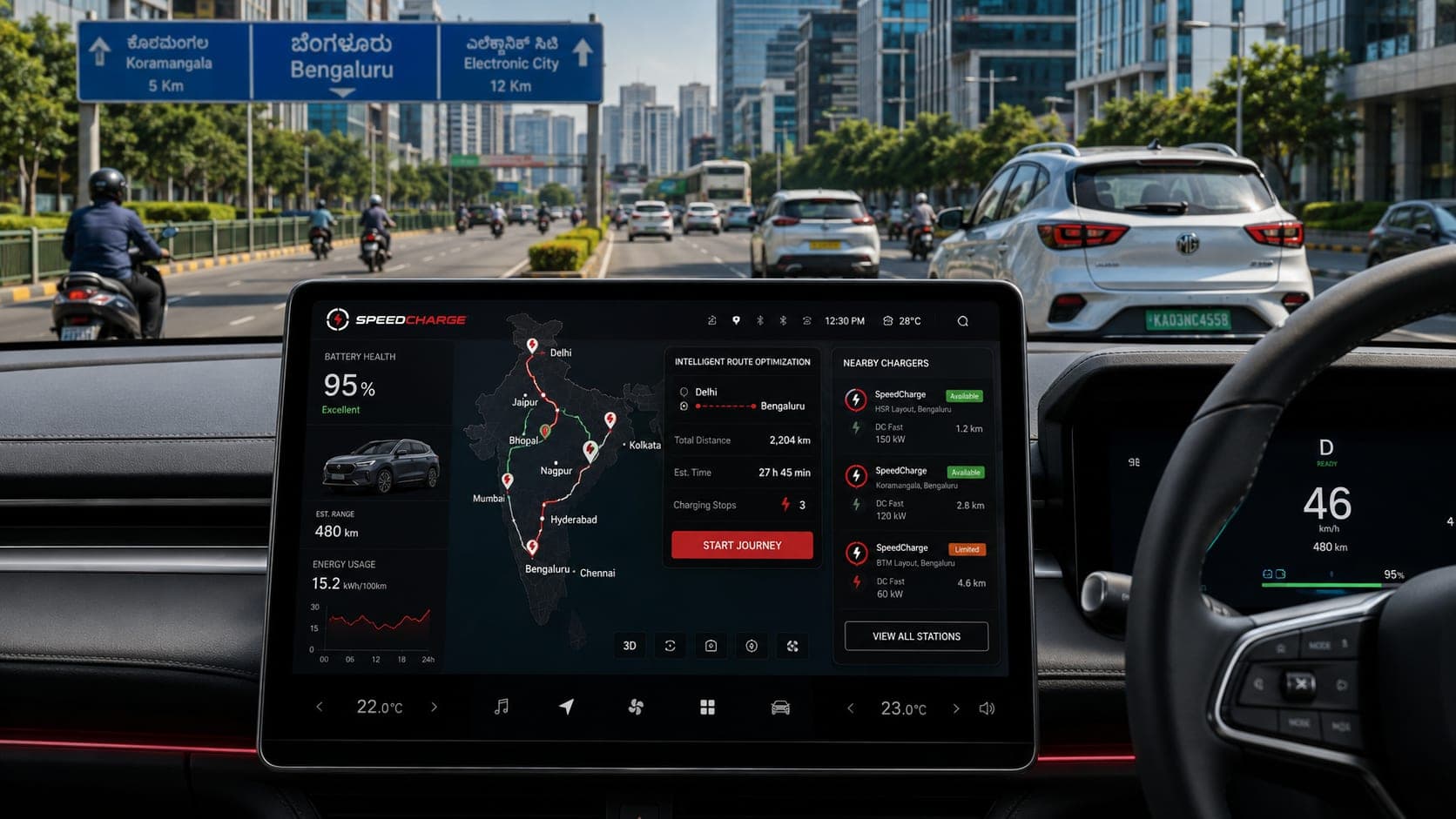
Good EV software reduces this uncertainty by showing live charging station status, connector type, charging speed, location details and payment options. A driver planning a trip from Delhi to Jaipur or Bengaluru to Mysuru needs more than a charger pin on a map. They need confidence that the charger is working before they reach there.
EV software improves daily charging confidence
For everyday EV users, software makes charging predictable. A good charging app can show nearby chargers, live availability, session progress, payment history and charging cost. This allows users to plan charging like any other daily digital service.
In practice, most Indian EV owners do not want to understand every technical detail behind the charger. They want a simple answer: can I charge here, how long will it take and what will it cost? Software provides that clarity.
EV software supports safer vehicle operation
Modern EVs depend on software to monitor battery behaviour, thermal conditions, power delivery, charging limits and performance data. This matters because battery health and charging safety are directly connected.
For users, the benefit is not always visible, but it is important. Smart software can help prevent unsafe charging behaviour, detect abnormal patterns and support better maintenance decisions over time.
How Charging Apps Are Changing the EV User Experience
Charging apps are one of the most visible parts of the EV software ecosystem. For many EV owners, the app is the main interface between the driver and the charging network. A useful app does not simply display a location. It helps the driver find, reserve, start, monitor and pay for a charging session with minimum friction.
This matters because EV adoption depends on habit formation. First-time EV users are still learning how charging works, what AC and DC charging mean, why charging speed changes, and how long a session may take. A confusing app makes EV ownership feel difficult. A clear app makes the transition from fuel to charging feel natural.
Charger discovery makes EV ownership practical
A charging app should help users find chargers based on location, vehicle compatibility, charger type and availability. Static maps are not enough because a charger that exists on a map may still be occupied, offline or unsuitable for a particular vehicle.
For Indian users, this is especially important because chargers may be located inside malls, office complexes, residential communities, parking areas, hotels or highway stops. Clear discovery helps users avoid wasted travel and failed charging attempts.
Slot booking reduces waiting time
As EV adoption increases, popular charging locations can become busy during peak hours. Slot booking helps users reserve charging time in advance, reducing waiting time and uncertainty.
This feature is useful for office commuters, highway travellers and fleet operators. A delivery fleet, for example, cannot afford random delays at every charging stop. Scheduled charging helps managers plan routes, driver shifts and vehicle availability.
Live charging status builds user trust
Live charging status allows users to monitor the session from their phone. They can see whether charging has started, how much energy has been added, how long the session may take and whether they need to return to the vehicle.
This creates reassurance. For a user sitting inside a cafe, office or mall, real-time session tracking makes public charging feel controlled and safe.
SpeedCharge offers app-based charger discovery, slot booking, live charging status, route planning, wallet payments and session history through its charging ecosystem. For Indian EV users, these features directly solve practical adoption barriers rather than adding unnecessary complexity.
What EV Charging Software Does Behind the Scenes
The mobile app is only the front end. Behind every reliable charging experience is a back-end software system that manages charger performance, access control, payments, pricing, fault detection, maintenance alerts and usage reporting. This back-end layer is what turns a group of chargers into a scalable charging network.
For India, this is critical because charging infrastructure must work across different cities, site types, power conditions and customer segments. A highway station, fleet depot, residential society and mall parking charger all need different software controls. Manual management cannot scale efficiently across thousands of charging points.
Charge management systems control network reliability
A charge management system, often called CMS or CSMS, allows operators to monitor and control charging infrastructure remotely. It can track charger status, session activity, energy delivered, failed attempts, payment status, fault alerts and location-level performance.
For users, this back-end system shows up as better uptime. For operators, it reduces manual dependency. A charger fault can be detected remotely instead of waiting for customer complaints.
Remote diagnostics reduce downtime
Remote diagnostics help operators identify technical issues without sending a technician for every minor problem. If a charger has repeated session failures, network errors or abnormal energy readings, the software can flag the issue early.
In Indian conditions, this matters because charger performance can be affected by local electrical load, site wiring, voltage conditions and usage patterns. Remote monitoring helps maintain a more reliable charging experience.
Smart billing improves transparency
Charging software records each session, including user identity, energy consumed, time taken, payment amount and session status. This creates transparency for users, businesses and partners.
For individual users, this means clear charging history. For fleet operators, it means proper cost tracking. For franchise or location partners, it means visibility into usage and revenue.
Why Interoperability Is Important for EV Adoption in India
Interoperability means different EVs, chargers, apps, payment systems and networks can work together with fewer barriers. This is one of the most important software challenges in India’s EV ecosystem. If drivers need multiple apps, multiple access cards and separate wallets for different charging networks, EV ownership becomes frustrating.
The petrol and diesel refuelling experience is simple because access is widely available. EV charging needs to move toward similar ease, even though the technology is more complex. Software standards, connector compatibility, payment integration and open network communication can help create that smoother experience.
Connector compatibility affects charging success
Different vehicles and charger types use different connectors and charging standards. Many passenger EVs use CCS2 for DC fast charging, while AC charging often uses Type-2 sockets or cables. Electric two-wheelers, three-wheelers and commercial EVs may have different charging formats depending on the manufacturer.
Software helps simplify this complexity. A good app can filter chargers based on vehicle type and compatibility, so users do not have to manually understand every connector standard.
Unified access can reduce user frustration
A major challenge for EV users is fragmented charging access. One network may require a specific app, another may require a different payment method, and another may not show real-time availability.
Unified access, roaming partnerships and standardised protocols can reduce this friction. Even before full network unification becomes common, charging apps can improve transparency by showing clear station information, supported connector types and accepted payment modes.
Open standards can help infrastructure scale
India needs charging infrastructure that can scale across cities, highways, residential areas and commercial zones. Closed software systems make this difficult because they limit communication between vehicles, chargers and operators.
Open and compatible systems can help charging operators, OEMs, fleet companies, property owners and energy providers work together. This is important for long-term EV growth because the ecosystem needs cooperation, not isolated infrastructure.
How EV Software Helps Fleets, Businesses and Housing Societies
EV adoption in India is not only a private car story. Delivery fleets, corporate vehicles, residential societies, malls, hotels, office parks, logistics companies and parking operators are all becoming part of the charging ecosystem. Their software needs are different from individual EV owners.
A housing society needs resident billing and load management. A fleet operator needs charging schedules and vehicle uptime data. A mall needs usage and customer behaviour reports. A franchise investor needs revenue analytics. Software turns charging infrastructure into a manageable business and operations system.
Fleet operators need real-time vehicle and charger data
Fleet vehicles need high utilisation. If an electric delivery vehicle is unavailable because charging was poorly planned, the operator loses time and revenue.
Fleet charging software can show vehicle charging status, charger availability, energy consumption, session duration and usage trends. This helps managers schedule vehicles more efficiently and avoid charging bottlenecks.
Housing societies need smart load management
Apartment complexes face a different challenge. EV charging affects electrical load, parking usage, billing fairness and resident access. If multiple residents charge vehicles without proper planning, the society may face disputes or electrical stress.
Smart load management helps distribute available power safely. User-level billing ensures the correct resident pays for the correct charging session. Access control prevents unauthorised use. These features make EV charging easier for RWAs and facility managers.
Commercial properties can use EV charging as an amenity
Malls, hotels, offices and retail destinations can use EV charging to attract and retain customers. But to manage charging properly, they need software reports on usage, revenue, peak timings and charger performance.
SpeedCharge provides solutions for public charging networks, highway charging, home charging, premium charging hubs, compact city stations, parking bay solutions and fleet charging. Property owners can also explore location partner opportunities where suitable locations may generate income through revenue-sharing or rental-based models.
Cybersecurity and Data Protection in EV Software
Cybersecurity is now a core part of EV software because connected vehicles and chargers exchange sensitive information. A charging session may involve user accounts, payment data, vehicle details, charging behaviour, location information and access permissions. If this data is not protected, the risk affects both users and operators.
As charging networks grow, the attack surface also grows. Public chargers, mobile apps, payment gateways, cloud dashboards and operator systems all need protection. EV adoption depends on trust, and trust depends on secure software.
Secure payments protect user confidence
EV charging payments must be secure, clear and reliable. Indian users are comfortable with UPI and digital payments, but they also expect instant confirmation, proper receipts and accurate deductions.
A poor payment experience can make a user hesitate before using the same network again. Secure billing and transparent session records are therefore important for adoption.
Access control prevents misuse
Access control ensures that only authorised users can start charging sessions. This may happen through app login, RFID, QR code or account-based authentication.
This is important in public stations, workplaces, fleets and housing societies. Without access control, chargers can be misused, blocked or used without proper billing.
Remote monitoring improves safety response
Connected chargers can be monitored remotely for faults, unusual behaviour and failed sessions. This allows operators to act faster when a charger needs attention.
For Indian power conditions, remote monitoring is especially useful. Local electrical issues, voltage fluctuations and site-level faults can affect charger performance. Software helps operators detect and respond to such issues more efficiently.
Which EV Software Features Will Matter Most in India
The most useful EV software features are the ones that solve real user problems. Users do not need complicated dashboards for simple tasks. They need clear charger discovery, reliable payment, accurate session status and quick support. Businesses need reporting. Fleet operators need uptime. Housing societies need billing and load control.
As the EV ecosystem grows, software quality will separate reliable charging networks from fragmented charging setups. More chargers will help adoption, but smarter chargers will build stronger user confidence.
The table below shows which EV software features matter most for different user groups.
User Type | Software Feature That Matters Most | Why It Matters in India |
|---|---|---|
Daily EV owners | Live charger availability | Helps users avoid offline or occupied chargers |
Highway travellers | Route planning with charging stops | Reduces range anxiety during long-distance travel |
Housing societies | Smart load management and billing | Prevents disputes over electricity use and access |
Fleet operators | Real-time charging dashboard | Improves vehicle uptime and route planning |
Franchise investors | Revenue and usage analytics | Shows actual station performance |
Commercial properties | Automated reporting | Helps evaluate charging as a customer amenity |
AI and analytics can improve charger planning
Charging infrastructure should be placed where demand actually exists. Software can help operators study EV density, charger usage, traffic patterns, peak demand and under-served routes.
This helps avoid random charger installation. A charger near an office cluster, apartment belt, highway stop or fleet route may perform better than a charger placed without usage data.
Battery and charger data can improve user education
Many EV users still do not fully understand charging speed, state of charge, AC charging, DC fast charging or why charging slows after a certain battery level. Software can explain these patterns through simple app messages and session insights.
This reduces confusion. If a user understands why charging speed drops near 80 percent battery, they are less likely to assume the charger is faulty.
Software-backed uptime will become a trust signal
As more charging stations appear, users will not judge networks only by charger count. They will judge whether chargers work when needed.
SpeedCharge operates 2,500+ live charging points across 45+ cities with 99.9% uptime reliability. For EV users comparing charging networks, uptime and live availability are practical trust signals because they directly affect whether a charging session succeeds.
How EV Software Supports EV Charging Franchise Growth
EV charging is also becoming a serious business opportunity for entrepreneurs, landowners, retail property owners and institutional investors. But the success of an EV charging franchise does not depend only on charger hardware. It also depends on software-led monitoring, pricing, settlements, usage analytics and technical support.
A charging station investor needs to know how much energy is delivered, when peak usage happens, how many sessions are completed, what revenue is generated and whether chargers are operating properly. Software provides that visibility.
Real-time dashboards help investors track performance
Franchise investors need transparent performance data. A dashboard can show charger usage, energy throughput, revenue, session count and location-level trends.
This helps investors make better decisions. If a station performs better during office hours, pricing and promotion can be adjusted. If highway charging demand rises during weekends, operational planning can be improved.
Automated settlements reduce operational confusion
Revenue sharing, billing and payout structures need clear records. Automated settlements reduce manual disputes and create better financial transparency for franchise and location partners.
This is especially important in a FOCO model, where the franchise owner invests and the company operates the station. The investor needs accurate reports without managing every technical detail personally.
Software helps scale charging businesses
A single charging station can be managed manually to some extent. A network across multiple locations cannot. Software allows operators to monitor stations remotely, detect faults, manage pricing, support customers and track revenue across multiple locations.
SpeedCharge’s franchise model includes Fast Charging Stations and Super Charging Stations, with Fast Charging Station investment starting from Rs. 20 lakhs. The model includes FOCO operations, CMS dashboard, technical support, marketing assistance, real-time analytics and automated settlements. Readers evaluating the business opportunity can review the SpeedCharge franchise model for more details.
What EV Owners and Businesses Should Check Before Choosing a Charging Network
Choosing a charging network should not be based only on charger count or location. The software layer matters because it controls how reliable, transparent and convenient the charging experience becomes. A powerful charger with poor software can still create failed sessions, unclear billing and user frustration.
Before choosing an EV charging provider, users and businesses should check how the network handles live availability, payments, access control, remote monitoring and support.
Check whether the app shows live charger availability, not just station location. A static map is not enough for reliable charging.
Check whether the charger supports the vehicle’s connector type and charging requirement. Compatibility should be clear before the user reaches the station.
Check whether the payment process is simple, secure and suitable for Indian digital behaviour. UPI, wallet and digital records make charging easier.
Check whether the network offers session history and billing transparency. This is useful for individual users, fleets and businesses.
Check whether the provider has remote monitoring and technical support. This helps reduce downtime and failed charging attempts.
Check whether the network can scale. A housing society, mall or fleet may start small, but demand can grow quickly once EV usage increases.
Users who want to find available charging points can use the SpeedCharge charger locator. Businesses and property owners can also explore partner options with SpeedCharge based on their site and charging requirement.
What This Means for India’s EV Adoption Journey
EV adoption in India will not depend only on better vehicles or more charging stations. It will depend on whether the complete experience feels reliable. Software is the layer that connects the vehicle, charger, driver, operator, payment system and support team.
For EV owners, the priority is simple: find a charger, know it works, charge safely and pay easily. For businesses, the priority is performance visibility. For societies, it is safe access and fair billing. For franchise investors, it is transparent usage and revenue data.
The next phase of India’s EV growth will be led by networks that combine hardware strength with software reliability. More chargers will help, but smarter chargers will build trust faster.
Why Software-Backed Charging Networks Will Shape EV Confidence in India
SpeedCharge is a Noida-based EV charging infrastructure brand building public charging, home charging, highway charging, premium charging hubs, compact city stations, parking bay solutions and fleet charging infrastructure. The network includes 2,500+ live charging points across 45+ cities, app-based charging access, 99.9% uptime reliability, digital payments and session monitoring.
For users, this means charging can be discovered, planned and tracked through a digital experience instead of guesswork. For entrepreneurs and property owners, SpeedCharge also offers franchise and location partner models supported by CMS dashboards, analytics, billing visibility and technical support.
This combination of hardware deployment and software-backed operations is important because India’s EV ecosystem needs more than charger installation. It needs reliable networks that users can trust repeatedly. A charging station that is visible, monitored, secure and easy to pay for becomes part of the everyday EV ownership habit.
If you are an EV owner, housing society, business, fleet operator or property owner planning for EV charging in India, evaluate the software experience before choosing a charging network. Reliable charger discovery, live availability, secure payments and usage visibility can make EV adoption easier.
Visit https://www.speedcharge.in/ to explore SpeedCharge charging solutions, locate chargers or review partnership opportunities. You can also contact the team at +91 9634858070 or support@speedcharge.in
Frequently Asked Questions
What is EV software in simple words?
EV software is the digital system that helps electric vehicles, chargers, apps, payment platforms and operators work together. It supports charging, route planning, battery monitoring, billing, diagnostics, access control and data reporting. For users, good EV software makes charging easier, safer and more predictable.
Why is software important for EV adoption in India?
Software is important because Indian EV users need reliable charging, live station availability, digital payments, route planning and clear session tracking. Without software, charging becomes uncertain and fragmented. Strong EV software reduces range anxiety, improves charger uptime and helps users trust EVs for daily and long-distance travel.
How does an EV charging app help drivers?
An EV charging app helps drivers find nearby chargers, check live availability, reserve slots, monitor charging status and pay digitally. For Indian users, this is useful because charger demand, traffic conditions and station availability can change quickly. The app makes charging more planned and less stressful.
What is a charge management system?
A charge management system is back-end software that helps charging operators monitor and control chargers remotely. It tracks active chargers, failed sessions, energy usage, payments, faults and revenue. For public networks, fleets and franchise stations, this software is essential for uptime, reporting and maintenance planning.
Can EV software reduce range anxiety?
Yes, EV software can reduce range anxiety by showing working chargers, route options, charging speed, connector compatibility and live availability. It gives drivers more control before and during a trip. This is especially useful on highways and in metro cities where charger demand can change throughout the day.
Why do housing societies need smart EV charging software?
Housing societies need smart EV charging software for load management, user billing, access control and safety monitoring. Without software, residents may disagree over electricity usage and charger access. Smart systems help RWAs track who charged, how much energy was used and how billing should be handled.
Is cybersecurity important in EV charging software?
Yes, cybersecurity is important because EV charging involves payments, user accounts, location data, vehicle information and charger access. Secure software protects users from misuse, payment risks and unauthorised access. As charging networks grow, cybersecurity will become a core part of EV infrastructure reliability.
How can businesses benefit from EV charging software?
Businesses can use EV charging software to track charger usage, revenue, customer demand, energy consumption and maintenance issues. Malls, hotels, offices, fleets and parking operators can make better decisions when they have real-time data instead of manual records. This makes EV charging easier to manage as a service or business asset.